
CMBC(600016)

Search documents
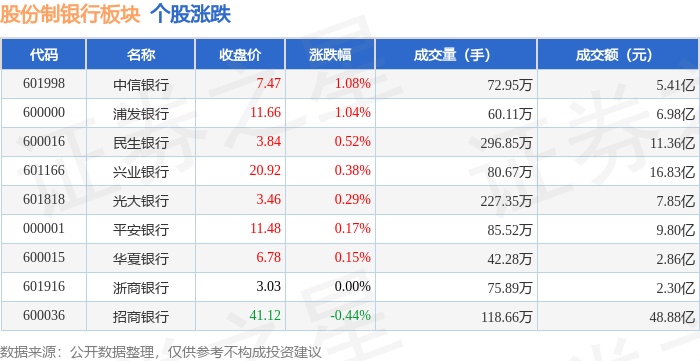
股份制银行板块1月12日涨0.26%,中信银行领涨,主力资金净流出10.83亿元
Zheng Xing Xing Ye Ri Bao· 2026-01-12 09:04
Group 1 - The banking sector saw a slight increase of 0.26% on January 12, with CITIC Bank leading the gains [1] - The Shanghai Composite Index closed at 4165.29, up 1.09%, while the Shenzhen Component Index closed at 14366.91, up 1.75% [1] - The trading volume and turnover for major banks were significant, with CITIC Bank's closing price at 7.47, reflecting a 1.08% increase and a turnover of 541 million yuan [1] Group 2 - The net outflow of main funds from the banking sector was 1.083 billion yuan, while retail investors saw a net inflow of 579 million yuan [1] - CITIC Bank had a net inflow of 53.24 million yuan from main funds, despite a net outflow from retail investors [1] - The overall fund flow indicated a mixed sentiment, with some banks experiencing significant net outflows from main funds, such as Industrial Bank with a net outflow of 75.54 million yuan [1]






永安期货晨会纪要-20260112
Yong An Qi Huo· 2026-01-12 05:26
Economic Overview - The US unemployment rate has decreased to 4.4%, while non-farm payrolls added only 50,000 jobs in December, indicating a cautious hiring environment [9][12] - Consumer confidence in the US has risen to a four-month high, with the Michigan University consumer sentiment index at 54, up from 52.9 in December [12][16] - In Iran, widespread protests challenge the theocratic regime, marking the most severe test since the 1979 Islamic Revolution [9][12] Market Performance - The Shanghai Composite Index rose by 0.92% to 4120.43 points, marking a continuous upward trend with 16 consecutive days of gains [1][6] - The Hang Seng Index increased by 0.32% to 26231.79 points, with significant gains in the gold and internet healthcare sectors [1][6] - Major US indices also saw gains, with the Dow Jones up 0.48% to 49504.07 points, and the S&P 500 rising by 0.65% to 6966.28 points [1][6] Industry Insights - China's top antitrust authority has initiated an investigation into the competitive landscape of the food delivery platform industry, citing concerns over subsidy-driven price wars that are squeezing the real economy [9][12] - Major platforms like Alibaba, Meituan, and JD.com have committed to cooperating with the investigation [12] - The investigation aims to promote lawful and fair competition within the market, addressing the issue of "involution" in the industry [12]



民生银行:用心服务 长情相伴
Bei Jing Ri Bao Ke Hu Duan· 2026-01-11 20:14
Core Insights - China Minsheng Bank has maintained its mission of "serving the public and caring for people's livelihoods" since its establishment in Beijing on January 12, 1996, continuously innovating and enhancing service quality to resonate with the capital's economic and social development [1][2] Group 1: Support for Small and Micro Enterprises - The bank focuses on the strategy of being "the bank for private enterprises," continuously innovating business models and product services to address the financing pain points of small and micro enterprises through "precise drip irrigation" and "long-term companionship" [3][6] - A case study highlights how the bank provided a 2 million yuan loan to a struggling hotel, which led to a significant increase in occupancy rates and nearly doubled its revenue in the same year [4][5] - The bank has established 26 small and micro enterprise financial centers in Beijing, offering integrated services that include not only credit support but also policy consultation, tax planning, and legal rights protection [6][11] Group 2: Support for Technological Innovation - Minsheng Bank has actively engaged with the commercial aerospace sector, providing tailored financial solutions to companies like Beijing Star River Power Aerospace Technology Co., with a loan of 1 billion yuan approved within 1-2 months to support rocket development [9][10] - In 2023, the bank provided 500 million yuan in credit support to Zhongke Aerospace, which significantly reduced their overall financing costs and allowed them to focus on technological advancements [10] - The bank has built a comprehensive service network for technology enterprises, including 3 specialized branches and 6 financial centers, covering major high-tech industry clusters in Beijing [11] Group 3: Community and Elderly Services - Minsheng Bank has established community branches as "neighborhood financial stations," focusing on providing financial security and quality of life for the elderly, with over 1,100 community outlets nationwide [13][14] - The bank has implemented various initiatives to enhance community financial services, including setting up love stations and promoting age-friendly renovations in branches [14] - The bank's community services have reached over one million customers in Beijing, managing financial assets exceeding 50 billion yuan [14]

过渡期收官在即,银行业首席合规官密集就位
Mei Ri Jing Ji Xin Wen· 2026-01-11 12:29
Core Insights - The banking industry is undergoing a restructuring wave in risk and compliance systems due to tightening regulatory rules and a complex risk environment [1][2] - A surge in appointments for Chief Risk Officers (CROs) and Chief Compliance Officers (CCOs) is expected by the end of 2025 and early 2026, with over 20 banks and branches already approved for relevant positions since the beginning of 2025 [1][2] Regulatory Changes - The "Measures for Compliance Management of Financial Institutions" requires financial institutions to establish a CCO at their headquarters, who will be classified as a senior management position [2] - The transitional period for compliance with this regulation is set to expire one year after its implementation on March 1, 2025 [2] Appointment Trends - A variety of banks, including Ping An Bank, Industrial Bank, and Minsheng Bank, have announced the appointment of CCOs as the transitional deadline approaches [2] - The trend shows a mix of large, medium, and small institutions moving forward with these appointments [2] Governance Models - Two governance models are emerging: "one person holding multiple roles" and "independent separation" for CCOs and CROs [3] - The "one person holding multiple roles" model is prevalent among smaller banks, allowing for unified decision-making in risk and compliance management [3] - The "independent separation" model is more common in larger banks, emphasizing specialized development and independent oversight in risk management [3][4] Talent Acquisition Challenges - The establishment of CCO and CRO positions presents new challenges for talent acquisition, with a preference for candidates possessing a combination of frontline business experience, cross-regional vision, and professional qualifications [6] - Some banks are adopting market-based recruitment strategies for CCOs, breaking traditional selection models [6] Compensation Trends - The compensation for CCOs is rising, with annual total income expected to be no less than the average for senior management positions [6] - Reports indicate that the reference monthly salary for these positions can reach between 100,000 to 130,000 yuan [6] Compliance Management Evolution - Effective compliance management is evolving from a "cost center" to a "value guardian," playing a crucial role in mitigating credit, market, and liquidity risks [7] - The compliance governance system is expected to become more institutionalized and refined, with clearer responsibilities and a growing demand for composite compliance talent [7][8] Core Competencies for CCOs - The core competencies for CCOs are identified as business insight, regulatory interpretation, execution capability, and cross-departmental collaboration [8] - These competencies are essential for CCOs to effectively support governance and create compliance value [8]


中国民生银行股份有限公司关联交易公告
Shang Hai Zheng Quan Bao· 2026-01-09 20:05
Core Viewpoint - China Minsheng Bank has approved the acquisition of shares in Linzhi Minsheng Village Bank from related parties, enhancing its ownership and facilitating the bank's restructuring [1][4]. Summary by Sections 1. Overview of Related Transactions - The bank will acquire 2.8345% (2.5 million shares) from Giant Investment for 2 million RMB and 1.7007% (1.5 million shares) from Southern Hope for 1.2 million RMB, using its own funds [4][10]. 2. Related Party Information - Giant Investment is controlled by Shi Yuzhu, holding 4.97% of the bank's shares, while Southern Hope, controlled by Liu Yonghao, holds 5.26% [5][6]. 3. Details of the Transaction - The transaction is classified as a related party transaction and does not constitute a major asset restructuring. It does not require shareholder approval [4][5]. 4. Transaction Pricing - The share transfer price is set at 0.8 RMB per share, based on the bank's audited net assets as of March 31, 2025 [10][11]. 5. Purpose and Impact of the Transaction - This acquisition aims to increase the bank's stake in Linzhi Minsheng Village Bank, aiding in its restructuring without adversely affecting the bank's operations or financial status [13][14]. 6. Approval Process - The transaction was reviewed and approved by the bank's independent directors and board meetings, with no dissenting votes recorded [14][16].
民生银行(01988) - 中国民生银行股份有限公司关联交易公告
2026-01-09 14:30
香港交易及結算所有限公司及香港聯合交易所有限公司對本公告的內容概不負責,對其準確性 或完整性亦不發表任何聲明,並明確表示,概不對因本公告全部或任何部分內容而產生或因倚 賴該等內容而引致之任何損失承擔任何責任。 中國民生銀行股份有限公司 CHINA MINSHENG BANKING CORP., LTD. (在中華人民共和國註冊成立的股份有限公司) (股份代號:01988) 於本公告日期,本行執行董事為高迎欣先生、王曉永先生及張俊潼先生;非執行 董事為劉永好先生、史玉柱先生、宋春風先生、梁鑫傑先生、林立先生及鄭海陽 先生;獨立非執行董事為曲新久先生、溫秋菊女士、宋煥政先生、楊志威先生、 程鳳朝先生及劉寒星先生。 证券简称:民生银行 A 股代码:600016 优先股简称:民生优 1 优先股代码:360037 编号:2026-001 中国民生银行股份有限公司 关联交易公告 海外監管公告 本公告乃根據香港聯合交易所有限公司證券上市規則第13.10B條由中國民生銀行 股份有限公司(「本行」)作出。 茲載列本行在上海證券交易所網站及中國報章刊登之《中國民生銀行股份有限公 司關聯交易公告》,僅供參閱。 承董事會命 中國民生 ...
民生银行:将以320万元受让林芝民生村镇银行4.5352%股份
Xin Lang Cai Jing· 2026-01-09 13:57
1月9日金融一线消息,民生银行发布公告称,将以200万元受让上海巨人投资集团有限公司持有的林芝 民生村镇银行股份有限公司2.8345%股份,120万元受让南方希望实业有限公司持有的林芝民生村镇银 行1.7007%股份,构成关联交易。 民生银行受让其他股东持有的林芝民生村镇银行股份后,收购林芝民生村镇银行并设立林芝二级分行, 林芝民生村镇银行依法解散。 民生银行表示,本次交易有利于进一步增加本行对林芝民生村镇银行的持股比例,有利于更好地实施对 林芝民生村镇银行的改制,对本行正常经营活动及财务状况无重大不利影响。 1月9日金融一线消息,民生银行发布公告称,将以200万元受让上海巨人投资集团有限公司持有的林芝 民生村镇银行股份有限公司2.8345%股份,120万元受让南方希望实业有限公司持有的林芝民生村镇银 行1.7007%股份,构成关联交易。 民生银行受让其他股东持有的林芝民生村镇银行股份后,收购林芝民生村镇银行并设立林芝二级分行, 林芝民生村镇银行依法解散。 民生银行表示,本次交易有利于进一步增加本行对林芝民生村镇银行的持股比例,有利于更好地实施对 林芝民生村镇银行的改制,对本行正常经营活动及财务状况无重大不利 ...
民生银行:获批收购林芝民生村镇银行并设立林芝二级分行
Bei Jing Shang Bao· 2026-01-09 13:08
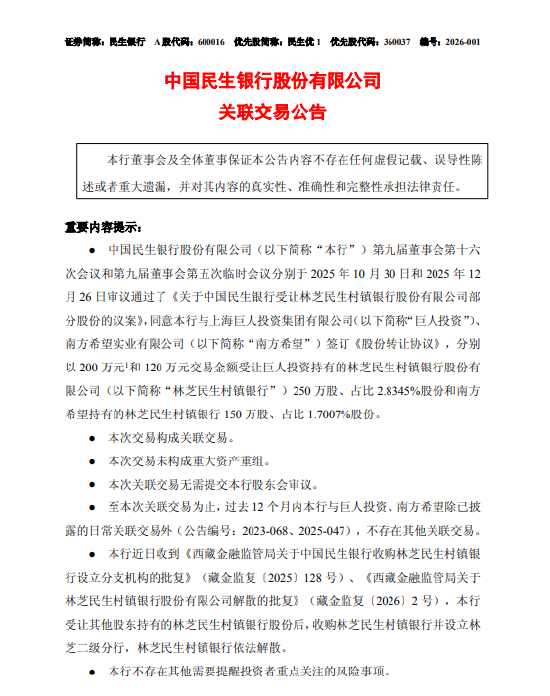
北京商报讯(记者 宋亦桐)1月9日,民生银行发布公告指出,该行第九届董事会第十六次会议和第九 届董事会第五次临时会议分别于2025年10月30日和2025年12月26日审议通过了《关于中国民生银行受让 林芝民生村镇银行股份有限公司部分股份的议案》,同意该行与上海巨人投资集团有限公司(以下简 称"巨人投资")、南方希望实业有限公司(以下简称"南方希望")签订《股份转让协议》,分别以200 万元和120万元交易金额受让巨人投资持有的林芝民生村镇银行股份有限公司(以下简称"林芝民生村镇 银行")250万股、占比2.8345%股份和南方希望持有的林芝民生村镇银行150万股、占比1.7007%股份, 本次交易构成关联交易。 民生银行表示,该行近日收到《西藏金融监管局关于中国民生银行收购林芝民生村镇银行设立分支机构 的批复》《西藏金融监管局关于林芝民生村镇银行股份有限公司解散的批复》,该行受让其他股东持有 的林芝民生村镇银行股份后,收购林芝民生村镇银行并设立林芝二级分行,林芝民生村镇银行依法解 散。 ...
民生银行(600016.SH):与巨人投资、南方希望签订《股份转让协议》
Ge Long Hui A P P· 2026-01-09 13:05
格隆汇1月9日丨民生银行(600016.SH)公布,为进一步增加本行对林芝民生村镇银行的持股比例,更好 地实施对林芝民生村镇银行的改制,本行与巨人投资、南方希望签订《股份转让协议》,分别以200万 元和120万元交易金额受让巨人投资持有的林芝民生村镇银行250万股、占比2.8345%股份和南方希望持 有的林芝民生村镇银行150万股、占比1.7007%股份。本次交易的资金来源为本行自有资金。至本次关 联交易为止,过去12个月内本行与巨人投资、南方希望及其他关联方之间相同交易类别下标的相关的关 联交易未占本行最近一期经审计净资产绝对值5%以上。 ...
民生银行:与巨人投资、南方希望签订《股份转让协议》
Ge Long Hui· 2026-01-09 12:52
格隆汇1月9日丨民生银行(600016.SH)公布,为进一步增加本行对林芝民生村镇银行的持股比例,更好 地实施对林芝民生村镇银行的改制,本行与巨人投资、南方希望签订《股份转让协议》,分别以200万 元和120万元交易金额受让巨人投资持有的林芝民生村镇银行250万股、占比2.8345%股份和南方希望持 有的林芝民生村镇银行150万股、占比1.7007%股份。本次交易的资金来源为本行自有资金。至本次关 联交易为止,过去12个月内本行与巨人投资、南方希望及其他关联方之间相同交易类别下标的相关的关 联交易未占本行最近一期经审计净资产绝对值5%以上。 ...