YTCO(600066)

Search documents
2月新能源重卡实销超7400辆!徐工/三一/重汽争冠 东风/远程/宇通逆增 | 头条
第一商用车网· 2026-03-14 06:13
Core Viewpoint - The sales of new energy heavy trucks in China have experienced a significant decline in February 2026, marking the first year-on-year decrease since February 2023, ending a streak of 36 consecutive months of growth [1][2][16]. Sales Performance - In February 2026, the domestic new energy heavy truck market sold 7,435 units, representing a 9% year-on-year decrease and a 54% month-on-month decline [1][2]. - The overall heavy truck market saw a total sales of 28,400 units in February, with a 41% decline both month-on-month and year-on-year [2]. Market Share - In February 2026, new energy heavy trucks accounted for 26.16% of the total heavy truck market, down approximately 7 percentage points from the previous month but up nearly 10 percentage points from the same month last year [4]. - For January-February 2026, the market share of new energy heavy trucks reached 30.58%, slightly higher than the 2025 annual share of 28.89% [4]. Regional Distribution - By February 2026, there were 285 cities in China with registered new energy heavy trucks, with 65 cities having over 100 registrations [7]. Leading Companies - In February 2026, 12 companies sold over 100 units of new energy heavy trucks, with two companies exceeding 1,000 units: XCMG with 1,230 units and SANY with 1,078 units [9]. - The top 12 manufacturers showed mixed results in February, with some companies like Yutong and United Heavy Truck achieving over 100% growth, while others experienced significant declines [11]. Cumulative Sales Data - Cumulatively, from January to February 2026, new energy heavy truck sales reached 23,500 units, a 54% increase year-on-year, although the growth rate has significantly narrowed compared to January [12]. - The leading companies in cumulative sales for January-February 2026 included XCMG (4,413 units), China National Heavy Duty Truck (3,365 units), and SANY (3,296 units) [14]. Market Dynamics - The decline in sales in February 2026 is attributed to the long Spring Festival holiday and the reduction in the new energy vehicle purchase tax, which led to a preemptive buying surge in late 2025 [1][2][16].







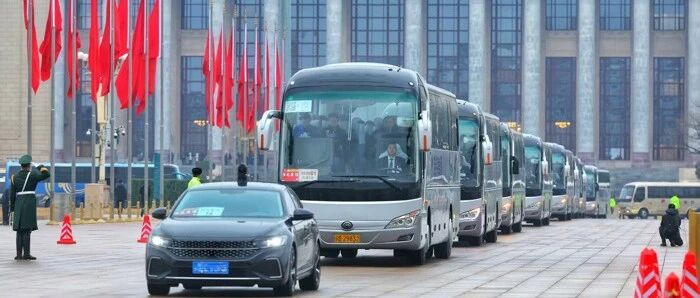
连续22年“不缺席”!宇通凭什么成为全国两会交通保障主力军?| 头条
第一商用车网· 2026-03-10 01:53
Core Viewpoint - The article highlights the significant role of Yutong Bus in providing reliable transportation services for the National Two Sessions, showcasing its commitment to quality and safety over 22 years of service [2][11]. Group 1: Service Performance - Yutong Bus has provided 159 vehicles for the National Two Sessions, achieving a 53% share of the transportation fleet, with the T7 model being the primary choice due to its high performance and comfort [2][4]. - The company has maintained a "zero failure" record for 22 consecutive years, demonstrating its capability to deliver world-class transportation solutions for major national events [4][11]. Group 2: Operational Excellence - A comprehensive support system was established for the event, including a dedicated team of over 30 personnel and a "stationed support + mobile assistance" service model, ensuring rapid response and coverage across all locations [5][7]. - Yutong implemented a rigorous inspection process for all vehicles, including a dual inspection and online testing protocol, ensuring that all potential issues are addressed promptly [7]. Group 3: Team Commitment - The dedication of frontline staff is emphasized, with team members like Yue Hongwei reflecting on their long-term commitment to service excellence during the National Two Sessions [8][10]. - The company fosters a culture of mentorship, where experienced staff train newcomers, ensuring that the ethos of "zero failure, zero delay" is ingrained in every operational aspect [10]. Group 4: Brand Impact - Yutong's consistent presence at the National Two Sessions not only ensures safe transportation for delegates but also enhances the reputation of Chinese manufacturing on a global stage [11].

整车主线周报:本周SW乘用车表现较好,原材料及汇兑压力依然明显-20260309
Soochow Securities· 2026-03-09 14:48
Investment Rating - The industry investment rating is "Overweight," indicating an expected outperformance of the industry index relative to the benchmark by more than 5% over the next six months [42]. Core Insights - The report highlights a recovery in passenger vehicle demand due to the implementation of subsidy policies, with a positive outlook for the passenger vehicle sector in Q1 2026. It emphasizes the importance of selecting resilient domestic companies and those with strong export capabilities [32][33]. - For heavy trucks, the report anticipates a sales volume of 800,000 to 850,000 units in 2026, reflecting a year-on-year increase of 3%. It recommends leading companies in the heavy truck sector [35]. - The bus sector is expected to see a growth in sales to 40,000 units in 2026, driven by the continuation of subsidy policies and the need for fleet renewal [36]. - The motorcycle market is projected to grow by 14% in total sales, with a significant increase in large-displacement motorcycles, particularly in export markets [33]. Summary by Sections Passenger Vehicles - The report expects a recovery in passenger vehicle demand in Q1 2026 due to subsidy policies, with a focus on high-end electric vehicle manufacturers such as Jianghuai Automobile, Geely, Great Wall, and others [32][33]. - The report suggests prioritizing companies with proven execution capabilities in overseas markets, recommending BYD, Great Wall, and Chery for export [32]. Heavy Trucks - In 2025, the wholesale volume reached 1.144 million units, a year-on-year increase of 26.8%. The report forecasts a sales volume of 800,000 to 850,000 units for 2026, a 3% increase year-on-year [35]. - Recommended companies include China National Heavy Duty Truck Group, Weichai Power, and others [35]. Buses - The report indicates that the bus subsidy policy has exceeded expectations, with a projected sales increase to 40,000 units in 2026, a 40% year-on-year growth [36]. - Key recommendations include Yutong Bus and King Long [36]. Motorcycles - The motorcycle industry is expected to achieve total sales of 19.38 million units in 2026, a 14% increase, with large-displacement motorcycles projected to grow by 31% [33]. - Recommended companies include Chunfeng Power and Longxin General [33].




宇通客车(600066) - 关于担保计划范围内担保进展的公告
2026-03-09 10:45
| 对控股子公司 | 被担保人名称 | | 公司全资子公司(具体如下) | | --- | --- | --- | --- | | 及控股子公司 | 2 月担保发生额 | | 13,725.76 万元 | | 之间相互提供 | 是否在前期预计额度内 | ☑是 | □否 | | 的担保 | 本次担保是否有反担保 | □是 | ☑否 | 证券代码:600066 证券简称:宇通客车 编号:临2026-006 宇通客车股份有限公司 关于担保计划范围内担保进展的公告 本公司董事会及全体董事保证本公告内容不存在任何虚假记载、误导性陈述 或者重大遗漏,并对其内容的真实性、准确性和完整性承担法律责任。 重要内容提示: 根据上海证券交易所相关披露要求,公司对担保计划范围 内的担保进展情况进行月度汇总披露。 2026 年 2 月担保事项概况 本次担保事项已经公司于 2025 年 4 月 25 日召开的 2024 年 年度股东大会审议通过,同意公司继续提供以下担保:对控股子 公司及控股子公司之间相互提供的担保;为购房人提供阶段性担 保;对销售业务链相关企业提供的担保。 根据公司 2024 年年度股东大会授权,在下年度对外担保预 计 ...
【联合发布】商用车周报(2026年3月第1周)
乘联分会· 2026-03-09 08:41
Core Insights - The article discusses the Chinese government's 2026 work report, emphasizing a proactive fiscal policy with a focus on "two heavy" constructions and "two new" initiatives, supported by a special long-term bond issuance of 1.3 trillion yuan [4]. Fiscal Policy - The fiscal policy for 2026 includes a budget deficit of 5.89 trillion yuan, an increase of 230 billion yuan from the previous year, with total public budget expenditures reaching 30 trillion yuan, up approximately 1.27 trillion yuan [5]. - The government plans to issue 1.3 trillion yuan in special long-term bonds to support consumption and infrastructure projects [5]. Industry Development - The automotive industry aims for a sales target of 32.3 million vehicles in 2025, with a 3% year-on-year increase, and 15.5 million of those being new energy vehicles, reflecting a 20% growth [6]. - The automotive sector is encouraged to enhance its production value by approximately 6% year-on-year [6]. New Energy Vehicles - The promotion of new energy vehicles includes a target of 100% for new urban buses and 90% for taxis (including ride-hailing) to be electric [7]. - The government supports the development of charging infrastructure and the integration of renewable energy sources for electric vehicle charging [7]. Market Dynamics - In February 2026, the commercial vehicle market showed mixed results, with a 12.8% decline in sales for Beiqi Foton, while medium and heavy trucks experienced an 11.2% increase [10]. - Companies like Jiangling and Yutong Bus reported double-digit growth, indicating a positive trend in certain segments of the commercial vehicle market [10]. International Trade - The Middle East is projected to be China's third-largest export market for commercial vehicles by 2025, with an expected export volume of 158,000 units, a 42.9% increase year-on-year [19]. - The ongoing conflicts in the region pose challenges such as increased logistics costs and supply chain risks, but also present opportunities for market restructuring and localization for Chinese commercial vehicle companies [19][21]. Technological Advancements - Companies in the autonomous logistics vehicle sector, such as Karl Power and New Stone, have secured significant funding to expand their operations and technology [14]. - The focus is on deploying autonomous trucks and enhancing the integration of technology with logistics operations [15]. Supply Chain Resilience - The article emphasizes the need for Chinese automotive companies to diversify their supply chains and reduce reliance on single markets, particularly in light of geopolitical tensions [21]. - Strategies include enhancing local production capabilities and establishing safety stock for critical components [21].



江淮第一 重汽进前三 庆铃升两位 2月轻卡影响力格局生变 | 头条
第一商用车网· 2026-03-09 07:00
Core Viewpoint - The "Light Truck First Influence Index" in February 2026 showed a decline in total score due to the impact of the Spring Festival, with a 26% decrease from January and a 6.6% decrease year-on-year from February 2025, despite ongoing promotional activities and new vehicle launches [1]. Group 1: Market Performance - In February, major light truck companies like Jianghuai and Dongfeng reported significant vehicle deliveries across various logistics scenarios, including cold chain and school meal transportation [2]. - China National Heavy Duty Truck's HOWO light truck improved its ranking, entering the top three, while FAW Liberation and Qingling also made notable advancements in the rankings [7][8]. Group 2: Promotional Activities - China National Heavy Duty Truck launched a Spring Festival promotion offering various incentives, including discounts and gifts for customers [4]. - Dongfeng held a nationwide Spring Festival group purchase event, which was well-received, enhancing its brand reputation in the logistics sector [5]. - Jianghuai initiated a customer reward campaign with multiple benefits, including discounts and service packages for vehicle purchases [8]. Group 3: Strategic Developments - Qingling signed a strategic cooperation agreement with Hidi Smart Driving to develop a smart logistics system, focusing on cost reduction and efficiency [4]. - Foton Aoling held a partner conference to discuss industry trends and strategic collaboration, aiming for growth and market expansion [7]. - FAW Liberation focused on promoting its new energy vehicles during a customer appreciation event, emphasizing sustainability and technology [12].


宇通客车:2月份销量点评:总销量同环比提升,出海新能源表现强势超预期-20260309
Changjiang Securities· 2026-03-09 03:10
Investment Rating - The investment rating for the company is "Buy" and is maintained [6]. Core Views - The company reported a total bus sales of 1,806 units in February 2026, representing a year-on-year increase of 15.0% and a month-on-month increase of 4.5%. The sales of medium and large buses were 1,410 units, with a year-on-year increase of 1.7% and a month-on-month increase of 6.5%. For January to February 2026, total bus sales reached 3,534 units, a year-on-year decrease of 14.2%, with medium and large bus sales down 20.1% year-on-year [2][4][10]. - The company is recognized as a global leader in the bus industry, with good long-term growth potential and a consistent high dividend capability, highlighting its investment value. In the domestic market, the growth of passenger buses continues, supported by the "old-for-new" policy, which promotes the growth of new energy buses. In the overseas market, the company's globalization and high-end strategy are advancing, with exports demonstrating profitability, supporting continuous performance improvement [2][10]. Summary by Sections Sales Performance - In February 2026, the company sold 1,806 buses, a 15.0% increase year-on-year and a 4.5% increase month-on-month. The sales for January to February 2026 totaled 3,534 units, down 14.2% year-on-year [2][4][10]. Market Strategy - The company is enhancing its direct sales and service model, improving service quality and efficiency. The domestic market is expected to recover due to the "old-for-new" policy and the natural replacement cycle of new energy buses. In the overseas market, the company is accelerating its expansion, with the first overseas new energy commercial vehicle factory established in Qatar, designed for an initial annual output of 300 units, expandable to 1,000 units [10]. Financial Outlook - The company is projected to have a full-year dividend of 1.5 yuan per share (before tax) in 2024, with a total payout of 3.32 billion yuan and a dividend rate of 80.7%. The expected net profits for 2025 and 2026 are 5.03 billion yuan and 5.87 billion yuan, respectively, corresponding to PE ratios of 12.9X and 11.1X [10].
宇通客车(600066):2月销量点评:总销量同环比提升,出海新能源表现强势超预期
Changjiang Securities· 2026-03-08 09:12
Investment Rating - The investment rating for the company is "Buy" and it is maintained [6]. Core Insights - The company reported a total bus sales of 1,806 units in February 2026, representing a year-on-year increase of 15.0% and a month-on-month increase of 4.5%. The sales of medium and large buses were 1,410 units, with a year-on-year increase of 1.7% and a month-on-month increase of 6.5%. For January to February 2026, total bus sales reached 3,534 units, a decrease of 14.2% year-on-year, with medium and large bus sales down by 20.1% year-on-year [2][4][10]. - The company is recognized as a global leader in the bus industry, with good long-term growth potential and a strong ability to maintain high dividends, highlighting its investment value. In the domestic market, the growth of seated buses continues, supported by the "old-for-new" policy, which promotes the growth of new energy buses. In the overseas market, the company's globalization and high-end strategy are advancing, with exports demonstrating profitability, supporting continuous performance improvement [2][10]. Summary by Relevant Sections Sales Performance - In February 2026, the company sold 1,806 buses, with a year-on-year increase of 15.0% and a month-on-month increase of 4.5%. The sales for January to February 2026 totaled 3,534 units, down 14.2% year-on-year [2][4]. - The export volume in February included approximately 600 units, up from 312 units in the same month last year, with new energy exports reaching about 200 units, compared to 56 units last year [10]. Market Strategy - The company is enhancing its direct sales and service model, improving service quality and efficiency. The domestic market is expected to recover due to the "old-for-new" policy and the natural replacement cycle of new energy buses. In the overseas market, the company is accelerating its expansion, with the first overseas new energy commercial vehicle factory established in Qatar, designed for an initial annual output of 300 units, expandable to 1,000 units [10]. Financial Outlook - The company is expected to have sufficient cash flow to support high dividends, with a projected total dividend of 3.32 billion yuan for 2024, translating to a dividend per share of 1.5 yuan (before tax) and a dividend payout ratio of 80.7%. The estimated net profits for 2025 and 2026 are 5.03 billion yuan and 5.87 billion yuan, respectively, with corresponding price-to-earnings ratios of 12.9X and 11.1X [10].
159辆保障用车!宇通连续22年主力护航全国两会
第一商用车网· 2026-03-05 11:05
Core Viewpoint - The article highlights the significant role of Yutong Bus in providing transportation support for the National Two Sessions, showcasing its high-quality vehicles and service capabilities, particularly the Yutong T7 model, which has been a reliable choice for high-profile events over the years [1][4][11]. Group 1: Event Participation and Vehicle Performance - Yutong Bus provided 159 vehicles for the National Two Sessions, accounting for 53% of the total, reaffirming its position as a key player in event transportation [1]. - The fleet included 84 Yutong T7 vehicles, which are recognized for their high quality and reliability, having undergone rigorous testing in extreme conditions [3][4]. - The T7 model has been the mainstay for the National Two Sessions for 11 consecutive years, demonstrating its established reputation in high-profile national events [4]. Group 2: Quality Assurance and Service Support - Yutong's commitment to quality is evident in its comprehensive service support system, which includes a dedicated team and a rapid response mechanism for any issues that may arise during the event [9][11]. - The company implemented a thorough inspection process for all vehicles, including the T7, ensuring that over 100 inspection items were checked to maintain high operational standards [9][11]. - Yutong has enhanced its after-sales support and established a robust supply chain for critical components, ensuring efficient service and maintenance during the events [11]. Group 3: Strategic Development and Future Plans - Yutong is advancing its high-end vehicle strategy with the upcoming launch of the Tianyu S12, which aims to further enhance its market position in high-end transportation [12][14]. - The dual flagship strategy, featuring both the T7 and the Tianyu S12, is designed to meet diverse high-end travel needs, reinforcing Yutong's leadership in the premium bus segment [12][14]. - The company's long-term vision aligns with the goals of the 14th Five-Year Plan, emphasizing its capability to provide world-class transportation solutions for national events and contribute to the high-quality development of China's bus industry [14].
宇通客车2月销量增15%!这一类车暴涨114%
第一商用车网· 2026-03-05 02:11
3月4日晚间,宇通客车股份有限公司发布2026年2月份产销数据快报。快报显示,2026年2月,宇通客车实现销售1806辆,同比增长 14.96%。其中,大型客车销售930辆,同比增长26.53%;中型客车销售480辆;轻型客车销售396辆,同比大涨114.05%。大型客车 和轻型客车均实现了同比正增长,轻型客车增幅最为强劲。 欢迎 扫码关注 第一商用车网视频号 及时掌握市场趋势、行业数据 | | | | | | | | 早 | | --- | --- | --- | --- | --- | --- | --- | --- | | 产 | 盟 | 2026年 | 去年同期 | 单月数量 | 本年 | 去年同期 | 累计数量 | | | | 2月份 | | 同比变动 | 累计 | 累计 | 同比变动 | | 生产量 | | 2.061 | 1.578 | 30.61% | 4,228 | 4.138 | 2.17% | | 其中:大型 | | 1.116 | 724 | 54.14% | 2.321 | 1.899 | 22.22% | | 中型 | | 470 | 532 | -11.65% | 917 | 1 ...