GUANGHUI ENERGY(600256)

Search documents
石油行业21日主力净流出1.77亿元,广汇能源、洲际油气居前
Sou Hu Cai Jing· 2025-08-21 07:46
Core Insights - The oil industry experienced a slight increase of 0.46% on August 21, with a net outflow of 177 million yuan in principal funds [1] - Among the constituent stocks, 14 rose while 5 fell [1] Fund Flow Analysis - The stocks with the highest net outflow of principal funds were Guanghui Energy (125 million yuan), Intercontinental Oil & Gas (107 million yuan), Donghua Energy (28.68 million yuan), Taishan Petroleum (22.25 million yuan), and Shanghai Petrochemical (20.47 million yuan) [1] - China Petroleum and Sinopec saw net inflows of 40.26 million yuan and 1.27 billion yuan respectively, with their stock prices increasing by 1.51% and 2.45% [1] Stock Performance - Key stock performances included: - China Petroleum: Latest price 8.75, increase of 1.51%, net inflow of 40.26 million yuan, net inflow ratio 3.22% [1] - Sinopec: Latest price 5.86, increase of 2.45%, net inflow of 1.27 billion yuan, net inflow ratio 7.47% [1] - Bohui Co.: Latest price 15.38, increase of 1.12%, net inflow of 1.32 million yuan, net inflow ratio 6.37% [1] - Shenyang Chemical: Latest price 4.29, increase of 1.42%, net inflow of 845.75 thousand yuan, net inflow ratio 10.37% [1]



A股煤炭板块震荡反弹,安源煤业涨停
Mei Ri Jing Ji Xin Wen· 2025-08-21 02:16
每经AI快讯,8月21日,A股煤炭板块震荡反弹,安源煤业涨停,广汇能源、兖矿能源、陕西能源、华 阳股份等跟涨。 (文章来源:每日经济新闻) ...



煤炭概念震荡反弹,安源煤业涨停
Xin Lang Cai Jing· 2025-08-21 01:54
Group 1 - The coal sector is experiencing a volatile rebound, with significant gains observed in various companies [1] - Anyuan Coal Industry has reached the daily limit increase, indicating strong market interest [1] - Other companies such as Guanghui Energy, Yanzhou Coal Mining, Shaanxi Energy, and Huayang Co. have also seen upward movement in their stock prices [1]
消失的中间商,敏感的煤价:物流总包筑壁垒,量价挂钩扩优势
ZHONGTAI SECURITIES· 2025-08-20 12:28
Investment Rating - The industry investment rating is maintained at "Overweight" [2] Core Viewpoints - The combination of "logistics package" and "volume-price linkage" is driving the increase in industry concentration, forcing intermediaries out of the market and enhancing the sensitivity of coal prices [5] - The "logistics package" mechanism significantly reduces comprehensive logistics costs, creating sustainable advantages in delivery certainty and cost, while raising entry barriers for small coal operators [5] - The "volume-price linkage" mechanism strengthens scale premiums, allowing large mining and trading enterprises to gain larger discounts, while smaller entities face profit margin compression [5] - The weakening of intermediary roles is expected to enhance coal price sensitivity, with a clear trend of price reversal under the backdrop of supply contraction expectations [5] - The report emphasizes the importance of evaluating the effectiveness of "anti-involution" policies and their impact on liquidity and risk preferences to seize coal investment opportunities [5] Summary by Sections Policy Focus on Cost Reduction and Efficiency - National policies are continuously promoting the development of logistics package models [14] - The logistics package model is seen as a core strategy to reduce overall logistics costs through integrated services [7] Strengthening Long-term Contract Barriers - Long-term contract policies are reinforcing scale barriers, putting pressure on intermediaries [16] - The proportion of railway coal in total coal shipments has increased significantly in 2023 compared to 2022 [21][20] Volume-Price Linkage Trading Pilot - The introduction of volume-price linkage trading mechanisms is expected to benefit large market players significantly [25] - The rapid decrease in port coal inventories contrasts with weak net inflows, indicating a structural tightening in supply [24][23] - The Taiyuan Coal Trading Center has initiated a volume-price linkage trading mechanism to enhance market liquidity and efficiency [27] Investment Recommendations - The report recommends focusing on elastic stocks in the coal sector, highlighting specific companies likely to benefit from the current market dynamics [10]



石油石化行业资金流入榜:恒力石化等7股净流入资金超3000万元
Zheng Quan Shi Bao Wang· 2025-08-20 09:04
Market Overview - The Shanghai Composite Index rose by 1.04% on August 20, with 30 industries experiencing gains, led by the beauty care and oil & petrochemical sectors, which increased by 2.42% and 2.36% respectively [1] - The oil & petrochemical industry ranked second in terms of daily gains [1] - The pharmaceutical and biological sector was the only industry to decline, with a decrease of 0.07% [1] Capital Flow Analysis - The main capital flow showed a net outflow of 30.229 billion yuan across the two markets, with 10 industries seeing net inflows [1] - The electronics sector had the highest net inflow, amounting to 5.522 billion yuan, with a daily increase of 2.32% [1] - The food and beverage industry followed with a net inflow of 2.494 billion yuan and a daily increase of 1.39% [1] Oil & Petrochemical Sector Details - The oil & petrochemical industry saw a daily increase of 2.36% with a net inflow of 561 million yuan, comprising 47 stocks, of which 42 rose and 4 fell [2] - The top stocks in terms of net capital inflow included Hengli Petrochemical with 195 million yuan, followed by Baomo Co. and China Petroleum with 128 million yuan and 100 million yuan respectively [2] - Notable stocks with significant net outflows included Guanghui Energy, Hengtong Co., and Tongkun Co., with outflows of 105 million yuan, 23.013 million yuan, and 19.715 million yuan respectively [2]





上市公司现金分红总额创新高
Zhong Guo Hua Gong Bao· 2025-08-20 02:30
Group 1 - The core viewpoint of the article highlights the increasing cash dividend awareness among listed companies in China, with a record total cash dividend of 2.4 trillion yuan for 2024, representing a 9% increase from 2023 [1] - Major companies such as China National Petroleum Corporation, Sinopec, and China Shenhua Energy are among those leading in cash dividends, with China National Petroleum Corporation distributing 86 billion yuan in 2024 [1] - The number of companies consistently paying dividends has risen, with 2,447 out of 4,445 companies listed for over three years having paid dividends for three consecutive years, marking a 12% increase from the previous year [2] Group 2 - The average dividend payout ratio for listed companies in 2024 is 39%, with 1,411 companies having an average payout ratio greater than 40%, a 24% increase from 2023 [2] - The trend of increasing dividend payments reflects a growing internal drive among companies to provide predictable cash flow returns to investors, contributing to higher quality development in the capital market [3] - The average dividend yield for 466 companies over the past three years exceeds 3%, with 133 companies yielding over 5%, indicating a significant advantage over some national bond yields [2]
广汇能源股价小幅下跌 石油石化行业资金流出居前
Sou Hu Cai Jing· 2025-08-19 14:21
Group 1 - The stock price of Guanghui Energy closed at 5.35 yuan on August 19, down 0.74% from the previous trading day [1] - The opening price was 5.39 yuan, with a high of 5.40 yuan and a low of 5.35 yuan, and the trading volume reached 804,922 hands, totaling a transaction amount of 432 million yuan [1] - Guanghui Energy operates in the oil and petrochemical industry, with main businesses covering natural gas, coal, and coal chemical sectors, and has a complete industrial chain layout in LNG and coal [1] Group 2 - On that day, the net outflow of main funds for Guanghui Energy was 122 million yuan, with a cumulative net outflow of 567 million yuan over the past five trading days [1] - Among the oil and petrochemical industry, the stock's net fund outflow scale ranks among the top, second only to China National Petroleum and China National Offshore Oil [1]
解密主力资金出逃股 连续5日净流出541股
Zheng Quan Shi Bao Wang· 2025-08-19 09:11
Core Insights - A total of 541 stocks in the Shanghai and Shenzhen markets have experienced net outflows of main funds for five consecutive days or more as of August 19 [1] - China Nuclear Power has seen the longest net outflow period at 26 days, followed by Anjie Technology at 21 days [1] - The largest total net outflow amount is from Shobead, with a cumulative outflow of 2.205 billion yuan over 8 days, closely followed by China Nuclear Power with 2.159 billion yuan over 26 days [1] Summary by Category Stocks with Longest Net Outflow - China Nuclear Power: 26 days, 2.159 billion yuan, 9.36% of trading volume, -2.77% cumulative change [1] - Anjie Technology: 21 days, details not specified [1] - Shobead: 8 days, 2.205 billion yuan, 7.97% of trading volume, -0.77% cumulative change [1] Stocks with Significant Net Outflow Amounts - Shobead: 2.205 billion yuan over 8 days [1] - China Nuclear Power: 2.159 billion yuan over 26 days [1] - Tianqi Lithium: 1.930 billion yuan over 6 days [1] Stocks with High Net Outflow Proportions - Guanghui Energy: 21.78% of trading volume over 7 days, with a 3.08% decline [1] - China Nuclear Power: 9.36% of trading volume over 26 days [1] - Tianqi Lithium: 8.50% of trading volume over 6 days [1]


石油石化行业资金流出榜:广汇能源等7股净流出资金超3000万元
Zheng Quan Shi Bao Wang· 2025-08-19 09:09
Market Overview - The Shanghai Composite Index fell by 0.02% on August 19, with 18 out of the 28 sectors rising, led by the comprehensive and communication sectors, which increased by 3.48% and 1.87% respectively [1] - The non-banking financial and defense industries experienced the largest declines, down by 1.64% and 1.55% respectively [1] Capital Flow - The main capital outflow from the two markets totaled 61.83 billion yuan, with six sectors seeing net inflows [1] - The home appliance sector led the net inflow with 2.175 billion yuan and a daily increase of 0.87%, followed by the food and beverage sector, which saw a 1.04% rise and a net inflow of 1.981 billion yuan [1] Oil and Petrochemical Sector - The oil and petrochemical sector declined by 0.58% with a net capital outflow of 618 million yuan [2] - Among the 47 stocks in this sector, 18 rose, including one that hit the daily limit, while 27 fell, including one that hit the lower limit [2] - The top three stocks with the highest net inflow were 康普顿 (304.81 million yuan), 海油发展 (159.44 million yuan), and 岳阳兴长 (133.17 million yuan) [2][3] Individual Stock Performance - The stocks with the largest net outflows included 广汇能源 (1.24 billion yuan), 中国石油 (1.08 billion yuan), and 中国海油 (1.06 billion yuan) [2] - The performance of individual stocks in the oil and petrochemical sector varied, with 康普顿 showing a significant increase of 10% [3]



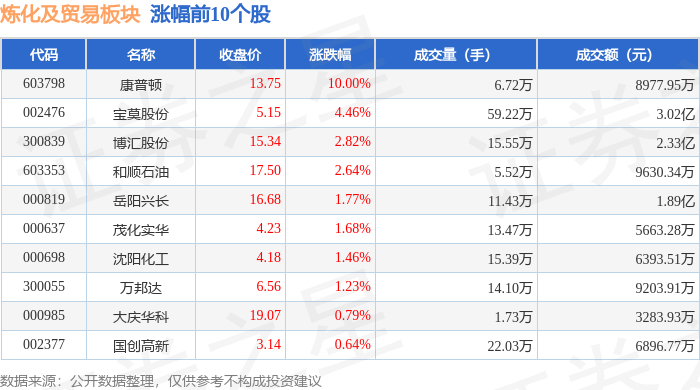
炼化及贸易板块8月19日跌0.55%,统一股份领跌,主力资金净流出3.91亿元
Zheng Xing Xing Ye Ri Bao· 2025-08-19 08:37
Market Overview - The refining and trading sector experienced a decline of 0.55% on August 19, with Unified Corporation leading the drop [1] - The Shanghai Composite Index closed at 3727.29, down 0.02%, while the Shenzhen Component Index closed at 11821.63, down 0.12% [1] Stock Performance - Notable gainers in the refining and trading sector included: - Kangzhidun (603798) with a closing price of 13.75, up 10.00% [1] - Yucao Co. (002476) with a closing price of 5.15, up 4.46% [1] - Bohui Co. (300839) with a closing price of 15.34, up 2.82% [1] - Major decliners included: - Unified Corporation (600506) with a closing price of 22.21, down 3.18% [2] - Hengyi Petrochemical (000703) with a closing price of 6.05, down 2.10% [2] - Yuxin Co. (002986) with a closing price of 12.48, down 1.65% [2] Capital Flow - The refining and trading sector saw a net outflow of 391 million yuan from main funds, while retail investors contributed a net inflow of 240 million yuan [2] - The sector's capital flow details indicate: - Kangzhidun (603798) had a net inflow of 26.49 million yuan from main funds [3] - Unified Corporation (000819) had a net inflow of 20.99 million yuan from main funds [3] - Yucao Co. (002476) had a net inflow of 16.84 million yuan from main funds [3]