
TONGWEI CO.,LTD(600438)

Search documents
新能源行业25Q1-3财务费用总结:光伏反内卷稍见成效,风电毛利率已企稳回升
Soochow Securities· 2025-11-14 10:22
Investment Rating - The report indicates a positive outlook for the photovoltaic sector, with signs of recovery in profitability and stable growth in the wind power sector [1][5]. Core Insights - The renewable energy sector reported a revenue of 11,722 billion yuan for Q1-3 2025, a year-on-year decrease of 1%, and a net profit of 242 billion yuan, down 19% year-on-year. In Q3 2025, revenue was 4,138 billion yuan, up 2% year-on-year, and net profit was 118 billion yuan, up 41% year-on-year [2][7]. - The photovoltaic segment experienced a significant reduction in losses, with Q3 2025 revenue at 2,315 billion yuan, down 8% year-on-year, but net profit surged to 28.4 billion yuan, a year-on-year increase of 1,495% [2][37]. - The wind power segment showed robust growth, with Q3 2025 revenue of 1,135 billion yuan, up 22% year-on-year, and net profit of 50 billion yuan, up 33% year-on-year [2][16]. Summary by Sections Revenue and Profitability - The renewable energy sector's revenue for Q1-3 2025 was 11,722 billion yuan, with a net profit of 242 billion yuan. Q3 2025 saw a revenue of 4,138 billion yuan and a net profit of 118 billion yuan, marking a significant recovery [2][15]. - The photovoltaic sector's revenue for Q1-3 2025 was 6,640 billion yuan, with a net loss of 43 billion yuan. In Q3 2025, revenue was 2,315 billion yuan, and net profit was 28.4 billion yuan, indicating a strong recovery [2][37]. Segment Performance - The photovoltaic segment's Q3 2025 performance showed a revenue decline of 8% year-on-year but a remarkable net profit increase of 1,495%. The wind power segment continued to grow, with a 22% revenue increase year-on-year [2][16][37]. - The report highlights that the profitability of the wind power segment is improving, with a notable increase in gross margins due to price adjustments and operational efficiencies [2][16]. Market Trends - The report notes a gradual recovery in demand for household energy storage, with significant growth expected in commercial and large-scale storage solutions. The anticipated installation capacity for 2025 is around 150 GWh, representing a year-on-year increase of over 40% [2][6]. - The photovoltaic industry is undergoing a restructuring process, with upstream profitability recovering as prices for silicon materials rise. This trend is expected to continue into 2026, leading to a reshaped industry ecosystem [2][6]. Recommendations - The report recommends focusing on high-growth areas such as inverters and mounting systems, as well as leading photovoltaic companies with cost advantages and strong distribution channels [2][6].




锂电行业:行业筑底后向上动能涌现,关注“涨价”行情演绎
Guotou Securities· 2025-11-14 09:01
Investment Rating - The report maintains an investment rating of "Outperform the Market - A" for the power equipment and new energy sector [5]. Core Insights - The lithium battery industry is showing upward momentum after bottoming out, driven by strong demand from the new energy vehicle market and the rising profitability of energy storage [1][10]. - The photovoltaic industry is experiencing a cyclical recovery, with policies aiding in supply-demand balance and price stabilization [2]. - The wind power sector is expected to maintain high growth, with significant installation demand projected for the upcoming years [3]. Summary by Sections Lithium Battery Industry - The lithium battery sector is witnessing a recovery with strong sales in new energy vehicles, leading to a price increase in lithium materials. For instance, lithium carbonate prices have risen to 80,000 yuan/ton and hexafluorophosphate lithium to 110,000 yuan/ton as of November 2025 [1]. - The global demand for new energy vehicles continues to grow, with domestic sales of new energy passenger vehicles reaching 11.228 million units in the first nine months of 2025, a year-on-year increase of 34.9% [16]. - Solid-state batteries are emerging as a revolutionary technology with advantages in energy density and safety, expected to be commercialized between 2027 and 2030 [1][10]. Photovoltaic Industry - The photovoltaic market is stabilizing after years of rapid growth, with an expected annual installation of over 200 GW until 2030. However, the industry still faces overcapacity issues that need to be addressed through market and policy measures [2]. - The report highlights the importance of policy support in restoring supply-demand balance and price recovery in the photovoltaic sector, with significant investment opportunities arising from new technologies [2][11]. Wind Power Industry - The wind power sector has exceeded its installation targets during the 14th Five-Year Plan, with expectations of an average annual installation of 120 GW during the 15th Five-Year Plan, a 66% increase from the previous period [3]. - Both onshore and offshore wind projects are expected to see robust demand, with offshore wind power development being a key focus area for future growth [3][12].




光伏股,“过山车”
Di Yi Cai Jing· 2025-11-14 04:10
Core Viewpoint - The photovoltaic sector experienced a rebound after rumors regarding a multi-crystalline silicon storage platform were debunked, leading to significant stock price increases for major companies in the industry [3][4]. Group 1: Market Reactions - Following the rumors on November 12, stocks of leading companies like Longi Green Energy and JA Solar approached their daily limit down, but recovered after clarifications from the China Photovoltaic Industry Association and JA Solar [3][4]. - On November 14, companies such as Canadian Solar and Hongyuan Green Energy saw stock increases of over 5%, continuing the upward trend from the previous day [3]. Group 2: Industry Challenges - The photovoltaic industry is currently facing a unique situation of overcapacity and slowing demand, compounded by price pressures across the supply chain [4]. - Analysts indicate that the global new production capacity from 2023 to 2024 is sufficient to meet the actual installation demand for 2025, with existing capacities potentially meeting demand until 2035 [4]. Group 3: Inventory Concerns - Global silicon material inventory has reportedly exceeded 500,000 tons, marking a historical high, with domestic inventory expected to surpass 400,000 tons by the end of the year [5]. Group 4: Export Opportunities - China dominates the photovoltaic product market overseas, with significant orders coming from regions like the Middle East, Southeast Asia, and India, despite trade barriers in the U.S. and India [6]. - The manufacturing cost of China's photovoltaic products is approximately 8 cents, significantly lower than the nearly 50 cents in the U.S. and 10-20 cents in other regions, providing a competitive edge in exports [6].






光伏股“过山车”!装机高增速时代将不再,行业寄望海外增量市场掘金
Di Yi Cai Jing· 2025-11-14 03:26
Core Viewpoint - The photovoltaic (PV) industry is currently experiencing a significant imbalance between supply and demand, leading to price pressures and concerns over excess capacity, despite recent market recovery following rumors being debunked [1][2][3]. Group 1: Market Dynamics - The PV sector has seen a rebound in stock prices for major companies like Arctech and LONGi Green Energy after rumors regarding the multi-crystalline silicon storage platform were clarified [1]. - The market's reaction to the storage rumors highlights the existing supply-demand imbalance and price pressures within the PV industry [1][3]. Group 2: Capacity and Inventory - The global PV industry is facing overcapacity, with new production capacity expected to meet actual installation demands until 2025, and existing capacity potentially satisfying needs until 2035 [3]. - Current inventory levels of silicon materials have reached historical highs, with estimates suggesting over 500,000 tons globally and over 400,000 tons in China's multi-crystalline silicon sector by the end of the year [3]. Group 3: Export Opportunities - China dominates the global market for PV products, with significant orders coming from regions like the Middle East, Southeast Asia, and India, despite trade barriers in the U.S. and India [4]. - The cost advantage of Chinese PV products is notable, with manufacturing costs around 8 cents per watt compared to nearly 50 cents in the U.S. and 10-20 cents in other regions [4]. - The diversification of export destinations and products is increasing, with a growing reliance on Chinese supply chains for more complex components like silicon wafers and battery cells [4].
光伏“小作文”风波平息市值增386亿 价格企稳通威隆基单季减亏9.56亿
Chang Jiang Shang Bao· 2025-11-13 23:45
Core Viewpoint - The recent rumors regarding the photovoltaic industry, particularly concerning the storage platform and regulatory issues, caused significant market fluctuations but were quickly debunked by the China Photovoltaic Industry Association, leading to a recovery in stock prices [2][3][5]. Market Reaction - On November 12, the photovoltaic sector experienced a sharp decline, with the A-share photovoltaic index dropping over 3.5%, and individual stocks like Arctech and Longi Green Energy seeing significant losses [3][6]. - Following the clarification from the industry association, the market rebounded on November 13, with the photovoltaic sector rising by 1.40% and the photovoltaic equipment sector increasing by 2.01%, adding approximately 386 billion yuan in market value [2][7]. Industry Performance - As of the first three quarters of 2025, over half of the 70 photovoltaic equipment companies listed on A-shares reported profitability, indicating a stabilization in the industry [2][12]. - Major companies like Tongwei Co. and Longi Green Energy reported significant reductions in losses during the third quarter of 2025, with a combined loss reduction of 9.56 billion yuan [12]. Price Trends - The price of polysilicon has shown signs of recovery, with a notable increase from 38,000 yuan per ton in early 2025 to 53,200 yuan per ton by November 2025 [10]. - The average bidding prices for components have also slightly increased, reflecting a stabilization in the market [10]. Technological Advancements - The industry is pursuing technological innovations to reduce costs, with Longi Green Energy recently achieving world records in solar cell efficiency [13].
一纸谣传压垮光伏板块?协会企业急辟谣
3 6 Ke· 2025-11-13 08:20
Core Viewpoint - The photovoltaic sector experienced a significant drop due to rumors regarding the cancellation of a storage platform, leading to a collective decline in major stocks such as Canadian Solar and JA Solar, which fell over 6% [1][2]. Group 1: Market Reaction - The photovoltaic sector was already fragile, and any minor disturbance could trigger panic selling, as evidenced by the sharp decline following the rumors [2]. - Major stocks like Canadian Solar saw a drop of over 14%, while JA Solar, LONGi Green Energy, and others fell more than 6% [2]. - The photovoltaic ETF also experienced a decline of over 5%, indicating widespread market panic [2]. Group 2: Rumor and Response - The rumors included claims that a silicon material and component alliance was rejected by authorities and that JA Solar's secretary claimed the storage platform was "dead" [2]. - In response, JA Solar denied the rumors, stating that no such comments were made by executives and emphasized their commitment to supporting the photovoltaic industry's policies [3]. - The China Photovoltaic Industry Association also issued a statement declaring the rumors as false and warned against malicious actions aimed at undermining the industry [3]. Group 3: Importance of Storage Platform - The storage platform is considered a crucial measure for the photovoltaic industry's "anti-involution" strategy, aimed at stabilizing the market [4]. - A proposed joint storage platform involving major companies is in the planning stages, with an estimated fund size of around 70 billion yuan [4]. - The initiative aims to control production by acquiring smaller production lines, which is seen as essential for the recovery of the photovoltaic supply chain [4]. Group 4: Industry Performance and Challenges - The photovoltaic industry is facing significant operational challenges, with a clear divergence in profitability across the supply chain [5]. - JA Solar reported a 24.05% year-on-year decline in revenue for Q3 2025, with a net loss of 11.65 billion yuan, reflecting the struggles of the downstream sector [5]. - In contrast, LONGi Green Energy showed signs of improvement, with a revenue of 509.15 billion yuan for the first nine months of the year, indicating a potential recovery [5]. Group 5: Market Sentiment and Future Outlook - The recent market reaction highlights the industry's sensitivity to policy changes and rumors, reflecting broader concerns about the implementation of the "anti-involution" policies [6]. - The stability of silicon prices and the ability to pass costs down the supply chain are critical factors for the industry's recovery [6]. - The overall market remains under pressure due to high inventory levels and concerns about the balance of interests between upstream and downstream sectors [6].


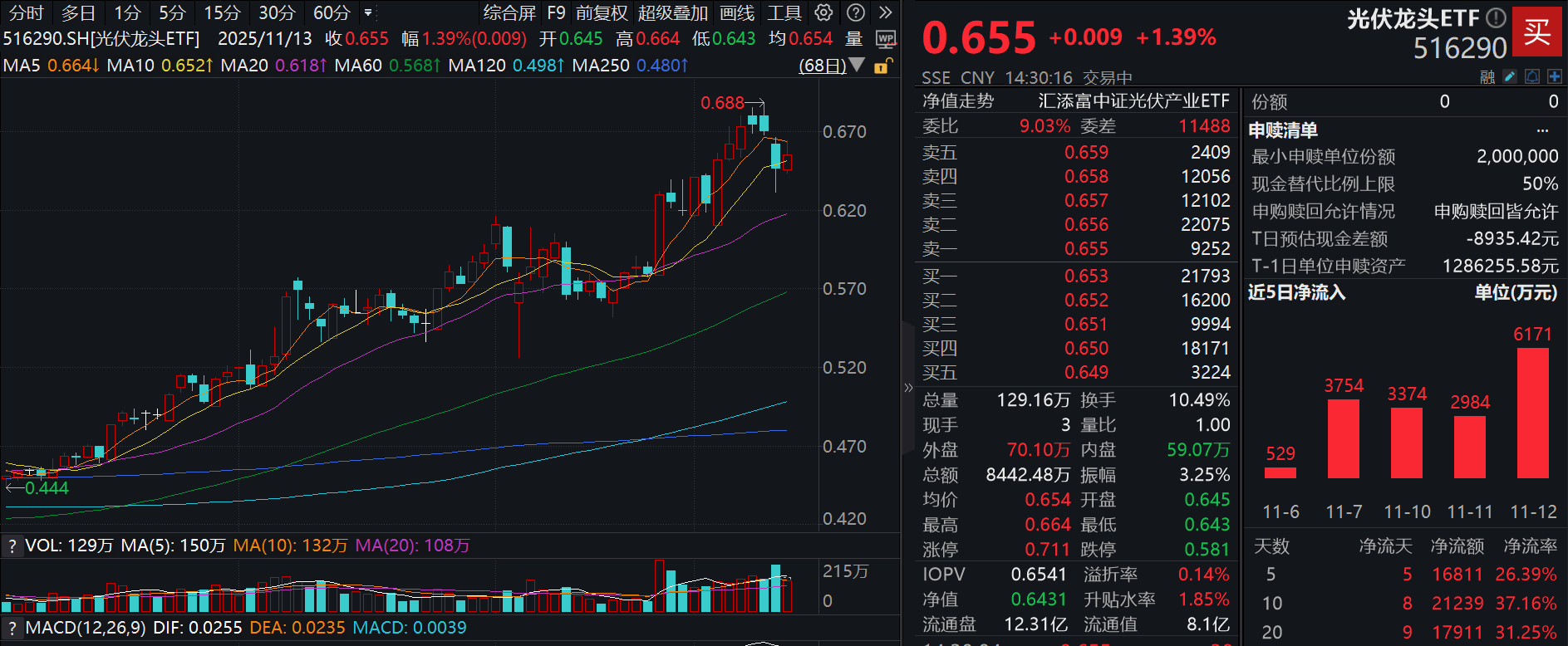
晶澳科技紧急澄清不实传闻,光伏应声反弹!上能电气20cm涨停,光伏龙头ETF(516290)反攻涨1.4%,连续7日获资金合计净流入超1.8亿元
Sou Hu Cai Jing· 2025-11-13 06:51
Core Viewpoint - The photovoltaic sector experienced a strong rebound following the Chinese Photovoltaic Industry Association's statement and JA Solar's clarification regarding false rumors, leading to significant inflows into the leading photovoltaic ETF (516290) [1][5]. Group 1: Market Performance - As of 14:30, the photovoltaic leading ETF (516290) rose by 1.39%, with intraday gains exceeding 2%, and a trading volume surpassing 84 million yuan, marking seven consecutive days of net inflows totaling over 180 million yuan [1]. - The index of the photovoltaic leading ETF (516290) saw strong performance with stocks like Sungrow Power (0.39% increase), TBEA (1.97% increase), and LONGi Green Energy (1.92% increase) showing notable gains [3][4]. Group 2: Industry Response - The Chinese Photovoltaic Industry Association issued a statement on November 12, refuting false information circulating online and emphasizing ongoing efforts to promote industry self-discipline and "anti-involution" initiatives [5][7]. - JA Solar released a clarification stating that its board secretary did not make any statements attributed to them, labeling the rumors as misleading and damaging to the company's reputation [5]. - Tongwei Co. expressed strong support for the photovoltaic "anti-involution" actions, believing that relevant policies will gradually be implemented [6]. Group 3: Supply and Demand Dynamics - The supply of polysilicon has shown signs of pressure, with production expected to decrease below 120,000 tons in November due to the dry season, while demand has weakened following a significant increase in solar installations earlier in the year [8]. - The current inventory of polysilicon stands at approximately 460,000 tons, with a need for a further 30% reduction in production to normalize inventory levels by 2026 [8].


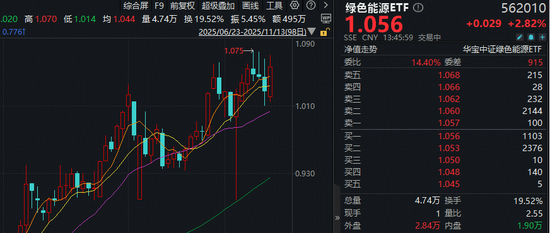
新能源暴涨!近300亿主力资金狂涌!锂电走强,绿色能源ETF反包大涨4%,智能电动车ETF连收3根均线
Xin Lang Ji Jin· 2025-11-13 06:04
Group 1: Market Overview - The electric equipment sector received a net inflow of nearly 30 billion yuan, ranking first among 31 Shenwan primary industries [1] - The green energy ETF (562010) surged, with an intraday increase of 4.19%, currently up 2.82% [1][4] - Key stocks in the green energy sector include Tianqi Materials, which hit the daily limit, and Tianhua New Energy, which rose over 16% [1][4] Group 2: Lithium and Battery Materials - Lithium hexafluorophosphate prices are fluctuating daily, with some market quotes reaching 150,000 yuan per ton, doubling since mid-October [3] - The demand for energy storage batteries and most lithium battery materials has shown signs of tightening supply, indicating a potential turning point for profitability in the lithium battery supply chain [3] Group 3: Technological Advancements - Significant progress has been made in perovskite LED technology, achieving an efficiency of 45.5% [3] - Analysts suggest that the maturation of perovskite battery technology will lay a solid foundation for large-scale commercialization by 2025 [3] Group 4: Policy Developments - The National Energy Administration issued guidelines to promote the integrated development of renewable energy, aiming for enhanced market competitiveness by 2030 [3] - A joint directive from the National Development and Reform Commission and the National Energy Administration aims to establish a multi-level renewable energy consumption and regulation system [3] Group 5: Investment Opportunities - The top ten weighted stocks in the green energy ETF include major players like CATL, Sungrow Power, and BYD [5] - The smart electric vehicle ETF (516380) focuses on both electrification and intelligent automotive technologies, presenting long-term investment opportunities in the electric and smart vehicle sectors [5]



从三季报看中国经济 科创驱动上市公司稳中向好
Jing Ji Ri Bao· 2025-11-13 00:16
Core Insights - A-share listed companies have shown strong performance in Q3 2025, with both year-on-year and quarter-on-quarter growth driven by macro policies and technological innovation [1][2][3] Electronics Industry - The electronics sector is entering an upward cycle, with high-tech industries maintaining rapid growth. R&D investment in high-tech manufacturing services reached 229.6 billion yuan, a 9% increase year-on-year, driving revenue and net profit growth of 10% and 19% respectively [2][3] - The semiconductor industry, particularly AI-driven segments, has seen significant profit increases, with companies like Cambrian achieving a revenue of 4.607 billion yuan, up 2386.38% year-on-year, and a net profit of 1.605 billion yuan [2] - The overall revenue for the Shenzhen electronics sector reached 1.59 trillion yuan, a 15.03% increase year-on-year, with net profit growing by 32.12% to 79.122 billion yuan [3][4] New Energy Sector - The new energy sector has become a key area for growth, with companies in the battery, photovoltaic, and wind power equipment sectors achieving a combined revenue of 1.06 trillion yuan, up 10.56% year-on-year, and a net profit of 78.705 billion yuan, up 31.87% [5][6] - Notable performers include CATL, which reported a revenue of 283.072 billion yuan, a 9.28% increase, and a net profit of 49.034 billion yuan, a 36.20% increase [5][6] Consumer Sector - The consumer sector has shown resilience, with policies aimed at boosting consumption leading to steady growth. Companies in the home appliance sector reported a revenue increase of 5.17% year-on-year [8][9] - The demand for smart home products has surged, with companies like Ecovacs seeing a net profit increase of 131% [9] - The automotive sector, particularly in new energy vehicles, has also seen significant growth, with major manufacturers reporting over 10% increase in sales [9][10] Future Outlook - The electronics and new energy sectors are expected to maintain high growth levels, supported by AI demand and domestic substitution trends [3][4] - The consumer sector is likely to benefit from ongoing policy support and technological advancements, with new consumption scenarios emerging [10][11]






“小作文”致光伏股价跳水 龙头企业澄清不实言论
Zheng Quan Ri Bao Zhi Sheng· 2025-11-12 17:33
Core Viewpoint - The recent rumors regarding the "photovoltaic storage platform" have caused significant volatility in the photovoltaic sector, leading to sharp declines in stock prices of major companies, although some recovery was noted by the end of the trading day [1][2]. Group 1: Market Reaction - On November 12, major companies in the photovoltaic sector experienced substantial stock price drops, with Canadian Solar (阿特斯) falling over 17%, and other leading firms like Tongwei Co., Longi Green Energy, and JA Solar nearing their daily limit down [1]. - The overall photovoltaic ETF declined by more than 4% on the same day, indicating widespread market concern [1]. Group 2: Company Responses - JA Solar issued a clarification statement denying any internal or external meetings where misleading comments were made, labeling the circulating information as a harmful rumor [1]. - The China Photovoltaic Industry Association's executive secretary urged the public not to spread rumors and emphasized the industry's efforts to promote orderly exit of outdated capacities [1][2]. Group 3: Industry Context - The excessive market reaction to the "storage" rumors highlights the severe supply-demand imbalance and price pressures faced by the photovoltaic industry, particularly in the upstream polysilicon segment [2]. - The concept of a "storage platform" is seen as a market-driven approach to reduce vicious competition and facilitate the exit of ineffective capacities, aiming to restore healthy profit levels in the industry [3]. - Ongoing efforts to combat "involution" in the photovoltaic sector are being supported by policy-level initiatives, including multiple industry meetings and consultations on mandatory national standards [3].