TONGWEI CO.,LTD(600438)

Search documents
从自身攻坚到全链推进 光伏产业减碳加速破局
Zhong Guo Zheng Quan Bao· 2025-08-10 21:05
Core Viewpoint - The Chinese photovoltaic industry is transitioning towards a model that balances "green manufacturing" and "manufacturing green" as it faces challenges in carbon emissions and resource consumption while expanding capacity [1][2]. Industry Overview - The photovoltaic industry in China is experiencing significant growth, with a cumulative installed capacity of over 1 billion kilowatts as of May 2023, surpassing thermal power for the first time [1]. - The industry is under pressure to enhance its green and low-carbon transformation, with 95% of surveyed companies setting climate goals and 87% disclosing carbon emissions data [1][2]. Carbon Emissions - The total carbon emissions from the 44 companies that disclosed their operational data reached 105 million tons of CO2 equivalent for 2024, with a notable increase from 45.23 million tons in 2022 to 70.57 million tons in 2024, marking a 46.6% rise from 2022 to 2023 and a 5.7% increase from 2023 to 2024 [2]. - The primary drivers of rising carbon emissions are production expansion and potential increases in energy consumption due to technological upgrades [2]. Policy and Regulation - The Ministry of Industry and Information Technology is set to release guidelines to promote high-quality development in the photovoltaic sector, focusing on resource utilization, energy management, and ESG disclosures [2]. - Regulatory guidance from stock exchanges emphasizes the need for companies to disclose 21 ESG-related topics, including emissions and biodiversity [2]. Product Carbon Footprint - The carbon footprint of photovoltaic products is becoming a critical factor in market competitiveness, with strict requirements in regions like France and South Korea [3]. - 25 companies have disclosed carbon footprint data for over 80 products, while 11 others are working on carbon footprint assessments without disclosing quantitative data [3]. Supply Chain Emissions - Scope 3 emissions from the supply chain account for over 90% of total greenhouse gas emissions for companies focused on photovoltaic components, and over 50% for those producing silicon materials [4]. - 20 companies have disclosed their Scope 3 emissions, with several integrating supplier emissions into their management practices [4][5]. Renewable Energy Utilization - 40 companies reported using renewable energy, totaling 57.1 million megawatt-hours in 2024, resulting in a reduction of over 32.55 million tons of CO2 equivalent [5]. - Companies like Sungrow Power Supply and Tongwei Co. have reported that renewable energy constitutes over 60% of their total energy consumption [5]. Water Resource Management - 80% of companies involved in the production of polysilicon, silicon wafers, and solar cells have disclosed water resource consumption data, with some taking targeted actions based on water resource assessments [6]. - The industry faces challenges in recycling retired photovoltaic components, with predictions of significant volumes of waste starting in 2025 [6][7]. Recycling Challenges - 16 out of 31 companies involved in component production have disclosed efforts in waste component recycling, but the lack of a mandatory recycling mechanism and high costs of recycling technologies pose significant challenges [7]. - The industry is encouraged to adopt a circular economy approach, integrating production, usage, and recycling processes [7].






电力设备新能源2025年8月投资策略:互联网巨头上修AI资本开支,反内卷政策推进下光伏、风机价格提高
Guoxin Securities· 2025-08-09 13:58
Group 1: AIDC Power Equipment Industry - The AIDC power equipment industry is expected to benefit from increased AI capital expenditure by global internet giants, with Google raising its 2025 capital expenditure from $75 billion to $85 billion, and Meta adjusting its range from $64-72 billion to $66-72 billion [1][28] - The release of OpenAI's GPT-5 model is anticipated to drive advancements in AI large models, further supporting the AIDC power equipment sector [29] - Key companies to focus on in the AIDC power equipment chain include Jinpan Technology, New Special Electric, Igor, and others [1][30] Group 2: Photovoltaic Industry - The "anti-involution" policy is leading to a recovery in photovoltaic product prices, with significant rebounds in prices for polysilicon, silicon wafers, and battery cells [2][84] - The photovoltaic industry is expected to enter a stable development phase by 2027, with a focus on capacity integration and clearing, particularly in the silicon material segment [2] - Key companies in the photovoltaic sector include GCL-Poly Energy, New Special Energy, Tongwei Co., and TBEA [2][84] Group 3: Wind Power Industry - Wind turbine prices are recovering, which is likely to lead to sustained profitability across the industry chain, with all model bidding prices in the first half of the year exceeding the lowest cost prices of 2024 [2][55] - The wind power industry is projected to achieve record installations in 2025, with stable main machine prices and a rebound in profitability driven by technological cost reductions [55] - Recommended companies in the wind power sector include Goldwind Technology, Dongfang Cable, and Daikin Heavy Industries [2][55] Group 4: Solid-State Battery Industry - The solid-state battery industry is making progress, with several companies announcing advancements in production and testing phases, including Qianyan and Honeycomb Energy [3][69] - Major automotive manufacturers like SAIC and Mercedes-Benz are planning to launch solid-state battery models by 2030, indicating a growing market for this technology [3][69] - Key players in the solid-state battery supply chain include Xiamen Tungsten, Tiannai Technology, and others [3][70] Group 5: Power Battery and Charging Pile Industry - The domestic electric vehicle market is expected to show slight improvement in August, with battery production anticipated to increase as companies prepare for peak season deliveries [68] - The production of positive electrode materials is expected to recover, driven by sustained demand for lithium iron phosphate from overseas battery manufacturers [68] - Key companies in the power battery sector include CATL, EVE Energy, and others [70]



光伏专利大战:TOP10企业专利护城河深度解析
Tai Mei Ti A P P· 2025-08-09 10:02
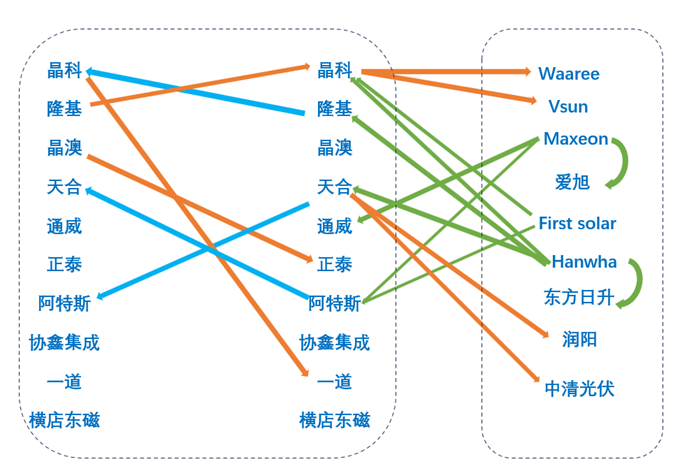
Core Viewpoint - The article discusses the ongoing patent wars in the photovoltaic (PV) industry, emphasizing the shift from an incremental growth phase to a competitive landscape where companies are focusing on retaining advanced production capacity and eliminating outdated capacity. Patents are seen as a crucial tool in this "anti-involution" strategy [1]. Group 1: Patent Litigation Overview - The patent litigation between JinkoSolar and LONGi Green Energy is highlighted as a significant ongoing conflict in the PV sector, with a need to assess the patent situations of the top 10 companies in terms of module shipments [3]. - Since 2019, the patent wars in the PV industry have been continuous, with only two companies, GCL-Poly and Hengdian East Magnetic, not involved in any patent litigation [3]. - Tongwei Co., while rapidly rising in the top 10, has had minimal patent litigation exposure, primarily due to its dual leadership in silicon materials and cells [3]. Group 2: Patent Application Statistics - Trina Solar leads in patent applications with 7,219 patents, followed by JinkoSolar and LONGi Green Energy in second and third places, respectively [7]. - Canadian Solar, despite facing multiple patent infringement lawsuits, has a substantial patent application count of 4,669, placing it among the top tier of PV companies [7]. - GCL-Poly has a relatively low patent application count, while Hengdian East Magnetic has over 3,700 patents, but only 681 are related to PV technology, making it the lowest among the top 10 [7]. Group 3: Patent Validity and Status - LONGi Green Energy holds the highest number of valid patents at 3,900, while Trina Solar has 3,448 valid patents, and JinkoSolar has 2,449 [10]. - The analysis shows that Yida New Energy has the lowest percentage of expired patents at 3%, while GCL-Poly and Canadian Solar have high expiration rates of 40% and 32%, respectively [10]. - The proportion of pending patents indicates that Trina Solar has over 33% pending, while Hengdian East Magnetic and JinkoSolar have around 30% [10]. Group 4: Patent Types and Quality - JinkoSolar and Trina Solar have the highest number of invention patents, with JinkoSolar's invention patents making up 70% of its total applications [12]. - GCL-Poly's patent applications are primarily domestic, with minimal international presence, indicating a focus on the domestic market [17]. - GCL-Poly has a total of 1,138 patent applications, with 519 being valid, but a significant number of low-value patents have been abandoned or rejected [19]. Group 5: Legal Events and Patent Management - GCL-Poly has engaged in various legal events related to its patents, including transfers and acquisitions, indicating active management of its patent portfolio [25]. - Hengdian East Magnetic has also seen significant patent pledges, with over 75 patents pledged for financing, reflecting a strategic approach to leveraging its patent assets [38]. - The company has a relatively high number of invention patents, with 445 out of 681 total patents, indicating a focus on high-quality innovations [35]. Group 6: Strategic Insights and Recommendations - Both GCL-Poly and Hengdian East Magnetic have lower overall patent strengths compared to leading companies like JinkoSolar and LONGi Green Energy, which may impact their competitive positioning [42]. - GCL-Poly's strategy of acquiring external patents could enhance its litigation capabilities, while Hengdian East Magnetic's effective maintenance of patent validity is crucial for future legal defenses [42]. - The article suggests that PV companies should enhance innovation and proactively manage patent risks to minimize litigation exposure [45].





前五名厂商上半年电池片出货87.8GW TOPCon占比近九成
Zheng Quan Shi Bao Wang· 2025-08-08 13:39
Core Insights - The global total shipment volume of the top five battery manufacturers is projected to reach approximately 87.8 GW in the first half of 2025, representing a year-on-year growth of about 12.5% [1] - The top five manufacturers are Tongwei Co., Ltd., Zhongrun Guoneng, Yingfa Ruineng, Jietai Technology, and Aiko Solar, with only Yingfa Ruineng and Jietai Technology swapping positions compared to 2024 [1] - The market is witnessing a significant shift towards TOPCon technology, which accounted for 88.3% of shipments, while PERC and BC technologies had shares of approximately 11.2% and less than 1%, respectively [2] Company-Specific Developments - Zhongrun Guoneng continues to ship PERC battery cells from its Chinese production base while advancing technology upgrades and product iterations [1] - Yingfa Ruineng's N-type battery cell shipments ranked second globally, and the company began shipping BC battery cells in Q2 2025, becoming the first specialized battery manufacturer to export BC cells [1] - Aiko Solar primarily uses BC batteries for its own module products, with PERC still being the main product line, accounting for 70% of its shipments [1] Market Trends and Pricing Dynamics - The shipment of 210RN size TOPCon cells reached approximately 31.4% in the first half of 2025, a significant increase from about 8% in the same period last year, indicating rapid market acceptance [2] - The battery cell market experienced a price surge in March due to a domestic installation rush, with TOPCon prices briefly exceeding 0.3 yuan/W, but prices fell to historical lows of 0.23 to 0.24 yuan/W by early July [2] - The introduction of "anti-involution" measures is expected to provide positive signals for the industry, potentially alleviating the oversupply situation and guiding the market towards healthier operating levels [3] Future Outlook - While the policy effects and market recovery are anticipated to take time, the long-term outlook suggests that these measures could help battery manufacturers mitigate losses and improve operational structures [3] - The industry is at a transformative juncture, where companies that can effectively respond to challenges and enhance brand competitiveness will be better positioned to seize new growth opportunities [3]

光伏反内卷系列报告:政策逐步落地,光伏反内卷进入新阶段
Shenwan Hongyuan Securities· 2025-08-08 09:45
Investment Rating - The report suggests a positive outlook for the photovoltaic industry, particularly focusing on the benefits from the anti-involution policies and the expected price increases across the supply chain [3][19][22]. Core Insights - The current round of anti-involution is fundamentally different from previous self-regulatory efforts, with significant policy and regulatory measures being implemented since the sixth Central Financial Committee meeting [3][18]. - The anti-involution has catalyzed positive changes in the industry, leading to substantial price increases in the photovoltaic supply chain, particularly in polysilicon, which has seen prices rise above 40,000 yuan per ton [3][14]. - The feasibility of price transmission from polysilicon to downstream components is supported by the involvement of state-owned energy enterprises, which are expected to resist low-price competition [3][38]. - Polysilicon is identified as the key focus for the anti-involution efforts, with policies aimed at eliminating outdated production capacity and promoting industry consolidation [3][23]. - The supply side has initiated changes, while the demand side is seen as the critical area for breakthroughs, with new policies expected to stimulate demand in the photovoltaic market [3][45]. Summary by Sections 1. Review of Anti-Involution Market - The report reviews the developments in the photovoltaic market since the implementation of anti-involution policies, highlighting the significant price increases in polysilicon and other components [3][12][14]. 2. Positive Changes from Anti-Involution Expectations - The report notes that the anti-involution expectations have led to a positive market response, with polysilicon futures prices rising significantly and aligning closely with the prices of photovoltaic materials [11][12]. 3. Policy Implementation Phase with Focus on Polysilicon - The report emphasizes that the implementation of policies targeting polysilicon production is crucial for the success of the anti-involution strategy, with a focus on reducing outdated capacity and enhancing industry standards [3][22][29]. 4. Indicators of Anti-Involution Effects: Component Prices - The report identifies the rising prices of photovoltaic components as a key indicator of the success of the anti-involution measures, with expectations for further price increases as the supply chain adjusts [3][14][38]. 5. Supply-Side Anti-Involution and Demand-Side Efforts - The report discusses the need for coordinated efforts between supply-side adjustments and demand-side stimulation to ensure the sustainability of the photovoltaic market, particularly in light of new regulatory frameworks [3][45][42].

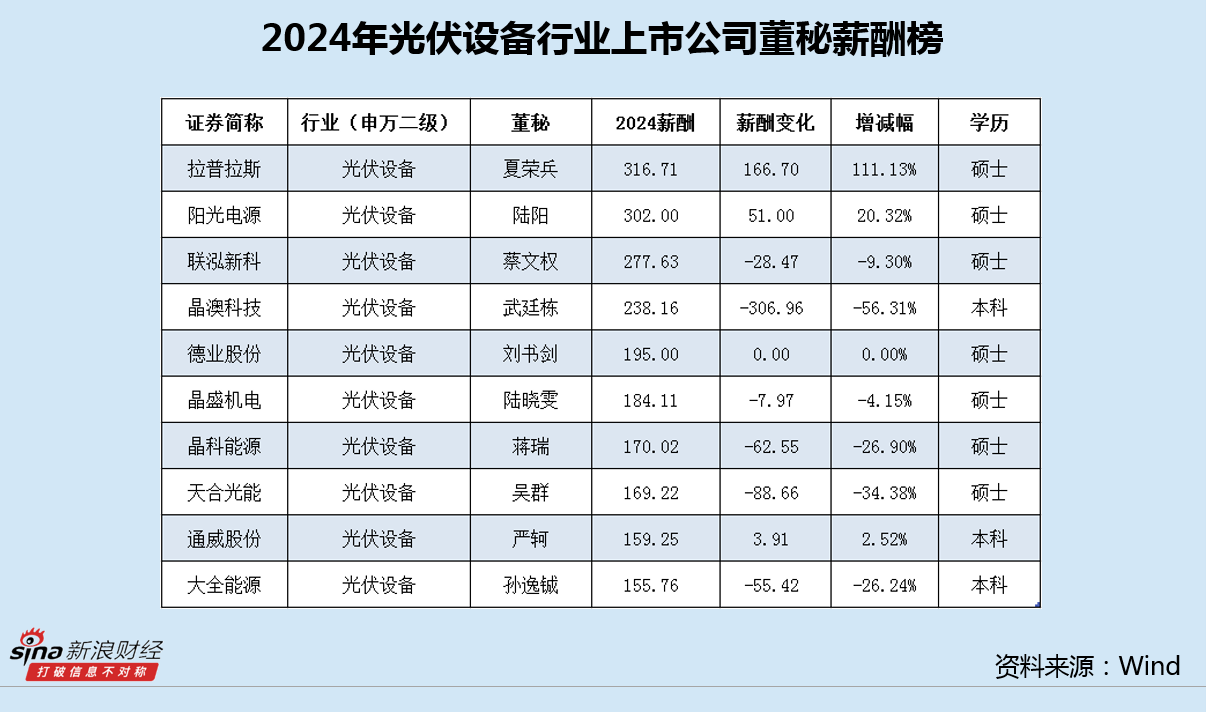
光伏设备行业董秘薪酬榜:拉普拉斯夏荣兵年薪316万高居榜首 年内涨薪166万
Xin Lang Zheng Quan· 2025-08-08 06:17
Core Insights - The report highlights that in 2024, the total salary for A-share listed company secretaries reached 4.086 billion yuan, with an average annual salary of 754,300 yuan [1] - Among the listed companies in the photovoltaic equipment industry, the total salary for secretaries amounted to 63.1969 million yuan, with an average annual salary of 929,400 yuan [1] - The highest-paid secretary in the industry is Xia Rongbing from Laplace, earning 3.1671 million yuan, with a salary increase of 1.667 million yuan, representing a growth rate of 111.13% [1][2] Industry Salary Overview - The photovoltaic equipment sector includes 68 listed companies, with a total secretary salary of 63.1969 million yuan [1] - The average salary for secretaries in this sector is 929,400 yuan, which is higher than the overall average for A-share listed companies [1] - Notable salary changes include: - Xia Rongbing (Laplace): 3.1671 million yuan, up 1.667 million yuan (111.13%) - Lu Yang (Sungrow): 3.02 million yuan, up 510,000 yuan (20.32%) - Cai Wenquan (Lianqiang Xinke): 2.7763 million yuan, down 284,700 yuan (-9.30%) [2]

塔克拉玛干沙漠最大光伏电站发电破3亿度,光伏ETF基金(159863)上涨超2%
Xin Lang Cai Jing· 2025-08-08 05:47
Group 1 - The core viewpoint is that the photovoltaic industry is experiencing a strong upward trend, with the Zhongzheng Photovoltaic Industry Index rising by 2.27% and key stocks like Sunshine Power increasing by 13.51% [1] - The largest photovoltaic power station in the Taklamakan Desert, the Tayuqi Mo Photovoltaic Power Station, has generated over 300 million kilowatt-hours of green electricity [1] - Huazhong Securities indicates that prices across the photovoltaic industry chain are rising, with stable increases in silicon material prices and a narrowing rise in N-type silicon material prices [1] Group 2 - As of July 31, 2025, the top ten weighted stocks in the Zhongzheng Photovoltaic Industry Index account for 56.16% of the index, including Sunshine Power, Longi Green Energy, and TCL Technology [2] - The photovoltaic ETF fund closely tracks the Zhongzheng Photovoltaic Industry Index, which selects up to 50 representative listed companies involved in the photovoltaic industry chain [1]

"反内卷"推进下多晶硅行业现积极信号 头部企业积极限产或为破局之路
Shang Hai Zheng Quan Bao· 2025-08-08 04:40
百川盈孚数据显示,8月6日,多晶硅价格指数为46500元/吨,月涨幅高达34.78%。同日,多晶硅期货主 力合约日内涨幅达4%。 作为光伏行业上游关键原材料之一,多晶硅市场正迎来关键性变局。 短期内多晶硅价格或维持高位运转 政策积极信号亦不断释放。有业内专家对上海证券报记者表示,推动整个行业止损盈利,关键在于头部 企业严格履行自律限产措施,进而达成去库存目标。价格获得有效支撑后,多晶硅行业方能步入稳定有 序发展阶段。 "反内卷"积极信号密集释放 "有必要再总结一下:市场化兼并重组+政策强制约束+技术淘汰机制。"8月4日,一位多晶硅上市公司 高管在微信朋友圈就"反内卷"的主要措施作出点评。 市场化兼并重组涉及到落后产能淘汰。一家硅料龙头企业相关人士透露,7月29日,一场硅料头部企业 闭门会议在北京召开。虽然外界传闻此会议与硅料行业并购重组有关,但该硅料龙头企业相关人士对记 者表示一切以官方发布为准。 虽然该闭门会议就并购重组的商议进展尚不为外界所知,不过,上海证券报近日曾报道该并购重组方案 的主要交易思路。记者从业内获悉,头部硅料企业正筹划出资设立一个类似OPEC(石油输出国组织) 的行业组织。该组织的形式为一 ...
光伏行业密集利好持续,光伏ETF基金(159863)上涨近1%
Xin Lang Cai Jing· 2025-08-08 03:08
Core Viewpoint - The photovoltaic industry is experiencing positive developments driven by new regulatory measures aimed at energy consumption standards, which are expected to lead to industry transformation and consolidation [1][2][3]. Group 1: Regulatory Developments - The National Development and Reform Commission and the State Administration for Market Regulation have drafted a consultation document on the revision of the Price Law, which is currently open for public feedback [1]. - The Ministry of Industry and Information Technology has issued a special energy-saving inspection task list for the polysilicon industry for 2025, focusing on "comprehensive energy consumption per unit product" as a key inspection criterion [2]. Group 2: Industry Transformation - The energy consumption standards and strict inspections are expected to accelerate the elimination of outdated production capacity, optimizing industry competition structure and resource allocation [2]. - Companies that fail to meet new energy consumption standards may face elimination or mandatory rectification, which will enhance overall industry efficiency [1][2]. Group 3: Technological Upgrades - The push for higher energy consumption standards will compel companies to invest more in cost reduction and efficiency-enhancing technologies, as well as to adopt green electricity to lower carbon emissions [2][3]. - This shift is anticipated to increase the proportion of green electricity used in the industry, supporting the overall green and low-carbon development goals of the photovoltaic sector [2]. Group 4: Market Dynamics - The exit of inefficient production capacity and potential tightening of new capacity approvals are expected to suppress the supply expansion of polysilicon, while global photovoltaic installation demand remains robust [3]. - This dynamic improvement in supply and demand is likely to reverse the recent trend of oversupply and declining prices, leading to a recovery in product prices and profitability for companies in the photovoltaic industry [3]. Group 5: Industry Index and ETF - The CSI Photovoltaic Industry Index (931151) has shown a positive performance, with significant gains in constituent stocks such as Sungrow Power (300274) and LONGi Green Energy (601012) [1][4]. - The index reflects the overall performance of listed companies involved in the photovoltaic industry chain, with the top ten weighted stocks accounting for 56.16% of the index [4].
光伏、风电利好凸显!新能源ETF(159875)交投活跃,近一月新增规模位居同类榜首
Xin Lang Cai Jing· 2025-08-08 03:08
Group 1 - The China Securities New Energy Index increased by 0.83%, with significant gains from component stocks such as Sunshine Power (+7.27%) and China Minmetals Resources (+4.24%) [1] - The New Energy ETF (159875) saw a trading volume of 16.47 million yuan, with a turnover rate of 1.83% [1] - Over the past month, the New Energy ETF's average daily trading volume was 39.61 million yuan, indicating strong market interest [1] Group 2 - The New Energy ETF's net asset value increased by 2.22% over the past six months, with a maximum monthly return of 25.07% since inception [1] - The top ten weighted stocks in the China Securities New Energy Index account for 43.41% of the index, with notable companies including CATL and Longi Green Energy [2] - A strategic partnership between Green Energy Wisdom Digital Energy Technology Co., Ltd. and Xinjiang Commerce Logistics Group aims to enhance logistics and emergency drone fleet bases in key regions, accelerating the construction of wind and solar projects in Xinjiang [2]