AikoSolar(600732)

Search documents
爱旭股份2025年净利预亏12亿—19亿元
Bei Jing Shang Bao· 2026-01-18 08:13
爱旭股份表示,受行业结构性产能过剩影响,供需失衡状况仍未显著改善,主要产品价格持续处于相对 低位,以及2025年下半年上游原材料价格持续上涨而下游组件价格传导不畅,导致公司全年经营承压, 业绩亏损,但亏损幅度较上年显著收窄。 北京商报讯(记者 马换换 李佳雪)1月18日,爱旭股份(600732)披露公告称,公司预计2025年年度实 现归属净利润为-12亿元至-19亿元,上年同期亏损约为53.19亿元。 ...

爱旭股份发预亏,预计2025年归母净亏损12亿元至19亿元
Zhi Tong Cai Jing· 2026-01-18 08:06
爱旭股份(600732)(600732.SH)披露2025年年度业绩预告,公司预计2025年年度实现归属于母公司所 有者的净亏损12亿元至19亿元;公司预计2025年年度实现归属于母公司所有者的扣除非经常性损益后的 净亏损16亿元至23亿元。 公告显示,报告期内,得益于公司ABC组件高功率、高价值、高安全性的市场优势,2025年ABC组件 销售量同比实现翻倍以上增长,国内外市场的占有率和知名度均持续提升。然而受行业结构性产能过剩 影响,供需失衡状况仍未显著改善,主要产品价格持续处于相对低位,以及2025年下半年上游原材料价 格持续上涨而下游组件价格传导不畅,导致公司全年经营承压,业绩亏损,但亏损幅度较上年显著收 窄。 ...
爱旭股份(600732.SH)发预亏,预计2025年归母净亏损12亿元至19亿元
智通财经网· 2026-01-18 08:04
公告显示,报告期内,得益于公司ABC组件高功率、高价值、高安全性的市场优势,2025年ABC组件 销售量同比实现翻倍以上增长,国内外市场的占有率和知名度均持续提升。然而受行业结构性产能过剩 影响,供需失衡状况仍未显著改善,主要产品价格持续处于相对低位,以及2025年下半年上游原材料价 格持续上涨而下游组件价格传导不畅,导致公司全年经营承压,业绩亏损,但亏损幅度较上年显著收 窄。 智通财经APP讯,爱旭股份(600732.SH)披露2025年年度业绩预告,公司预计2025年年度实现归属于母 公司所有者的净亏损12亿元至19亿元;公司预计2025年年度实现归属于母公司所有者的扣除非经常性损 益后的净亏损16亿元至23亿元。 ...
爱旭股份:预计2025年净利润亏损12亿元~19亿元
Mei Ri Jing Ji Xin Wen· 2026-01-18 08:03
Core Viewpoint - The company, Aishuo Co., Ltd. (600732.SH), expects a net profit loss of 1.2 billion to 1.9 billion yuan for the fiscal year 2025, despite achieving over 100% year-on-year growth in sales volume of its ABC components and improving market share and brand recognition domestically and internationally [1]. Group 1 - The company anticipates a net profit loss of 1.2 billion to 1.9 billion yuan for 2025 [1]. - Sales volume of ABC components is expected to more than double year-on-year [1]. - The company’s market share and brand recognition continue to improve in both domestic and international markets [1]. Group 2 - The industry is still facing supply-demand imbalance, which has not significantly improved [1]. - Prices of major products remain at relatively low levels [1]. - Continuous increase in upstream raw material prices in the second half of 2025, coupled with poor transmission of these costs to downstream component prices, is putting pressure on the company's operations [1]. - Despite the losses, the extent of the loss is expected to narrow significantly compared to the previous year [1].
爱旭股份:预计2025年净亏损12亿元-19亿元
Ge Long Hui A P P· 2026-01-18 08:01
格隆汇1月18日|爱旭股份(600732.SH)公告称,公司预计2025年度实现归属于母公司所有者的净利润亏 损12亿元至19亿元。2025年公司ABC组件销售量同比实现翻倍以上增长,国内外市场的占有率和知名 度均持续提升。然而受行业结构性产能过剩影响,供需失衡状况仍未显著改善,主要产品价格持续处于 相对低位,以及2025年下半年上游原材料价格持续上涨而下游组件价格传导不畅,导致公司全年经营承 压,业绩亏损,但亏损幅度较上年显著收窄。 ...
爱旭股份:预计2025年净利润亏损12亿元—19亿元
Zheng Quan Shi Bao Wang· 2026-01-18 07:51
人民财讯1月18日电,爱旭股份(600732)1月18日公告,公司预计2025年度实现归属于母公司所有者的 净利润亏损12亿元至19亿元。2025年公司ABC组件销售量同比实现翻倍以上增长,国内外市场的占有 率和知名度均持续提升。然而受行业结构性产能过剩影响,供需失衡状况仍未显著改善,主要产品价格 持续处于相对低位,以及2025年下半年上游原材料价格持续上涨而下游组件价格传导不畅,导致公司全 年经营承压,业绩亏损,但亏损幅度较上年显著收窄。 ...
爱旭股份(600732) - 2025 Q4 - 年度业绩预告
2026-01-18 07:50
证券代码:600732 股票简称:爱旭股份 编号:临 2026-002 上海爱旭新能源股份有限公司 2025 年年度业绩预告 本公司董事会及全体董事保证本公告内容不存在任何虚假记载、误导性陈述或者重大遗 漏,并对其内容的真实性、准确性和完整性承担法律责任。 重要内容提示: ● 本期业绩预告适用于净利润为负值的情形。 ● 上海爱旭新能源股份有限公司(以下简称"公司")预计2025年年度实现归 属于母公司所有者的净利润为-120,000万元至-190,000万元。 经财务部门初步测算,预计公司 2025 年年度实现归属于母公司所有者的净利润 为-120,000 万元至-190,000 万元。 预计 2025 年年度实现归属于母公司所有者的扣除非经常性损益后的净利润 为-160,000 万元至-230,000 万元。 (三)本次业绩预告未经注册会计师审计。 二、上年同期经营业绩和财务状况 (一)利润总额:-644,076.71 万元。归属于母公司所有者的净利润:-531,943.19 万元。归属于母公司所有者的扣除非经常性损益的净利润:-555,279.89 万元。 (二)每股收益:-2.91 元。 ● 公司预计2 ...
爱旭股份(600732.SH):预计2025年度净亏损1.2亿元至1.9亿元
Ge Long Hui A P P· 2026-01-18 07:48
报告期内,得益于公司ABC组件高功率、高价值、高安全性的市场优势,2025年ABC组件销售量同比 实现翻倍以上增长,国内外市场的占有率和知名度均持续提升。然而受行业结构性产能过剩影响,供需 失衡状况仍未显著改善,主要产品价格持续处于相对低位,以及2025年下半年上游原材料价格持续上涨 而下游组件价格传导不畅,导致公司全年经营承压,业绩亏损,但亏损幅度较上年显著收窄。 格隆汇1月18日丨爱旭股份(600732.SH)发布公告,经财务部门初步测算,预计公司2025年年度实现归属 于母公司所有者的净利润为-1.2亿元至-1.9亿元。预计2025年年度实现归属于母公司所有者的扣除非经 常性损益后的净利润为-1.6亿元至-2.3亿元。 ...
国家电网“十五五”投资4万亿元,固态电池近期催化密集落地



GOLDEN SUN SECURITIES· 2026-01-18 06:32
Investment Rating - The report indicates a positive outlook for the power equipment industry, particularly in the renewable energy sector, with significant investments and technological advancements expected to drive growth [1][2][4]. Core Insights - The report highlights that the State Grid's investment during the "14th Five-Year Plan" period is projected to reach 4 trillion yuan, marking a 40% increase compared to the previous plan [2]. - The report emphasizes the stability in polysilicon prices and the continuous rise in battery component prices, with N-type battery prices increasing to 0.40 yuan per watt [15][16]. - The report identifies three key areas of focus: supply-side reform leading to price increases in the industry chain, long-term growth opportunities from new technologies, and industrialization opportunities from perovskite GW-level layouts [16]. Summary by Sections 1. New Energy Generation 1.1 Photovoltaics - Polysilicon prices remain stable, while battery component prices are on the rise, with N-type battery prices reaching an average of 0.40 yuan per watt [15]. - The report notes that leading component companies are responding to industry self-discipline by raising component prices, with distributed sales prices reaching 0.72 yuan per watt [15][16]. - Key companies to watch include Tongwei Co., GCL-Poly, LONGi Green Energy, JA Solar, and Trina Solar [16]. 1.2 Wind Power & Grid - The UK AR7 offshore wind auction results exceeded expectations, with a total scale of approximately 8.4GW, validating the upward trend in European offshore wind [17]. - The State Grid's investment is expected to enhance transmission capacity significantly, addressing bottlenecks in renewable energy delivery [18]. - Companies to focus on include Goldwind, Yunda Wind Power, Mingyang Smart Energy, and Sany Heavy Energy [18]. 1.3 Hydrogen & Energy Storage - By 2025, the production and sales of fuel cell vehicles in China are projected to reach 7,797 units, reflecting a 44% year-on-year increase [20]. - The report anticipates that new energy storage installations will reach 58.6GW/175.3GWh by 2025, with significant growth expected in the energy storage sector [21]. - Key players in the hydrogen sector include Shuangliang Energy, Huadian Heavy Industries, and Shenghui Technology [20]. 2. New Energy Vehicles - Solid-state batteries are gaining traction, with several automakers making progress towards mass production by 2026 [29]. - Companies such as BYD, Changan Automobile, and Chery are expected to achieve significant milestones in solid-state battery technology [29]. - The report suggests monitoring companies like Xiamen Tungsten, Hailiang Co., and Nanjing Advanced Lithium Battery [29]. 3. Industry Trends - The report notes a 0.4% increase in the new energy equipment sector from January 12 to January 16, 2026, with a cumulative increase of 5.3% since the beginning of the year [12]. - The photovoltaic equipment sector saw a 3.52% increase, while the wind power equipment sector experienced a decline of 1.28% during the same period [13].
毁约式涨价!光伏组件上演“最后的疯狂”
Ge Long Hui A P P· 2026-01-17 11:23
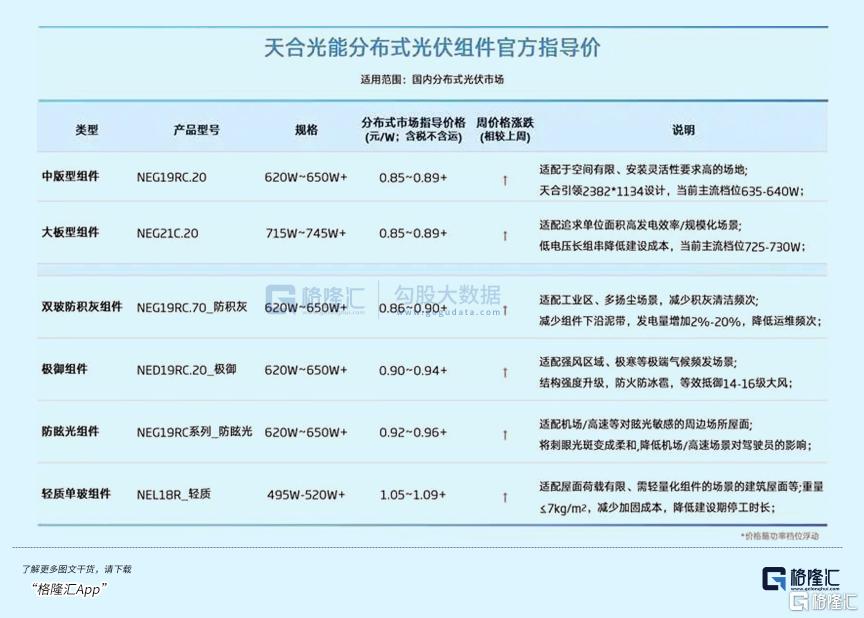
Core Viewpoint - The photovoltaic (PV) module industry is experiencing an unexpected price surge in early 2026, driven by the impending cancellation of export tax rebates and rising costs of key materials like silver and aluminum, leading to significant profit compression and potential industry-wide upheaval [1][7][19]. Price Surge and Market Dynamics - Several distributed PV investment companies have reported sudden price increases on previously agreed contracts, with one leading manufacturer raising prices from 0.73 yuan/W to 0.8 yuan/W [2]. - On January 13, Trina Solar announced a collective price increase for various distributed PV module models, with official guidance prices ranging from 0.85 to 0.89+ yuan/W [2][3]. - A total of 12 module manufacturers raised their prices this week, with increases ranging from 0.04 to 0.15 yuan/W [4]. Cost Factors - The cancellation of export tax rebates, effective April 1, 2026, is a significant catalyst for the price increases, as companies rush to fulfill orders before the policy takes effect [7][8]. - The price of silver has surged over 150% in 2025, increasing its cost share in PV modules from approximately 17% to around 30%, making it the largest cost component [10][13]. - The rising prices of aluminum and other materials have further exacerbated cost pressures, with aluminum's cost share increasing from 8-12% to 12-15% [14][16]. Industry Overcapacity and Challenges - The PV industry is facing severe overcapacity, with silicon production capacity expected to cover more than double the global demand from 2025 to 2027, while actual demand is below 600 GW [17]. - Despite the overcapacity, over 40 billion yuan is still being invested in new PV projects, worsening the supply-demand imbalance [18]. - The cancellation of export tax rebates is anticipated to trigger a brutal industry-wide clearing, with many companies lacking competitive advantages likely to exit the market [19][24]. Financial Impact and Future Outlook - The removal of export tax rebates will significantly reduce profit margins for PV companies, with estimates indicating a profit reduction of 46-51 yuan per 210R module exported [24]. - Many companies are already reporting substantial losses, with projections indicating that the entire PV silicon industry could face losses amounting to hundreds of billions in 2025 [27][28]. - The industry is expected to undergo a significant consolidation, with over 30% of inefficient capacity being eliminated, allowing leading companies with strong technology and global presence to capture over 80% of the market share [29].