
Shanxi Xinghuacun Fen Wine Factory (600809)

Search documents
华源证券:重视ROA企稳的消费板块 寻找价或量仍景气的细分赛道
智通财经网· 2025-12-24 13:01
Core Viewpoint - Different consumer sectors exhibit both differences and commonalities in recovery rhythms, with ROA being a leading indicator for operational recovery in consumer enterprises [1][2] Group 1: Recovery Rhythm Analysis - The recovery rhythm of various consumer sectors is influenced by industry supply and demand, as well as supply chain structures, with a focus on stock market competition as a mainstream phenomenon [2] - The stages of enterprise and channel adjustments are outlined, starting from oversupply to a new balance in supply and demand, with ROA serving as a key indicator throughout these stages [2] - Current recovery sequences indicate that soft drinks and snacks are leading, followed by food supply chains, condiments, dairy products, beer, and finally, liquor [2][3] Group 2: Investment Strategy - Emphasis on sectors where ROA stabilizes, indicating potential valuation recovery opportunities, with a preference for sectors that still show price or volume growth [3] - Price logic suggests that rising CPI may drive valuation recovery in traditional industries with high penetration rates, such as liquor, beer, and dairy products, which are likely to attract incremental capital [3][4] - Recommended companies in the liquor sector include Kweichow Moutai, Luzhou Laojiao, and Shanxi Fenjiu, while in dairy, focus on Yili and Mengniu [3] Group 3: Volume Logic - In the context of cost-effective consumption, companies with high supply chain efficiency are expected to gain volume, with specific recommendations for companies in the food supply chain and soft drinks [4] - Industries with low penetration rates may withstand economic cycles, with recommendations for low-alcohol beverages and functional foods that can enhance brand premium through specialization [4] - Companies benefiting from overseas market expansion include Angel Yeast and Bailong Chuangyuan [4]





扩内需:食品饮料行业投资机会
2025-12-24 12:57
Summary of Key Points from the Conference Call Industry Overview - The food and beverage industry is experiencing systemic opportunities driven by policies aimed at expanding domestic demand and increasing residents' income levels, which are expected to enhance consumption capabilities [1][2] - The liquor industry is undergoing a deep adjustment, with expectations of entering an EPS killing phase by 2025, while high-end liquor brands like Moutai and Lao Jiao are recommended for investment [1][4] - The dairy industry has completed supply-demand adjustments, with anticipated increases in demand for milk powder and liquid milk due to fertility and income policies, highlighting companies like Yili and New Dairy as potential recovery opportunities [1][5] - The snack food sector is benefiting from the "lipstick effect," new channels, and health trends, with recommendations for companies such as Salted Fish, Wei Long, Wan Chen Food, and Qiaqia Food [1][6] - The beverage sector is seeing a clear trend towards health, with non-traditional channels gaining market share, making high-growth companies like Dongpeng Beverage noteworthy [1][7] Key Insights and Arguments - The central economic work conference in 2026 will prioritize expanding domestic demand, which is expected to lead to a series of policies stimulating consumption, positively impacting the food and beverage industry [2] - The food and beverage sector has faced significant changes in volume, price, and channel structure over the past six years, with varying performances across sub-sectors [3] - The liquor sector is expected to see marginal improvements in 2026, driven by policies aimed at boosting business and government consumption [4] - The dairy sector is projected to enter a recovery phase, with increased demand anticipated due to supportive policies [5] - The snack food market is expected to gradually recover, supported by rising incomes and new retail channels [6] Additional Important Content - Cost fluctuations are a significant factor affecting the performance of consumer goods companies, with some agricultural product costs declining, providing investment opportunities [9] - The planting area for sunflower seeds is expected to recover, leading to a projected 10% decrease in the cost of sunflower seeds, which will positively impact Qiaqia Food's gross margin [10][11] - The konjac market is facing supply-demand imbalances, with high prices expected to ease in 2026, alleviating cost pressures for companies like Wei Long and Salted Fish [12] - The sugar molasses market is currently at low prices, providing strong support for Angel Yeast's profitability [13] - Innovative companies are leveraging product and channel innovations to drive growth, with notable examples including Nongfu Spring and Uni-President [14] - Efficient supply chain management is crucial for companies, with Dongpeng Beverage demonstrating strong performance in this area [15] Future Outlook - Dongpeng Beverage is expected to achieve double-digit growth in 2026 through strategic measures and product innovations [16] - Wan Chen is enhancing store quality and accelerating store openings, which is expected to improve profitability in the snack food sector [17][18] - Hai Tian Flavoring has implemented efficiency improvements under new management, resulting in revenue and profit growth exceeding industry averages [19] - The restaurant industry is expected to see a mild recovery, with companies like Yihai International and Tianhe Flavoring showing potential for improvement [20][21] - In the liquor sector, companies like Yanghe and Budweiser are expected to benefit from product and channel improvements, leading to potential breakthroughs in performance [22][23][25] - Gan Yuan Food is focusing on expanding e-commerce and high-end membership stores, with a stable development outlook [26][27] - Overall, companies in the food and beverage sector are expected to experience gradual recovery and growth, making them worthy of investor attention [28]





13只白酒股下跌 贵州茅台1400.90元/股收盘
Bei Jing Shang Bao· 2025-12-24 12:16
Core Viewpoint - The liquor industry is entering a phase of rapid performance clearing, with expectations of a weak recovery in demand as policy pressures ease and consumption expansion policies take effect [1] Industry Summary - The three major indices collectively rose, with the Shanghai Composite Index closing at 3940.95 points, up 0.53% [1] - The liquor sector closed at 2196.49 points, with a slight increase of 0.18%, although 13 liquor stocks experienced declines [1] - The current industry valuation is low, and pessimistic expectations are fully priced in, indicating a clearer direction for industry clearing and a more defined bottom [1] Company Summary - Kweichow Moutai (600519) closed at 1400.90 CNY per share, down 0.49% [1] - Wuliangye (000858) closed at 109.28 CNY per share, down 0.40% [1] - Shanxi Fenjiu (600809) closed at 175.60 CNY per share, down 0.96% [1] - Luzhou Laojiao (000568) closed at 119.94 CNY per share, down 0.38% [1] - Yanghe Brewery (002304) closed at 62.10 CNY per share, down 0.06% [1]



食品饮料2026年投资策略报告:曙光渐显,在分化中前行-20251224
Hua Yuan Zheng Quan· 2025-12-24 12:13
Group 1: Core Insights - The report emphasizes the recovery stage of consumer spending, highlighting that different sectors exhibit both commonalities and differences in their recovery rhythms, driven by supply-demand dynamics and industry structure [4][5] - ROA (Return on Assets) is identified as a leading indicator for the operational recovery of consumer companies, with a focus on analyzing various sub-sectors [4][13] Group 2: Sector Performance - The current recovery sequence indicates that soft drinks and snacks are leading, followed by the catering supply chain, condiments, dairy products, beer, and finally, liquor [5][25] - The report draws parallels with Japan's 1990s consumption differentiation, noting that sectors addressing consumer pain points and with low penetration rates are likely to succeed [5][6] Group 3: Investment Strategy - The report suggests focusing on sectors where ROA is stabilizing, indicating potential valuation recovery opportunities, particularly in traditional sectors like liquor, beer, and dairy [6][8] - It recommends identifying sub-sectors with either price or volume growth, with a preference for price-driven strategies [6][8] Group 4: Detailed Sector Analysis - The frozen food sector is showing signs of marginal improvement, with leading companies enhancing operational efficiency through product innovation and channel reforms [27][28] - The snack sector is experiencing high demand, driven by new channel developments, although competition is intensifying [33][35] - The beer industry is under pressure, with a focus on high-end products, but overall growth is slowing due to external economic factors [39][41] - The dairy sector is nearing the end of its adjustment phase, with expectations of improved performance as raw milk prices rise [41][42] - The liquor sector is currently in a phase of inventory reduction, with performance risks gradually clearing as channels stabilize [43][48]


食品饮料行业资金流出榜:五粮液等7股净流出资金超5000万元
Zheng Quan Shi Bao Wang· 2025-12-24 09:45
Market Overview - The Shanghai Composite Index rose by 0.53% on December 24, with 26 out of the 28 sectors experiencing gains, led by defense and electronics sectors, which increased by 2.88% and 2.12% respectively [1] - The agriculture, forestry, animal husbandry, and fishery sectors, along with coal, were the biggest losers, declining by 0.85% and 0.70% respectively [1] Capital Flow Analysis - The net inflow of capital in the two markets reached 10.37 billion yuan, with 17 sectors seeing net inflows [1] - The electronics sector had the highest net inflow of 8.68 billion yuan, corresponding to its 2.12% increase, followed by the power equipment sector with a net inflow of 3.76 billion yuan and a daily increase of 1.03% [1] Food and Beverage Sector Performance - The food and beverage sector declined by 0.36%, with a net outflow of 1.11 billion yuan [2] - Out of 124 stocks in this sector, 46 rose, including one hitting the daily limit, while 73 fell, with two hitting the lower limit [2] - The top three stocks with the highest net inflow were Huangshi Group (21.71 million yuan), Yangyuan Beverage (21.13 million yuan), and Richen Co. (10.47 million yuan) [2] Food and Beverage Capital Flow - The top stocks with net outflows included Wuliangye (-162.02 million yuan), Shanxi Fenjiu (-138.72 million yuan), and Kweichow Moutai (-112.55 million yuan) [3] - Other notable stocks with significant outflows were Haiqin Food (-106.74 million yuan) and Angel Yeast (-64.93 million yuan) [3]
酒价内参12月24日价格发布 青花郎上涨6元实现三连阳
Xin Lang Cai Jing· 2025-12-24 02:42
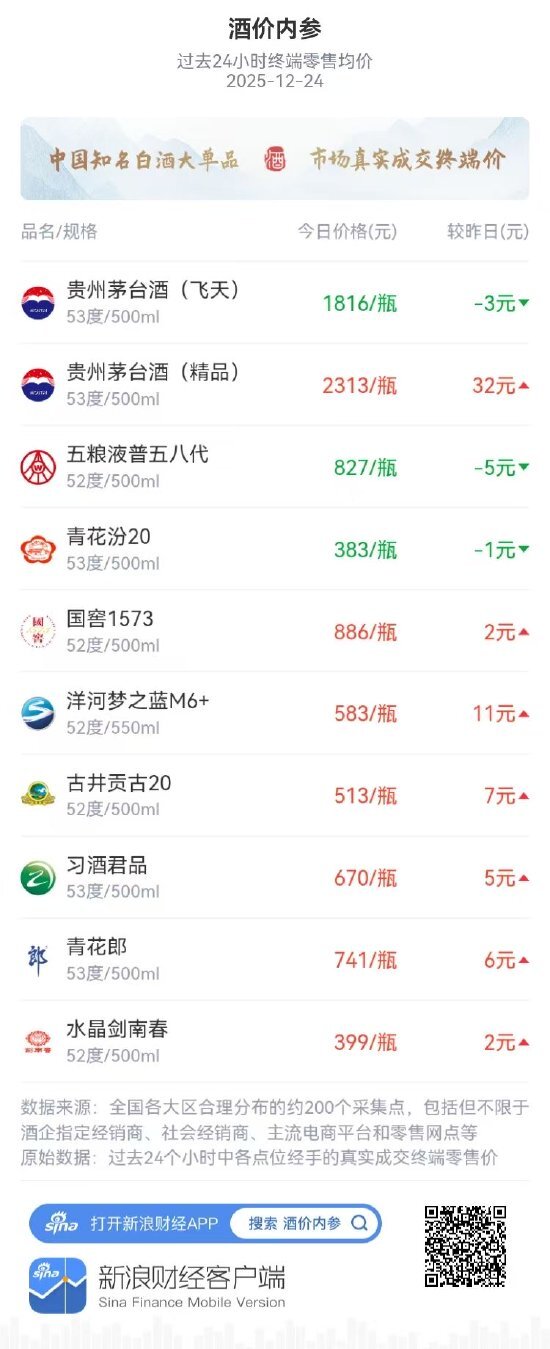
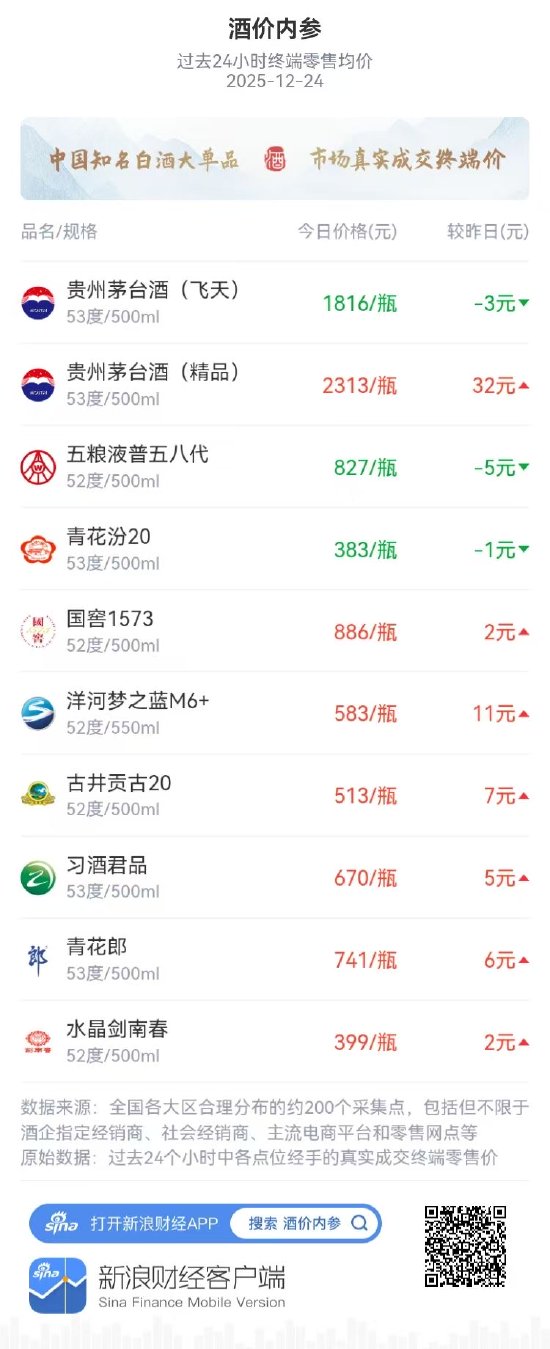
Core Insights - The Chinese liquor market has seen a significant increase in the retail prices of its top ten products, indicating a strong festive consumption atmosphere [1][2] - The overall price for a bundled sale of these ten products reached 9131 yuan, marking a daily increase of 56 yuan, the highest single-day rise recently [1] - The market is experiencing a broad upward trend driven by holiday demand, with premium products like Moutai leading the price increases [1][2] Price Movements - Moutai's premium product price increased by 32 yuan per bottle, reflecting strong demand for high-end gifts and banquet needs ahead of the holidays [1][2] - Other notable price changes include: - Yanghe Dream Blue M6+ up by 11 yuan per bottle - Gujing Tribute Wine up by 7 yuan per bottle - Qinghua Lang and Xijiu Junpin up by 6 yuan and 5 yuan per bottle respectively, with Qinghua Lang achieving three consecutive days of price increases [1] - Some products experienced minor price adjustments, such as Wuliangye down by 5 yuan and Feitian Moutai down by 3 yuan [1] Market Dynamics - The surge in Moutai prices is linked to recent news about the company's "quantity control" measures, which have led to a reduction in the supply of non-standard products by 30%-50% [2] - There is a noted shortage of certain Moutai products, leading to increased market speculation and consumer purchasing behavior, further driving up prices as the double festival approaches [2]


酒价内参12月24日价格发布 古井贡古20上涨7元
Xin Lang Cai Jing· 2025-12-24 01:26
Core Insights - The Chinese liquor market has seen a significant increase in the retail prices of the top ten products, indicating a strong festive consumption atmosphere, with the total price for a packaged set reaching 9131 yuan, up 56 yuan from the previous day, marking a recent single-day high in price increase [1][6][7] Price Movements - The price of premium Moutai increased by 32 yuan per bottle, leading the market surge, reflecting strong demand for high-end gifts and banquet needs ahead of the holidays [7] - Other notable price increases include: - Yanghe Dream Blue M6+: up 11 yuan per bottle - Gujing Gong 20: up 7 yuan per bottle - Qinghua Lang: up 6 yuan per bottle - Xijiu Junpin: up 5 yuan per bottle - Guojiao 1573 and Shuijing Jian Nan Chun: both up 2 yuan per bottle [7][9] - Some products experienced minor price adjustments, with Wuliangye Pu 58th generation down 5 yuan, Feitian Moutai down 3 yuan, and Qinghua Fen 20 down 1 yuan, which are considered normal fluctuations [7] Market Dynamics - The data for the "Liquor Price Reference" is sourced from approximately 200 collection points across various regions, including designated distributors, social distributors, mainstream e-commerce platforms, and retail outlets, aiming to provide objective and traceable market price data [2][7] - The recent price surge for premium Moutai is linked to supply control measures announced by the company, which have led to a reduction in the availability of non-standard products by 30%-50%, creating a sense of scarcity and driving up prices as demand increases during the holiday season [2][7]
白酒板块12月23日跌0.3%,皇台酒业领跌,主力资金净流出7.43亿元
Zheng Xing Xing Ye Ri Bao· 2025-12-23 09:08
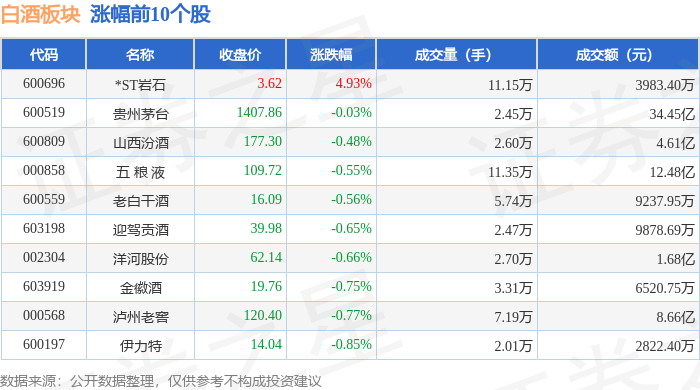
Group 1 - The liquor sector experienced a decline of 0.3% on December 23, with Huangtai Liquor leading the drop [1] - The Shanghai Composite Index closed at 3919.98, up 0.07%, while the Shenzhen Component Index closed at 13368.99, up 0.27% [1] - Notable individual stock performances include ST Yanshi with a closing price of 3.62, up 4.93%, and Kweichow Moutai at 1407.86, down 0.03% [1] Group 2 - The liquor sector saw a net outflow of 743 million yuan from main funds, while retail investors contributed a net inflow of 418 million yuan [2] - The trading volume for major liquor stocks varied, with Wuliangye recording a transaction amount of 1.248 billion yuan and Luzhou Laojiao at 866 million yuan [1][2] - The stock performance of various companies showed a downward trend, with notable declines in shares such as Shede Liquor down 1.39% and Gujing Gongjiu down 1.35% [2] Group 3 - The main fund inflow and outflow data indicates that ST Yanshi had a net inflow of 5.177 million yuan, while Yilite experienced a significant outflow of 5.646 million yuan [3] - The data reflects a mixed sentiment among investors, with retail investors showing a positive net inflow in several stocks despite the overall sector decline [3] - The analysis of fund flows highlights the varying investor interest, with some stocks like Laobai Ganjiu seeing a net outflow of 12.036 million yuan from main funds [3]

19只白酒股下跌 贵州茅台1407.86元/股收盘
Bei Jing Shang Bao· 2025-12-23 08:04
开源证券在其研报中指出,当前白酒行业仍处深度调整期,需求下行驱动价格带持续下移。行业从规模 扩张转向存量竞争,各家酒企围绕真实消费需求重新切分市场"蛋糕"。在此背景下,头部企业均摒弃单 纯业绩导向,短期报表虽受调整影响承压,但主动纾解渠道压力、优化供需结构的举措,是实现渠道健 康发展的必经之路。 北京商报讯(记者刘一博冯若男)12月23日尾盘,沪指3919.98点上涨0.07%。白酒板块2192.45点收盘下跌 0.99%,其中19只白酒股下跌,贵州茅台(600519)1407.86元/股收盘。 从个股来看,贵州茅台收盘价达1407.86元/股,下跌0.03%;五粮液(000858)收盘价达109.72元/股, 下跌0.55%;山西汾酒(600809)收盘价达177.30元/股,下跌0.48%;泸州老窖(000568)收盘价达 120.40元/股,下跌0.77%;洋河股份(002304)收盘价达62.14元/股,下跌0.66%。 ...
山西汾阳组织质量专题培训助推白酒产业发展
Zhong Guo Zhi Liang Xin Wen Wang· 2025-12-23 03:37
Core Viewpoint - The training session held in Shanxi Province aims to enhance quality management in the local liquor industry, specifically focusing on the development of the Fenjiu brand and its competitive edge through quality improvement [1] Group 1: Training Objectives and Content - The training session, themed "Strengthening Quality Foundations," was organized to unify the understanding of quality enhancement as a means to promote regional brand development [1] - Topics covered included legal regulations, quality management systems, product labeling, and interpretation of group standards [1] - Experts provided case studies to highlight operational risks and discussed the pathways for establishing quality management systems [1] Group 2: Industry Development and Support - The local market supervision bureau emphasized the importance of compliance and the dual role of service and regulation in supporting healthy industry development [1] - A commitment was made to establish quality improvement records for enterprises and to conduct ongoing support initiatives [1] - The goal is to continuously enhance the reputation of the "core production area of Qingxiang liquor" and empower sustainable industry development [1]