Shanxi Xinghuacun Fen Wine Factory (600809)

Search documents
食品饮料行业 2026 年度投资策略报告(二):白酒:底部信号夯实,重视优质酒企配置机会-20251225
Guoxin Securities· 2025-12-25 13:59
Group 1 - The report indicates that the liquor industry is currently facing supply-demand imbalances, with companies reducing growth expectations and releasing channel pressures. The white liquor index has dropped by 12% since the beginning of 2025, underperforming the CSI 300 index by 33% [1][11] - The report highlights that the overall market demand for white liquor has shown slight recovery, but actual demand remains weak, with mainstream product prices in a downward trend. Companies like Wuliangye and Gujing Gongjiu are reducing growth expectations, leading to significant declines in Q3 performance [1][22] - The report suggests that the white liquor sector is entering a configuration phase, with leading companies like Kweichow Moutai improving their price-volume relationship and showcasing dividend asset attributes, with a projected dividend yield of 4% in 2026 [3][4] Group 2 - Looking ahead to 2026, the report anticipates that supply-side optimization and channel clearing will occur, with a focus on quality company configurations. The industry is expected to see gradual recovery in demand, particularly during the Spring Festival sales period [2][29] - The report notes that channel inventory has decreased since Q3 2025, and companies are focusing on maintaining dynamic profits for distributors. Leading companies are gradually relaxing channel policies, indicating a stabilization trend in product prices post-holiday [2][42] - The competitive landscape is shifting from price differentiation to brand and organizational capabilities, with companies that can establish pricing power in specific regions or demographics likely to emerge from the adjustment cycle first [2][29] Group 3 - Investment recommendations suggest that the white liquor sector is now in a configuration zone, with a focus on brands that can navigate through cycles, such as Kweichow Moutai and Shanxi Fenjiu, which are expected to see valuation improvements as market liquidity increases [3][4] - The report emphasizes the importance of companies that have established advantages in pricing and regional market share during the adjustment phase, such as Luzhou Laojiao, Gujing Gongjiu, and Jinhui Liquor [3][4] - The report also highlights companies with strong shareholder returns and cash flow safety margins, such as Wuliangye, as potential investment opportunities [3][4]





从“卖产品”到“卖文化” 酒企出海新征程
Bei Jing Shang Bao· 2025-12-25 13:52
Core Viewpoint - The Chinese liquor industry is increasingly focusing on international markets as domestic competition intensifies, with a significant number of companies expanding overseas to seek new growth opportunities [1][8]. Group 1: Market Expansion - As of December 25, 2023, 63.9% of Chinese liquor companies are either expanding or have already established a presence in overseas markets, indicating a collective shift towards internationalization [1]. - Major brands like Moutai, Wuliangye, and Luzhou Laojiao are actively entering global markets, while Huangjiu brands such as Guyue Longshan and Kuaijishan are also leveraging traditional culture alongside their products [1][3]. Group 2: Product Strategy - Companies are adopting two distinct strategies for internationalization: "cultural integration" with tailored products for foreign markets, and "value output" by exporting established domestic products [3]. - Moutai has launched a series of products specifically designed for international markets, while other brands like Luzhou Laojiao and Wuliangye are exporting their star products that have already gained traction in China [3][4]. Group 3: Cultural Integration - The cultural aspect of product export is becoming increasingly important, with companies recognizing that successful internationalization involves not just product sales but also cultural storytelling [6]. - Initiatives such as Wuliangye's "He Mei Global Tour" and various cultural exchange activities by other brands aim to promote Chinese liquor culture globally [6][7]. Group 4: Market Challenges - Despite the enthusiasm for international expansion, challenges remain, including the need for localization and the predominance of Chinese consumers in overseas markets [8][9]. - The Southeast Asian market is currently the primary focus for many companies, supported by a significant Chinese diaspora, but broader acceptance among local consumers is still a hurdle [8][9]. Group 5: Future Directions - To penetrate mainstream overseas markets, companies must innovate and adapt their products to local tastes, particularly through the integration of liquor with Chinese cuisine [9].



从“卖产品”到“卖文化” 营销变革下酒企出海新征程
Bei Jing Shang Bao· 2025-12-25 13:30
Core Viewpoint - The Chinese liquor industry is increasingly focusing on international markets as domestic competition intensifies, with a significant number of companies expanding overseas to seek new growth opportunities [1][7]. Group 1: Market Expansion - As of December 25, 2023, 63.9% of Chinese liquor companies are either expanding or have already established a presence in overseas markets [1]. - Major brands like Kweichow Moutai, Wuliangye, and Luzhou Laojiao are actively entering international markets, alongside traditional yellow wine brands like Guyue Longshan and Kuaijishan [1][2]. Group 2: Product Strategy - Companies are adopting two distinct strategies for internationalization: "cultural integration" with tailored products for foreign markets and "value output" by exporting established domestic products [2]. - Kweichow Moutai has launched a series of new products specifically designed for overseas markets, marking a significant expansion after six years [2]. - Luzhou Laojiao is innovating with products like ready-to-drink cocktails and oak barrel liquor to cater to international consumer preferences [3]. Group 3: Cultural Integration - The liquor industry recognizes that cultural storytelling is essential for successful international expansion, with many companies engaging in high-profile cultural activities to promote Chinese liquor [4][5]. - Initiatives like Wuliangye's "He Mei Global Tour" and the opening of tasting houses by Guyue Longshan in Paris highlight the industry's focus on cultural exchange [5][6]. Group 4: Market Challenges - Despite the enthusiasm for international markets, challenges remain, including a reliance on Chinese consumers abroad and the need for deeper localization to appeal to diverse international tastes [7][8]. - The Southeast Asian market is identified as a primary target for expansion, supported by a significant Chinese diaspora that influences local consumption patterns [7]. Group 5: Future Directions - Industry experts suggest that to penetrate mainstream markets, liquor companies must innovate and adapt products to local tastes, potentially developing lower-alcohol or pre-mixed beverages [8]. - There is a call for greater integration of liquor with Chinese cuisine to enhance market appeal and consumer acceptance [8].
白酒浮华消散,行业寻找新主场|2025中国经济年报
Hua Xia Shi Bao· 2025-12-25 12:57
Core Insights - The Chinese liquor industry is still in a deep adjustment phase as of the end of 2025, shifting from volume growth to a focus on market share redistribution due to declining demand pressures [2][3] - The high-end market is losing its appeal, leading to a downward adjustment in mainstream price ranges, with distributors adopting a cautious outlook for the upcoming Spring Festival sales [2][3] - Key issues facing the industry include overcapacity, high inventory levels, price inversions, and a lack of consumption scenarios, as highlighted by industry leaders [2][3] Market Dynamics - The price of Moutai liquor has become a significant indicator of industry adjustments, with its wholesale price dropping to 1500 yuan per bottle in December 2025, reflecting broader market challenges [3][4] - Among 20 A-share listed liquor companies, only Guizhou Moutai and Shanxi Fenjiu reported positive growth in the first three quarters of the year, while the remaining 18 experienced negative growth [3][4] - The new regulations on government consumption and changing preferences among younger consumers are contributing to the industry's downturn [3][4] Industry Adjustments - The current adjustment is characterized by a proactive approach from leading companies, focusing on quality improvement and channel optimization rather than aggressive price cuts [4][5] - There is a significant market differentiation occurring, with top brands managing to maintain their positions while smaller and less established brands face existential threats [4][5] - The industry is expected to enter a "U-shaped" recovery phase in 2026, driven by structural differentiation and improvements in actual sales and inventory levels [5][6] Strategic Shifts - The industry is undergoing a transformation in response to new consumer behaviors, with a consensus on the need for lower-alcohol products to cater to younger demographics [6][7] - Companies are increasingly embracing e-commerce and new retail models to adapt to changing market dynamics [6][7] - Internationalization is becoming a necessary strategy, with companies like Luzhou Laojiao expanding into over 70 countries, although challenges such as trade barriers and cultural differences remain [7][8] Future Outlook - The industry is expected to realign its value propositions to connect more closely with consumers' daily lives, marking a significant shift in survival logic [8]
20只白酒股上涨 贵州茅台1414.17元/股收盘
Bei Jing Shang Bao· 2025-12-25 08:36
Core Viewpoint - The article highlights the recent performance of the Chinese stock market, particularly the rise of the liquor sector, indicating a competitive landscape among major liquor companies [1] Industry Summary - The three major indices collectively rose, with the Shanghai Composite Index closing at 3959.62 points, up by 0.47% [1] - The liquor sector index closed at 2220.34 points, increasing by 1.09%, with 20 liquor stocks experiencing gains [1] Company Summary - Kweichow Moutai's stock closed at 1414.17 CNY per share, up by 0.95% [1] - Wuliangye's stock closed at 110.60 CNY per share, up by 1.21% [1] - Shanxi Fenjiu's stock closed at 178.67 CNY per share, up by 1.75% [1] - Luzhou Laojiao's stock closed at 120.72 CNY per share, up by 0.65% [1] - Yanghe Brewery's stock closed at 62.69 CNY per share, up by 0.95% [1] Competitive Landscape - CITIC Securities reports that the liquor industry has entered an era of competition among famous brands, with increasing internal differentiation among listed companies [1] - Companies are actively managing market order, promoting product iterations, and enhancing consumer engagement, while increasing expenditure to boost sales and facilitate inventory reduction, thereby improving market share [1]
海南封关开启,酒企南下“抢滩”
Xin Lang Cai Jing· 2025-12-25 08:24
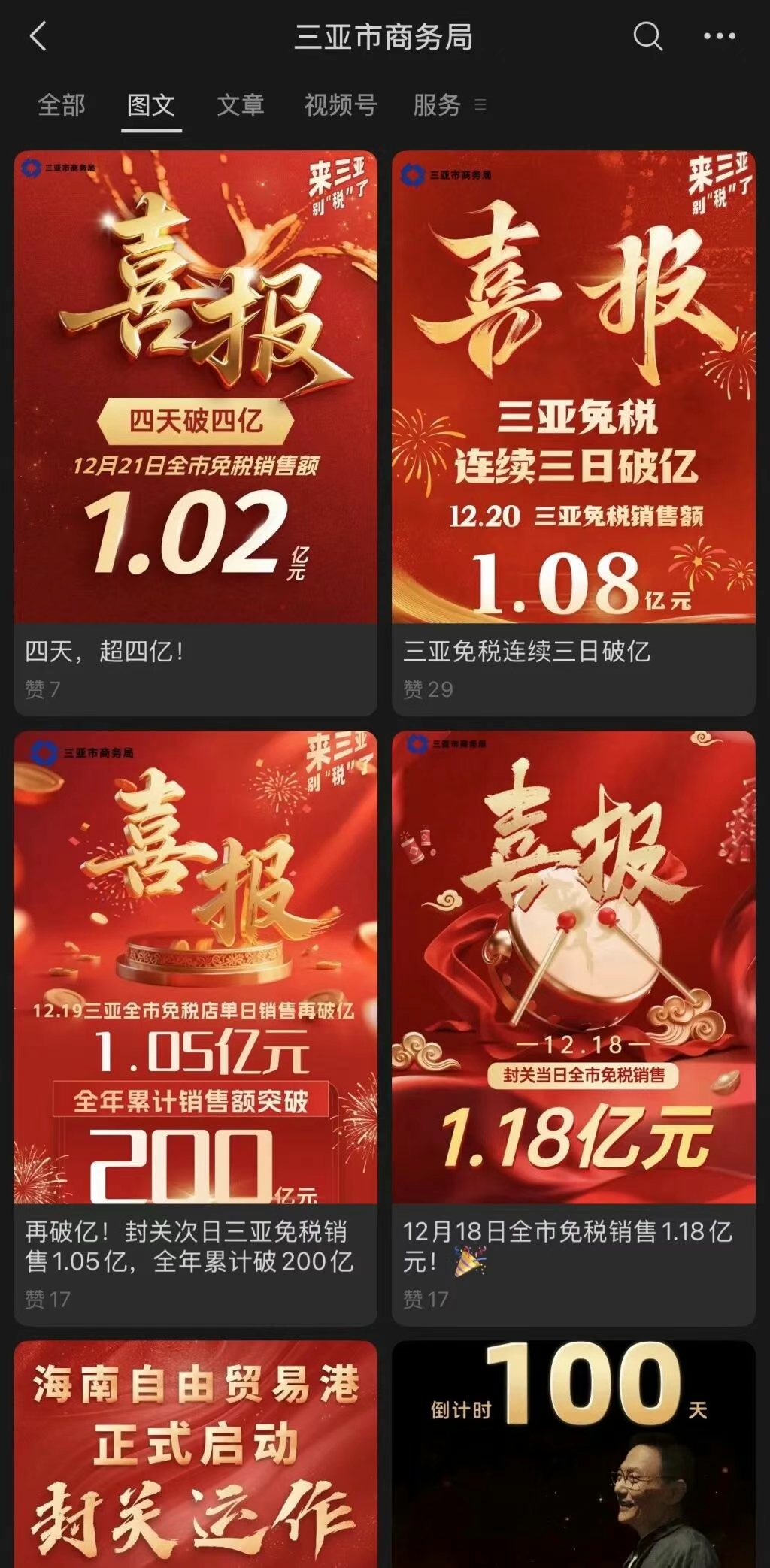
Core Viewpoint - The official launch of the Hainan Free Trade Port's full island closure operation on December 18 is expected to create significant policy advantages and institutional dividends for various industries, including the liquor industry, which is poised to leverage this opportunity for international expansion [1][4]. Group 1: Liquor Companies' Moves in Hainan - Major liquor companies such as Fenjiu, Wuliangye, and Langjiu have recently established operations in Hainan, indicating a trend of companies positioning themselves to capitalize on the new opportunities presented by the free trade port [4][5]. - The establishment of Fenjiu International Trade (Hainan) Co., Wuliangye's supply chain management company with a registered capital of 100 million yuan, and Langjiu's collaboration with Hainan Ecological Software Park exemplify proactive strategies by these companies [4][5]. - Other brands like Moutai and Luzhou Laojiao have also made significant investments in Hainan, with Moutai establishing a resort and Luzhou Laojiao setting up an international trade company [4][5]. Group 2: Supply Chain and Trade Dynamics - Hainan's closure policy is designed to enhance trade efficiency by allowing easier access for foreign goods and capital while maintaining regulatory controls for goods entering mainland China [1][5]. - The policy encourages the consolidation of processing activities within Hainan, reducing costs and improving logistics efficiency for liquor companies [5][6]. - The port of Yangpu is highlighted as a key hub for integrating scattered processing stages, which can significantly lower operational costs for liquor exporters [5][6]. Group 3: Hainan as a New Trade Hub - Hainan is positioned to potentially divert some trade flows from Singapore, which has historically been a significant hub for Chinese liquor exports [6][7]. - The region's capabilities are expected to evolve into a composite function that combines the roles of both Singapore and Hong Kong, facilitating not only trade but also production and brand showcasing for liquor companies [8][9]. - The zero-tariff policy in Hainan is anticipated to lower production costs for liquor companies, enhancing their competitiveness in international markets [8][9]. Group 4: Policy and Market Implications - The dual benefits of policy empowerment and innovative pathways provided by Hainan's closure are seen as advantageous for the liquor industry, simplifying processes and enhancing efficiency [9][10]. - The establishment of a trade network connecting Hainan, Southeast Asia, and the global market is expected to accelerate the penetration of Chinese liquor into ASEAN countries [9][10]. - The new institutional framework and shorter pathways for liquor exports from Hainan are viewed as revitalizing the long-standing topic of liquor internationalization [10].
白酒股,午后走高
Di Yi Cai Jing Zi Xun· 2025-12-25 05:59
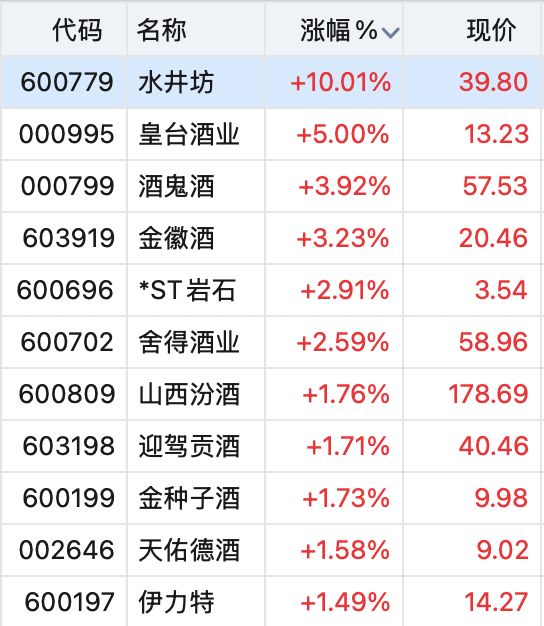
Core Viewpoint - The liquor stocks experienced a significant upward trend in the afternoon of December 25, with notable gains in several companies, indicating a positive market sentiment in the sector [1]. Group 1: Stock Performance - Shuijingfang (水井坊) reached the daily limit with a gain of 10.01%, trading at 39.80 [2] - Huangtai Liquor (皇台酒业) increased by 5.00%, with a current price of 13.23 [2] - Jiugui Liquor (酒鬼酒) rose by 3.92%, priced at 57.53 [2] - Jinhui Liquor (金徽酒) saw a 3.23% increase, trading at 20.46 [2] - Shede Liquor (舍得酒业) gained 2.59%, with a price of 58.96 [2]


观酒|湾区白酒半年图谱:名酒价格频频失守,行业陷深度博弈
Nan Fang Du Shi Bao· 2025-12-25 05:56
Core Insights - The Chinese liquor industry is undergoing significant transformation in 2025, facing challenges such as high channel inventory and weak terminal sales, while also experiencing new opportunities driven by changing policies, consumption patterns, and scenarios [2][3] - The market is seeing a shift towards product innovation targeting younger consumers, with low-alcohol beverages and fruit-flavored wines becoming popular among Generation Z [2] - The industry is also accelerating its international expansion, moving from product export to cultural export, as domestic growth slows [2] Price Trends - The retail prices of liquor in the Guangdong-Hong Kong-Macao Greater Bay Area have shown a clear trend of "overall decline, weak peak seasons, and increasing differentiation" [4][6] - Over half of the monitored products in the Bay Area have experienced price declines, including high-end brands like Moutai and Wuliangye, indicating a significant pressure on the price points [6][10] - The price of high-end products has collectively "cooled down," with many products in the 1,000 yuan price range facing substantial pressure, leading to a significant gap between listed and actual transaction prices [6][10] Regional Analysis - In Guangzhou, the liquor market has continued to show price declines and frequent fluctuations, reflecting a deepening adjustment trend [8][9] - Shenzhen's liquor prices have shown stability in offline channels, acting as a "price ballast," while online channels have seen significant price drops [12][15] - In Foshan, the price trends are characterized by a "two-tier" differentiation, with stable products maintaining their prices while others experience significant volatility [16][17] - Dongguan's liquor market has shown structural differentiation in price trends, with high-end products under pressure and mid-range products adopting flexible pricing strategies [19][21] Market Dynamics - The collective price adjustments in the Bay Area are driven by a combination of macroeconomic pressures, industry cycles, and channel transformations [22][23] - The current market pressure stems from a cooling demand for consumption, particularly in business and banquet settings, alongside a shift in consumer preferences [22] - The evolution of channels, particularly the rise of instant retail platforms, has increased price transparency and intensified competition among channels [23] Future Outlook - The market is expected to maintain a "low-price" trend in the short term, with the upcoming Spring Festival being a focal point for potential sales recovery [24] - However, significant price rebounds are unlikely until consumer confidence is restored and channel inventories are effectively reduced [24] - The industry is likely to see a shift from price wars to competition based on brand strength, product innovation, and refined channel management [24]
白酒股,午后走高
第一财经· 2025-12-25 05:53
Core Viewpoint - The article highlights a significant increase in the stock prices of various Chinese liquor companies, indicating a positive trend in the industry as of December 25. Group 1: Stock Performance - Water井坊 (600779) experienced a maximum increase of 10.01%, reaching a price of 39.80 [1][2] - 皇台酒业 (000995) saw a rise of 5.00%, with its current price at 13.23 [1][2] - 酒鬼酒 (000799) increased by 3.92%, now priced at 57.53 [1][2] - 金徽酒 (603919) rose by 3.23%, with a current price of 20.46 [1][2] - 舍得酒业 (600702) had a growth of 2.59%, reaching a price of 58.96 [1][2] - 山西汾酒 (600809) increased by 1.76%, now at 178.69 [1][2] - 迎驾贡酒 (603198) saw a rise of 1.71%, priced at 40.46 [1][2] - 金种子酒 (600199) increased by 1.73%, with a current price of 9.98 [1][2] - 天佑德酒 (002646) rose by 1.58%, now priced at 9.02 [1][2] - 伊力特 (600197) had a growth of 1.49%, reaching a price of 14.27 [1][2]
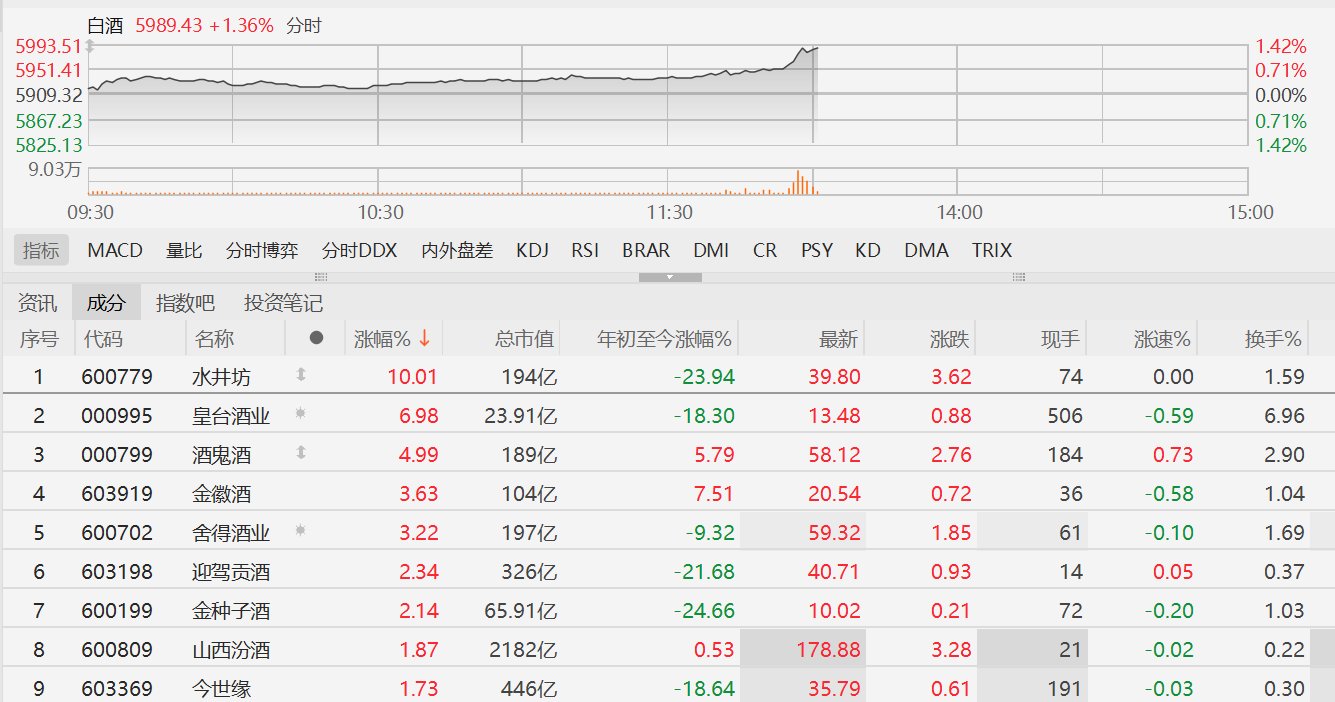
A股白酒股快速拉升,水井坊涨停
Ge Long Hui A P P· 2025-12-25 05:43
Group 1 - The A-share market saw a rapid increase in liquor stocks, with Shui Jing Fang hitting the daily limit, Huangtai Liquor rising over 6%, and Jiu Gui Jiu increasing nearly 5% [1] - Other notable performers included Jin Hui Jiu and She De Jiu Ye, both rising over 3% [1] Group 2 - The liquor index showed a gain of 1.36%, reaching 5989.43 points [2] - Shui Jing Fang had a significant increase of 10.01%, with a total market value of 194 billion [2] - Huangtai Liquor rose by 6.98%, with a market value of 23.91 billion [2] - Jiu Gui Jiu increased by 4.99%, with a market value of 189 million [2] - Jin Hui Jiu and She De Jiu Ye saw increases of 3.63% and 3.22%, respectively, with market values of 104 billion and 197 billion [2]