
CMS(600999)

Search documents
艾罗能源收警示函 去年上市超募11.8亿元招商证券保荐
Zhong Guo Jing Ji Wang· 2025-11-04 06:54
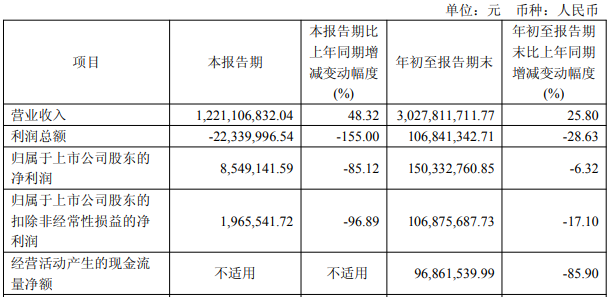
Core Viewpoint - Airo Energy (688717.SH) received a warning letter from the Zhejiang Securities Regulatory Bureau due to violations in fundraising management and disclosure practices [1][2][3]. Group 1: Violations in Fundraising Management - Airo Energy disclosed inaccurate progress on fundraising projects, specifically stating that the "Energy Storage Battery and Inverter Expansion Project" would be operational by June 2022, while it is actually set to start in December 2023 [2]. - The company failed to timely disclose changes in the implementation location of the "Smart Energy R&D Center" project, which was moved from Fuyang District to Xihu District in Hangzhou without proper notification [2]. - Airo Energy did not disclose a pre-litigation preservation situation regarding its Agricultural Bank fundraising account, which was frozen for 3.32 million yuan in September 2024 [2][3]. Group 2: Regulatory Actions - The actions of Airo Energy violated multiple regulations, including the "Guidelines for the Supervision of Fundraising Management and Use by Listed Companies" and the "Information Disclosure Management Measures" [3]. - Key executives, including the Chairman and General Manager Li Xinf, were found negligent in ensuring compliance with fundraising regulations and disclosure obligations [3]. Group 3: Financial Performance - In Q3 2025, Airo Energy reported revenue of 1.22 billion yuan, a year-on-year increase of 48.32%, but net profit dropped by 85.12% to 8.55 million yuan [5]. - For the first three quarters of 2025, the company achieved revenue of 3.03 billion yuan, up 25.80%, while net profit decreased by 6.32% to 150 million yuan [5]. - In 2024, Airo Energy's revenue was 3.07 billion yuan, down 31.30%, with net profit falling by 80.88% to 204 million yuan [6]. - In 2023, the company reported revenue of 4.47 billion yuan, a decline of 3.01%, and net profit of 1.07 billion yuan, down 6.12% [7][8].



一克千金!黄金还能涨吗?|2025招商证券“招财杯”ETF实盘大赛
Sou Hu Cai Jing· 2025-11-04 03:08
Core Viewpoint - The article discusses the ongoing trends in gold prices, emphasizing a long-term bullish outlook despite short-term fluctuations, driven by factors such as weakening dollar credit and global de-dollarization trends [2][3][10]. Group 1: Gold Price Trends - Gold prices have surged approximately 55.8% this year, with a notable 30% increase from late August to mid-October [2][3]. - The recent price corrections are attributed to the calming of risk events, including news of a potential ceasefire in Ukraine and improved U.S.-China relations [5][6]. - The long-term bullish trend in gold prices is supported by continuous purchases from global central banks and the weakening of dollar credit [3][4][10]. Group 2: Investment Strategies - Investors are advised to consider gold as part of their asset allocation, with suggestions to allocate around 15% of their portfolio to gold, as noted by Bridgewater's Dalio [5][16]. - For ordinary investors, gold-related ETFs and linked funds are recommended as practical investment vehicles due to their ease of access and liquidity [16][17]. - The article highlights that gold and equity assets typically have low correlation, making gold a favorable option during periods of declining risk appetite [16]. Group 3: Market Dynamics - The article notes that the current market environment differs significantly from the 2011-2015 period when gold prices fell due to U.S. economic recovery and tightening monetary policy [6][7]. - The ongoing de-dollarization trend and the current liquidity environment, characterized by a new round of interest rate cuts by the Federal Reserve, provide a supportive backdrop for gold prices [4][8][10]. - The article also mentions that the rise in gold ETF holdings in North America and other Western countries has contributed to the upward momentum in gold prices this year [11][12].
招商证券:白酒出清信号积极,底部渐显 布局强势龙头+早出清改善
智通财经网· 2025-11-04 03:04
Core Insights - The report from China Merchants Securities indicates that the liquor industry is experiencing significant revenue and profit declines, with Q3 2025 showing a decrease of 18% in revenue and 22% in profit, marking a challenging period for the industry [1][2] Industry Performance - In Q3 2025, the liquor industry reported revenues of 787 billion yuan, net profits of 280 billion yuan, and cash returns of 839 billion yuan, reflecting year-on-year declines of 18.4%, 22.2%, and 26.7% respectively [2] - The industry is entering a "corporate endurance period," with major players like Wuliangye leading the way in clearing inventory, indicating a deep adjustment phase for financial reports [2] - Excluding Moutai, the revenue, net profit, and cash returns for the liquor industry in Q3 2025 were 389 billion yuan, 88 billion yuan, and 402 billion yuan, showing declines of 31.5%, 48.0%, and 44.1% respectively [2] Company-Specific Analysis - High-end liquor brands are facing significant policy impacts, with Moutai showing slight revenue growth while Wuliangye is signaling positive inventory clearance [3] - The performance of mid-range liquor brands is mixed, with Fenjiu showing growth due to product expansion and resource acquisition, while others like Shui Jing Fang and Shede continue to adjust [3] - The overall profitability of liquor companies is under pressure, with many experiencing a decline in profit margins and increased costs due to historical issues [3] Holdings Analysis - The proportion of white liquor holdings continues to decline, with the concentration of holdings in Moutai and Wuliangye increasing, while holdings in Fenjiu and Luzhou Laojiao are decreasing [4] - In Q3 2025, the heavy holding proportion of the white liquor sector fell by 1.0 percentage points to 4.0%, marking a significant adjustment from previous highs [4] - The concentration of holdings in Moutai and Wuliangye has risen, while other brands like Fenjiu and Gujing have seen a decrease in holding concentration [4]


多家券商上调两融业务规模上限;泉果基金创始人王国斌病逝
Mei Ri Jing Ji Xin Wen· 2025-11-04 01:21
Group 1 - Multiple securities firms have raised the upper limit of margin financing and securities lending (two-in-one business) in response to a favorable capital market and active trading [1] - Huatai Securities announced an increase in its margin financing limit to three times its net capital, while China Merchants Securities raised its limit from 150 billion to 250 billion yuan [1] - This trend reflects confidence in the capital market outlook and is expected to enhance brokerage firms' income from capital intermediary services, positively impacting stock prices of leading firms like Huatai and China Merchants [1] Group 2 - Wang Guobin, the founder of Quanguo Fund, passed away on November 3, leading to a change in management with the chairman taking over as general manager [2] - Wang was a prominent figure in China's asset management industry, known for advocating value investing and having over 30 years of experience in the securities field [2] - His passing may raise concerns about corporate governance stability in the short term, while his investment philosophy could continue to influence the company's strategy and the industry's approach to value investing in the long term [2] Group 3 - In October, net inflows into stock ETFs exceeded 100 billion yuan, marking a continued strong interest in equity assets [3] - Securities and banking sector ETFs attracted significant inflows, while several growth-oriented ETFs experienced outflows, indicating a mixed market sentiment [3] - The ongoing popularity of ETFs is expected to inject incremental funds into the A-share market, although the divergence in fund flows suggests a trend towards balanced market styles [3] Group 4 - The total scale of bond ETFs has surpassed 700 billion yuan, marking the sixth "billion" milestone achieved this year [4] - Over 70% of the current scale increase is attributed to new products launched in 2025, with more than 60% of the 53 products being newly established this year [4] - The rapid growth of bond ETFs indicates a strong demand for stable asset allocation, which may lead to an expansion of institutional business in asset management and public funds [4]



多家券商上调两融业务规模上限;泉果基金创始人王国斌病逝 | 券商基金早参
Mei Ri Jing Ji Xin Wen· 2025-11-04 01:20
Group 1: Margin Financing Business Expansion - Multiple securities firms have raised the upper limit for margin financing business, reflecting confidence in the capital market outlook [1] - Huatai Securities announced an increase in its margin financing limit to three times its net capital, while China Merchants Securities raised its limit from 150 billion to 250 billion yuan [1] - This expansion is expected to enhance the income from capital intermediary services for leading firms like Huatai and China Merchants, positively impacting their stock prices [1] Group 2: Passing of Wang Guobin - Wang Guobin, the founder of Quanguo Fund, passed away on November 3, 2023, at the age of 57, leaving a significant impact on the asset management industry [2] - Wang was a pioneer of the "value investment" philosophy in China, with over 30 years of experience in the securities industry, and was known as an "entrepreneurial investor" [2] - His passing may lead to increased scrutiny on the governance stability of Quanguo Fund, while his investment philosophy is likely to continue influencing the company's strategy and the broader industry [2] Group 3: Stock ETF Inflows - In October, net inflows into stock ETFs exceeded 100 billion yuan, marking a continued strong interest in equity assets [3] - The inflows were primarily driven by securities and banking sector ETFs, while several growth-oriented ETFs experienced net outflows [3] - The trend indicates a growing willingness among investors to allocate funds through ETFs, potentially injecting structural vitality into the market [3] Group 4: Bond ETF Growth - The total scale of bond ETFs has surpassed 700 billion yuan, marking the sixth "billion" milestone achieved this year [4] - Over 70% of the current scale increase is attributed to new products launched in 2025, with more than 60% of the 53 products being newly established this year [4] - The significant growth in bond ETFs reflects a strong demand for stable asset allocation, which may lead to a diversion of funds from equity markets [4]
前10月33家券商分44.59亿承销保荐费 国泰海通夺第一
Zhong Guo Jing Ji Wang· 2025-11-03 23:19
Summary of Key Points Core Viewpoint - In the first ten months of 2025, a total of 87 companies were listed on the Shanghai Stock Exchange, Shenzhen Stock Exchange, and Beijing Stock Exchange, raising a total of 901.23 billion yuan in funds, indicating a robust capital market activity in China [1]. Group 1: Listing and Fundraising - A total of 87 companies were listed, with 29 on the main board, 29 on the ChiNext, 11 on the Sci-Tech Innovation Board, and 18 on the Beijing Stock Exchange [1]. - The total fundraising amount reached 901.23 billion yuan, with Huadian New Energy leading at 181.71 billion yuan [1]. - Other notable fundraisers included Xi'an Yicai and Zhongce Rubber, raising 46.36 billion yuan and 40.66 billion yuan respectively [1]. Group 2: Underwriting and Sponsorship Fees - 33 securities firms participated in the underwriting and sponsorship of the newly listed companies, earning a total of 44.59 billion yuan in fees [1]. - Guotai Junan ranked first in underwriting fees, earning 58.83 million yuan from sponsoring nine companies [1]. - CITIC Securities and CITIC Jianzhong followed in the ranking, earning 54.50 million yuan and 53.56 million yuan respectively [2]. Group 3: Detailed Underwriting Contributions - Guotai Junan sponsored nine companies, including Changjiang Nengke and United Power [1]. - CITIC Securities sponsored seven companies, including Xi'an Yicai and Ruili Kemi [2]. - CITIC Jianzhong sponsored seven companies, including Daosheng Tianhe and Zhongce Rubber [2]. Group 4: Overall Market Performance - The top five securities firms accounted for 50.77% of the total underwriting fees, amounting to 22.64 billion yuan [4]. - Other firms in the top ten included CICC, China Merchants Securities, and Shenwan Hongyuan, with fees ranging from 13.66 million yuan to 23.16 million yuan [4].



券商三季度末持股市值逾660亿元 重仓布局高端制造与科技赛道
Shang Hai Zheng Quan Bao· 2025-11-03 18:16
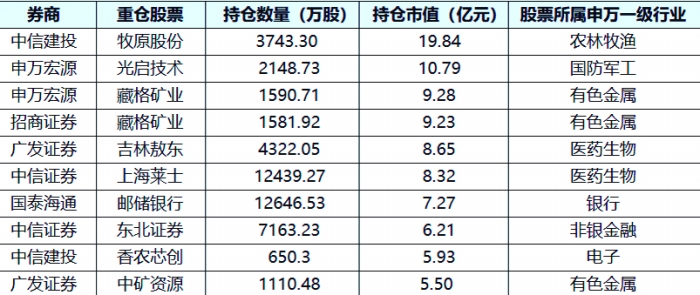
Core Insights - The report highlights that 44 brokerage firms have invested in 351 stocks, with a total holding value exceeding 66 billion yuan as of the end of Q3 [2][3] - High-end manufacturing and technology sectors are identified as popular investment directions for brokerages, reflecting a shift towards structural opportunities in the equity market [2][3] Brokerage Holdings Overview - The top 10 stocks held by brokerages by market value include Muyuan Foods, Guangqi Technology, and Cangge Mining, with holdings exceeding 1 billion yuan for several stocks [3][4] - The distribution of holdings indicates a strong focus on sectors such as machinery, pharmaceuticals, electronics, and basic chemicals, with the highest number of stocks in machinery equipment (35 stocks) and pharmaceuticals (28 stocks) [3][4] Trading Activity - Brokerages have entered 186 new stocks, with notable new positions including Postal Savings Bank and China Foreign Transport, each exceeding 30 million shares [4] - A total of 69 stocks saw increased holdings, particularly in the basic chemicals and transportation sectors, while 61 stocks were reduced, indicating a selective approach to portfolio management [5][4] Self-Operated Business Performance - Self-operated business remains the largest revenue contributor for brokerages, with a reported income of 186.857 billion yuan in the first three quarters, marking a 43.83% year-on-year increase [6][7] - Major brokerages like CITIC Securities and Guotai Junan reported significant growth in self-operated income, driven by a recovering equity market and strategic asset allocation [6][7] Market Trends and Analysis - Analysts note that the active trading environment and increased margin financing have positively impacted brokerage performance, with a significant rise in average daily trading volume [7] - The shift towards equity assets and the reduction in bond investments reflect a broader trend of rebalancing within the brokerage sector [7]



多家券商上调两融业务规模上限
Zheng Quan Ri Bao· 2025-11-03 15:53
Core Viewpoint - The active trading in the margin financing and securities lending (referred to as "two financing") market has led to significant growth in net interest income for listed brokerages, prompting many to raise their business scale limits to meet market demand [1][2][3]. Group 1: Business Growth and Market Demand - Several brokerages, including Huatai Securities and China Merchants Securities, have announced increases in their two financing business scale limits, with Huatai's limit set to three times its net capital and China Merchants increasing its limit from 150 billion to 250 billion [2][3]. - The two financing market has seen a substantial increase in balance, reaching 2.49 trillion yuan as of October 31, with a year-on-year growth of 33.34% [3][4]. - The number of new two financing accounts opened in September reached 205,400, marking a record high for the year [3]. Group 2: Revenue Growth for Brokerages - In the first three quarters of the year, 42 listed brokerages achieved a total net interest income of 33.906 billion yuan, reflecting a year-on-year increase of 54.52% [4]. - Among these brokerages, 30 reported a year-on-year increase in net interest income, with notable growth rates from Longcheng Securities (3126.77%) and Guotai Junan (232.31%) [4]. Group 3: Strategic Enhancements and Compliance - Brokerages are enhancing their service capabilities and market share in the two financing sector, with companies like Guoyuan Securities focusing on risk management and Southwest Securities leveraging financial technology to improve service efficiency [5]. - It is emphasized that brokerages must balance growth with compliance and safety, ensuring they meet regulatory requirements while expanding their two financing operations [5].
证券公司利用大模型技术构建财富业务创新应用体系研究
Zhong Guo Zheng Quan Bao· 2025-11-03 12:12
Core Insights - The securities industry is entering a deep transformation phase towards digital intelligence, with large model technology providing revolutionary opportunities for wealth management business [1][2] - The application of large models in the securities industry has transitioned from experimental stages to commercial implementation, driven by increasing wealth management demand and various transformation pressures [2][3] Industry Trends - Wealth management is shifting from generic financial sales to differentiated marketing focused on customer experience [4] - The integration of online and offline services is leading to a more connected operational model in wealth management [4] - The industry is moving towards intelligent and precise wealth management, utilizing big data for targeted customer identification and marketing [4] Challenges Faced - High customer acquisition costs, with online costs per effective account rising to 300-400 yuan, and some premium channels exceeding 1000 yuan [5] - Weak data governance, with only 1%-2% of IT investment allocated to data management, leading to issues of data inconsistency and quality [5] - Insufficient advisory capabilities, as wealth management transformation demands higher professional skills from advisors [5] - High service costs, with traditional models requiring advisors to serve nearly 3000 clients each, hindering personalized service [5] Opportunities from Large Models - Large model technology enhances efficiency through intelligent reports, content understanding, and customer service, improving service quality and operational efficiency [6] - Cost optimization is achieved via automation, intelligent recommendations, and precise marketing, reducing acquisition and service costs [6] - Capability enhancement through knowledge bases and reasoning chains addresses the professional skill gaps in advisory teams [6] Application Framework - The infrastructure layer includes computing and storage resources, with leading firms utilizing high-performance GPU clusters while smaller firms may share resources [8] - The model layer consists of general and finance-specific models, with a mixed architecture approach to balance specialization and cost [9] - The application technology layer connects models to business scenarios, utilizing RAG technology, prompt engineering, and intelligent agent technology [10] Implementation Path - The implementation of large model applications should follow a phased strategy: infrastructure development, core capability enhancement, and business scenario penetration [14] - Leading firms adopt a "self-research first, cooperation second" strategy, while smaller firms focus on rapid application of general model APIs [15] Recommendations for Development - Firms should choose appropriate technology paths based on their resources, with larger firms investing in self-research and smaller firms leveraging open-source models [17] - Focus on high-frequency, essential business scenarios for application, such as intelligent customer service and risk control [17] - Strengthening data governance is crucial to ensure data quality and compliance for large model applications [17] - Investment in training financial technology talent is necessary to support innovation in the sector [17]


招商证券:白酒加速出清 底部逐渐显现
智通财经网· 2025-11-03 09:01
Core Insights - The report from China Merchants Securities indicates a significant decline in the Chinese liquor industry for Q3 2025, with revenue, net profit, and cash returns dropping by 18.4%, 22.2%, and 26.7% respectively, compared to the previous year [1][2] - The industry is experiencing a deep adjustment phase, with leading companies like Wuliangye showing substantial declines, marking a challenging period for enterprises [1][2] Revenue and Profit Analysis - The liquor industry's revenue, net profit, and cash returns for Q3 2025 were reported at 787 billion, 280 billion, and 839 billion yuan respectively, reflecting a year-on-year decline of 18.4%, 22.2%, and 26.7% [1] - Excluding Moutai, the industry's revenue, net profit, and cash returns were 389 billion, 88 billion, and 402 billion yuan, showing a more severe decline of 31.5%, 48.0%, and 44.1% year-on-year [2] Company Performance - High-end liquor brands are facing significant policy impacts, with Moutai showing slight revenue growth while Wuliangye indicates a strong signal of adjustment [3] - Companies like Fenjiu are expanding their market presence, achieving revenue growth, while others like Water Well and Shede are still in the adjustment phase [3] Channel and Inventory Management - Companies are adopting inventory control measures, leading to a significant drop in revenue but allowing for the accumulation of inventory [4] - The overall profitability of liquor companies is under pressure, with many experiencing a decline in profit margins due to rising costs and historical issues [4] Investment Trends - The proportion of heavy holdings in the liquor sector has decreased, with a notable drop of 10 percentage points from its peak, indicating a cautious investment environment [5] - Moutai and Wuliangye have seen an increase in holding concentration, while other brands like Fenjiu and Laojiao have seen a decrease [5] Investment Recommendations - The report suggests that as inventory clears and prices stabilize, the stock prices of leading companies are expected to rebound, with a focus on strong brands like Shanxi Fenjiu and Guizhou Moutai [6] - Companies that have proactively adjusted and managed their historical burdens, such as Wuliangye and Luzhou Laojiao, are also recommended for investment [6][7]
