NJBK(601009)

Search documents
南银法巴消费金融增资至60亿元人民币
Jing Ji Guan Cha Wang· 2025-12-16 07:32
Group 1 - The core point of the article is that Nanyin FaBa Consumer Finance has increased its registered capital from 5.215 billion RMB to 6 billion RMB, representing an approximate increase of 15% [1] - The company was established in May 2015 and is legally represented by Zhang Weinian [1] - Shareholders of the company include Nanjing Bank, BNP Paribas, the International Finance Corporation, and BNP Paribas Personal Finance [1]

26家银行密集分红!总额超2600亿,工商银行居首,多家首次推出中期方案
Sou Hu Cai Jing· 2025-12-16 05:23
Core Viewpoint - As of December 15, 2025, 26 A-share listed banks have announced mid-term or quarterly dividend plans, with a total expected payout exceeding 260 billion yuan [1]. Group 1: Major Contributors - The six major state-owned banks are the main contributors to this dividend distribution, with Industrial and Commercial Bank of China leading at 50.396 billion yuan, followed by China Construction Bank at 48.605 billion yuan, Agricultural Bank of China at 41.823 billion yuan, Bank of China at 35.250 billion yuan, Postal Savings Bank of China at 14.771 billion yuan, and Bank of Communications at 13.811 billion yuan [3]. - The total cash dividend from these six major banks exceeds 200 billion yuan [3]. Group 2: Other Banks - Among joint-stock banks, both Industrial Bank and CITIC Bank are expected to distribute over 10 billion yuan in dividends, specifically 11.957 billion yuan and 10.461 billion yuan respectively [3]. - Everbright Bank and Minsheng Bank are also projected to exceed 5 billion yuan in dividends [3]. - Several regional small and medium-sized banks are actively participating in mid-term dividends, with Shanghai Bank, Nanjing Bank, Hangzhou Bank, Shanghai Rural Commercial Bank, and Ningbo Bank leading in dividend amounts [3]. - Notably, banks like Industrial Bank and Ningbo Bank are introducing mid-term dividend plans for the first time [3]. Group 3: Dividend Implementation - Several banks have specified the dates for dividend distribution, with Industrial and Agricultural Banks set to distribute cash dividends on December 15, 2025 [3]. - Bank of Communications has announced that it expects to distribute mid-term cash dividends to A-share shareholders on December 25, 2025 [3].





26家A股银行分红2600亿元
Shen Zhen Shang Bao· 2025-12-15 22:55
Group 1 - The core viewpoint of the articles highlights that A-share listed banks in China are distributing significant cash dividends, with the six major state-owned banks leading the way, collectively announcing a total cash dividend of 204.657 billion yuan for the mid-term [1][2] - By December 15, 2025, 26 A-share listed banks are expected to disclose mid-term or quarterly dividend plans, with total dividends projected to exceed 260 billion yuan, where the six major state-owned banks account for 78.7% of the total dividends [1][2] - The major state-owned banks, including Industrial and Commercial Bank of China, Agricultural Bank of China, and others, have maintained a dividend payout ratio of 30% or more of their net profit [2] Group 2 - The Industrial and Commercial Bank of China leads the dividend distribution with 50.396 billion yuan, followed by other major banks with significant amounts, indicating a strong trend in dividend payouts among these institutions [2] - In the joint-stock bank category, several banks, including Industrial Bank and China CITIC Bank, are also participating in dividend distributions, with some like Industrial Bank and Ningbo Bank introducing mid-term dividend plans for the first time [2] - The banking sector has shown strong performance in the A-share market, with the overall bank sector rising by 10.71% this year, and specific banks like Agricultural Bank of China seeing a remarkable increase of 48.88% in their stock prices [3]



守护“膝”望:南京银行上海分行金融活水赋能医疗科技企业稳健前行
2 1 Shi Ji Jing Ji Bao Dao· 2025-12-15 06:09
Core Viewpoint - The article emphasizes the rapid development of the medical technology industry in China, particularly in the orthopedic joint replacement sector, driven by innovation and financial support, showcasing the capabilities of companies like KuanYue Medical on a global stage [1][5]. Group 1: Company Overview - KuanYue Medical was founded in 2015 by Wang Junwen, who aimed to create a "Chinese Johnson & Johnson," with a unique strategy of "overseas R&D, Chinese manufacturing, and global sales" [2]. - The company has established an international R&D center led by top scientists, ensuring its technology aligns with global standards [7]. Group 2: Market Potential - The orthopedic joint replacement market is undergoing structural changes, with increasing disposable income and health awareness leading to a shift in patient attitudes from "having to undergo surgery" to "choosing to improve quality of life" [3]. - The penetration rate of joint replacement surgeries in China is approximately 0.01%, which is only one-tenth of that in the U.S., indicating significant growth potential [4]. Group 3: Competitive Advantage - KuanYue Medical has set a high internal testing standard of 30 million cycles for its artificial joints, far exceeding the FDA's requirement of 5 million cycles, demonstrating its commitment to product durability and quality [6][7]. - The company has successfully penetrated 15 global markets and is the first domestic company to achieve actual implantations in the U.S., with international sales accounting for over 60% of its revenue [5]. Group 4: Financial Empowerment - KuanYue Medical's growth has been supported by strategic investments from various financial institutions, including a significant partnership with Nanjing Bank, which has evolved from a small credit line to a comprehensive financial support system [8]. - The collaboration with Nanjing Bank includes innovative financing models such as "loans + equity rights," enhancing the company's financial strategy as it aims for a Hong Kong listing [8][9]. Group 5: Future Outlook - The aging population in China and the substantial gap in joint replacement penetration compared to the U.S. present a promising growth trajectory for KuanYue Medical [9]. - Nanjing Bank is positioned to transition from a mere funding provider to a deep strategic partner, supporting KuanYue Medical throughout its industrial and capital cycles [9].
总数突破2600亿,26家上市银行官宣分红方案,多家银行首次分红
Guan Cha Zhe Wang· 2025-12-15 03:47
Group 1 - A total of 26 A-share listed banks have announced interim or quarterly dividend plans, exceeding the 24 banks that did so in 2024 [1] - The total expected dividend amount from these banks is over 260 billion yuan, with state-owned banks accounting for approximately 70% of this total [1] - Industrial and Commercial Bank of China leads with a proposed dividend of 50.396 billion yuan, followed by China Construction Bank, Agricultural Bank of China, Bank of China, Postal Savings Bank, and Bank of Communications with dividends of 48.605 billion yuan, 41.823 billion yuan, 35.250 billion yuan, 14.771 billion yuan, and 13.811 billion yuan respectively [1] Group 2 - Several banks, including Industrial Bank and Ningbo Bank, are announcing dividend plans for the first time [2] - Industrial Bank plans to distribute a cash dividend of 5.65 yuan per 10 shares, totaling 11.957 billion yuan, which represents 30.02% of its net profit attributable to ordinary shareholders for the first half of 2025 [2]

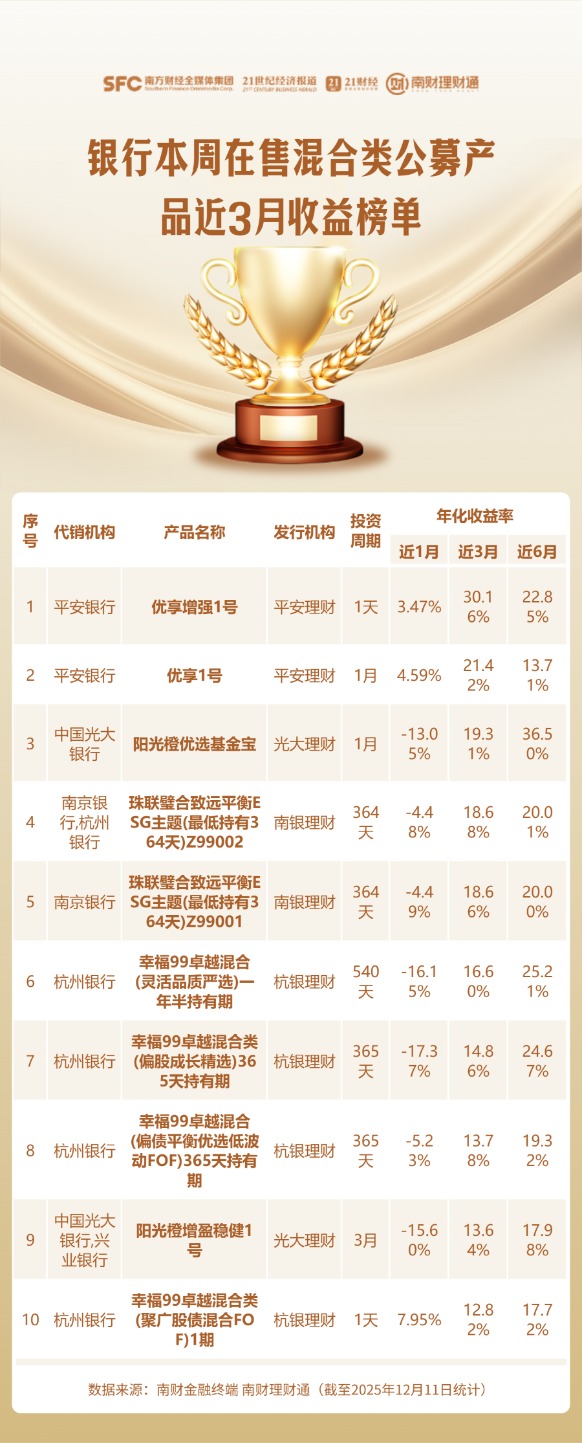
本周在售多只高收益混合类理财近1个月收益率转负
2 1 Shi Ji Jing Ji Bao Dao· 2025-12-15 01:05
Core Insights - The report focuses on mixed-asset products issued by wealth management companies, highlighting superior-performing products available for investors through distribution channels [1] - A ranking of products is provided based on their annualized performance over the last month, three months, and six months, reflecting their multidimensional performance amid recent market fluctuations [1] Group 1: Product Performance - The ranking showcases annualized returns for products over different time frames, with a specific emphasis on the three-month annualized yield for sorting [1] - The report includes a list of 28 distribution institutions, such as major banks like Industrial and Commercial Bank of China, Bank of China, and Agricultural Bank of China, among others [1] Group 2: Product Availability - The assessment of the "on-sale" status of wealth management products is based on their investment cycle projections, but actual availability may vary due to factors like sold-out quotas or differences in product listings for different clients [1] - Investors are advised to refer to the actual displays on the distribution bank's app for the most accurate product availability [1]


公募销售新规落地,政银绑定深化下银行扩表动能有望复苏
Western Securities· 2025-12-14 12:55
Investment Rating - The report indicates a positive outlook for the insurance sector, recommending specific companies such as China Pacific Insurance, China Ping An, China Life (H), and China Taiping, while also recommending New China Life Insurance [4][17]. Core Insights - The financial industry experienced a mixed performance, with the non-bank financial index rising by 0.81%, outperforming the CSI 300 index by 0.89 percentage points. The insurance sector showed a notable increase of 2.36%, while the banking sector declined by 1.77% [2][11]. - The central economic work conference emphasized a proactive fiscal policy, which is expected to benefit the insurance sector by increasing infrastructure asset supply and improving credit risk perceptions [14][15]. - The report highlights the potential for valuation recovery in the brokerage sector, driven by regulatory changes that align public fund interests with long-term investor returns [18][19]. Summary by Sections 1. Weekly Performance and Sector Insights - The non-bank financial index rose by 0.81%, with the insurance sector outperforming the CSI 300 index by 2.44 percentage points [2][11]. - The banking sector underperformed, with a decline of 1.77%, attributed to macroeconomic policy expectations [3][21]. 2. Insurance Sector Data Tracking - The insurance sector's premium income showed steady growth, with life insurance and property insurance premiums increasing by 9.6% and 4.0% year-on-year, respectively [17][26]. - The report notes that the 10-year government bond yield decreased to 1.84%, which is favorable for the insurance sector's investment strategies [31]. 3. Brokerage Sector Data Tracking - The brokerage sector's PB valuation stands at 1.37x, indicating potential for valuation recovery as earnings improve [19][42]. - Regulatory changes in public fund sales are expected to enhance the industry's focus on long-term investor interests [18][19]. 4. Banking Sector Data Tracking - The banking sector's PB valuation is at 0.54x, suggesting it remains undervalued [21][25]. - The central economic work conference's focus on domestic demand and flexible monetary policy is expected to support the banking sector's growth [22][23].




银行角度看11月社融:金融总量增长平稳,结构分化延续
ZHONGTAI SECURITIES· 2025-12-14 12:10
Investment Rating - The industry investment rating is "Overweight (Maintain)" [2] Core Viewpoints - The report indicates that the total social financing (社融) in November increased by 2.49 trillion yuan, which is 159.7 billion yuan more than the same period last year, exceeding the consensus expectation of 2.02 trillion yuan [5][8] - The cumulative social financing for the first eleven months shows a year-on-year growth of 8.5%, maintaining the same growth rate as in October [5][8] - The report highlights a structural differentiation in financing, with trust loans, bond financing, and unendorsed bank acceptance bills showing significant year-on-year increases, while credit and government bonds experienced declines [5][9] Summary by Sections Social Financing Situation - In November, social financing increased by 2.49 trillion yuan, with a year-on-year increase of 159.7 billion yuan, surpassing expectations [5][8] - The cumulative social financing for the first eleven months shows an 8.5% year-on-year increase, consistent with October's growth rate [5][8] Credit Situation - The report notes that the credit supply is lower than in previous years, with November's new RMB loans amounting to 405.3 billion yuan, which is 116.3 billion yuan less than the same month last year [5][12] - The credit balance grew by 6.4% year-on-year, with a slight decline in growth rate compared to the previous month [12] Liquidity and Deposit Situation - The report indicates that M1 growth has slowed, while M2 and M1's differential has slightly expanded [19] - In November, RMB deposits increased by 1.4 trillion yuan, which is 760 billion yuan less than the same period last year, with a year-on-year growth rate of 7.7% [21] Investment Recommendations - The report suggests a shift in the investment logic for bank stocks from "pro-cyclical" to "weak-cyclical," indicating that during periods of economic stagnation, high dividend yields from bank stocks will remain attractive [24] - Two main investment lines are recommended: regional banks with strong certainty and large banks with high dividend yields [24]

融资再创新高,把握优质金融股
HTSC· 2025-12-14 12:00
Investment Rating - The report maintains an "Overweight" rating for the securities and banking sectors, while suggesting a cautious approach towards the insurance sector [9]. Core Insights - The report highlights a recovery in trading activity, with stock trading volume exceeding 2 trillion yuan over two trading days, and financing balances reaching a new high of 2.49 trillion yuan [1][12]. - The Central Economic Work Conference reiterated a proactive fiscal policy and moderately loose monetary policy stance, emphasizing the need for continued deepening of capital market reforms [1][23]. - The report expresses optimism regarding the performance of insurance products during the "opening red" period, although it notes that this is not the primary driver of valuation [1][46]. Summary by Sections Investment Opportunities - The report identifies investment opportunities in the following order: securities > banking > insurance [1][12]. - The trading activity has rebounded, with significant increases in stock transaction volumes and financing balances [1][12]. Sub-industry Perspectives 1. **Securities**: The report notes a high level of trading activity and a recovery in financing balances, suggesting a favorable environment for brokerage firms [2][13]. 2. **Banking**: The report indicates that the banking sector is seeing improved cost-effectiveness and suggests focusing on high-quality banks for structural opportunities [2][23]. 3. **Insurance**: The report advises caution due to uncertainties in market liquidity and sector rotation, recommending a focus on stable combinations [2][46]. Key Companies and Dynamics - **Securities**: Recommended companies include CITIC Securities, Guotai Junan, and GF Securities [3][47]. - **Banking**: Suggested quality stocks include Nanjing Bank, Chengdu Bank, and Shanghai Bank [3][47]. - **Insurance**: The report recommends focusing on stable companies such as AIA, Ping An, and China Pacific Insurance [46].


A股上市银行密集派发中期分红,总额超2600亿元引关注
Huan Qiu Wang· 2025-12-14 02:53
Group 1 - The core viewpoint of the article highlights that as of December 13, 26 A-share listed banks have disclosed their mid-term or quarterly dividend plans for 2025, surpassing the 24 banks that did so in the same period of 2024, with total dividends expected to exceed 260 billion yuan [1][3] - The banks disclosing dividend plans include 6 large state-owned banks, 6 joint-stock banks, and 14 small and medium-sized banks, with the six major state-owned banks expected to contribute over 200 billion yuan in cash dividends [3] - Industrial and Commercial Bank of China leads with an estimated dividend of approximately 50.4 billion yuan, followed by China Construction Bank, Agricultural Bank of China, Bank of China, Postal Savings Bank of China, and Bank of Communications [3] Group 2 - Joint-stock banks such as Industrial Bank and CITIC Bank are expected to have mid-term dividends exceeding 10 billion yuan, while China Everbright Bank and Minsheng Bank are projected to exceed 5 billion yuan [3] - Some small and medium-sized banks, like Shanghai Bank and Nanjing Bank, also show significant dividend amounts, with several banks like Industrial Bank and Ningbo Bank introducing mid-term dividend plans for the first time [3] - The increase in dividend frequency among commercial banks is a response to the new "National Nine Articles" aimed at promoting multiple dividends per year for listed companies, enhancing the connection between company profits and investor returns [3] Group 3 - More frequent dividends can directly enhance shareholder satisfaction, allowing investors to share in the banks' operational success in a timely manner [4] - Stable cash returns align well with the investment needs of long-term funds such as social security funds, pension funds, and insurance capital, helping to attract these funds for long-term holding [4] - The positioning of banks as dividend-oriented can create a virtuous cycle of attracting long-term capital, enhancing stock price stability, and reducing abnormal price fluctuations caused by short-term speculation [4]