
Longi(601012)

Search documents
研判2025!中国光伏检测设备行业相关政策、发展现状、企业分析及未来前景展望:光伏产业供过于求,导致行业内企业业绩短期承压[图]
Chan Ye Xin Xi Wang· 2025-12-26 01:17
Core Viewpoint - The photovoltaic testing equipment industry is experiencing rapid growth driven by the expansion of photovoltaic cell and module production capacity, leading to increased demand for testing equipment and higher quality standards in production processes [1][3][6]. Industry Overview - Photovoltaic testing equipment is essential for assessing the performance, quality, safety, and reliability of photovoltaic components and systems, playing a crucial role in the development of the photovoltaic industry [3][4]. - The market size of China's photovoltaic testing equipment industry is projected to reach 2.101 billion yuan in 2024, representing a year-on-year increase of 4.9% [1][7]. Industry Policies - Recent government policies have been implemented to promote the development of the photovoltaic industry, including guidelines for updating and replacing equipment to improve efficiency standards [4][6]. - The 2024-2025 energy conservation and carbon reduction action plan emphasizes the construction of large-scale photovoltaic bases in desert areas, which will further drive the demand for testing equipment [4][6]. Market Dynamics - The cumulative installed capacity of photovoltaic systems in China increased from 204.2 GW in 2019 to 886.66 GW in 2024, with new installations rising from 30.1 GW to 277.17 GW during the same period [6]. - The rapid growth in installed capacity is expected to lead to increased demand for testing equipment to ensure quality control and operational efficiency [6][10]. Competitive Landscape - The photovoltaic testing equipment market is dominated by a few large manufacturers from Europe, the United States, and Japan, while domestic companies in China are rapidly improving their technology and quality [8][9]. - Key players in the Chinese market include Shanghai Optoelectronics Technology Co., Ltd., Shenzhen Huashengchang Technology Co., Ltd., and others, with varying performance and revenue trends [8][9]. Development Trends - The industry is moving towards greater automation and intelligence in testing processes, integrating visual defect detection systems to enhance production efficiency and reduce labor costs [10][11]. - As the focus shifts from quantity to quality, there is an increasing demand for high-performance testing equipment, prompting continuous technological innovation within the industry [11]. - Global expansion is accelerating, with Chinese companies establishing production bases in Southeast Asia and the Middle East to meet international market demands and comply with global testing standards [12].



上游材料价格上升 光伏组件厂商相继上调组件报价
2 1 Shi Ji Jing Ji Bao Dao· 2025-12-26 00:06
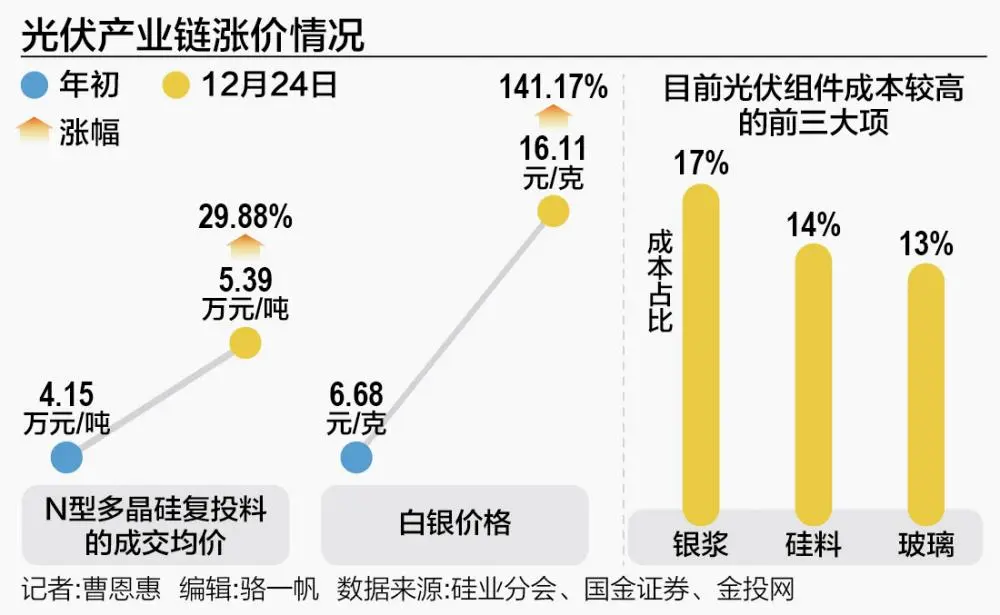
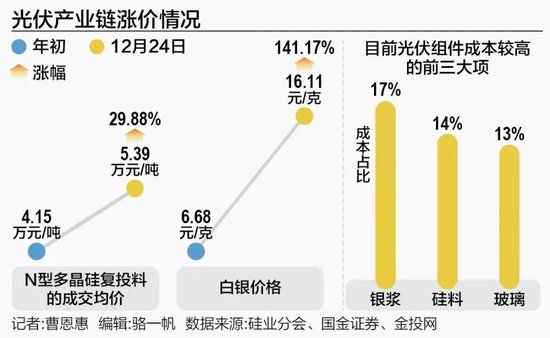
Core Viewpoint - The recent price increase of photovoltaic (PV) modules is primarily driven by rising upstream material costs, particularly silver paste, which has seen significant price hikes due to surging silver prices [1][4]. Group 1: Price Increases and Market Dynamics - Major PV manufacturers like Longi Green Energy and JinkoSolar have raised module prices by 0.02 to 0.05 yuan per watt, citing increased costs of upstream materials [1]. - Silver futures and spot prices have reached historical highs, with increases of over 130% and 150% respectively this year [1]. - Despite the price increases in upstream materials, the price of PV modules has only risen by less than 2% this year, lagging behind other components like silicon wafers and battery cells, which have seen increases of over 19% and 15% respectively [4][6]. Group 2: Cost Structure Changes - The cost structure of PV modules has shifted, with silver paste now accounting for 17% of the total cost, surpassing silicon materials, which have decreased in cost share due to falling prices [3]. - The average transaction price of N-type multi-crystalline silicon has risen from 41,500 yuan/ton at the beginning of the year to 53,900 yuan/ton by December 24, marking a 29.88% increase [4]. Group 3: Investment Returns and Market Sentiment - The internal rate of return (IRR) for PV projects has been negatively impacted by declining feed-in tariffs, with current IRR expectations for domestic projects ranging from 6% to 7%, down from previous standards of 7% to 7.5% [5][6]. - There is a strong correlation between module prices and IRR, suggesting that rising module prices could deter investment in new installations [6]. Group 4: Future Outlook and Demand - The demand for PV modules is currently limited, and expectations for rapid market growth are diminishing, with the industry facing a potential inflection point in demand growth [8]. - The National Energy Administration reported that from January to October, China added 252.87 GW of new PV capacity, but the market is expected to stabilize rather than experience rapid growth in the future [8].

白银狂飙141%,硅料大涨,光伏组件想涨价却涨不动
21世纪经济报道· 2025-12-25 23:34
Core Viewpoint - The recent price increase of photovoltaic (PV) modules is primarily driven by rising upstream material costs, particularly silver paste, which has seen significant price hikes due to the surge in silver prices [1][5][6]. Group 1: Price Increases and Cost Structure - Major PV module manufacturers, including Longi Green Energy and JinkoSolar, have raised their module prices by 0.02 to 0.05 yuan per watt due to increased costs of upstream materials [1]. - Silver paste has become the largest cost component in PV modules, accounting for 17% of the total cost, followed by silicon materials at 14% and glass at 13% [5]. - The average price of N-type multicrystalline silicon has risen from 41,500 yuan/ton at the beginning of the year to 53,900 yuan/ton by December 24, marking a 29.88% increase [6]. - The spot price of silver has increased from 6.68 yuan/gram to 16.11 yuan/gram, reflecting a 141.17% rise [6]. Group 2: Market Dynamics and Investment Returns - The price increase of upstream materials has not effectively translated to module prices due to concerns over the internal rate of return (IRR) for downstream solar power plant operators, which has been negatively impacted by recent policy changes [6][7]. - The IRR for domestic PV projects has decreased to a range of 6% to 7%, down from previous standards of 7% to 7.5% [6][7]. - There is a strong correlation between module prices and the IRR for solar power plants, indicating that any price increase in modules could dampen installation demand [7]. Group 3: Future Price Expectations and Market Demand - Industry experts suggest that module prices need to reach at least 0.8 yuan/W to ensure profitability for integrated module companies, with some estimates suggesting a target range of 0.88 to 0.99 yuan/W [9]. - The current average price for N-type TOPCon modules is 0.698 yuan/W, with a slight increase of 0.7% noted recently [9]. - Despite the desire for price increases, the limited market demand poses challenges for driving module prices higher in the short term [10]. - The newly released data indicates that China's newly installed PV capacity reached 252.87 GW from January to October, but the growth rate is expected to slow down, leading to uncertainty in future demand [10].

白银狂飙141%,硅料大涨,光伏组件想涨价却涨不动
Xin Lang Cai Jing· 2025-12-25 23:31
Core Viewpoint - The recent price increase of photovoltaic (PV) modules is primarily driven by rising upstream material costs, particularly silver paste, which has seen significant price hikes due to soaring silver prices [1][3][4]. Group 1: Price Increases and Market Dynamics - Major PV manufacturers like Longi Green Energy and JinkoSolar have raised module prices by 0.02 to 0.05 yuan per watt due to increased costs of raw materials [1][3]. - Silver futures and spot prices have surged, with increases exceeding 130% and 150% respectively this year [1][3]. - The price increase of PV modules has lagged behind other components in the supply chain, with module prices rising less than 2% compared to significant increases in silicon wafers and battery cells [4][12]. Group 2: Cost Structure Changes - The cost structure of PV modules has shifted, with silver paste now accounting for 17% of the total cost, surpassing silicon materials which have decreased in cost share [11][12]. - The average transaction price of N-type multi-crystalline silicon has risen from 41,500 yuan per ton at the beginning of the year to 53,900 yuan per ton by December 24, marking a 29.88% increase [12]. - The price of silver has increased from 6.68 yuan per gram to 16.11 yuan per gram, reflecting a 141.17% rise [12]. Group 3: Investment Returns and Market Sentiment - The internal rate of return (IRR) for PV projects has been negatively impacted by declining electricity prices, with current IRR estimates for domestic projects ranging from 6% to 7% [4][13]. - There is a strong correlation between module prices and the IRR for solar power plants, suggesting that rising module prices could deter investment due to lower expected returns [5][13]. - Industry experts express skepticism about the sustainability of the recent price increases, questioning whether they can be maintained in the face of limited market demand [6][14]. Group 4: Future Market Outlook - The China Photovoltaic Industry Association has not provided forecasts for new installed capacity for 2026, indicating increased uncertainty regarding future demand [8][16]. - From January to October, China's newly installed PV capacity reached 252.87 GW, attributed to a surge in installations earlier in the year [8][16]. - The global PV market is expected to experience a slowdown in growth, with future demand projected to stabilize rather than increase rapidly [9][16].
硅片集体涨价12%,上游硅料驱动行业反转,龙头率先响应
Xuan Gu Bao· 2025-12-25 23:18
Group 1 - Major silicon wafer companies have significantly raised prices, with 183N wafers priced at 1.4 yuan/piece, 210RN at 1.5 yuan/piece, and 210N at 1.7 yuan/piece, averaging a 12% increase [1] - The price increase is primarily driven by substantial rises in upstream silicon material costs, indicating a potential recovery in profitability across the industry [1] - The establishment of a new company focused on multi-crystalline silicon capacity integration and mergers, backed by leading silicon material firms, aims to promote technological upgrades and optimize production capacity and costs [1] Group 2 - China Galaxy Securities highlights that the photovoltaic industry, as a key sector for "anti-involution," may see accelerated supply clearing due to policy support and technological advancements, with a potential industry turnaround by 2026 [2] - Guohai Securities notes that the newly formed silicon material storage platform is expected to enhance capital investment and establish reasonable pricing for multi-crystalline silicon, contributing to ongoing supply-side reforms and improved industry conditions [2] - The silicon material segment is anticipated to be the primary beneficiary of price increases, leading to early profitability improvements, while the battery and module sectors will gradually recover as price structures stabilize [2] Group 3 - Longi Green Energy, a leading company in the domestic photovoltaic industry, has raised silicon wafer prices in line with industry trends, leveraging its core advantages in high-efficiency battery technology [3] - JA Solar Technology operates as an integrated enterprise in the photovoltaic sector, focusing on the research, development, production, and sales of silicon wafers, batteries, and modules, as well as the development and operation of solar power plants [3]
沪银涨超5%创新高;绍兴地铁撞击事故调查报告发布;京东年终奖震惊“打工人”!从19薪到25薪,最高“上不封顶”丨每经早参
Mei Ri Jing Ji Xin Wen· 2025-12-25 23:09
Group 1 - The price of silver in Shanghai rose by 5.50%, reaching a historical high of 18,131 RMB per kilogram [4] - JD.com announced its year-end bonus plan for 2025, with departments upgraded to 19 salaries offering up to 22 salaries for top performers, and those upgraded to 20 salaries offering up to 24 salaries [25] - JD.com's average salary for the procurement and sales department is expected to reach 25 salaries this year, with a target of 26 salaries in 2026 [25] Group 2 - The Egyptian central bank decided to lower the benchmark interest rate by 100 basis points, bringing the deposit rate down to 20% and the loan rate to 21% [4] - The Chinese Ministry of Commerce expressed strong opposition to the U.S. imposing additional tariffs on Chinese semiconductor products, stating that it does not recognize the conclusions of the U.S. 301 investigation [6] - The Ministry of Commerce also responded to questions regarding TikTok's establishment of a joint venture in the U.S., emphasizing the need for solutions that comply with Chinese laws and regulations [5] Group 3 - The National Defense Ministry of China stated that it will increase pressure in response to provocations from Taiwan independence advocates, emphasizing the necessity of military preparedness [8] - The Chinese government announced an increase in the compensation and living allowance standards for certain retired military personnel and other beneficiaries starting from August 1, 2025 [9] - The National Tobacco Monopoly Administration is seeking public opinion on a draft notice to enforce restrictive policies on the e-cigarette industry [7] Group 4 - Longi Green Energy confirmed a price increase for silicon wafers, with average increases reaching 12% [20] - Xiaomi announced the price of its new flagship model, the Xiaomi 17 Ultra, starting at 6,999 RMB, reflecting a 500 RMB increase from the previous model [21] - Deep Blue Automotive completed a C-round financing of 6.122 billion RMB, aimed at enhancing its competitiveness in the new energy vehicle sector [26]




沪银涨超5%创新高!这款白银基金限购100元;952名涉电诈嫌疑人被押解回国;绍兴地铁撞击事故调查报告发布;埃及降息100基点丨每经早参
Mei Ri Jing Ji Xin Wen· 2025-12-25 22:09
因圣诞节假期,欧美等主要市场周四休市。 每经编辑|陈鹏程 王晓波 V 日本11月失业率公布 2 荣耀WIN系列将于12月26日正式发布 3 星宸科技2025开发者大会暨产品发布会将于1 月26日举办 4 北京市机器人产业协会成立大会将于12月26E 召开 5 国家发改委12月26日将举行新闻发布会,介绍 国家创业投资引导基金有关工作 1 隔夜市场 沪银收涨5.50%,报18131元人民币/公斤,创历史新高。 当地时间25日,埃及央行在当天召开的货币政策委员会会议上决定,将基准利率下调100个基点。此次降息后,存款利率降至20%,贷款利率降至21%。此 次降息,是埃及央行2025年内的第五次降息。 2 商务部回应TikTok将在美成立合资公司 商务部新闻发言人何咏前12月25日在回答关于TikTok将在美成立合资公司的有关提问时说,中国政府希望企业达成符合中国法律法规、利益平衡的解决方 案。 商务部:坚决反对美对华半导体产品加征301关税 商务部新闻发言人何咏前25日在回答关于美宣布对部分中国半导体产品加征301关税的有关提问时说,中方注意到有关情况,已通过中美经贸磋商机制向美 方提出严正交涉。中方不认同美方3 ...

AI攻坚“下一站”:京东方、隆基与国盾量子的深度答卷
2 1 Shi Ji Jing Ji Bao Dao· 2025-12-25 13:44
Core Insights - The emergence of domestic AI models like DeepSeek has led to a global reassessment of China's AI capabilities and the value of its technological assets, making AI and digitalization essential for future competitiveness [1] - The integration of AI into various industries is redefining the competitive landscape, with companies like LONGi Green Energy, Guodian Quantum, and BOE leading the way in smart manufacturing, quantum technology, and IoT innovation [1] Group 1: AI Integration in Manufacturing - LONGi Green Energy is embedding AI throughout its manufacturing processes, establishing benchmarks for efficiency and quality, and utilizing AI for process optimization, quality prediction, and accelerated R&D [7][8] - BOE is transitioning from a display leader to an IoT innovation enterprise, leveraging AI across its entire business model, including manufacturing, product development, and operations [2][4] - The concept of the "AI factory" introduced by BOE emphasizes a fully AI-native approach to production, enhancing product intelligence and operational efficiency [3][5] Group 2: Product Innovation and Development - AI is transforming BOE's product development by introducing new production methods and tools, improving material research, simulation design, and process optimization [4] - The company has launched the "BOE Blue Whale Display Model" to enable intelligent upgrades across the industry chain, focusing on quality, power consumption, and user interaction [5] Group 3: Quantum Technology and Security - Guodian Quantum is positioning itself as a leader in quantum communication, expanding its applications from national security to various industries, thereby enhancing digital trust and security [9][10] - The company is actively involved in building a nationwide quantum communication network, which aims to provide advanced security for data transmission in critical sectors like government, finance, and energy [11]


7家组件厂齐涨2-6分!未来组件价格大概率还将继续上涨
Xin Lang Cai Jing· 2025-12-25 13:34
Group 1 - The core viewpoint of the article is that the recent surge in photovoltaic component prices is both inevitable and a result of rising costs in the supply chain, particularly due to the increase in silver prices [8] - Major manufacturers such as Longi and JA Solar have initiated price increases of 2-4 cents, followed by Trina Solar raising prices by 5-6 cents, Tongwei by 3-4 cents, and others, leading to a general increase in component prices to 0.70 yuan/W or higher [2] - The price increase has created tension in the downstream solar power station sector, which is struggling to accept the higher costs due to declining profitability from the implementation of policy 136 [2][6] Group 2 - Many smaller component manufacturers are hesitant to raise prices due to fears of contract cancellations, as evidenced by reports of contracts being voided shortly after agreements were made [3][4] - The primary reason given by component manufacturers for the price hikes is the soaring cost of silver paste, which has become the largest cost component in solar modules, accounting for 17% of total costs [6][7] - The current situation presents a dilemma where rising production costs compel manufacturers to increase prices, while reduced profitability for solar power stations makes it difficult for investors to accept these price hikes [7]


隆基绿能:确有上调硅片报价,与网传幅度一致
Xin Lang Cai Jing· 2025-12-25 12:29
据市场消息,12月25日头部硅片企业联合大幅上调报价,其中183N硅片报价1.4元/片、210RN报价1.5 元/片、210N报价1.7元/片,平均涨幅达到12%。隆基绿能相关负责人表示,当日确有上调报价,与网传 幅度一致。(上证报) ...