CSEC,China Shenhua(601088)

Search documents
中国神华累派现4805亿分红率62% 顶住煤电跌价冲击前九月赚391亿
Chang Jiang Shang Bao· 2025-11-04 00:08
Core Viewpoint - China Shenhua, known as the "Dividend King," is set to distribute approximately 195 billion yuan in cash dividends to shareholders, representing 79% of its mid-term net profit for 2025 [2][4]. Dividend Distribution - The company will distribute a cash dividend of 0.98 yuan per share, totaling around 194.71 billion yuan, with A-shares receiving approximately 161.61 billion yuan [4][5]. - The dividend distribution will take place on November 10, with the A-share registration date set for November 7 [4]. Historical Dividend Performance - Since its IPO in 2007, China Shenhua has distributed a total of approximately 480.5 billion yuan in cash dividends, accounting for 62% of its cumulative profits [2][5]. - The company has maintained a high dividend payout ratio, with rates exceeding 70% in recent years, including 91.81% in 2020 and 76.53% in 2024 [5][6]. Financial Performance - In the first three quarters of 2025, China Shenhua reported a net profit of approximately 391 billion yuan, despite a decline in coal prices and sales [2][9]. - The company's revenue for the same period was approximately 2,131.51 billion yuan, reflecting a year-on-year decrease of 16.57% [9][10]. - The company has a strong financial position, with a debt-to-asset ratio of only 24.36% and cash reserves exceeding 1,200 billion yuan [2][14]. Industry Context - China Shenhua operates in a cyclical industry, currently experiencing a low economic cycle, with both coal and electricity sales declining [12][13]. - Despite the challenging market conditions, the company has demonstrated resilience, earning approximately 1.4 billion yuan per day in the first three quarters of 2025 [13].


最高超194亿元 这些公司即将大手笔分红(附名单)
Zheng Quan Shi Bao Wang· 2025-11-04 00:06
Core Viewpoint - China Shenhua is set to distribute a cash dividend of RMB 0.98 per share, totaling RMB 194.71 billion, following the approval of its profit distribution plan at the second extraordinary general meeting of shareholders in 2025 [2][4]. Group 1: Dividend Distribution - China Shenhua will distribute cash dividends based on a total share capital of 19.869 billion shares, with the record date for the dividend set for November 7, 2025, and the payment date on November 10, 2025 [2]. - The company has a dividend payout ratio of 79% for the first half of 2025, which is an increase from the previously committed minimum of 65% for 2025-2027 [4]. - Other companies with upcoming dividends include DeYa Co. with a payout of RMB 1.108 per share and Haier Smart Home with RMB 0.2692 per share [5][8]. Group 2: Financial Performance - For the first three quarters of 2025, China Shenhua reported a revenue of RMB 213.15 billion, a decrease of 16.6% year-on-year, and a net profit of RMB 39.05 billion, down 10% year-on-year [4]. - Haier Smart Home achieved a revenue of RMB 234.05 billion, reflecting a year-on-year growth of 15.31%, with a net profit of RMB 17.37 billion, up 14.64% [6]. - DeYa Co. reported a revenue of RMB 8.846 billion, a year-on-year increase of 10.36%, and a net profit of RMB 2.347 billion, up 4.79% [5]. Group 3: Market Outlook - The coal and electricity joint operation of China Shenhua is expected to mitigate the impact of falling coal prices, contributing to stable performance and maintaining high dividends [4]. - The global smart home industry is accelerating, presenting structural opportunities in emerging overseas markets for companies like Haier Smart Home [6]. - The acquisition of Hangjin Energy by China Shenhua is anticipated to enhance resource endowment and operational efficiency [4].
【早报】贝森特称美国可能对华加征关税,外交部回应;台积电回应涨价传闻
财联社· 2025-11-03 23:10
Industry News - TSMC plans to implement a price increase of approximately 3%-5% for advanced processes below 5nm starting January 2026, indicating a four-year pricing strategy [7] - The Ministry of Finance and the State Administration of Taxation clarified tax collection matters related to gold, leading to adjustments in pricing for physical gold bars by China Merchants Bank [5] - The National Medical Insurance Administration announced the conclusion of negotiations for the 2025 National Medical Insurance Directory, focusing on price agreements for innovative drugs [7] - The Chinese government has decided to extend visa-free policies for 45 countries, including France and Germany, until December 31, 2026, to facilitate international travel [2] Company News - China Shenhua announced a cash dividend distribution totaling 19.471 billion yuan for the first half of 2025 [8] - Huayuan Technology is involved in a strategic cooperation agreement with Tailan New Energy to collaborate on solid-state batteries and key materials [9] - Industrial and Commercial Bank of China has resumed accepting applications for gold accumulation business after a temporary suspension [7] - Artis expects to have a storage system capacity of 15 GWh and cell capacity of 3 GWh by the end of 2025 [10]



中国神华能源股份有限公司2025年半年度权益分派实施公告
Shang Hai Zheng Quan Bao· 2025-11-03 20:44
Core Viewpoint - China Shenhua Energy Co., Ltd. announced its cash dividend distribution plan for the first half of 2025, with a cash dividend of RMB 0.98 per share (before tax) for A-share shareholders [2][4]. Summary by Sections Dividend Distribution Details - The cash dividend distribution is set at RMB 0.98 per share (including tax) for A-share shareholders, while qualified foreign institutional investors (QFII) and RQFII will receive RMB 0.882 per share (after tax) [2][8]. - The total cash dividend to be distributed amounts to RMB 19,471,149,555.90 (including tax), based on a total share capital of 19,868,519,955 shares [4][10]. Shareholder Meeting and Approval - The profit distribution plan was approved during the second extraordinary general meeting of shareholders held on October 24, 2025, with the announcement published on October 25, 2025 [2][3]. Implementation Method - A-share dividends will be distributed through China Securities Depository and Clearing Corporation Limited, Shanghai Branch, to registered shareholders after the market closes on the record date [5][6]. - For Hong Kong investors holding shares via the "Shanghai-Hong Kong Stock Connect," dividends will be paid in RMB through the Hong Kong Central Clearing and Settlement System [6][9]. Taxation Information - A-share individual shareholders and securities investment funds will not have income tax withheld on the cash dividend of RMB 0.98 per share [8][10]. - QFII and RQFII shareholders will have a 10% corporate income tax withheld, resulting in a net dividend of RMB 0.882 per share [9][10].
600319重大资产重组 明日停牌!
Zheng Quan Shi Bao Wang· 2025-11-03 14:14
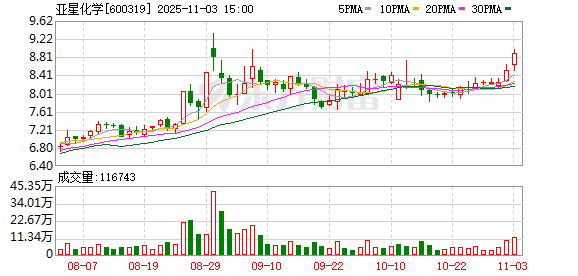
Market Overview - The A-share market saw all three major indices close higher, with the Shanghai Composite Index rising by 0.55%, the Shenzhen Component increasing by 0.19%, and the ChiNext Index up by 0.29% [2] - The total trading volume for the day was 2.13 trillion yuan, a decrease of over 210 billion yuan compared to the previous trading day [2] - More than 3,500 stocks closed higher, with 91 stocks hitting the daily limit up [2] Sector Performance - The Hainan Free Trade Zone concept led the market, with stocks like Intercontinental Oil and Gas, Hainan Development, and Haima Automobile hitting the daily limit up [2] - Other sectors that saw gains included dyes, horse racing, and film and television [2] - Conversely, sectors such as fentanyl, PVDF, and battery concepts experienced the largest declines [2] Historical Highs - A total of 44 stocks reached historical closing highs, excluding newly listed stocks from the past year [3] - The electric equipment, machinery, and electronics sectors had a significant concentration of stocks reaching new highs, with 7, 7, and 5 stocks respectively [3] - The average price increase for stocks that reached historical highs was 5.62%, with notable gainers including Aerospace Intelligent Equipment, Yaxiang Integration, and Baiao Chemical [3] Institutional Activity - In the day's trading, 9 stocks were net bought by institutions, with 6 stocks seeing net purchases exceeding 10 million yuan [5] - Aerospace Intelligent Equipment topped the list with a net purchase of 106 million yuan, followed by Aerospace Technology and Jinhua New Materials, both exceeding 35 million yuan [5] - On the sell side, Thinking Control faced the largest net sell-off at 125 million yuan, followed by Kaimete Gas and Rongxin Culture [6] Northbound Capital Flow - Eight stocks were net bought by northbound funds, with Aerospace Intelligent Equipment leading at 93.44 million yuan [8] - Northbound funds sold off 8 stocks, with Kaimete Gas experiencing the largest net sell at 145 million yuan [8] Notable Announcements - Yaxing Chemical is planning to issue shares and pay cash to acquire control of Tianyi Chemical, resulting in a stock suspension [10] - China Mobile's controlling shareholder plans to transfer 41.98 million shares to China National Petroleum Corporation [11] - China Shenhua announced a cash dividend distribution totaling 19.471 billion yuan for the first half of 2025 [12]





煤炭行业资金流入榜:安泰集团、潞安环能等净流入资金居前
Zheng Quan Shi Bao Wang· 2025-11-03 13:07
Market Overview - The Shanghai Composite Index rose by 0.55% on November 3, with 22 out of 28 sectors experiencing gains, led by the media and coal industries, which increased by 3.12% and 2.52% respectively [1] - The total net outflow of capital from the two markets was 23.944 billion yuan, with 9 sectors seeing net inflows, primarily in the media sector, which attracted 2.031 billion yuan [1] Industry Performance Coal Industry - The coal industry saw a 2.52% increase, with a net inflow of 799 million yuan, and 32 out of 37 stocks in this sector rose, including one stock hitting the daily limit [2] - The top three stocks with the highest net inflow in the coal sector were: - Antai Group: 178 million yuan - Lu'an Environmental Energy: 135 million yuan - China Shenhua: 104 million yuan [2] - The coal sector had five stocks with significant net outflows, led by Huayang Co., Daya Energy, and Zhongmei Energy, with outflows of 22.569 million yuan, 15.988 million yuan, and 15.324 million yuan respectively [2][3] Capital Flow Analysis - The media sector led the net capital inflow with 2.031 billion yuan, followed by the banking sector with an inflow of 1.831 billion yuan and a daily increase of 1.33% [1] - The sectors with the highest net capital outflows included non-ferrous metals and electronics, with outflows of 7.054 billion yuan and 4.571 billion yuan respectively [1]



A股公告精选 | 大手笔分红 中国神华(601088.SH)将派发现金红利超194亿元
智通财经网· 2025-11-03 12:40
Group 1 - China Shenhua announced a cash dividend distribution of RMB 19.471 billion for the first half of 2025, with a per-share dividend of RMB 0.98 [1] - China Mobile's controlling shareholder plans to transfer 41.9813 million shares (0.19% of total shares) to China National Petroleum Corporation [1] Group 2 - Shengyi Technology's major shareholder plans to reduce its stake by up to 1.03% between November 26, 2025, and February 25, 2026 [2] - The chairman and chief accountant of Shengyi Technology also plan to reduce their holdings due to personal financial needs [2] Group 3 - Huitian New Materials signed a strategic cooperation agreement with TaiLan New Energy to collaborate on adhesives for solid-state batteries [3] - TaiLan New Energy holds over 800 patents related to solid-state batteries, indicating strong technological capabilities [3] Group 4 - Sanhua Intelligent Control repurchased 1.9361 million shares for a total amount of approximately RMB 55.9833 million, representing 0.0460% of its total share capital [4] - The highest and lowest repurchase prices were RMB 47.00 and RMB 22.69 per share, respectively [4] Group 5 - Siwei Liekong's vice president was placed under investigation, but the company reported that operations remain normal [5] - Yaxing Chemical is planning a major asset restructuring through the acquisition of Tianyi Chemical's controlling stake, leading to a temporary stock suspension [6] Group 6 - Hanjian Heshan signed a procurement contract worth RMB 207 million with China Nuclear Industry Huaxing Construction, accounting for 26.29% of its projected audited revenue for 2024 [6] - Qiangrui Technology plans to invest RMB 70 million to acquire a 35% stake in Aluminum Treasure Technology, which supplies cooling components for AI servers [6] Group 7 - Boying Special Welding's major shareholders plan to reduce their holdings by up to 3% due to operational needs [7]
中国神华:2025年半年度权益分派实施公告
Zheng Quan Ri Bao Zhi Sheng· 2025-11-03 12:12
Group 1 - The core point of the article is that China Shenhua announced its cash dividend distribution plan for the first half of 2025, which includes a cash dividend of RMB 0.98 per share (tax included) for A-shares [1] - The record date for the dividend distribution is set for November 7, 2025, while the ex-dividend date and the date of cash dividend payment are both scheduled for November 10, 2025 [1]
又一巨头宣布:分红194.71亿!A股投资者,迎来“大红包”
Zhong Guo Ji Jin Bao· 2025-11-03 11:39
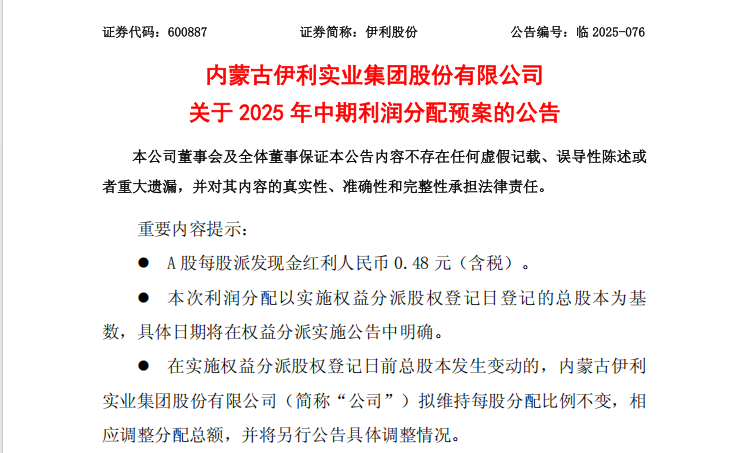
Core Viewpoint - The number of A-share companies planning to implement interim dividends has reached a record high, with China Shenhua proposing a cash dividend of 19.471 billion yuan [1][2]. Group 1: Interim Dividend Announcements - As of November 3, 845 A-share companies announced plans for interim dividends in 2025, marking a year-on-year increase of 20.03%, with 325 companies issuing interim dividend proposals for the first time [1][14]. - China Shenhua plans to distribute a cash dividend of 0.98 yuan per share, totaling 19.471 billion yuan [1]. - Yili Co. announced its first interim dividend plan, proposing a cash dividend of 0.48 yuan per share, amounting to 3.036 billion yuan [4]. - Industrial Fulian plans to distribute a cash dividend of 3.3 yuan per 10 shares, totaling 6.551 billion yuan [8]. Group 2: Financial Performance and Profitability - Many A-share companies are able to declare interim dividends due to their robust financial health and strong profitability [2][7]. - As of November 3, 31 A-share companies with a net profit exceeding 3 billion yuan in the first three quarters of 2025 are planning interim dividends [3][14]. - Hikvision plans to distribute a cash dividend of 4 yuan per 10 shares, totaling 3.666 billion yuan, with a net profit of 9.319 billion yuan in the first three quarters, reflecting a year-on-year increase of 14.94% [14]. Group 3: Market Trends and Regulatory Environment - The trend of increasing interim dividends is supported by policies aimed at enhancing investor returns, with the number of companies announcing interim dividends rising significantly from 194 in 2023 to 845 in 2025 [14][16]. - The unique value of interim dividends is gaining attention, as they shorten the investment return cycle and allow investors to share in corporate growth more quickly [16].

又一巨头宣布:分红194.71亿!A股投资者,迎来“大红包”
中国基金报· 2025-11-03 11:34
Core Viewpoint - The number of A-share companies planning mid-term dividends has reached a record high, with China Shenhua planning to distribute a cash dividend of 19.471 billion yuan [2][3]. Group 1: Mid-term Dividend Trends - As of November 3, 845 A-share companies announced plans for mid-term dividends in 2025, a year-on-year increase of 20.03%, with 325 companies announcing mid-term dividends for the first time [5]. - The robust financial health and strong profitability of many A-share companies underpin the trend of mid-term dividends [6]. - Notable mid-term dividend plans include China Shenhua's 0.98 yuan per share cash dividend, totaling 19.471 billion yuan, and Industrial Fulian's 3.3 yuan per 10 shares, totaling 6.551 billion yuan [3][15]. Group 2: Company Performance and Dividend Policies - Yili's first mid-term dividend proposal includes a cash dividend of 0.48 yuan per share, totaling 3.036 billion yuan, continuing its tradition of high dividend levels [8][9]. - Industrial Fulian reported a 48.52% year-on-year increase in net profit to 22.487 billion yuan for the first three quarters of 2025, driven by the expanding AI server market [17]. - Yili's net profit for the first three quarters of 2025 decreased by 4.07% to 10.426 billion yuan, but the company aims for a dividend payout ratio of no less than 70% in the coming years [19]. Group 3: Regulatory and Market Implications - Recent policies, including the new "National Nine Articles," have emphasized the importance of enhancing investor returns, leading to an increase in mid-term dividend announcements [24][27]. - Mid-term dividends allow for a shorter investment return cycle, enabling investors to share in corporate growth more quickly and promoting reinvestment of funds [27].