Air China(601111)

Search documents
中证香港300运输指数报1116.70点,前十大权重包含中国国航等
Jin Rong Jie· 2025-08-19 08:22
Core Insights - The China Securities Hong Kong 300 Transportation Index (H300 Transportation) has shown significant growth, with a 6.51% increase over the past month, 20.58% over the past three months, and 23.57% year-to-date [1] Group 1: Index Performance - The H300 Transportation Index is currently reported at 1116.70 points [1] - The index is designed to reflect the overall performance of listed companies in various sectors such as banking, transportation, resources, infrastructure, logistics, and leisure [1] Group 2: Index Composition - The top ten weighted companies in the H300 Transportation Index include J&T Express (21.64%), ZTO Express (21.63%), and Seaspan Corporation (12.67%) [1] - The index is fully composed of companies listed on the Hong Kong Stock Exchange, with a 100% representation [1] Group 3: Sector Breakdown - The sector composition of the index shows that express delivery accounts for 43.26%, shipping for 32.87%, and air transportation for 10.77% [2] - Other sectors include logistics (7.39%), highways (3.23%), and ports (2.47%) [2] Group 4: Index Adjustment Mechanism - The index samples are adjusted biannually, with changes implemented on the next trading day following the second Friday of June and December [2] - Weight factors are generally fixed until the next scheduled adjustment, with special circumstances allowing for temporary adjustments [2]

“用心相伴,与爱同行”国航主题日活动亮相大阪世博会中国馆
人民网-国际频道 原创稿· 2025-08-19 01:03
Core Viewpoint - Air China successfully hosted the "Heartfelt Companionship, Walking Together with Love" themed day at the China Pavilion during the 2025 Osaka World Expo, showcasing its role as an "aerial bridge" between China and Japan, and promoting cultural exchange and friendship between the two nations [1][3][15]. Group 1: Event Highlights - The themed day featured immersive interactive experiences and emotional storytelling, attracting participants from around the world [1][3]. - Air China representatives shared the company's development history and route network, highlighting advancements in service through digital technology and innovations in green and low-carbon practices [9][15]. - The event included performances by a Chinese erhu player and a dance artist, symbolizing the connection between the two countries [11]. Group 2: Leadership and Support - Yan Fei, Vice President of Air China, emphasized the airline's commitment to enhancing international operations and cultural exchanges between China and Japan [3]. - Fang Wei, Deputy Consul General of China in Osaka, expressed support for Air China's role in strengthening ties between the two nations [5][6]. - Former Japanese Prime Minister Yukio Hatoyama sent a congratulatory message, highlighting the importance of Air China's network in fostering connections between the peoples of China and Japan [7][8]. Group 3: Community Engagement - Air China's Japan-Korea regional headquarters is based in Tokyo, with operations in eight cities across Japan, providing direct flights between nine Japanese airports and major cities in China [17]. - The airline has actively engaged in social responsibility initiatives, including donations of rescue equipment and training for emergency response [17][18].


民航“反内卷”启动,三大航上半年亏损超40亿元
21世纪经济报道· 2025-08-18 15:38
Core Viewpoint - The civil aviation industry in China is experiencing record-high transportation volumes, but faces significant financial losses and increasing competition pressures, prompting the introduction of self-regulatory measures to combat "involution" in the market [1][5][12]. Group 1: Transportation Volume and Growth - In July, China's civil aviation industry achieved a historical high with a total transportation turnover of 148 billion ton-kilometers, a passenger volume of 71.82 million, and cargo mail volume of 867,000 tons, representing year-on-year growth of 8.6%, 3.9%, and 15.3% respectively [1][6][7]. - Domestic passenger transport reached 64.73 million, up 2.7% year-on-year, while international routes saw a 15.7% increase with 7.09 million passengers [6]. - Cargo transport also showed strong growth, with domestic routes handling 479,000 tons (up 10.8%) and international routes 388,000 tons (up 21.5%) [7]. Group 2: Financial Performance of Major Airlines - The three major airlines reported losses exceeding 40 billion yuan in the first half of the year, with Air China expecting a net loss of 1.7 to 2.2 billion yuan, China Eastern Airlines projecting a loss of 1.2 to 1.6 billion yuan, and China Southern Airlines estimating a loss of 1.338 to 1.756 billion yuan [5][10]. - Factors contributing to these losses include market supply imbalances, changes in passenger demographics, competition from high-speed rail, and increased international uncertainties [10]. Group 3: Price Trends and Market Dynamics - Despite the peak travel season, average ticket prices in July fell by 8.8% year-on-year, indicating weak price performance [11]. - The industry anticipates a potential reduction in supply and a gradual increase in demand as the economy recovers, which may support price increases in the future [11]. Group 4: Regulatory Measures and Industry Response - The China Air Transport Association released a self-regulatory charter aimed at addressing "involution" in the industry, emphasizing adherence to market rules and anti-competitive practices [1][12][14]. - The charter seeks to curb malicious competition, such as predatory pricing and false advertising, and aims to enhance the overall market order [1][12]. - Experts suggest that the charter's implementation could help stabilize the market and improve the industry's long-term competitiveness [14]. Group 5: Recommendations for Market Expansion - To avoid "involution," experts recommend expanding international routes to meet the growing demand for business travel and cross-border tourism, which could enhance the global market share of Chinese airlines [15][16]. - Proper allocation of capacity between trunk and regional flights is essential to prevent competition that undermines pricing and service quality [16]. - A coordinated development strategy between high-speed rail and civil aviation is necessary to optimize the transportation system and mitigate price wars [16].



航空行业7月数据点评:暑运旺季过半,运力运量保持增长
Shenwan Hongyuan Securities· 2025-08-18 14:15
Investment Rating - The report maintains a positive outlook on the aviation industry, indicating a "Look Favorably" rating for the sector [2][4]. Core Insights - The summer travel season has seen a steady increase in both capacity and passenger volume, with domestic flights up by 2.2% and international flights up by 14.1% year-on-year [4]. - The average daily aircraft utilization in July was 8.8 hours, reflecting a 13% increase month-on-month and a 0.6% increase year-on-year [4]. - The report highlights that the demand for air travel remains strong, with airlines increasing capacity to meet this demand [4]. Summary by Sections Capacity and Passenger Volume - In July, the overall capacity (ASK) increased by 3.5% year-on-year, with domestic passenger volume rising by 2.0% and international passenger volume increasing by 13.1% [4]. - The report provides detailed statistics for major airlines, showing varied growth rates in capacity and passenger turnover [5]. Airline Performance - Six listed airlines showed different performance metrics in July, with China Eastern Airlines and Spring Airlines leading in capacity growth [4]. - The report notes that Spring Airlines continues to have the highest passenger load factor at 91.9% [4]. Domestic and International Markets - The domestic market shows a balanced growth in supply and demand, with significant increases in capacity and passenger volume for China Eastern Airlines and Southern Airlines [4]. - In the international market, airlines have significantly increased capacity, with China Eastern Airlines and Spring Airlines recovering to pre-pandemic levels [4]. Investment Recommendations - The report suggests a continued positive outlook for the aviation sector, with expectations of a gradual increase in passenger volume and load factors over the next 3-5 years [4]. - Recommended stocks include China National Aviation, Spring Airlines, and China Eastern Airlines, among others, based on their strong performance and growth potential [7].



交通运输物流行业2025年7月航空数据点评:需求同比增速放缓,航协提出价格自律淡季或现改善
Minsheng Securities· 2025-08-18 11:04
Investment Rating - The report maintains a "Buy" recommendation for several airlines, including China National Aviation, China Eastern Airlines, Southern Airlines, Spring Airlines, Juneyao Airlines, and Huaxia Airlines, indicating a positive outlook for these companies [5]. Core Insights - The aviation demand growth rate has slowed down year-on-year in July 2025, with the overall capacity growth limited. The six listed airlines in A-shares reported a year-on-year increase of 5.0% in Available Seat Kilometers (ASK) and 5.5% in Revenue Passenger Kilometers (RPK), with an overall load factor of 83.7%, up 0.4 percentage points [1][11]. - The industry is experiencing a price decline, with both domestic and international ticket prices dropping. The domestic economy class ticket prices fell by 7.4% year-on-year, while international ticket prices decreased by 16% [2][12]. - The international routes have recovered to 2019 levels, with ASK and RPK increasing by 12.5% and 12.7% year-on-year, respectively, indicating a strong recovery trend in international travel [1][16]. Summary by Sections Section 1: Demand and Supply Dynamics - In July 2025, the domestic aviation demand growth rate remained flat compared to June, with domestic ASK and RPK increasing by 3.1% and 2.3%, respectively, and a load factor of 85.0% [1][11]. - The international routes showed a significant recovery, with a year-on-year increase in ASK and RPK, reflecting a strong demand recovery driven by policy changes and market needs [16][19]. Section 2: Pricing Trends - The industry is characterized by a price-for-volume strategy, with high aircraft utilization and load factors not translating into revenue growth. The average aircraft utilization remained at 8.8 hours, unchanged from the previous year [2][12]. - The report highlights a significant drop in ticket prices, with domestic economy class prices down by 7.4% and international prices down by 16% year-on-year, indicating a challenging pricing environment [2][12]. Section 3: Fleet Expansion - The fleet of the six listed airlines increased by 0.3% month-on-month in July 2025, with a total of 3,315 aircraft managed. The report notes that the airlines are gradually receiving new Boeing aircraft, contributing to fleet growth [3][24]. - The report details the specific aircraft additions, including 12 narrow-body aircraft, primarily from the A320 series and B737 MAX, indicating a focus on modernizing the fleet [3][24][26]. Section 4: Investment Recommendations - The report suggests monitoring the recovery of business travel demand, as any marginal improvement could provide a basis for price increases in the fourth quarter, enhancing investor sentiment in the sector [4]. - The report emphasizes the importance of seasonal demand fluctuations and suggests that airlines like Huaxia Airlines, Juneyao Airlines, and Spring Airlines could benefit from improved business travel conditions [4].

航空机场板块8月18日涨0.47%,华夏航空领涨,主力资金净流出703.01万元
Zheng Xing Xing Ye Ri Bao· 2025-08-18 08:39
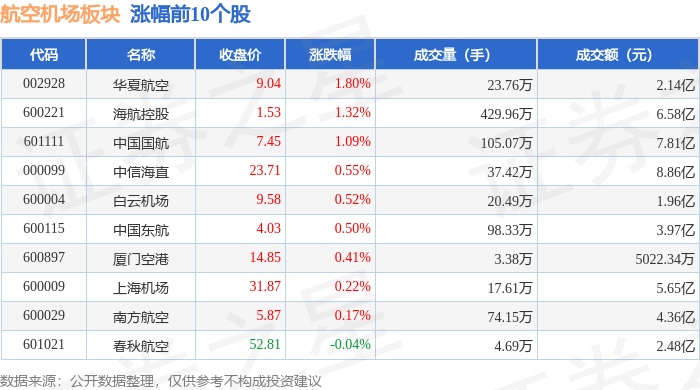
Market Performance - On August 18, the aviation and airport sector rose by 0.47% compared to the previous trading day, with Huaxia Airlines leading the gains [1] - The Shanghai Composite Index closed at 3728.03, up 0.85%, while the Shenzhen Component Index closed at 11835.57, up 1.73% [1] Stock Performance - Huaxia Airlines (002928) closed at 9.04, with a gain of 1.80% and a trading volume of 237,600 shares, amounting to a transaction value of 214 million yuan [1] - HNA Holding (600221) closed at 1.53, up 1.32%, with a trading volume of 4,299,600 shares [1] - China National Aviation (601111) closed at 7.45, gaining 1.09% with a trading volume of 1,050,700 shares [1] - Other notable performances include China Eastern Airlines (600115) at 4.03, up 0.50%, and Shanghai Airport (600009) at 31.87, up 0.22% [1][2] Capital Flow - The aviation and airport sector experienced a net outflow of 7.03 million yuan from institutional investors, while retail investors saw a net inflow of 12.1 million yuan [2][3] - The capital flow for specific stocks showed that Shanghai Airport had a net inflow of 30.52 million yuan from institutional investors, while HNA Holding had a net inflow of 29.26 million yuan [3]


航空行业2025年7月数据点评:行业反内卷措施不断推进,静待票价企稳改善
Huachuang Securities· 2025-08-18 04:13
Investment Rating - The industry investment rating is "Recommended" [2] Core Viewpoints - Continuous efforts to combat "involution" in the aviation industry are underway, with expectations for ticket prices to stabilize and improve [9] - The demand side remains resilient due to endogenous growth in domestic demand and ongoing recovery in international routes [9] - Supply constraints are expected to persist, and a decrease in oil prices will alleviate cost pressures [9] - Positive outlook on domestic regional market leader Huaxia Airlines and low-cost airline leader Spring Airlines, which leverage their core competitiveness to optimize "traffic-cost-price" dynamics [9] - Anticipation of elasticity release from major airlines represented by Air China, with a favorable recovery in international routes and efficient operation of wide-body aircraft expected to benefit Juneyao Airlines [9] Summary by Sections 1. Airline Data Analysis for July - In July, the overall ASK (Available Seat Kilometers) growth rates were led by Spring Airlines (10.4%), followed by Eastern Airlines (7.4%), Southern Airlines (6.7%), Air China (2.3%), and Juneyao Airlines (-3.0%) [2] - RPK (Revenue Passenger Kilometers) growth rates for July were highest for Eastern Airlines (9.4%), followed by Spring Airlines (8.6%), Southern Airlines (7.3%), Air China (2.2%), and Juneyao Airlines (-3.2%) [2] - Cumulative ASK growth from January to July showed Spring Airlines (9.6%) leading, followed by Eastern Airlines (7.5%) and Southern Airlines (5.7%) [2] - Cumulative RPK growth for the same period was highest for Eastern Airlines (11.8%) [2] 2. Passenger Load Factor - In July, the passenger load factor was highest for Spring Airlines at 91.9%, followed by Juneyao Airlines and Eastern Airlines both at 84.8% [4] - Cumulative load factor from January to July showed Spring Airlines at 90.7%, with Southern Airlines at 85.3% [4] 3. Fleet Size - As of July 2025, the five listed airlines collectively added 7 aircraft, with a year-on-year fleet size increase of 3.5% [4]
航空运输月度专题:票价疲软客座率高位提升,关注“反内卷”推进-20250817
Xinda Securities· 2025-08-17 13:36
Investment Rating - The investment rating for the airline transportation industry is "Positive" [2][6]. Core Insights - The industry has maintained a high passenger load factor, but ticket prices have shown weakness, particularly in July, attributed to limited travel demand and intense competition among airlines. The implementation of the "anti-involution" measures and the self-discipline agreement by the China Air Transport Association is expected to mitigate malicious competition and stabilize pricing [3][12]. - The average ticket price in the domestic market has decreased by 9.1% year-on-year as of mid-August 2025, with July's average ticket price down 8.8% year-on-year. However, the rate of decline in ticket prices has recently narrowed [4][25]. - The airline industry is experiencing a slowdown in capacity growth, with domestic airlines maintaining low growth rates in capacity deployment. The passenger load factor remains high, with significant year-on-year increases noted for major airlines [6][43]. Summary by Sections 1. Supply and Demand - The industry passenger load factor reached 84.6% in June 2025, up 1.3 percentage points year-on-year. The available seat kilometers (ASK) and revenue passenger kilometers (RPK) increased by 5.5% and 7.1% year-on-year, respectively [14][18]. - Domestic routes saw a 3.8% increase in turnover volume year-on-year, while international routes have nearly recovered to 97.7% of 2019 levels [23][24]. 2. Ticket Pricing - The average domestic ticket price was 867 CNY, down 9.1% year-on-year as of August 15, 2025. The average ticket price in July fell by 8.8% year-on-year, with a slight narrowing of the decline observed in early August [4][25]. - Recent weekly average ticket prices showed declines of -7.9%, -10.8%, -9.8%, and -8.4% in the four weeks leading up to mid-August [25][26]. 3. Fuel and Exchange Rates - The average price of aviation fuel decreased by 12.9% year-on-year in August 2025. The average ex-factory price of aviation kerosene was 5616 CNY per ton, with a significant decline noted in the first two quarters of 2025 [36][39]. - The exchange rate of the US dollar to the Chinese yuan remained stable, with a slight decrease of 0.71% from the end of 2024 to mid-August 2025 [36][42]. 4. Airline Operations - In the first seven months of 2025, domestic airlines showed varied capacity growth, with some airlines like Spring Airlines increasing capacity by 4.0%, while others like China United Airlines saw a decline [6][43]. - The passenger load factor for major airlines in July 2025 was as follows: China Southern Airlines at 84.38%, China Eastern Airlines at 84.76%, and Spring Airlines at 91.86% [46].
交通运输产业行业周报:危化品水运价格企稳回升,航协发布公约反内卷-20250817
SINOLINK SECURITIES· 2025-08-17 11:07
Investment Rating - The report recommends "Buy" for the logistics sector, specifically highlighting SF Holding in the express delivery segment and Hecun Co., Ltd. in the smart logistics space [2][3]. Core Insights - The express delivery sector saw a 15% year-on-year increase in business volume in July, but the average revenue per ticket decreased by 5.3%. The report anticipates a potential increase in ticket prices due to seasonal demand and price adjustments in production areas [2]. - The logistics sector is experiencing a stabilization in hazardous chemical water transport prices, with a recommendation for Hecun Co., Ltd. as it focuses on smart logistics and benefits from improving demand [3]. - The aviation sector is responding to regulatory changes aimed at curbing unhealthy competition, with a noted increase in flight operations and a recommendation for major airlines like Air China and China Southern Airlines due to expected profit elasticity from supply-demand optimization [4]. Summary by Sections Transportation Market Review - The transportation index decreased by 0.5% from August 9 to August 15, while the Shanghai and Shenzhen 300 index increased by 2.4%, indicating underperformance in the transportation sector [12]. Industry Fundamentals Tracking Shipping and Ports - The report indicates that the shipping sector is under pressure, with the China Export Container Freight Index (CCFI) at 1193.34 points, down 0.6% week-on-week and down 40.9% year-on-year. The Shanghai Export Container Freight Index (SCFI) is at 1460.19 points, down 2.0% week-on-week and down 52.9% year-on-year [20]. - Domestic shipping is showing a slight improvement, with the Domestic Container Freight Index (PDCI) at 1068 points, up 1.7% week-on-week and up 7.9% year-on-year [28]. Aviation and Airports - The report notes a slight increase in domestic flight operations, with an average of 17,225 flights per day, up 2.76% year-on-year. The report also highlights the release of a self-regulatory charter by the China Air Transport Association to combat unhealthy competition [4][49]. - The domestic air passenger volume in June 2025 was 54.01 million, a 3% increase year-on-year, while international passenger volume increased by 17% [52]. Rail and Road - The report indicates a stable upward trend in road transport, with a 2.44% year-on-year increase in truck traffic on highways. The railway sector also shows positive signs, with a 5.4% year-on-year increase in freight volume for the Daqin Railway in July [73][78].

三大航,提前布局上海“第三机场”!
第一财经· 2025-08-17 05:48
Core Viewpoint - The establishment of the joint venture company for the Nantong New Airport indicates a strategic move to enhance Shanghai's international aviation hub status, with significant involvement from Shanghai Airport Group and local government [4][6]. Group 1: Company Formation and Structure - The newly formed Nantong New Airport Construction Investment Co., Ltd. is primarily engaged in civil airport operations and construction, with Shanghai Airport Group holding a 51% stake and Nantong Urban Construction Group holding 49% [3][4]. - The joint venture's establishment highlights Shanghai Airport's leading role in the development of the Nantong New Airport, often referred to as "Shanghai's third airport" [4][6]. Group 2: Airport Development and Planning - The Nantong New Airport is planned to have two long-distance runways and a terminal capable of handling 40 million passengers annually, with future expansion potential to accommodate 80 million passengers [9]. - The airport's location is approximately 100 kilometers from both Shanghai Hongqiao and Pudong airports, necessitating effective transportation network planning to integrate the three airports [6][9]. Group 3: Strategic Importance and Market Potential - Major airlines, including Air China, China Eastern Airlines, and China Southern Airlines, are proactively planning operations at the Nantong New Airport, recognizing its potential for local passenger traffic and spillover from Shanghai [9]. - The Long Triangle region already has seven major airports, and the development of Nantong New Airport is part of a broader strategy to optimize airport operations and enhance regional aviation competitiveness [10]. Group 4: Regional Collaboration and Integration - The establishment of the Nantong New Airport aligns with the Yangtze River Delta regional integration plan, which aims to create a coordinated airport system to avoid redundancy and improve efficiency [10]. - The East Airport Group's acquisition of several regional airports indicates ongoing efforts to streamline airport management and enhance service capabilities across the region [10].