
Bank Of Shanghai(601229)

Search documents
实至名归!上海银行董事长顾建忠上榜“2025年度城商行十大杰出董事长”
Sou Hu Cai Jing· 2025-12-16 09:24
运营商财经网讯 日前,运营商财经网独家编制的"2025年度城商行十大杰出董事长"名单揭晓。此榜单依据各银行机构业 绩、高管突出成就等综合实力制定,秉持着全面、公正的原则,榜单评选不收取任何费用。 其中,上海银行董事长顾建忠成功上榜。在顾建忠近30年工作经历中,有超过一半的时间在上海银行度 过,"年轻有为"是业内人士对他最多的评价。今年上半年,阔别上海银行10年之久的顾建忠重新回归, 掌舵这家头部城商行。 根据上海银行发布的2025年三季报,今年前三季度,上海银行实现营收411.4亿元,同比增长4.04%;净 利润180.59亿元,同比增长2.66%。显然,上海银行业绩非常好。顾建忠上榜"2025年度城商行十大杰出 董事长",也当之无愧。 运营商财经网金融部主任刘庆表示,这位对机构普惠、科技金融、零售等业务特别关注且熟悉的董事 长,下一步会带领上海银行如何发展,着实令人期待! 运营商财经(官方微信公众号yyscjrd)—— 主流财经网站,一家全面覆盖科技、金融、证券、汽车、 房产、食品、医药、日化、酒业及其他各种消费品网站。 ...


26家银行密集分红!总额超2600亿,工商银行居首,多家首次推出中期方案
Sou Hu Cai Jing· 2025-12-16 05:23
Core Viewpoint - As of December 15, 2025, 26 A-share listed banks have announced mid-term or quarterly dividend plans, with a total expected payout exceeding 260 billion yuan [1]. Group 1: Major Contributors - The six major state-owned banks are the main contributors to this dividend distribution, with Industrial and Commercial Bank of China leading at 50.396 billion yuan, followed by China Construction Bank at 48.605 billion yuan, Agricultural Bank of China at 41.823 billion yuan, Bank of China at 35.250 billion yuan, Postal Savings Bank of China at 14.771 billion yuan, and Bank of Communications at 13.811 billion yuan [3]. - The total cash dividend from these six major banks exceeds 200 billion yuan [3]. Group 2: Other Banks - Among joint-stock banks, both Industrial Bank and CITIC Bank are expected to distribute over 10 billion yuan in dividends, specifically 11.957 billion yuan and 10.461 billion yuan respectively [3]. - Everbright Bank and Minsheng Bank are also projected to exceed 5 billion yuan in dividends [3]. - Several regional small and medium-sized banks are actively participating in mid-term dividends, with Shanghai Bank, Nanjing Bank, Hangzhou Bank, Shanghai Rural Commercial Bank, and Ningbo Bank leading in dividend amounts [3]. - Notably, banks like Industrial Bank and Ningbo Bank are introducing mid-term dividend plans for the first time [3]. Group 3: Dividend Implementation - Several banks have specified the dates for dividend distribution, with Industrial and Agricultural Banks set to distribute cash dividends on December 15, 2025 [3]. - Bank of Communications has announced that it expects to distribute mid-term cash dividends to A-share shareholders on December 25, 2025 [3].




申万宏源助力上海银行100亿元无固定期限资本债券成功发行
申万宏源证券上海北京西路营业部· 2025-12-16 04:26
免责声明 本内容最终解释权归申万宏源证券有限公司所有。 202 5 年 12 月 9 日,申万宏源证券助力上海银行股份有限公司 2025年无固定期限资 本债券 成功发行, 本 次 永续债发行规模为人民币 100亿元,期限5+N年,发行利率为 2.42%,全场认购倍数2.53倍。 上海银行 作为 国内 20家系统重要性银行之一,以"精品银行"为战略愿景,秉 持"精诚至上,信义立行"的核心价值观,围绕高质量可持续发展目标,将数字化作为创 新驱动、提升能级的核心力量,加快转型发展,努力实现新的质变。本次为上海银行首 次发行永续债,是上海银行积极贯彻落实国家金融政策、持续优化资本结构、增强服务 实体经济长期动能的重要战略举措。 近年来 , 申万宏源证券与上海银行建立了良好的合作关系,本次债券的成功发行 彰显了我司强大的资本市场销售实力,申万宏源 各 部门积极协调配合,得到了发行人 的高度评价和充分认可 。 未来,申万宏源将继续以服务国家战略、服务实体经济为主 线,深耕重点地区和核心客户,推动区域经济高质量发展,践行金融央企责任担当。 ...

小红日报 | 孚日股份涨停,标普红利ETF(562060)标的指数收涨0.17%
Xin Lang Cai Jing· 2025-12-16 01:04
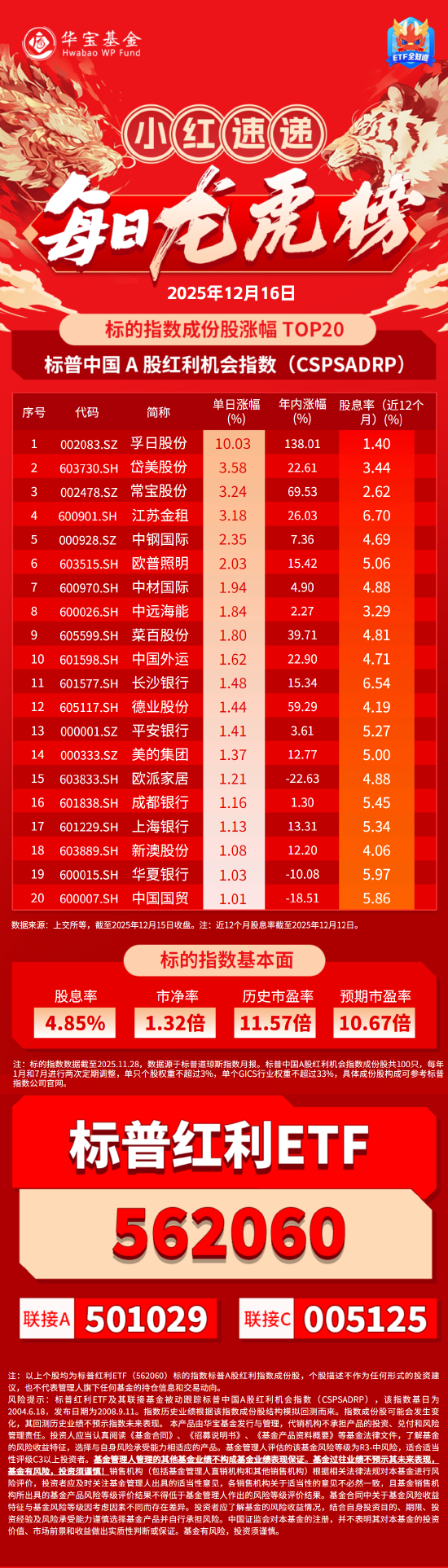
Core Insights - The article highlights the top 20 stocks in the S&P China A-Share Dividend Opportunity Index (CSPSADRP) based on their performance and dividend yield as of December 15, 2025 [1][4] Group 1: Stock Performance - The top-performing stock is LuRi Co., Ltd. (002083.SZ) with a daily increase of 10.03% and a year-to-date increase of 138.01% [1][4] - Dai Mei Co., Ltd. (603730.SH) ranks second with a daily increase of 3.58% and a year-to-date increase of 22.61% [1][4] - Changbao Co., Ltd. (002478.SZ) follows with a daily increase of 3.24% and a year-to-date increase of 69.53% [1][4] Group 2: Dividend Yields - Jiangsu Jinzhong (600901.SH) offers the highest dividend yield among the top 20 stocks at 6.70% [1][4] - Other notable dividend yields include Changsha Bank (601577.SH) at 6.54% and Huaxia Bank (600015.SH) at 5.97% [1][4] - The average dividend yield for the top 20 stocks varies, with several companies offering yields above 5% [1][4] Group 3: Additional Stock Insights - The performance of stocks like Midea Group (000333.SZ) shows a year-to-date increase of 12.77% despite a daily increase of only 1.37% [1][4] - Some stocks, such as Oppein Home Group (603833.SH), have experienced a year-to-date decline of 22.63% [1][4] - The data reflects a diverse range of performance and dividend strategies among the top stocks in the index [1][4]





26家A股银行分红2600亿元
Shen Zhen Shang Bao· 2025-12-15 22:55
Group 1 - The core viewpoint of the articles highlights that A-share listed banks in China are distributing significant cash dividends, with the six major state-owned banks leading the way, collectively announcing a total cash dividend of 204.657 billion yuan for the mid-term [1][2] - By December 15, 2025, 26 A-share listed banks are expected to disclose mid-term or quarterly dividend plans, with total dividends projected to exceed 260 billion yuan, where the six major state-owned banks account for 78.7% of the total dividends [1][2] - The major state-owned banks, including Industrial and Commercial Bank of China, Agricultural Bank of China, and others, have maintained a dividend payout ratio of 30% or more of their net profit [2] Group 2 - The Industrial and Commercial Bank of China leads the dividend distribution with 50.396 billion yuan, followed by other major banks with significant amounts, indicating a strong trend in dividend payouts among these institutions [2] - In the joint-stock bank category, several banks, including Industrial Bank and China CITIC Bank, are also participating in dividend distributions, with some like Industrial Bank and Ningbo Bank introducing mid-term dividend plans for the first time [2] - The banking sector has shown strong performance in the A-share market, with the overall bank sector rising by 10.71% this year, and specific banks like Agricultural Bank of China seeing a remarkable increase of 48.88% in their stock prices [3]



A股公告精选 | 沐曦股份(688802.SH)将于12月17日在科创板上市
智通财经网· 2025-12-15 12:17
Group 1 - Muxi Co., Ltd. will list its common stock on the Sci-Tech Innovation Board on December 17, 2025 [1] - Xinghua New Materials signed a strategic cooperation agreement with Guoteng Company to collaborate in the quantum technology field [2] - TCL Technology's subsidiary plans to acquire a 10.7656% stake in Shenzhen Huaxing Semiconductor for 60.45 billion RMB [3] Group 2 - Jingjia Micro's subsidiary has completed key stages of its edge AI SoC chip, marking a significant project breakthrough [4] - Cambricon plans to use 2.778 billion RMB of its capital reserve to offset losses [5] - Bojun Technology's subsidiary intends to invest 600 million RMB in an automotive lightweight component production base in Chongqing [6] Group 3 - Longqi Technology plans to invest approximately 1.5 billion RMB to build an AI + smart terminal digital benchmark factory in Nanchang [7] - Taili Technology signed a strategic cooperation framework agreement with Jinan University to establish an advanced functional materials research institute with an investment of 100 million RMB [8][9] - Pengding Holdings plans to invest a total of 4.297 billion RMB in a production facility in Thailand by 2026 [10] Group 4 - China Metallurgical Group reported a new contract amount of 958.13 billion RMB from January to November 2025, a decrease of 8.6% year-on-year [16] - 吉祥航空 reported an 8.92% year-on-year increase in passenger turnover in November 2025 [17] - Hainan Airport's passenger throughput reached 2.0909 million in November 2025, a year-on-year increase of 8.16% [20] Group 5 - Xinhua Insurance reported a cumulative original insurance premium income of 188.85 billion RMB from January to November 2025, a year-on-year increase of 16% [21] - Huafeng Aluminum's controlling shareholder plans to reduce its stake by up to 2.17% [22] - Digital Vision plans to repurchase shares worth 80 million to 120 million RMB [23]


上海银行(601229) - 上海银行2025年第二次临时股东会会议材料
2025-12-15 10:30
上海银行股份有限公司 2025 年第二次临时股东会 会 议 材 料 二○二五年十二月二十六日 上海银行股份有限公司2025年第二次临时股东会会议文件 上海银行股份有限公司 2025 年第二次临时股东会会议须知 为了维护全体股东的合法权益,确保股东会的正常秩序和议事效率, 根据《中华人民共和国公司法》《银行保险机构公司治理准则》等法律、 法规的有关规定,特制定本须知。 一、本行根据《中华人民共和国公司法》《银行保险机构公司治理准 则》等法律、法规以及《上海银行股份有限公司章程》《上海银行股份有 限公司股东会议事规则》的规定,认真做好召开股东会的各项工作。 二、本行设立股东会秘书处,具体负责会议组织和记录等事宜。 三、本行董事会以维护股东的合法权益、确保大会的正常秩序和议事 效率为原则,认真履行有关职责。 四、股东参加股东会依法享有知情权、发言权、质询权、表决权等各 项股东权利。根据本行章程规定,于股权登记日在本行授信逾期的股东, 或股东质押本行股权数量达到或超过其持有本行股权的百分之五十时,其 在股东会上暂停行使表决权。 五、股东参加股东会,应当认真履行其法定义务,不得侵犯其他股东 的权益,不得扰乱大会的正常秩 ...
上海银行(601229) - 上海银行关于优先股全部赎回及摘牌的公告
2025-12-15 10:15
| 证券代码:601229 | 证券简称:上海银行 | 公告编号:临 2025-076 | | --- | --- | --- | | 优先股代码:360029 | | 优先股简称:上银优 1 | | 可转债代码:113042 | | 可转债简称:上银转债 | 上海银行股份有限公司 关于优先股全部赎回及摘牌的公告 上海银行股份有限公司(以下简称"公司")董事会及全体董事保证本公告 内容不存在任何虚假记载、误导性陈述或者重大遗漏,并对其内容的真实性、 准确性和完整性承担法律责任。 重要内容提示: 公司于 2017 年 12 月非公开发行 2 亿股优先股(以下简称"本次优先股"), 优先股代码:360029,优先股简称:上银优 1。有关本次优先股的赎回信息如 下: 一、本次优先股赎回履行的程序 公司2016年度股东大会审议通过了《关于上海银行股份有限公司非公开发 行优先股方案的议案》,授权公司董事会在本次优先股的赎回期内,根据相关 法律法规要求、银行业监督管理机构的批准以及市场情况,决定并全权办理与 赎回相关的所有事宜。公司董事会于2025年7月22日审议通过了《关于赎回优先 1 优先股代码:360029 优先股 ...
上海银行(601229) - 上海银行关于优先股停牌的提示性公告
2025-12-15 10:15
| 证券代码:601229 | 证券简称:上海银行 | 公告编号:临 2025-075 | | --- | --- | --- | | 优先股代码:360029 | | 优先股简称:上银优 1 | | 可转债代码:113042 | | 可转债简称:上银转债 | 上海银行股份有限公司 关于优先股停牌的提示性公告 上海银行股份有限公司(以下简称"公司")董事会及全体董事保证本公告内 容不存在任何虚假记载、误导性陈述或者重大遗漏,并对其内容的真实性、准确 性和完整性承担法律责任。 重要内容提示: 证券停复牌情况:适用 因拟赎回"上银优 1"优先股,公司的相关证券停复牌情况如下: | 证券代码 | 证券简称 | | 停复牌类型 | | 停牌起始日 | 停牌 | 停牌终止日 | 复牌日 | | --- | --- | --- | --- | --- | --- | --- | --- | --- | | | | | | | | 期间 | | | | 360029 | 上银优 | 1 | 优先股 | 停牌 | 2025/12/18 | | | | 公司于 2017 年 12 月非公开发行 2 亿股优先股(以下简称"本次优 ...
上海银行:公司拟于2025年12月19日赎回2亿股优先股
Zheng Quan Shi Bao Wang· 2025-12-15 10:06
Group 1 - The company plans to redeem 200 million shares of preferred stock on December 19, 2025, with a par value of RMB 100 per share, totaling RMB 20 billion [1] - To ensure fair information disclosure and protect investor interests, the company intends to apply for a suspension of trading for the preferred stock on December 18, 2025, prior to the redemption [1]