AGRICULTURAL BANK OF CHINA(601288)

Search documents
2025全球系统重要性银行公布!五家大行评分齐涨,工行升至第三组
Xin Lang Cai Jing· 2025-12-02 00:50
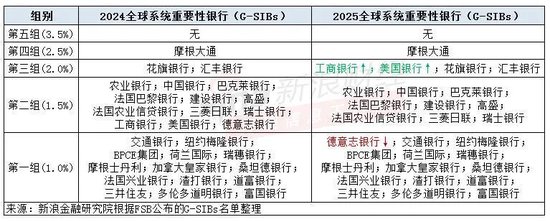
Core Points - The Financial Stability Board (FSB) released the 2025 Global Systemically Important Banks (G-SIBs) list, maintaining the number of Chinese banks at five, with the Industrial and Commercial Bank of China (ICBC) moving up to the third group, marking it as the first Chinese bank in this category [1][4][3] - The other four Chinese banks, namely Agricultural Bank of China, Bank of China, and China Construction Bank, remain in the second group, while Bank of Communications stays in the first group [4][5] Group Summaries - **G-SIB Group Rankings**: The 2025 G-SIB list includes five groups, with ICBC in the third group, requiring an additional capital requirement increase from 1.5% to 2.0%. The fourth group remains occupied by JPMorgan Chase, while the second group includes nine institutions, and the first group consists of 15 banks [4][5][12] - **Score Changes**: ICBC's score increased significantly by 33 points to 332, while Bank of China rose by 32 points to 314, Agricultural Bank by 15 points to 272, Construction Bank by 10 points to 259, and Bank of Communications by 9 points to 138 [8][10] - **Impact of Exchange Rates**: Analysts noted that exchange rate factors may have influenced the scoring of Chinese G-SIBs, with potential implications for their 2026 ratings. The historical context suggests that exchange rates have previously alleviated pressure on scores [10][7] - **TLAC Bond Issuance**: To meet the total loss-absorbing capacity (TLAC) requirements, major state-owned banks have been actively issuing TLAC bonds. For instance, Agricultural Bank issued TLAC bonds worth 20 billion yuan, and Bank of Communications issued bonds worth 30 billion yuan [13][12]






肖宏伟:协同联动彰显财政贴息成效
Zhong Guo Jing Ji Wang· 2025-12-01 23:38
Core Viewpoint - The personal consumption loan interest subsidy policy aims to stimulate domestic demand and support economic recovery in China, marking a shift from broad financial support to targeted measures [1][2]. Group 1: Policy Implementation and Impact - The interest subsidy policy has shown positive results, with over 1.1 million clients served by Agricultural Bank and an additional 117.7 billion yuan in loans from China Construction Bank by the end of September [1]. - The policy is designed to support two types of consumption: daily expenses under 50,000 yuan and key areas such as household vehicles, education, and elderly care, with a subsidy cap of 3,000 yuan [1][2]. - The collaboration between the Ministry of Finance, the People's Bank of China, and financial regulators emphasizes a "precise drip irrigation" approach, enhancing the efficiency of fiscal funds and targeting consumer needs [1][2]. Group 2: Consumer and Supply Side Effects - The policy effectively reduces consumer credit costs, with a 500 yuan subsidy covering nearly 30% of interest for a 50,000 yuan loan at a 3.5% annual rate, significantly easing the burden on families [2]. - Major state-owned banks and financial institutions have established a comprehensive service network, with Agricultural Bank's consumer loan balance increasing by 126.1 billion yuan and China Construction Bank surpassing 645.8 billion yuan [2]. - The policy creates a virtuous cycle of "fiscal guidance, financial support, and consumption stimulation," leveraging fiscal funds to encourage financial institutions to serve real consumption [2]. Group 3: Long-term Market Confidence and Structural Changes - The subsidy policy aligns with the trend of rising service consumption, with per capita service expenditure reaching 46.8% in the first three quarters of this year, driving consumption growth [3]. - The policy not only aims for short-term consumption boosts but also focuses on cultivating long-term market confidence and optimizing the consumption environment [3]. - Future efforts should enhance policy implementation mechanisms, strengthen inter-departmental collaboration, and improve data sharing to ensure the sustainability and precision of the policy [3].
中国农业银行股份有限公司 关于2025年总损失吸收能力非资本债券(第三期)(债券通)发行完毕的公告
Sou Hu Cai Jing· 2025-12-01 23:10
特此公告。 中国农业银行股份有限公司董事会 二〇二五年十二月一日 中国农业银行股份有限公司董事会及全体董事保证本公告内容不存在任何虚假记载、误导性陈述或者重 大遗漏,并对其内容的真实性、准确性和完整性承担法律责任。 经相关监管机构批准,中国农业银行股份有限公司(以下简称"本行")在全国银行间债券市场发行"中 国农业银行股份有限公司2025年总损失吸收能力非资本债券(第三期)(债券通)"(以下简称"本期债 券")。 本期债券于2025年11月27日簿记建档,于2025年12月1日发行完毕。本期债券发行总规模为人民币200亿 元,分为三个品种。其中品种一为4年期固定利率债券,发行规模为人民币140亿元,票面利率为 2.02%,在第3年末附有条件的发行人赎回权;品种二为6年期固定利率债券,发行规模为人民币30亿 元,票面利率为2.12%,在第5年末附有条件的发行人赎回权;品种三为11年期固定利率债券,发行规 模为人民币30亿元,票面利率为2.50%,在第10年末附有条件的发行人赎回权。 本期债券募集资金在扣除发行费用后,将依据适用法律和主管部门的批准用于提升本行总损失吸收能 力。 ...
港人北向贷款调查: 告别“多证明”迎来“验数据”
Zhong Guo Zheng Quan Bao· 2025-12-01 22:30
Core Viewpoint - The Hong Kong Financial Services and the Treasury Bureau and the Shenzhen Local Financial Supervision Bureau have jointly released an action plan to establish a cross-border financial technology center between Hong Kong and Shenzhen, aiming to implement over 20 cross-border data verification platforms in the financial sector by the end of 2027 [1] Group 1: Cross-Border Credit Landscape - The cross-border credit landscape between Hong Kong and Shenzhen is evolving, with a shift from a southward focus to a more balanced north-south dynamic, as Hong Kong residents' demand for loans in mainland China becomes more tangible [1][4] - The first significant case of cross-border consumer loans for Hong Kong residents has been successfully executed, marking a substantial breakthrough in the cross-border financial pilot [2][3] - The use of blockchain technology in the verification process is expected to streamline data validation, enhancing financial services for Hong Kong residents living in Shenzhen [2][3] Group 2: Challenges and Solutions - Long-standing issues such as credit information asymmetry and the need for collateral in the form of mainland property for Hong Kong residents seeking loans remain significant challenges [2][5] - Differences in credit reporting standards between the two regions and uneven coverage of loan products are identified as barriers to expanding northward loan services [5] - The action plan emphasizes the need for continuous collaboration between policy and market forces to address these challenges effectively [1][4] Group 3: Future Prospects - The market for cross-border loans is expected to grow rapidly, driven by policy support and technological innovation, with a focus on expanding access to financial services for a broader range of individuals and scenarios [6] - The establishment of a local credit platform in the Qianhai Cooperation Zone is part of the strategy to facilitate credit financing for Hong Kong residents [6] - The successful implementation of cross-border data verification platforms in the Guangdong-Hong Kong-Macao Greater Bay Area serves as a model for future collaborations, including potential partnerships with ASEAN countries [6]
港人北向贷款调查:告别“多证明”迎来“验数据”
Zhong Guo Zheng Quan Bao· 2025-12-01 20:25
Core Insights - The Hong Kong Financial Services and the Treasury Bureau and the Shenzhen Local Financial Supervision Bureau have jointly released an action plan to establish a cross-border financial technology center between Hong Kong and Shenzhen by 2027, aiming to implement over 20 cross-border data verification platforms in the financial sector [1][3] Group 1: Cross-Border Credit Landscape - The cross-border credit landscape between Hong Kong and Shenzhen is evolving, with a shift from a southbound focus to a more balanced north-south dynamic, as Hong Kong residents' demand for loans in mainland China becomes more tangible [1][4] - The first significant case of cross-border consumer loans for Hong Kong residents was successfully executed by Agricultural Bank of China Shenzhen Branch, utilizing a cross-border data verification platform [2][4] Group 2: Challenges and Solutions - There are existing challenges such as discrepancies in credit data standards and insufficient coverage of loan product scenarios, which need to be addressed to facilitate the growth of cross-border lending [1][4] - The use of blockchain technology in the verification process is expected to streamline data validation and enhance financial services for Hong Kong residents living in Shenzhen [2][3] Group 3: Policy and Market Dynamics - The action plan aims to explore mechanisms for cross-border financial data flow and enhance cooperation between financial institutions in both regions, with a target of establishing over 20 applications by the end of 2027 [3][6] - The Hong Kong Monetary Authority has indicated that successful pilot projects will be regularized, allowing for the development of market-driven cross-border credit solutions [6]
金融股价值再发现调研:银行股“破净”七年之痛
Shang Hai Zheng Quan Bao· 2025-12-01 19:23
农业银行在此轮行情中率先挣脱"破净"枷锁,让市场看到了希望。A股市场厚重而坚韧的基石——金融 股,或许已迎来其价值再发现的转折点。 金融业,特别是银行与险企,其经营本质是风险的管理与定价。眼下,随着经济周期变化、低利率时代 到来,"叙事转换"的资本市场回暖向好,让困扰金融股已久的估值问题再次被推至前台接受各方审视和 讨论。 这可能不是一场简单的轮动。金融股是有了新的驱动逻辑,还是一场源于深层认知革新的"价值重估"? 近期,上海证券报推出"金融股价值再发现"系列报道,旨在探寻金融股在新叙事环境下的新定价逻辑。 详见2版·焦点 传统估值框架下的金融股,常被简化为市盈率与市净率的数字游戏。42只银行股,大部分市净率 (PB)不到1倍,估值长期低于净资产的"魔咒"始终挥之不去,让银行经营者和市场投资者耿耿于怀。 ...
银行股“破净”七年之痛
Shang Hai Zheng Quan Bao· 2025-12-01 19:23
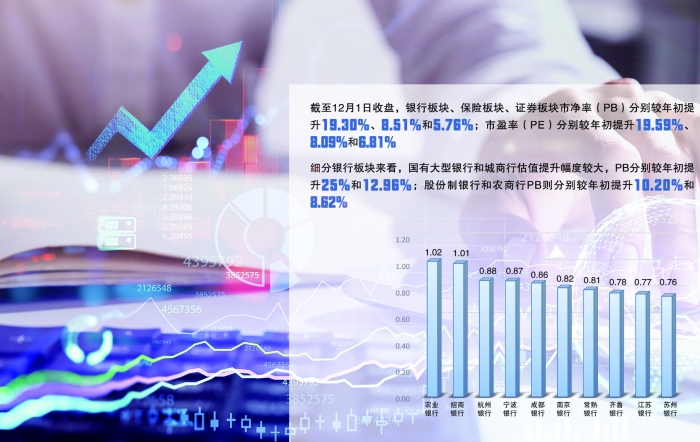
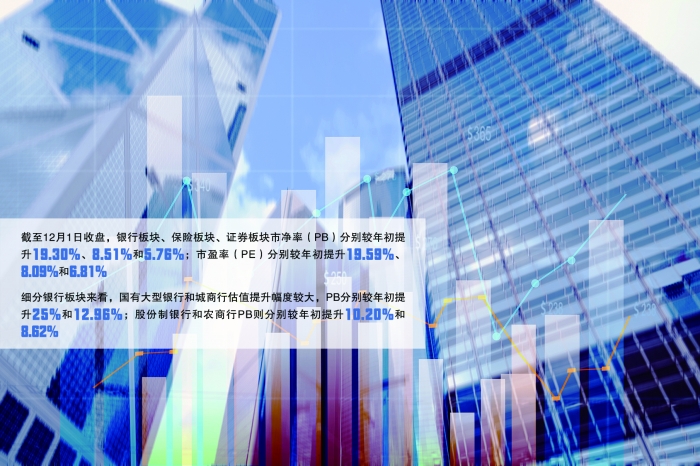
Core Viewpoint - The financial sector in the A-share market has been a key driver of the index's performance since 2025, despite facing complex domestic and international challenges. The sector's stock price performance has been counter-cyclical, supported by a recovering capital market and improved earnings [2][3]. Financial Sector Performance - Agricultural Bank of China has seen a remarkable stock price increase of 56% this year, breaking free from the "price-to-book" constraint, which opens up new valuation possibilities for bank stocks [3][10]. - Despite the strong performance of some banks, the overall banking sector remains trapped in a "price-to-book" dilemma, reflecting valuation challenges and limiting its ability to serve the real economy [3][4]. Valuation Challenges - The banking sector has experienced a continuous "price-to-book" ratio below 1 for seven consecutive years, with the current ratio at 0.56 compared to the broader A-share index at 1.79 [4]. - Factors contributing to this prolonged "price-to-book" issue include external economic downturns, insufficient growth, narrowing net interest margins, and concerns over asset quality [4][5]. Profitability and Regulatory Environment - The net interest margin for commercial banks is at a historical low of 1.42%, down 11 basis points year-on-year, which constrains profitability [5]. - Regulatory pressures on intermediary income sources and a trend of declining interest margins further limit banks' profit potential [5][6]. Impact of "Price-to-Book" on Operations - The "price-to-book" situation has created a "cascading effect," restricting banks' capital replenishment channels, limiting credit expansion, and leading to declining profitability [6]. - Banks face challenges in refinancing due to restrictions on companies that are "broken" or "underwater," making it difficult to raise capital through equity markets [6]. Strategic Shifts in Banking - Some banks have shifted to conservative operational strategies, leading to a contraction in business development and, in some cases, a "balance sheet shrinkage" [7]. - The focus on supporting the real economy and achieving financial goals requires banks to enhance their credit offerings and service capabilities [7][9]. Future Outlook and Valuation Recovery - The banking sector may be entering a long-term trend of valuation recovery, with major state-owned banks showing strong stock performance and several banks achieving historical highs [8][9]. - Analysts predict that the competitive landscape will lead to a "Matthew effect," where larger banks benefit more from policy support, while smaller banks struggle to improve valuations [9]. Stock Performance Data - As of December 1, 2025, the stock performance of various banks shows significant gains, with Agricultural Bank leading at 56.35%, followed by Xiamen Bank and Qingdao Bank with over 30% increases [10][11].
12月指数定期调样的影响估算




HTSC· 2025-12-01 12:34
Quantitative Models and Construction Methods 1. Model Name: Liquidity Impact Coefficient Model - **Model Construction Idea**: This model measures the liquidity impact of index adjustments on individual stocks by calculating the ratio of net fund flows to the stock's recent average daily trading volume[12][13] - **Model Construction Process**: The liquidity impact coefficient for a stock is calculated as follows: $$ impact_{i} = \sum_{k=1}^{N} \frac{\Delta weight_{k,i} \times AUM_{k}}{amt\_avg_{i,20}} $$ - \( \Delta weight_{k,i} \): Estimated weight change of stock \( i \) in index \( k \) - \( AUM_{k} \): Total assets under management of passive products tracking index \( k \) as of the end of November - \( amt\_avg_{i,20} \): Average daily trading volume of stock \( i \) over the past 20 trading days as of the end of November[12][13] - **Model Evaluation**: The model provides a quantitative framework to estimate short-term liquidity shocks caused by index adjustments, but it is subject to data discrepancies and assumptions, which may lead to deviations from actual results[13] --- Model Backtesting Results Liquidity Impact Coefficient Model - **Top 5 Stocks with Highest Positive Impact Coefficients**: - Zhangjiagang Bank (002839 CH): 11.55[15] - Jiangzhong Pharmaceutical (600750 CH): 11.44[15] - Tower Group (002233 CH): 11.04[15] - Jichuan Pharmaceutical (600566 CH): 10.14[15] - Zhengbang Technology (002157 CH): 9.99[15] - **Top 5 Stocks with Highest Negative Impact Coefficients**: - Shenzhen Expressway (600548 CH): -24.95[16] - Vanward Electric (002543 CH): -20.90[16] - Aviation Materials (688563 CH): -14.06[16] - Huaxi Biology (688363 CH): -10.81[16] - Ninghu Expressway (600377 CH): -10.54[16] --- Quantitative Factors and Construction Methods 1. Factor Name: Net Fund Flow Factor - **Factor Construction Idea**: This factor estimates the net fund inflow or outflow for stocks due to index adjustments, based on changes in index weights and the total AUM of passive products tracking the index[9][10] - **Factor Construction Process**: - Outflow Amount: Total AUM of linked products multiplied by the stock's actual weight in the index as of the end of November - Inflow Amount: Total AUM of linked products multiplied by the estimated weight of the stock in the index post-adjustment - Weight estimation is based on free-float market capitalization and index-specific weighting rules, such as dividend yield weighting or market capitalization weighting[9][10] - **Factor Evaluation**: The factor provides a transparent and systematic approach to estimate fund flows, but it is sensitive to assumptions about future index weights and AUM changes[9][10] --- Factor Backtesting Results Net Fund Flow Factor - **Top 5 Stocks with Highest Net Fund Inflows**: - Victory Precision (300476 CH): 112.61 billion CNY[10] - Dongshan Precision (002384 CH): 99.32 billion CNY[10] - Guangqi Technology (002625 CH): 77.81 billion CNY[10] - Sugon Information (603019 CH): 65.44 billion CNY[10] - Top Group (601689 CH): 53.07 billion CNY[10] - **Top 5 Stocks with Highest Net Fund Outflows**: - China Mobile (600941 CH): -40.02 billion CNY[11] - CRRC Corporation (601766 CH): -36.40 billion CNY[11] - Aluminum Corporation of China (601600 CH): -34.29 billion CNY[11] - TCL Zhonghuan (002129 CH): -30.07 billion CNY[11] - Huagong Tech (000988 CH): -27.44 billion CNY[11]
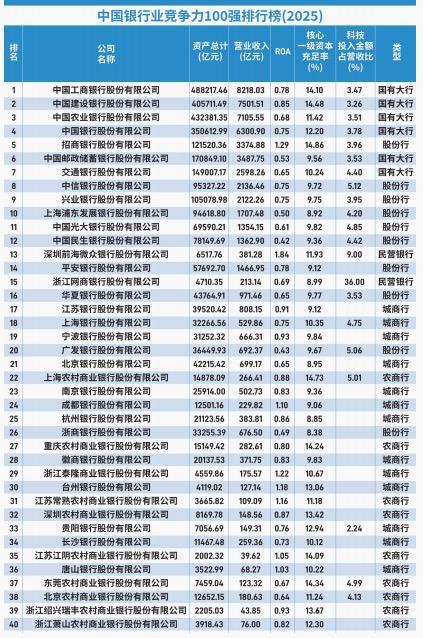
《2025中国银行业竞争力100强》发布,浙江16家银行上榜
2 1 Shi Ji Jing Ji Bao Dao· 2025-12-01 11:13
Core Insights - The "2025 China Banking Competitiveness Report" was released at the 21st Century Financial Annual Conference, highlighting the competitive landscape of the banking sector in China [1] - A total of 16 banks from Zhejiang province made it to the "Top 100 Competitiveness Rankings of Chinese Banks" [1] Rankings Overview - The rankings include 6 state-owned banks, 12 national joint-stock banks, 53 city commercial banks, 27 rural commercial banks, and 2 private banks, with 5 foreign banks also making the list [2][4] - The top three banks are Industrial and Commercial Bank of China, China Construction Bank, and Agricultural Bank of China, with total assets of 488.22 billion, 405.71 billion, and 532.38 billion respectively [2] Evaluation Framework - The evaluation framework consists of four categories: scale, profitability, stability, and growth, based on objective data from the 2024 annual reports [4] - Sub-rankings for scale, profitability, and growth provide a more detailed view of different types of banks' performances [4] Regional Insights - Zhejiang province's banks, such as Zhejiang Commercial Bank, ranked 26th, while Zhejiang Internet Bank and WeBank were the only two private banks to make the list, ranking 15th and 16th respectively [4][5] - City commercial banks from Zhejiang, including Ningbo Bank and Hangzhou Bank, ranked 19th and 25th, respectively, indicating a strong regional presence [5] Development Trends - The asset scale of China's banking industry continues to expand, with state-owned banks showing significant scale advantages, while smaller banks adopt differentiated growth strategies [6] - Profitability indicators show a widening gap, with larger banks benefiting from scale effects, while smaller banks face challenges due to factors like reduced loan prime rates [6] - Growth indicators reflect the potential for banks, focusing on core tier one capital adequacy, cost-to-income ratios, revenue growth, and technology investment [6]

农业银行(01288.HK)完成发行200亿元总损失吸收能力非资本债券
Sou Hu Cai Jing· 2025-12-01 10:58
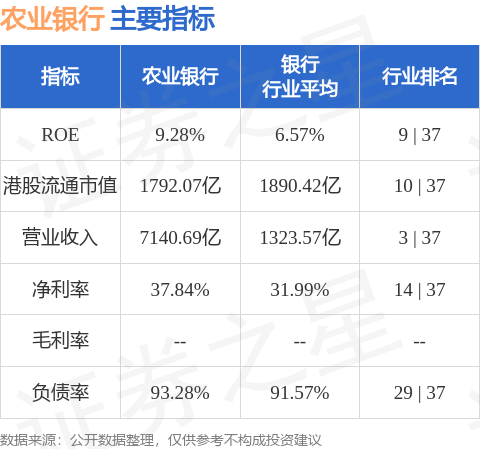
机构评级详情见下表: 农业银行港股市值1792.07亿港元,在银行行业中排名第10。主要指标见下表: 农业银行(01288.HK)公布,中国农业银行股份有限公司2025 年总损失吸收能力非资本债券(第三期)(债 券通)于2025年11月27日簿记建档,于2025年12月1日发行完毕。本期债券发行总规模为人民币200亿 元,分为三个品种。其中品种一为4年期固定利率债券,发行规模为人民币140亿元,票面利率为 2.02%,在第3年末附有条件的发行人赎回权;品种二为6年期固定利率债券,发行规模为人民币30亿元, 票面利率为2.12%,在第5年末附有条件的发行人赎回权;品种三为11年期固定利率债券,发行规模为人 民币30亿元,票面利率为 2.50%,在第10年末附有条件的发行人赎回权。本期债券募集资金在扣除发行 费用后,将依据适用法律和主管部门的批准用于提升该行总损失吸收能力。 截至2025年12月1日收盘,农业银行(01288.HK)报收于5.86港元,上涨0.51%,成交量8725.14万股,成交 额5.08亿港元。投行对该股的评级以买入为主,近90天内共有1家投行给出买入评级。申万宏源最新一 份研报给予农业银行 ...