AGRICULTURAL BANK OF CHINA(601288)

Search documents
六大行全面停售5年期大额存单
Di Yi Cai Jing· 2025-12-02 07:25
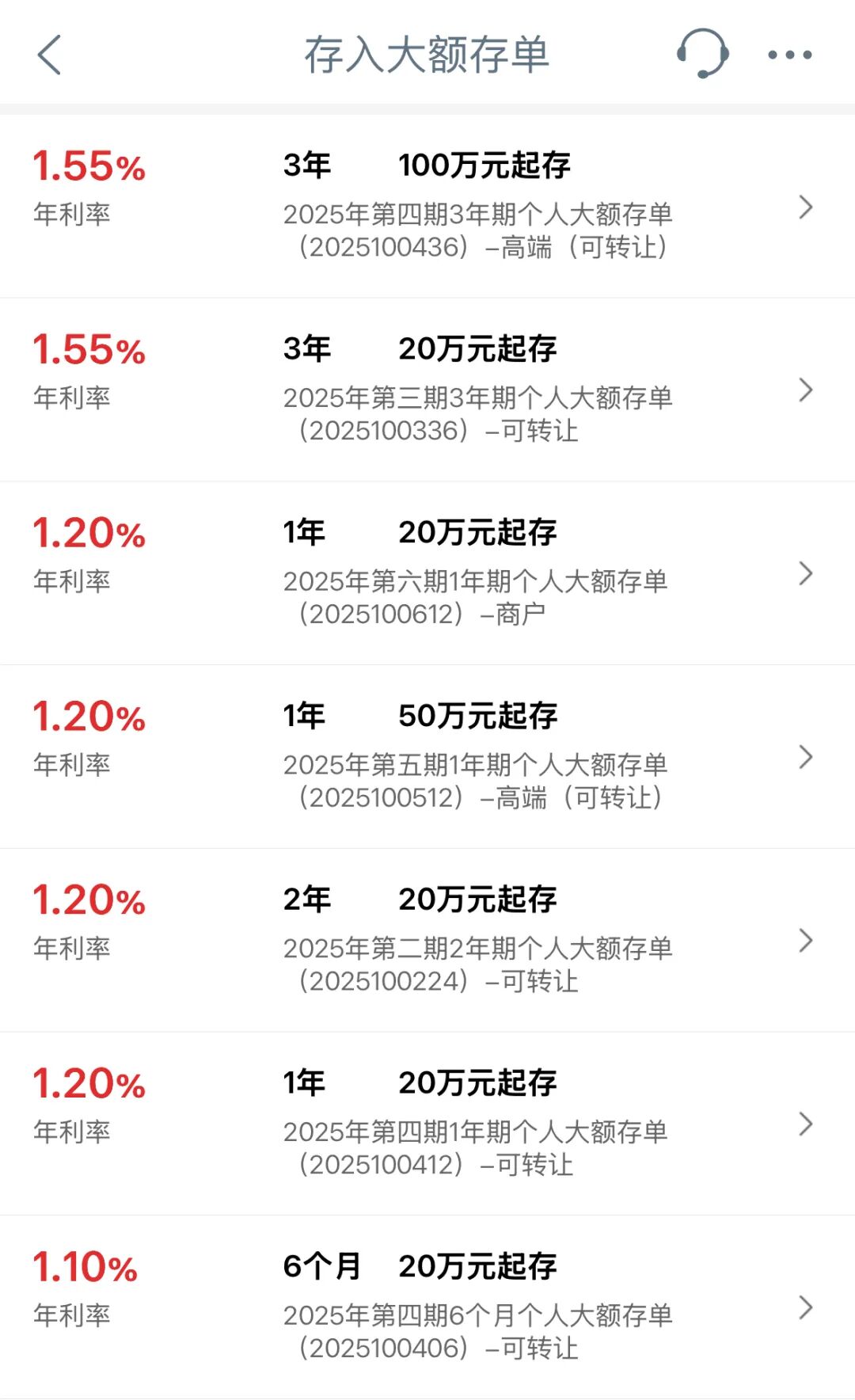
Group 1 - The core observation is that major banks in China are shifting their large-denomination time deposit products towards shorter maturities, with longer-term options being removed from availability [1] - Industrial and Commercial Bank of China (ICBC) currently offers large-denomination time deposits with maturities of 1 month, 3 months, 6 months, 1 year, 2 years, and 3 years, with the 3-year deposit yielding 1.55% and both the 1-year and 2-year deposits yielding 1.20% [1] - Other banks such as Bank of China, China Construction Bank, Bank of Communications, and Postal Savings Bank exhibit similar trends, having removed 5-year deposit products from their offerings [1] Group 2 - Agricultural Bank of China does not list any 5-year large-denomination time deposit products in its catalog for the period from 2018 to 2025 [1]






六大行,集体停售!
Jin Rong Shi Bao· 2025-12-02 07:16
Core Viewpoint - The major state-owned banks in China have completely stopped offering 5-year large denomination certificates of deposit (CDs), leading to a significant reduction in the availability of long-term deposit products in the market [1][2][6]. Group 1: Bank Actions - Six major state-owned banks, including Industrial and Commercial Bank of China, Agricultural Bank of China, Bank of China, China Construction Bank, Bank of Communications, and Postal Savings Bank of China, have ceased the sale of 5-year large denomination CDs [1][2]. - The remaining available terms for large denomination CDs have shifted to shorter durations, with the longest being 3 years, which has a rate of 1.55% [2][6]. - The trend of discontinuing long-term deposit products is not limited to national banks; local commercial banks and private banks are also following suit, as seen with the announcements from banks in Inner Mongolia [10][11]. Group 2: Market Dynamics - The withdrawal of 5-year CDs is attributed to the current downward trend in interest rates, which discourages banks from offering higher rates for long-term deposits [10]. - There is a notable increase in the overall deposit scale due to high savings enthusiasm among residents, while the demand for loans remains weak, leading banks to be less inclined to attract long-term deposits [10]. - Many banks are also reducing deposit rates, with some institutions cutting rates by as much as 65 basis points, reflecting a broader strategy to optimize their liability structure under pressure from interest margins [10][11]. Group 3: Investor Sentiment - The reduction in long-term deposit products has created a dilemma for ordinary depositors, as they struggle to find stable investment options [11]. - A survey indicates a slight decline in the proportion of depositors preferring to save more, suggesting a shift in asset allocation strategies among investors in a low-interest-rate environment [11]. - Financial experts recommend that investors adjust their expectations for returns and consider diversifying their asset allocation to include cash management products, money market funds, and government bonds [11]. Group 4: Industry Implications - The decline of long-term deposit products is prompting banks to accelerate their transformation efforts, focusing on wealth management and custodial services to stabilize non-interest income [11]. - Banks are encouraged to enhance their strategies on both asset and liability sides to maintain net interest margins amidst changing market conditions [11].

(送审)创新服务谋发展,固本守正兴北疆——农行内蒙古分行交出“十四五”高质量金融答卷
Zhong Guo Jin Rong Xin Xi Wang· 2025-12-02 06:38
Core Viewpoint - Agricultural Bank of China Inner Mongolia Branch aims to enhance financial services to support rural revitalization and the real economy during the 14th Five-Year Plan period, focusing on innovation, foundational support, and risk control to promote high-quality economic and social development in Inner Mongolia [1] Group 1: Service Innovation - The bank has implemented a differentiated policy framework to support regional strategies, providing a total of 1,306.6 billion yuan in various financing since the signing of the strategic cooperation agreement with the Inner Mongolia government in June 2022, achieving the 500 billion yuan financing target two years ahead of schedule [2] - The bank has established 281 county-level outlets, 70 township outlets, and 59 agricultural service stations, creating a service network that includes 3,272 financial village directors and mobile party member teams to enhance rural financial services [2] - By the end of October 2025, the bank's county loan balance reached 231.1 billion yuan, doubling from the end of 2020, making it the first state-owned bank in the region to exceed 200 billion yuan in county loans [2] Group 2: Operational Management - The bank is advancing a transformation strategy that integrates branch operations, retail, corporate services, and digitalization, including the addition of 600 customer managers and the streamlining of 74 internal structures [3] - The bank has launched various digital banking products and services, achieving an online loan balance of 144 billion yuan by the end of October 2025, which is over four times the loan scale at the end of 2020 [3] - The bank has introduced innovative services such as online agricultural loans and community dining services to enhance customer experience and support small and micro enterprises [3] Group 3: Risk Control - The bank has strengthened credit risk management by establishing a "white list" review system and a monitoring mechanism for key clients, optimizing management processes continuously [4] - Operational risk management has been enhanced through compliance training and the development of intelligent monitoring models to ensure adherence to regulations and improve overall risk management [4] - The bank is committed to maintaining its "finance for the people" ethos, focusing on service efficiency and proactive risk prevention as it contributes to the new development journey of the 14th Five-Year Plan [4]
农业银行贵港分行因账户管理、客户身份识别违规被罚28.9万元
Xi Niu Cai Jing· 2025-12-02 06:02
Group 1 - The People's Bank of China Guigang Branch imposed administrative penalties on Agricultural Bank of China Guigang Branch for two violations: breaching account management regulations and failing to fulfill customer identity verification obligations [1][3] - The penalties include a warning and a fine of 289,000 yuan for the bank, while two employees, Xu and Liang, were fined 14,000 yuan each for their direct responsibility in the identity verification violation [1][3] Group 2 - Agricultural Bank of China reported a revenue of 550.88 billion yuan for the first three quarters of 2025, representing a year-on-year increase of 1.97% [1] - The bank achieved a net profit attributable to shareholders of 220.86 billion yuan, reflecting a year-on-year growth of 3.03% [1]

中资离岸债每日总结(12.1) | 农业银行(01288.HK)发行
Sou Hu Cai Jing· 2025-12-02 02:59
Group 1 - President Trump has decided on the next Federal Reserve Chairman, expressing a desire for the nominee to implement interest rate cuts [2] - Trump has criticized current Chairman Jerome Powell for not lowering rates quickly enough and is looking for a more aggressive approach to rate cuts [2] - Kevin Hassett, the White House National Economic Council Director, is seen as a potential candidate who aligns with Trump's views on aggressive rate cuts [2] Group 2 - Other potential candidates include Federal Reserve Governors Christopher Waller and Michelle Bowman, former Fed Governor Kevin Warsh, and Rick Rieder from BlackRock [2] - The nominee will need Senate confirmation, and if an outsider is chosen, they may also require confirmation for a 14-year term starting next February [3] - Powell's current term as Chairman will end in May next year [3]

积极支持科创企业高质量发展
Jin Rong Shi Bao· 2025-12-02 02:09
(作者为农业银行重庆分行公司业务部总经理,本报记者左希采访整理) 一是积极构建多维度服务体系。我们从战略层面开展布局,完善服务架构,制定指导意见、实施方案 等。构建"1+12+N"科技金融三级服务体系,建立科技金融柔性团队服务模式,全面开展"金融活水入园 区"活动。建立科技金融核心、骨干人才库,打造既懂金融又懂科技的复合型队伍。 二是全周期支持企业稳健成长。从科研成果转化到产业集群建设,我们围绕科技型企业成长全过程开展 金融支持。在科技成果转化的关键环节,与重庆大学深度合作,精准识别并服务产学研合作企业,成功 落地"科技e贷"600万元。针对企业不同成长阶段实施精准化的梯度培育。在初创期,运用"数智赋能+资 金直达"模式,支持企业完成技术迭代。在为成熟期龙头企业提供服务时,注重加强行司联动,优化供 应链金融服务等,全面助推企业核心战略落地实施。 三是创新产品做好综合性金融服务。借助前沿的科技工具和产品,不断提升金融服务的效率、精准度和 覆盖面。积极用好"科技e贷""专精特新小巨人贷""科捷贷"等重点产品政策,全力解决科技型小微企 业、专精特新企业等融资需求,持续推动投贷联动取得实效。 在科技创新引领高质量发展 ...
中国金融板块-追踪工业风险:制造业固定资产投资增速显著放缓,助力更快管控风险-China Financials-Tracking industrial risks further notable slowdown in manufacturing FAI growth to help contain risks more quickly
2025-12-02 02:08
Summary of Key Points from the Conference Call Industry Overview - **Industry**: China Financials, specifically focusing on manufacturing and infrastructure investments in China [1][5][7] Core Insights and Arguments - **Manufacturing FAI Growth**: There has been a notable slowdown in manufacturing Fixed Asset Investment (FAI) growth, dropping to 2.7% year-over-year (yoy) from 4.0% yoy in the previous month, indicating steady progress on capital expenditure (capex) slowdown [7] - **Liability Growth**: Total liability growth for industrial firms moderated to 5.0% yoy, while manufacturing firms saw a slight increase to 5.9% yoy. This moderation is expected to lead to more rational capacity expansion [2][7] - **Revenue Decline**: Manufacturing revenue declined by 4.3% yoy, attributed to lower production levels due to overcapacity control efforts. The Value-Added Industrial (VAI) growth also slowed to 4.9% yoy from 6.5% yoy in September [3][10] - **Profit Growth**: Manufacturing profit growth moderated to 7.7% yoy from 9.9% yoy in September, influenced by higher financing costs and lower production [10] Future Outlook - **Infrastructure Investment**: A potential increase in infrastructure investments, supported by a new RMB 500 billion fund from the China Development Bank, is expected to bolster demand in 2026 and aid in the digestion of overcapacity risks [8][3] - **Sector Performance**: 77.1% of sectors experienced a slowdown in capex in October 2025 compared to the first half of 2025, while 39.3% of sectors showed profit improvement [9][7] Additional Important Information - **PPI Trends**: The Producer Price Index (PPI) rebounded month-over-month for the first time since December 2024, with the year-over-year decline narrowing to 2.1% [7] - **Investment Sentiment**: The overall sentiment towards the China Financials sector remains attractive, with ongoing efforts in financial tightening contributing to anti-involution measures [5][4] This summary encapsulates the critical insights from the conference call, highlighting the current state and future expectations of the manufacturing and financial sectors in China.




“全力托举”成就民营企业科技自立
Jin Rong Shi Bao· 2025-12-02 02:06
Core Viewpoint - The article highlights the role of agricultural banks in supporting the development of technology-driven enterprises like Seres Group, emphasizing the importance of comprehensive financial services in fostering innovation and competitiveness in the new energy vehicle sector [1][2][3][4]. Group 1: Company Overview - Seres Group is a private enterprise that has transitioned from relying on joint ventures to achieving technological independence, supported by comprehensive financial services from Agricultural Bank [1]. - The company is focused on producing smart and safe new energy vehicles, showcasing advanced manufacturing capabilities within its super factory [1]. Group 2: Financial Support and Strategy - Agricultural Bank has committed 500 million yuan in equity investment to support Seres Group's strategic layout in smart new energy, moving beyond traditional short-term credit models [2]. - The bank is exploring and optimizing the investment-loan linkage model to enhance support for technology enterprises, leveraging its risk management expertise to monitor financing conditions and mitigate bankruptcy risks [2][3]. Group 3: Broader Industry Impact - Agricultural Bank has established a comprehensive financial support ecosystem, including the creation of a 50 billion yuan Zhejiang Social Security Science and Technology Innovation Fund and 14 equity investment funds in pilot cities [3]. - As of September, Agricultural Bank has provided comprehensive financial support to over 80,000 technology enterprises, aiming to strengthen the financial backing for high-level technological self-reliance and the construction of a modern industrial system [4].

银行须向生态型科技金融服务商转型
Jin Rong Shi Bao· 2025-12-02 02:01
Core Insights - The case of Agricultural Bank providing financial support to Cyberspace Group represents a shift in banking from traditional credit models to a dual-value creation approach, emphasizing long-term capital and comprehensive services for technology enterprises [2][3] - The transformation from "financing" to "intelligence" highlights the need for banks to adapt their financial service systems and risk management frameworks to better support technology-driven companies [2][3] Group 1: Financial Innovation and Support - Agricultural Bank's investment of 500 million yuan in equity capital exemplifies a collaborative model that enhances the capital structure and market competitiveness of technology firms [2] - The case illustrates a replicable path for banks to transition from debt-oriented thinking to equity-oriented thinking, focusing on growth logic rather than collateral [3] Group 2: Challenges and Opportunities in Financing - The current financial support system in China is primarily based on indirect financing, with a need for improved long-term and patient capital supply, especially for foundational research and cutting-edge technology [4][5] - Direct financing, particularly through bonds and equity, is gaining traction in the technology sector, indicating a growing support from capital markets for innovation [4][5] Group 3: Recommendations for Banks - Banks should develop a comprehensive financial capability system that integrates investment, debt, and advisory services to meet the diverse capital needs of technology enterprises [3][6] - Emphasis should be placed on building specialized teams that understand technology, industry, and finance to enhance service delivery to innovation-driven companies [6] - Banks are encouraged to actively participate in the bond market and establish mechanisms for long-term capital support, including market-oriented debt-to-equity swaps [5][6]
风向变了!银行集体下架5年期定存!对普通人的钱包有啥影响?
Sou Hu Cai Jing· 2025-12-02 01:43
Group 1 - Recent months have seen a trend of banks, including small and medium-sized banks as well as major state-owned banks, reducing their 5-year fixed deposit and large certificate of deposit products, with small banks leading the way with cuts of up to 80 basis points [1][2] - The current round of deposit rate cuts is primarily a decentralized adjustment by small banks and does not yet reflect a comprehensive reduction led by major state-owned banks [2] - The People's Bank of China (PBOC) is expected to lower interest rates in January to support the 2026 growth target, with indications that deposit rates may decrease before the Loan Prime Rate (LPR) [5][6] Group 2 - As deposit rates decline, some funds are likely to shift from low-yield deposits to equity markets, indicating a potential change in investment behavior [7] - The government is showing unprecedented support for the stock market, with the approval of the first batch of seven dual-innovation artificial intelligence ETFs set to launch on November 28 [8] - The reduction in deposit rates, with current rates at 0.95% for 1-year and 1.05% for 2-year deposits, is expected to encourage residents to invest in the stock market and index funds [10] Group 3 - The dual inflow of resident and institutional funds into the market signifies a significant shift in investment patterns, moving away from traditional bank deposits and real estate towards equity markets [11]