
PING AN OF CHINA(601318)

Search documents
保险基本面梳理112:保险有春节红包行情吗?-20260208
Changjiang Securities· 2026-02-08 10:12
Investment Rating - The report maintains a "Positive" investment rating for the insurance sector [11]. Core Insights - The insurance sector is expected to benefit from a stable interest rate environment and a slow bull market, leading to improved interest spreads and valuations. If new premium growth remains strong, profitability is likely to improve, further enhancing sector valuations. The report recommends specific stocks including New China Life, Ping An, China Life, and China Pacific Insurance [3][10]. Summary by Sections Insurance Market Outlook - Historical data indicates that the insurance index typically shows positive returns in the five trading days before the Spring Festival, with a success rate of approximately 71.4%. The report anticipates a potential repeat of this trend in 2026, as the conditions appear favorable for premium growth [8][9]. Premium and Profitability Analysis - The report projects that the life insurance market could reach a scale of 4.8 trillion yuan, with a year-on-year growth rate of about 10%. The asset side is expected to benefit from a strong stock market performance, while the focus should be on long-term profitability improvements driven by policy and market changes [9][10]. Long-term Valuation Recovery - The insurance industry's ability and willingness to allocate equity will significantly increase in the foreseeable future, leading to improved interest spreads and enhanced policy profitability. The report emphasizes the importance of long-term perspectives on profitability improvement, suggesting that the sector has substantial room for valuation recovery [10].



最近流行去香港买保险
投资界· 2026-02-08 08:16
Core Viewpoint - The article emphasizes the growing attractiveness of the Hong Kong insurance market for mainland investors, highlighting the significant growth in insurance premiums and the advantages of Hong Kong insurance products over mainland offerings [2][5][7]. Group 1: Insurance Market Trends - In the context of declining interest rates, insurance has become a favored asset class, with the insurance sector index in A-shares achieving a 3-year return of 51.75%, compared to the 31.01% return of the securities index [2]. - The total net profit of the five major listed insurance companies in A-shares reached 426 billion yuan in the first three quarters of 2025, marking a year-on-year increase of 33.5% [3]. - The Hong Kong insurance market saw a surge in new policies, with a premium of 173.7 billion HKD in the first half of 2025, reflecting a year-on-year growth of 50.5% [5]. Group 2: Investment Preferences of Mainland Investors - Approximately 55% of the assets of new middle-class individuals in China are allocated to real estate, while 31% are held in banks, prompting a shift towards higher-yielding investments such as Hong Kong insurance [3]. - The article notes that 29% of new insurance policies in Hong Kong were purchased by mainland visitors, indicating a strong interest from this demographic [5]. Group 3: Advantages of Hong Kong Insurance Products - Hong Kong insurance products offer greater flexibility and higher investment returns compared to mainland products, with a significant portion of new policies being denominated in USD (79.8%) [7]. - The expected return rates for Hong Kong's participating insurance policies can reach up to 7%, significantly higher than the 2% maximum for similar products in mainland China [7][10]. - Hong Kong's critical advantage lies in its ability to provide policies that can be settled in multiple currencies, enhancing their appeal to investors [7]. Group 4: Market Dynamics and Future Outlook - The article predicts that by 2026, the "new three treasures" of Hong Kong—insurance, stocks, and overseas expansion—will stand out as key investment opportunities [4]. - The Hong Kong stock market has seen a notable increase in IPO activity, with 286.3 billion HKD raised in 2025, making it the top global destination for IPO financing [15]. - The average daily trading volume in the Hong Kong stock market increased by 90% in 2025, indicating heightened market activity and investor interest [16].


非银金融行业跟踪周报:券商密集融资发展境外业务,八部门升级虚拟货币等监管框架-20260208
Soochow Securities· 2026-02-08 08:03
Investment Rating - Maintain "Buy" rating for the non-bank financial sector [1] Core Views - The non-bank financial sector has shown resilience, with various sub-sectors outperforming the Shanghai and Shenzhen 300 Index recently [9][10] - The report highlights the ongoing regulatory tightening on virtual currencies by eight government departments, which may impact market dynamics [16] - The insurance sector is expected to see significant growth in new business value (NBV) and profitability in 2026, driven by favorable market conditions and product demand [23][33] - The securities industry is undergoing transformation, with potential new growth points emerging from market recovery and supportive policies [21] - The trust industry is entering a stable transition phase, while the futures market continues to maintain high transaction volumes [40][41] Summary by Sections 1. Recent Performance of Non-Bank Financial Sub-Sectors - All sub-sectors of non-bank financials outperformed the Shanghai and Shenzhen 300 Index in the last five trading days [9] - The multi-financial sector rose by 0.49%, while the securities and insurance sectors fell by 0.63% and 0.73%, respectively [9] 2. Non-Bank Financial Sub-Sector Insights 2.1 Securities - February trading volume decreased month-on-month, with average daily stock trading at 28,613 billion yuan, a 17.64% decline from the previous month but a 40.43% increase year-on-year [14] - The margin balance reached 26,809 billion yuan, up 49.43% year-on-year [14] - The average price-to-book (PB) ratio for the securities industry is projected at 1.2x for 2026 [21] 2.2 Insurance - The insurance sector is projected to see a significant increase in NBV, with expectations of a 50% year-on-year growth in net profit for 2025 [23] - The total premium income for life insurance is expected to reach 52,696 billion yuan in 2025, reflecting an 8.5% year-on-year increase [27] - The "insurance + health care" model is gaining traction, with ongoing developments in commercial health insurance [30] 2.3 Multi-Financial - The trust industry saw its asset scale reach 32.43 trillion yuan by mid-2025, a 20.11% year-on-year increase [34] - The futures market recorded a transaction volume of 9.51 billion contracts and a transaction value of 90.81 trillion yuan in December 2025, marking a 45.17% and 58.55% year-on-year growth, respectively [41] 3. Industry Ranking and Key Company Recommendations - The non-bank financial sector is currently undervalued, providing a safety margin for investors [21] - The insurance sector is favored due to its recovery potential and improving liability side, while the securities sector is expected to benefit from market recovery and policy support [21] - Recommended companies include China Life, Ping An, New China Life, China Pacific Insurance, CITIC Securities, and Tonghuashun [21]


非银金融行业:增量资金持续入市,关注非银板块配置机会
GF SECURITIES· 2026-02-08 04:29
Core Insights - The report emphasizes the continuous influx of incremental funds into the market, highlighting investment opportunities in the non-bank financial sector [1][7] - The industry rating remains at "Buy," indicating a positive outlook for the sector [2] Group 1: Market Performance - As of February 6, 2026, the Shanghai Composite Index closed at 4065.58 points, down 1.27%, while the Shenzhen Component Index fell 2.11% [12] - The average daily trading volume in the Shanghai and Shenzhen markets was 2.41 trillion yuan, reflecting a 3.38% decrease [7] Group 2: Industry Dynamics and Weekly Commentary Insurance Sector - The performance of listed insurance companies is expected to continue high growth, with a marginal improvement in long-term interest rate spreads [18] - China Ping An Group increased its stake in China Life H shares, indicating positive industry trends [18] - The first quarter of 2026 is anticipated to show better-than-expected performance for some insurance companies due to a low base in the first half of 2025 [18] Securities Sector - A significant increase in new accounts was observed in January 2026, with 491.58 million new A-share accounts opened, a 213% year-on-year increase [19] - The balance of margin trading reached a historical high, providing strong support for interest income in the securities industry [22] - The Hong Kong IPO market is active, with 384 companies applying for listings as of February 6, 2026, and a daily trading volume of 2202 billion yuan in January, a 94% year-on-year increase [24][28] Group 3: Investment Recommendations - The report suggests focusing on specific stocks within the insurance sector, including China Ping An (A/H), China Life (A/H), and New China Life (A/H) [18] - In the securities sector, recommended stocks include Guotai Junan (AH), CICC (H), and Huatai Securities (AH) due to their potential for performance improvement [7][18]


凉山监管分局同意 平安产险德昌支公司营业场所变更
Jin Tou Wang· 2026-02-08 02:54
2026年1月30日,国家金融监督管理总局凉山监管分局发布批复称,《关于中国平安财产保险股份有限 公司德昌支公司变更营业场所的请示》(平保产川分凉山中支发〔2026〕1号)收悉。经审核,现批复如 下: 一、同意中国平安财产保险股份有限公司德昌支公司营业场所变更为:四川省凉山彝族自治州德昌县汇 源路28号附114、115号。 二、中国平安财产保险股份有限公司应及时拆除原址标识与标牌,按照有关规定及时办理变更及许可证 换领事宜,完成变更后及时向我分局书面报告相关情况。 ...
险资巨头再次举牌同行
Zheng Quan Ri Bao· 2026-02-06 23:02
Group 1 - China Ping An increased its stake in China Life by 10.12% after acquiring 10.895 million H-shares, triggering relevant market rules [1] - The insurance sector is seeing increased investment from insurance capital due to low valuations, decreasing liability costs, and stable governance, which are essential for long-term returns [1] - Since last year, China Ping An has repeatedly increased its holdings in peer companies, indicating recognition of the long-term development prospects and investment value of leading insurance firms [1] Group 2 - The insurance sector is expected to have significant upward valuation potential due to strong market demand and improving liability costs, with a forecasted recovery in long-term interest rates [2] - Analysts suggest that the insurance industry has entered an upward cycle in terms of both volume and price, benefiting from factors like strong demand for savings and favorable regulatory policies [2] - Insurance capital is increasingly favoring stocks with stable operations, good liquidity, and high dividend yields, while also focusing on sectors aligned with national development strategies [3] Group 3 - The number of equity stakes taken by insurance capital is projected to reach 41 by 2025, reflecting a strategy to enhance investments in quality stocks for high dividends and long-term capital appreciation [3] - The "fixed income plus" investment strategy is expected to be adopted by insurance companies, aiming to increase equity investments while bolstering long-term fixed income assets [3]

险资巨头再次举牌同行 专家分析,此举有利于提升险企长期投资收益率
Zheng Quan Ri Bao· 2026-02-06 16:42
Group 1 - China Ping An increased its stake in China Life by 10.12% after acquiring 10.895 million H-shares, triggering relevant regulations in the Hong Kong market [1] - The insurance sector is seeing a trend where insurance capital is increasingly investing in undervalued stocks with stable governance and good business models, which helps alleviate the "asset shortage" and improve long-term investment returns [1] - Since last year, China Ping An has repeatedly increased its holdings in peer companies, with its stake in China Pacific Insurance rising from 5.04% to 11.28%, also triggering multiple regulatory events [1] Group 2 - Analysts expect the insurance sector's valuation to have significant upside potential due to strong market demand and improving liability costs, with a forecasted recovery in long-term interest rates supporting investment returns [2] - The insurance industry is entering an upward cycle in terms of both volume and price, driven by factors such as strong demand for savings and pension products, as well as regulatory changes affecting product pricing [2] - Insurance companies are expected to adopt a "fixed income plus" investment strategy, increasing their equity investments while enhancing their long-term fixed income assets [3]
郑路遥任首席执行官;曾上游任临时负责人;非上市险企Q4业绩出炉
Sou Hu Cai Jing· 2026-02-06 15:39
Policy and Regulation - The State Council held a meeting on February 6, emphasizing the importance of promoting effective investment to stabilize economic growth and enhance development momentum. It aims to innovate and improve policy measures, utilizing central budget investments, long-term special bonds, and local government bonds to support major projects in key areas such as infrastructure and emerging industries [1] - The Financial Regulatory Bureau announced that from June 1, 2026, insurance institutions will be subject to financial licenses, requiring existing insurance license holders to apply for a new financial license between June 1, 2026, and May 31, 2028 [4] Industry Dynamics - In 2025, the insurance industry achieved a record net profit of 666 billion yuan, a 33% increase compared to the previous highest level in 2021, despite a decrease in the number of reporting insurance companies [5] - The property insurance sector reported a total profit of 145.88 billion yuan in Q4 2025, a significant increase of 170.47% year-on-year, with 90.9% of companies reporting profits [6] - The total assets of the insurance industry grew by 15.06% in 2025, reaching 4.13145 trillion yuan, with premium income increasing by 7.43% to 61.194 billion yuan [5][6] Company News - Sheneng Property Insurance emerged as a strong performer in 2025, achieving a net profit increase of nearly 29 billion yuan and surpassing 100 billion yuan in premium income, marking a year-on-year growth of over 370% [15] - China Ping An increased its stake in China Life Insurance H-shares to 10.12% by acquiring 10.895 million shares at an average price of 33.2588 HKD per share, totaling approximately 362 million HKD [24] - China Life Insurance reported a total premium income exceeding 730 billion yuan in 2025, reflecting strong operational performance [16] Personnel Changes - Wang Gang, an "80s" generation executive, has been appointed as the chairman of Lujiazui Guotai Life Insurance, marking a significant leadership change as the company aims for further growth [22] - Several high-level personnel changes occurred at Sunshine Property Insurance, including the appointment of new roles for existing executives [23] Investment Trends - Insurance funds have increasingly participated in cornerstone investments in Hong Kong stocks, with a total subscription amount nearing 1 billion yuan across seven companies in early 2026 [28] - The total amount of cornerstone investments in January 2026 exceeded 18.5 billion HKD, marking a year-on-year increase of over 13 times, primarily driven by insurance funds and foreign institutions [28]
深圳创新“四姐妹”上榜胡润500强前十,迈瑞缩水760亿
Nan Fang Du Shi Bao· 2026-02-06 14:33
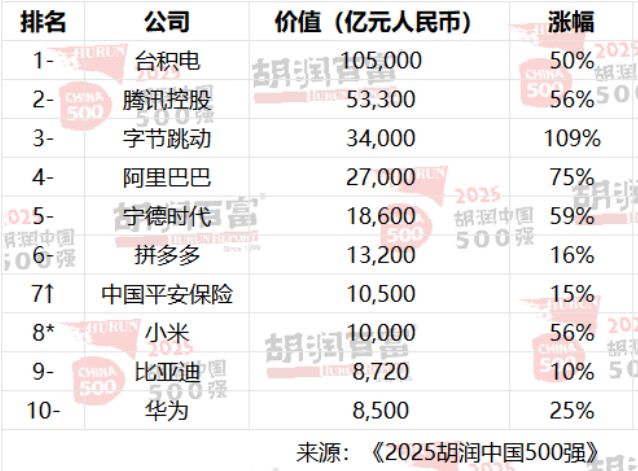
Core Insights - The latest Hurun China 500 list reveals the rankings of 500 non-state-owned enterprises in China, with a notable increase in the entry threshold to 34 billion RMB, a rise of nearly 30% compared to the previous year [1] - The list features 95 new entrants primarily from sectors such as consumer electronics, AI computing power, and new energy, while 99 companies dropped off the list, indicating a trend of fluctuation among companies [1] Group 1: Company Performance - Tencent's value reached 5.3 trillion RMB, marking a 50% increase, driven by strong performances in gaming, advertising, and fintech [2][3] - The "Shenzhen Four Sisters"—Huawei, BYD, Tencent, and China Ping An—are all in the top 10, with values of 850 billion RMB, 872 billion RMB, and 1.05 trillion RMB respectively, reflecting the resilience of Shenzhen's economy [3] - DJI, headquartered in Shenzhen, saw its value double due to its strong position in the consumer drone market and growth in overseas markets [5] Group 2: Industry Trends - The real estate sector saw a decline, with the number of listed companies dropping from 19 to 12 [1] - The Yangtze River Delta region has 161 companies in the Hurun China 500, accounting for 32% of the total, while the Guangdong-Hong Kong-Macau Greater Bay Area has 108 companies, representing 22% [4] - The report highlights that sectors such as AI computing, consumer electronics, innovative pharmaceuticals, and entertainment are key drivers of high-quality development in China's private economy [5]


中国平安增持中国人寿H股,持股比例增至10.12%
Bei Jing Shang Bao· 2026-02-06 12:16
Core Viewpoint - China Ping An increased its stake in China Life Insurance by purchasing approximately 10.89 million H-shares at an average price of about HKD 33.26 per share, totaling around HKD 362 million, raising its holding to 753 million shares, which is 10.12% of the company, triggering a mandatory disclosure [1] Group 1 - China Ping An's acquisition of H-shares indicates a strategic move to enhance its influence in China Life Insurance [1] - The transaction reflects a significant investment, with a total amount of approximately HKD 362 million involved [1] - Following the purchase, China Ping An's shareholding in China Life Insurance has increased to 10.12%, which is a notable threshold for regulatory disclosure [1]