NCI(601336)

Search documents
新华保险跌2.00%,成交额9.44亿元,主力资金净流出1.93亿元
Xin Lang Zheng Quan· 2025-09-15 06:09
Core Viewpoint - Xinhua Insurance's stock price has shown volatility, with a year-to-date increase of 30.41% but a recent decline in the last five and twenty trading days [1] Group 1: Stock Performance - On September 15, Xinhua Insurance's stock price fell by 2.00%, reaching 62.22 CNY per share, with a trading volume of 9.44 billion CNY and a turnover rate of 0.72% [1] - The total market capitalization of Xinhua Insurance is approximately 1940.98 billion CNY [1] - Year-to-date, the stock has increased by 30.41%, but it has decreased by 0.81% over the last five trading days and by 7.41% over the last twenty trading days [1] - Over the last sixty days, the stock price has increased by 13.27% [1] Group 2: Financial Performance - As of June 30, Xinhua Insurance reported a net profit attributable to shareholders of 147.99 billion CNY, representing a year-on-year growth of 33.53% [2] - The company has not reported any operating revenue for the first half of 2025 [2] - Cumulatively, Xinhua Insurance has distributed 359.39 billion CNY in dividends since its A-share listing, with 139.13 billion CNY distributed over the last three years [2] Group 3: Shareholder Information - As of June 30, the number of shareholders for Xinhua Insurance is 61,000, a decrease of 15.88% from the previous period [2] - The average number of circulating shares per shareholder is 34,325, which has increased by 18.96% compared to the previous period [2] - Hong Kong Central Clearing Limited is the fourth-largest circulating shareholder, holding 60.51 million shares, an increase of 6.70 million shares from the previous period [2]

大行评级|高盛:上调新华保险目标价至29港元 上调今年净利润预测
Ge Long Hui· 2025-09-15 05:16
Core Viewpoint - Goldman Sachs raised its profit forecast for New China Life Insurance by 25% for this year, reflecting better-than-expected performance in the first half and stock market gains in the third quarter [1] Group 1: Profit Forecast Adjustments - The investment bank increased its net profit forecasts for New China Life Insurance for the next two years by 6% to 7% due to a rebound in bond yields leading to slightly higher investment income [1] - The new business value forecast for the company from this year to 2027 was raised by 8% to 10%, driven by an increase in new premium sales [1] Group 2: Sales and Profitability - The increase in new business value was partially offset by a decline in profit margin due to increased contributions from the bancassurance channel [1] Group 3: Target Price and Rating - Goldman Sachs adjusted the target price for New China Life Insurance from HKD 26.5 to HKD 29 while maintaining a "Sell" rating [1]
非银周观点:市场交易美联储降息,关注贸易摩擦影响-20250915
Great Wall Securities· 2025-09-15 05:06
Investment Rating - The industry investment rating is "Outperform the Market" [3][22]. Core Viewpoints - The report indicates that macro narratives, disappointing domestic economic data for July, the Federal Reserve's open stance on interest rate cuts, and abundant market liquidity are key factors driving market strength. The report anticipates that after fluctuations, non-bank financials, represented by brokerages, are likely to show an upward trend [1][9]. - The report emphasizes the importance of focusing on the strengthening trends in the brokerage and financial IT sectors, recommending specific stocks such as Guolian Minsheng and those with valuation expansion potential like Dongfang Securities and Huatai Securities [1][10]. Summary by Sections 1. Main Points - The report covers the performance of the CSI 300 index at 4522 points (up 1.38%), the insurance index at 1288.79 points (down 0.7%), and the brokerage index at 7251.34 points (up 0.66%) for the week of September 8-12, 2025 [7]. - The report notes that the U.S. CPI for August met expectations, but initial jobless claims data was unexpectedly poor, reinforcing expectations for three interest rate cuts by the Federal Reserve before the end of the year [7][8]. 2. Key Investment Portfolio 2.1 Insurance Sector - The insurance sector is viewed as having attractive valuation recovery potential, with specific recommendations for stocks such as China Ping An, China Pacific Insurance, and New China Life Insurance [12]. 2.2 Brokerage Sector - The report highlights the potential of mid-sized securities firms benefiting from innovation and market conditions, recommending stocks like Dongfang Wealth and Zhejiang Securities. It also suggests focusing on leading firms with diversified revenue structures such as Huatai Securities and China Galaxy Securities [13].






估值具备性价比,建议关注板块优质龙头
Changjiang Securities· 2025-09-14 12:44
Investment Rating - The report maintains a positive outlook on the investment banking and brokerage industry [7] Core Insights - The recent implementation of the public fund fee reform in three phases is driving high-quality development in the industry. Brokerage firms continue to show high growth in their mid-year performance, and market enthusiasm remains high. The valuation still offers cost-effectiveness, suggesting a focus on leading companies and high-performing stocks in the sector. In the insurance sector, the overall trend supports the logic of deposit migration, increased equity allocation, and improved new policy costs, enhancing the certainty of long-term ROE improvement and accelerating valuation recovery [2][4] - From the perspective of profitability and dividend stability, the report continues to recommend Jiangsu Jinzu, which has stable profit growth and dividend rates, China Ping An, which maintains a high dividend yield, and China Pacific Insurance, which has clear advantages in business model and market position. Additionally, based on performance elasticity and valuation levels, the report recommends Xinhua Insurance, China Life, Hong Kong Stock Exchange, CITIC Securities, Dongfang Wealth, Tonghuashun, and Jiufang Zhitu Holdings [4] Summary by Sections Industry Overview - The non-bank financial index increased by 0.3% this week, with an excess return of -1.1% relative to the CSI 300, ranking 24th out of 31 industries. Year-to-date, the non-bank financial index is up 8.2%, with an excess return of -6.7%, also ranking 21st out of 31 [5] - Market enthusiasm has slightly declined, with an average daily trading volume of 23,264.15 billion yuan, down 10.63% week-on-week, and an average turnover rate of 2.45%, down 34.86 basis points [5] Key Industry News & Company Announcements - The China Securities Regulatory Commission released the "Classification Evaluation Regulations for Futures Companies" [6] - Company announcements include Guosen Securities completing the registration procedures for issuing new shares to acquire 96.08% of Wanhe Securities, and Xibu Securities completing the transfer of shares for the acquisition of Guorong Securities [6] Brokerage Data Tracking - The report highlights a slight recovery in margin financing, with a balance of 2.34 trillion yuan, up 2.67% week-on-week. The stock pledge market remains cautious, with expectations of continued contraction in stock pledge scale, but improved asset yield rates are anticipated to enhance income performance [45][49]



“报行合一”+政策松绑,上市险企银保渠道业绩倍增!
Sou Hu Cai Jing· 2025-09-14 02:46
Core Viewpoint - The significant growth in the bancassurance channel's performance in the first half of 2025 is a common characteristic among the five major listed insurance companies in A-shares, driven by factors such as "reporting and banking integration," strong demand for wealth management, and the recovery of the "one-to-many" model in bancassurance [1][6]. Group 1: Performance Metrics - China Ping An's bancassurance channel NBV increased by 168.6% year-on-year [3] - China Life's new single premium in the bancassurance channel grew by 111.1% year-on-year [3] - China Pacific Insurance's new insurance business in the bancassurance channel rose by 95.6% [3] - New China Life's first-year premium for long-term insurance in the bancassurance channel surged by 150.3% [3] - China People's Insurance's NBV on a comparable basis increased by 107.7% year-on-year [3] Group 2: Factors Driving Growth - Three main factors are driving the significant growth in the bancassurance channel: 1. "Reporting and banking integration" enhances the business value of the bancassurance channel [6] 2. The low-interest-rate environment has led to strong demand for wealth management, with insurance products offering relative advantages over bank deposits [6] 3. The recovery of the "one-to-many" model has opened up growth opportunities [6] Group 3: Channel Strategy - The bancassurance channel is becoming a consensus among listed insurance companies, with significant increases in both the number of partnerships with banks and per capita productivity [3][4] - The diversification of bancassurance channels is a growing trend, with a focus on not only state-owned and joint-stock banks but also city commercial banks and rural commercial banks [4] - The insurance industry is shifting towards a multi-channel strategy, recognizing the need to cater to different customer segments through various distribution channels [8]



2025年1-7月贵州省原保险保费收入共计395.89亿元,同比增长2.88%
Chan Ye Xin Xi Wang· 2025-09-14 02:44
Core Insights - The insurance premium income in Guizhou Province from January to July 2025 reached 39.589 billion yuan, showing a year-on-year growth of 2.88% [1] - Life insurance accounted for the highest share of the total insurance premium income in Guizhou, amounting to 15.828 billion yuan, which represents 39.98% of the total [1] Company Insights - Listed companies mentioned include Tianmao Group (000627), China Ping An (601318), China Pacific Insurance (601601), China Life (601628), China Insurance (601319), and Xinhua Insurance (601336) [1] - The report by Zhiyan Consulting provides an analysis of the development and investment prospects of the Chinese insurance industry from 2025 to 2031 [1] Industry Insights - The cumulative original insurance premium income in Guizhou Province from 2020 to July 2025 is illustrated in a statistical chart [1] - Zhiyan Consulting is recognized as a leading industry consulting firm in China, specializing in in-depth industry research and providing comprehensive consulting services for investment decisions [1]



金融监管总局印发《金融机构消费者权益保护监管评价办法》;泰康、平安等5家登上财富最受赞赏中国公司榜单|13精周报
13个精算师· 2025-09-13 02:08
Regulatory Dynamics - Three departments will jointly conduct a financial education publicity week from September 15 to 21, 2025, focusing on enhancing financial knowledge and protecting consumer rights [6] - Two departments announced a list of pilot projects for intelligent elderly care service robots, including 32 key technology projects [7] - The Financial Regulatory Bureau revised the consumer rights protection evaluation method for financial institutions, introducing seven evaluation elements [10] - The Central Bank will increase financial support for regions undergoing comprehensive reform trials for market-oriented resource allocation [12] - Beijing Shunyi will provide up to 50 million for new registered financial institutions [13] Company Dynamics - China Ping An increased its stake in Postal Savings Bank of China to 16.01% by purchasing 7,068.81 million HKD worth of shares [19] - Great Wall Life raised its stake in New天绿色能源 to 11.11% with an investment of 1,271.97 million HKD [20] - China Pacific Insurance plans to issue 155.56 billion HKD in zero-coupon convertible bonds to support its insurance business [23] - China Life Asset Management initiated a debt investment plan worth 2.1 billion for the Longxi口航电 hub project [24] - China Taiping showcased its achievements at the 2025 Service Trade Fair [29] Industry Dynamics - The insurance industry saw a 43.61% year-on-year increase in penalties in August 2025, totaling 44.33 million [49] - Insurance companies have issued over 273 billion HKD in zero-coupon convertible bonds this year [50] - Insurance capital is increasingly being allocated to ETFs, with a significant rise in holdings [51] - The trend of "insurance buying insurance" is re-emerging, with insurers increasing equity asset allocations [53] - 86 property insurance companies reported a combined net profit of over 527 billion, with only 8 companies reporting losses [64] Product and Service Innovations - Ping An Life launched the e生保 series of medical insurance products, featuring a new "安有医" service [67] - China Life introduced a new mid-range medical insurance product [66] - The "沪家保3.0" product was launched, increasing total coverage by nearly 15% without changing the premium [66]

新华保险(601336):银保NBV贡献过半 投资业绩持续释放
Xin Lang Cai Jing· 2025-09-12 12:33
Core Viewpoint - Xinhua Insurance reported a strong performance in the first half of 2025, with revenue and net profit attributable to shareholders increasing by 26.0% and 33.5% to 70 billion and 14.8 billion respectively, despite a 13.3% decline in net assets compared to the beginning of the year, which showed a recovery of 4.5% from the end of Q1 [1] Group 1: Business Performance - The new business value (NBV) growth for life insurance reached 58.4%, driven by significant increases in first-year premiums and single premiums, which grew by 65% and 353% respectively [2] - The contribution of the bancassurance channel to NBV reached 52.8%, indicating a strong focus on partnerships with banks to enhance distribution capabilities [2] - The individual insurance sales team showed stabilization in numbers and performance, with nearly 20,000 new hires in the first half of the year, a year-on-year increase of 182% [2] Group 2: Investment Performance - Investment performance was a key driver of profit growth, with investment income increasing by 82.3%, highlighting the importance of investment strategies for Xinhua Insurance [3] - The total investment return rate rose by 1.1 percentage points to 5.9%, with realized gains being a significant contributor compared to the previous year [3] - As of June 30, the core secondary equity investments accounted for approximately 21% of total assets, with a notable contribution from the long-term investment pilot program, which has yielded significant returns [3] Group 3: Profit Forecast and Valuation - The overall performance of Xinhua Insurance in the first half of 2025 indicates strong data on both the liability and investment sides, with expectations for improved value rates under new regulatory frameworks [4] - Projected net profits for 2025-2027 are estimated at 29.7 billion, 28.6 billion, and 30.3 billion respectively, with year-on-year growth rates of 13.3%, -3.7%, and 6.1% [4] - The current price-to-embedded value (PEV) ratios are projected to be 0.68, 0.62, and 0.57 for the years 2025-2027, maintaining a "buy" rating [4]
中长期资金入市提速!5家险企股票配置增逾28%、国内ETF破5万亿元
Cai Jing Wang· 2025-09-12 10:54
Group 1 - The core viewpoint of the articles highlights the increasing participation of long-term funds, such as insurance funds and public funds, in the capital market, which is expected to stabilize market volatility and enhance resource allocation efficiency [1][2][3] - The regulatory framework has been strengthened to encourage long-term investments, with measures like implementing longer assessment periods for insurance companies and increasing the proportion of equity funds [2][3] - The stock investment amount of the five major listed insurance companies reached 1.846429 trillion yuan, reflecting a growth of 28.71% compared to the beginning of the year, indicating a positive trend in the insurance sector's investment behavior [2][3] Group 2 - The total scale of public funds in China reached 35.08 trillion yuan, marking a significant increase and reflecting a shift towards rational, long-term investment strategies [4] - The domestic ETF market has also seen substantial growth, with the total scale surpassing 5 trillion yuan, an increase of over 34% from the end of 2024, indicating a growing preference for index-based investments [4][5] - Institutional investors have increased their holdings in equity funds, with the proportion rising from 34.44% to 40.49% year-on-year, showcasing a trend towards more stable investment behaviors [6] Group 3 - The enterprise annuity market is gradually increasing its investment in equities, with a current A-share investment ratio of about 14%, suggesting potential for significant growth in long-term equity investments [7] - The long-term assessment mechanisms are expected to enhance the equity asset allocation of enterprise annuity funds, contributing to the overall stability and growth of the capital market [7]
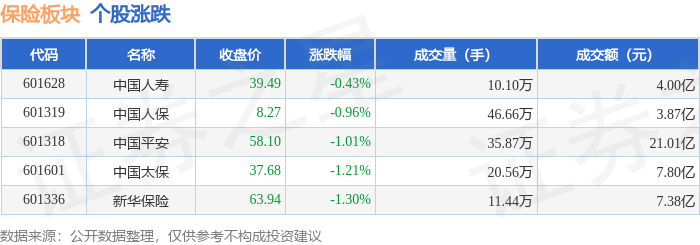
保险板块9月12日跌1.51%,新华保险领跌,主力资金净流出9.95亿元
Zheng Xing Xing Ye Ri Bao· 2025-09-12 08:38
Core Viewpoint - The insurance sector experienced a decline of 1.51% on September 12, with New China Life leading the drop, while the overall market indices showed slight increases [1] Group 1: Market Performance - The Shanghai Composite Index closed at 3883.69, up 0.22% [1] - The Shenzhen Component Index closed at 12996.38, up 0.13% [1] - The insurance sector's individual stock performance showed declines across major companies, with China Life down 0.43%, China Pacific down 1.21%, and New China Life down 1.30% [1] Group 2: Trading Volume and Capital Flow - The insurance sector saw a net outflow of 9.95 billion yuan from main funds, while retail investors contributed a net inflow of 4.65 billion yuan [1] - The trading volume for major insurance stocks included China Life with 10.10 million shares traded and a transaction value of 400 million yuan [1] - The capital flow data indicated that China Life had a significant net outflow of 1.56 billion yuan from main funds, while retail investors had a net inflow of 805.25 million yuan [2]