
CPIC(601601)

Search documents
中国太保:董事会同意聘任刘龙为首席投资官(总经理助理)
Zheng Quan Shi Bao Wang· 2025-12-31 09:46
人民财讯12月31日电,中国太保(601601)12月31日公告,公司已召开董事会会议,同意聘任刘龙为公 司首席投资官(总经理助理),聘期至本届董事会届满。刘龙担任公司首席投资官(总经理助理)的任职资 格须得到监管机构核准,在其任职资格得到核准前,苏罡将继续履行首席投资官职责。 ...
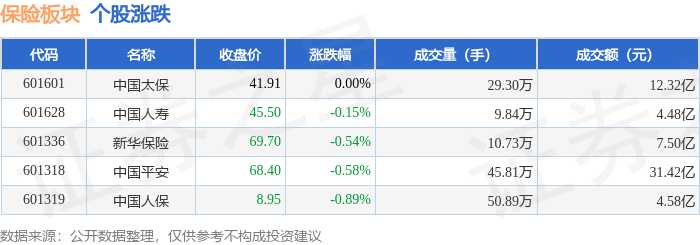
保险板块12月31日跌0.38%,中国人保领跌,主力资金净流出5亿元
Zheng Xing Xing Ye Ri Bao· 2025-12-31 09:07
Core Viewpoint - The insurance sector experienced a decline of 0.38% on December 31, with China Life Insurance leading the losses, while the overall market showed mixed results with the Shanghai Composite Index slightly up by 0.09% and the Shenzhen Component Index down by 0.58% [1] Group 1: Market Performance - The Shanghai Composite Index closed at 3968.84, reflecting a 0.09% increase [1] - The Shenzhen Component Index closed at 13525.02, showing a 0.58% decrease [1] - The insurance sector's individual stock performance varied, with China Life Insurance down by 0.15% and China Ping An down by 0.58% [1] Group 2: Stock Data - China Pacific Insurance (601601) closed at 41.91 with no change in price [1] - China Life Insurance (601628) closed at 45.50, down 0.15% with a trading volume of 98,400 shares and a transaction value of 448 million [1] - New China Life Insurance (601336) closed at 69.70, down 0.54% with a trading volume of 107,300 shares and a transaction value of 750 million [1] - China Ping An (601318) closed at 68.40, down 0.58% with a trading volume of 458,100 shares and a transaction value of 3.142 billion [1] - China Reinsurance (601319) closed at 8.95, down 0.89% with a trading volume of 508,900 shares and a transaction value of 458 million [1] Group 3: Fund Flow Analysis - The insurance sector saw a net outflow of 500 million from main funds, while retail investors contributed a net inflow of 305 million [1] - The detailed fund flow for individual stocks showed significant outflows for China Life Insurance and China Pacific Insurance, while retail investors showed positive net inflows for several stocks [2] - China Life Insurance had a main fund net inflow of 4.56 million, while China Reinsurance experienced a net outflow of 32.41 million from main funds [2]





保险行业2026年度投资策略:赤羽乘风,资负排云
EBSCN· 2025-12-31 09:05
Group 1 - The insurance sector is expected to deepen its transformation and maintain a recovery trend in fundamentals through 2026 [4][7] - In 2025, the insurance sector outperformed the market with a cumulative increase of 27.0%, surpassing the CSI 300 index by 8.8 percentage points, driven by strong growth in new business value (NBV) and improved investment returns [5][10] - The life insurance segment is seeing a stabilization in agent workforce and positive growth in new policies, supported by bank insurance and improved NBV margins [5][20] Group 2 - The property insurance segment is experiencing a slowdown in premium growth but is optimizing its business structure, with a focus on non-auto insurance [22] - The investment side of the insurance companies is benefiting from a rising equity market, with a projected increase in total investment returns and net profits expected to rise by 33.5% year-on-year for the first three quarters [5][7] - The high savings preference among residents and the reduction in bank deposit rates are expected to make participating insurance products with a guaranteed return of 1.75% more competitive in the market [7][8] Group 3 - The life insurance sector is projected to see continued growth in new business value, driven by the popularity of participating insurance products and the effective management of costs through the "reporting and operation integration" strategy [5][20] - The property insurance sector is expected to maintain its favorable conditions, with the "reporting and operation integration" policy further optimizing the combined ratio (COR) [5][22] - Investment strategies focusing on high dividend yields are anticipated to provide a safety net for net investment income, contributing to profit stability [7][8]


保险业2025年十大关键词,看这里!
券商中国· 2025-12-31 08:55
Core Viewpoint - The insurance industry in 2025 has achieved record highs in both scale and profitability, driven by practical reforms and a focus on rational management, while facing cyclical challenges [1]. Group 1: Industry Growth and Performance - As of October 2025, the total assets of the insurance industry reached 40.59 trillion yuan, an increase of 4.68 trillion yuan from the beginning of the year, marking a growth rate of 13.03% [4]. - The insurance sector has seen a continuous double-digit growth in total assets since 2023, attributed to rising premium income, cost optimization, enhanced capital replenishment, and improved asset allocation [4]. - The total premium income for 2025 is projected to be 57.63 billion yuan, reflecting a significant increase from previous years [2]. Group 2: Stock Market Performance - Insurance stocks have reached new highs in 2025, with major companies like China Ping An and China Life Insurance leading the market, contributing to a combined market value exceeding 3.3 trillion yuan, a nearly 30% increase from the beginning of the year [6][7]. - The net profit of five major listed insurance companies reached 426 billion yuan in the first three quarters of 2025, a year-on-year increase of 33.5%, setting a historical record [8]. Group 3: Industry Reforms - The insurance industry is actively engaging in "anti-involution" measures, focusing on rational competition and risk management rather than price wars, particularly in the auto insurance sector [10]. - The introduction of a dynamic adjustment mechanism for predetermined interest rates in insurance products has begun, with rates decreasing from 2.34% at the beginning of the year to 1.90% by the end of 2025 [19][18]. - The return of dividend insurance products has gained traction, with nearly half of new life insurance products being dividend-based, reflecting a shift in market strategy [21]. Group 4: Long-term Investment Strategies - The insurance sector is increasingly focusing on long-term investments, with regulatory changes encouraging a longer assessment period for performance metrics [12]. - By the end of 2025, the proportion of equity assets in insurance investments reached a historical high, with stock and fund allocations growing significantly [14]. Group 5: International Expansion - The insurance industry is entering a phase of internationalization, with companies exploring overseas markets, particularly in high-end equipment insurance and personal travel safety [22]. - The export of new energy vehicles has surged by 89.4% in the first three quarters of 2025, prompting insurance companies to expand their offerings in this sector [24]. Group 6: New Regulatory Frameworks - The release of the fourth life table in October 2025 will impact insurance product pricing and risk management, reflecting changes in population structure and mortality rates [26][27]. - The first commercial health insurance drug directory was published in December 2025, aiming to clarify the boundaries between basic medical insurance and commercial health insurance, thus promoting a multi-tiered medical security system [29].

万亿资本聚力锚定“双碳”未来 上市险企500万亿保额护航绿色转型
Chang Jiang Shang Bao· 2025-12-31 02:43
Core Viewpoint - The insurance industry is playing a crucial role in promoting the green transformation of the economy and society under the "dual carbon" strategy, with listed insurance companies leading the way in green upgrades across products, services, investments, and operations [2]. Group 1: Green Insurance Development - Listed insurance companies in China have made significant progress in the field of green insurance, with the five major A-share insurers providing a total of 496.24 trillion yuan in green insurance coverage across key areas such as clean energy and carbon sink protection [3]. - China Ping An reported a total premium income of 629.3 billion yuan from sustainable insurance by the end of 2024, with green insurance premiums reaching 58.6 billion yuan, marking a nearly 57% year-on-year increase [3]. - China Pacific Insurance has also been active in climate change response and environmental pollution management, offering approximately 147 trillion yuan in green insurance coverage and developing over 30 innovative insurance products [3][4]. Group 2: Green Investment Initiatives - The five major listed insurers have collectively surpassed 1 trillion yuan in green investment, focusing on sectors such as energy conservation, clean energy, and ecological environment upgrades [4]. - China Life has invested nearly 535 billion yuan in green projects, including over 300 billion yuan in green bonds, and has initiated ESG-focused financial asset management plans exceeding 2 billion yuan [5]. - The insurance sector is utilizing a dual approach of "insurance + investment" to effectively manage environmental and social risks while directing resources towards green industries, thereby supporting the low-carbon transition of the economy [5].

险企密集“去监事会” 保险业公司治理变革深化
Jin Rong Shi Bao· 2025-12-31 01:52
Core Viewpoint - The insurance industry is undergoing a significant transformation with the "exit of the supervisory board," as many companies are abolishing this governance structure to enhance efficiency and adapt to new regulatory requirements [2][4]. Group 1: Changes in Governance Structure - As of December 25, 2023, 13 insurance companies, including China Life and China Pacific Insurance, have announced the abolition of their supervisory boards, marking a profound change in the long-standing "three meetings and one layer" governance framework [2][3]. - The trend began with Japan's insurance company in April 2023, which was the first to announce the removal of the supervisory board, followed by state-owned insurance groups [2][3]. - By December 2023, major companies like China Life and New China Life had completed the necessary regulatory approvals to officially abolish their supervisory boards [3][4]. Group 2: Policy and Regulatory Drivers - The reform is driven by the new Company Law effective July 2024, allowing state-owned companies to replace supervisory boards with audit committees, which can enhance governance efficiency [4]. - The China Banking and Insurance Regulatory Commission issued a notice in December 2024, clarifying that financial institutions can establish audit committees to perform the functions of supervisory boards [4]. Group 3: Motivations Behind the Reform - The primary motivations for abolishing supervisory boards include the need to reduce costs, improve efficiency, and address issues of overlapping functions and formalized supervision [4]. - The transition is not seen as a reduction in oversight but rather a restructuring of the supervisory system, with audit committees taking over the responsibilities of the supervisory boards [4]. - The industry anticipates that this reform will enhance compliance and risk management capabilities, contributing to the high-quality development of the insurance sector [4].
中国分红险发展的前世今生:低利率时代的重逢
Soochow Securities· 2025-12-30 10:06
Investment Rating - The report maintains an "Accumulate" rating for the insurance sector [1]. Core Insights - The report discusses the evolution of participating insurance in China, highlighting its significance in a low-interest-rate environment and the shift towards floating yield products, which are gaining traction among domestic investors [2][6]. Summary by Sections 1. What is Participating Insurance? - Participating insurance is a type of insurance that combines protection and investment, allowing policyholders to share in the insurer's surplus [12]. - The operational mechanism involves sharing profits derived from better-than-expected performance, with a minimum of 70% of the surplus distributed to policyholders [6][15]. 2. Historical Development of Participating Insurance in Mainland China - The development of participating insurance has seen significant fluctuations influenced by policy and market factors, with its market share peaking at 75% in 2010 before declining due to market reforms [6][45]. - Since 2024, regulatory policies have encouraged the development of floating yield products, marking a consensus in the industry towards transitioning to participating insurance [6][45]. 3. Current Transition of Participating Insurance - The report anticipates that the proportion of participating insurance will continue to rise, with over 50% of new policies in the first half of 2025 being participating insurance [6][45]. - The transition is expected to alleviate pressure from interest rate losses and enhance the reliability of the insurance sector's embedded value (EV) [6][45]. 4. International Experience - In mature markets, floating yield products dominate, with Hong Kong's participating insurance being a core component, accounting for 85% of new premiums in 2024 [2][6]. - The report suggests that the characteristics of participating insurance in Hong Kong, such as multi-currency support and a design of low guarantees with high floating returns, could serve as a model for the mainland market [2][6]. 5. Key Metrics for Evaluating Participating Insurance - The report outlines four key indicators for assessing the performance of participating insurance: 1. **Guaranteed Rate**: Currently set at 1.75%, which is lower than traditional insurance [23]. 2. **Demonstration Rate**: Reflects expected returns, with current rates around 3.5% to 4% [24]. 3. **Actual Yield**: The industry average is capped at 3.2%, with some companies exceeding this limit [27]. 4. **Dividend Realization Rate**: Increased by 11 percentage points to 62% in 2024, indicating improved management and expectation guidance [29].

《保险公司资产负债管理办法(征求意见稿)》点评:资负管理的战略定位进一步提级
Shenwan Hongyuan Securities· 2025-12-30 09:33
Investment Rating - The report maintains an "Overweight" rating for the insurance industry, indicating a positive outlook for the sector's performance relative to the overall market [3]. Core Insights - The strategic positioning of asset-liability management for insurance companies has been elevated, with the introduction of the "Insurance Company Asset-Liability Management Measures (Draft for Comments)" by the Financial Supervisory Authority [2]. - The draft emphasizes three main goals for asset-liability management: matching the term structure, cost-benefit matching, and liquidity matching, with insurance companies bearing primary responsibility and the authority overseeing compliance [2]. - The governance structure requires clear delineation of responsibilities for the board of directors and senior management, establishing an asset-liability management committee and department within insurance companies [2]. - The report highlights the importance of asset-liability management in mitigating interest spread risks, especially in a declining interest rate environment, and aims to enhance the risk warning mechanism for insurance operations [2]. Summary by Sections Regulatory and Monitoring Indicators - For property and casualty insurance companies, there are three regulatory indicators focusing on income-cost coverage and liquidity, all of which must not fall below 100% [5]. - For life insurance companies, four regulatory indicators are established, including effective duration gap and comprehensive investment income coverage, also requiring a minimum of 100% [5]. Valuation of Key Companies - The report provides a valuation table for key non-bank financial companies, including China Life, Ping An, and China Pacific Insurance, with metrics such as market capitalization and price-to-earnings ratios [6]. - For instance, China Life has a market capitalization of 115.02 billion RMB and a PE ratio of 7.66, while Ping An has a market capitalization of 119.24 billion RMB and a PE ratio of 9.02 [6]. Investment Recommendations - The report continues to recommend several major insurance companies, including China Life (H), Ping An (A/H), China Pacific Insurance, China People’s Insurance, New China Life, and China Property Insurance, while suggesting to pay attention to China Taiping [3].
中信期货上海湖滨路分公司落地云南怒江兰坪“保险+期货”项目
Qi Huo Ri Bao Wang· 2025-12-30 09:29
Core Insights - The project "Insurance + Futures" launched by CITIC Futures and China Pacific Insurance in Lanping County, Nujiang Prefecture, aims to mitigate core operational risks for local pig farmers by using feed prices as the insured target [1] - The initiative leverages aid funds to cover core costs, facilitating a precise linkage between policy resources and financial tools, thus helping farmers stabilize operational expectations and lock in breeding costs [1] Group 1 - The project focuses on transferring the risk of rising feed prices to the futures market, providing a financial "safety net" for pig farmers [1] - The introduction of aid funds significantly lowers the participation threshold for local farmers, ensuring that financial protection services are accessible and burdensome [1] - CITIC Futures conducted in-depth research on local industry pain points to customize risk management solutions that meet the actual needs of pig farming in Lanping County [1] Group 2 - CITIC Futures plans to continue deepening the application of the "Insurance + Futures" model, expanding project coverage and enriching the types of protection offered [2] - The company aims to provide more precise financial services that align with rural industry needs, contributing to poverty alleviation and rural revitalization efforts [2]
中信期货启动云南怒江兰坪“保险+期货”项目
Zhong Zheng Wang· 2025-12-30 07:53
据介绍,中信期货上海湖滨路分公司作为中信期货深耕区域市场的业务单元,此次落地项目是其践行普 惠金融责任、赋能县域产业的具体举措。项目的顺利推进,既发挥了期货市场的风险管理功能,也让金 融活水真正滴灌至田间地头,为兰坪县生猪养殖产业的稳定发展提供了专业支撑。 展望未来,中信期货相关人士表示,公司将持续深化"保险+期货"模式的落地应用,扩大项目覆盖范 围、丰富保障品类,以更精准的金融服务对接乡村产业需求,为巩固脱贫成果、推进乡村振兴贡献期货 力量。 中证报中证网讯(记者胡雨王超)近日,中信期货有限公司上海湖滨路分公司联合中国太平洋财产保险股 份有限公司,启动了在云南省怒江州兰坪县落地的"保险+期货"价格险项目,力争为当地生猪养殖产业 送上金融"定心丸"。 此次项目聚焦兰坪县生猪养殖户的核心经营风险,以饲料价格为保障标的,通过引入援滇资金覆盖项目 核心成本,实现了"政策资源+金融工具"的精准联动:一方面借助"保险+期货"模式,将饲料价格上涨风 险转移至期货市场,帮助养殖户锁定养殖成本、稳定经营预期;另一方面,项目依托援滇资金的加持, 大幅降低了当地农户的参与门槛,让金融保障服务真正"轻负担、广覆盖"地触达产业一线。 ...