China Life(601628)

Search documents
金融之力 破瘠成沃 八桂大地奏响乡村产业振兴进行曲
Jin Rong Shi Bao· 2026-01-07 02:10
Core Viewpoint - The article discusses the transformation of rural assets in Guangxi, China, through financial innovation and technology, addressing the challenges faced by the agricultural sector and enhancing the connection between finance and rural industries [1][6][12]. Group 1: Challenges in Rural Development - Rural industries in Guangxi face multiple challenges, including dormant assets that are difficult to monetize and a lack of standardized valuation systems for livestock and aquaculture [3][5]. - Natural and market risks significantly impact agricultural production, making it vulnerable to environmental changes and price fluctuations, which complicates traditional financing models [4][5]. - The local sugar industry, despite being a major contributor to national production, struggles with financing issues that hinder its competitiveness and growth [5]. Group 2: Financial Innovations and Solutions - To address these challenges, Guangxi has implemented innovative financial practices, such as issuing property rights certificates for aquaculture, which allows farmers to secure loans based on clearly defined assets [6][7]. - Advanced technologies, like AI facial recognition for livestock, have been introduced to create unique digital identities for animals, facilitating better insurance and financing options [7][12]. - A collaborative financial model has been developed, combining insurance, credit, and government support to provide comprehensive financial services to farmers, resulting in significant loan amounts being disbursed [8][11]. Group 3: Economic Growth and Sustainability - The integration of supply chain finance and the development of specialized credit products have been emphasized to support local agricultural sectors, ensuring timely payments and reducing financing costs for farmers [8][12]. - E-commerce initiatives have been established to enhance the marketing of local agricultural products, providing training for villagers to improve their sales techniques and increase income [9]. - The overall financial ecosystem in Guangxi is evolving towards a more systematic approach, focusing on long-term sustainability and resilience in rural economic development [10][12].

临沂监管分局同意中国人寿临沂分公司商城营销服务部变更营业场所
Jin Tou Wang· 2026-01-07 01:59
一、同意中国人寿保险股份有限公司临沂分公司商城营销服务部将营业场所变更为:山东省临沂市兰山 区柳青街道(北城新区)广州路以南、沂蒙路以西曲沂社区沿街。 2025年12月30日,国家金融监督管理总局临沂监管分局发布批复称,《关于中国人寿保险股份有限公司 临沂分公司商城营销服务部营业场所地址变更的请示》(国寿人险临发〔2025〕130号)收悉。经审核, 现批复如下: 二、中国人寿保险股份有限公司应按照有关规定及时办理变更及许可证换领事宜。 ...
金融之力 破瘠成沃
Jin Rong Shi Bao· 2026-01-07 01:46
Core Viewpoint - The article highlights the transformation of rural assets in Guangxi through financial innovation and technology, addressing the challenges faced by the agricultural sector and promoting sustainable development in rural areas [1][11][21]. Group 1: Challenges in Rural Development - Rural areas in Guangxi face multiple challenges, including asset dormancy and industry shackles, which hinder development [4]. - The lack of standardized valuation systems for livestock and other agricultural assets makes it difficult for farmers to secure loans from traditional banks [5]. - Natural and market risks, such as flooding and price volatility, further exacerbate the vulnerability of agricultural production [6][8]. Group 2: Financial Innovations and Solutions - Financial institutions are innovating by developing policy insurance for local agricultural products, such as the "富硒星油藤" brand, which has secured insurance coverage of 4.1592 million yuan for 1,040 acres [3]. - The introduction of property rights certificates for aquaculture has allowed farmers to convert their rights into collateral, facilitating access to credit [11][12]. - Advanced technologies, such as AI facial recognition for livestock, have improved the efficiency of insurance and loan processes, enabling better risk management [12]. Group 3: Collaborative Financial Ecosystem - A collaborative model involving insurance, credit, and government support has been established to address financing challenges in the agricultural sector [12][21]. - The implementation of tailored financial products, such as marine carbon sink loans and index insurance for aquaculture, has been initiated to support specific agricultural needs [15][21]. - The establishment of e-commerce platforms and training programs for local farmers aims to enhance market access and sales of agricultural products [16][18]. Group 4: Systematic Policy Support - The People's Bank of China has implemented policies to provide financial resources to the agricultural sector, including fiscal subsidies and risk compensation mechanisms [19]. - The promotion of digital credit profiles for farmers has facilitated access to unsecured loans, significantly increasing loan amounts for agricultural projects [20]. - The establishment of a financial service command center for the sugar industry has led to the development of specialized financing models that support the entire supply chain [21].



险企开门红数据向好,行业迎资产负债双向改善阶段
Jin Rong Jie· 2026-01-07 01:00
Core Viewpoint - The individual insurance sector has shown strong performance in new policy premium growth, with leading companies like China Life, Ping An, Taikang, and Xinhua experiencing a growth rate of 40-60% in new individual insurance premiums as of January 1, 2026 [1][2] Market Environment - The continuous decline in bank deposit rates and the scarcity of medium to long-term deposit supply have made insurance products more attractive as low-risk savings alternatives, leading to a "deposit migration" effect [1] - A significant amount of fixed-term deposits will mature in 2026, further enhancing the appeal of insurance products [1] Product Structure - The introduction of a dynamic adjustment mechanism for the guaranteed interest rate in 2025 has led to a rapid rise in participating insurance products, which combine guaranteed returns with floating dividends [1] - From September to December 2025, participating insurance products accounted for 46% of newly launched life insurance, becoming a core driver of new policy growth [1] Policy Environment - The "reporting and operation integration" policy in the life insurance sector has curbed vicious price competition, shifting the focus of industry competition towards value-added services [1] - Regulatory adjustments have reduced the risk factors associated with equity investments for insurance companies, laying a foundation for improvements in the asset side of the industry [1] Future Outlook - The liability side of insurance companies is expected to maintain high prosperity, with strong demand for participating and savings-type insurance continuing [1] - The asset side is anticipated to benefit from a slow bull market in equities, with institutions predicting that new equity allocations by insurance funds in A-shares could reach between 300 billion to 770 billion yuan in 2026 [1] - The industry is entering a phase of "dual resonance" development on both the liability and asset sides [1]


“中保”盘点2025⑥中国资产大爆发!险资与股市如何相互成就?
Sou Hu Cai Jing· 2026-01-06 20:10
Core Viewpoint - The A-share market has started 2026 with strong performance, reaching a ten-year high, driven by active insurance stocks and favorable policies for long-term investments in the insurance sector [2][3]. Group 1: Insurance Market Performance - In the first two trading days of 2026, major insurance stocks such as New China Life, China Pacific Insurance, and Ping An Insurance saw significant gains, with increases of 15.93%, 12.98%, and 8.65% respectively [2]. - The year 2025 was marked by active participation of insurance capital in the market, with the Shanghai Composite Index rising by 18.41%, and the total trading volume in the A-share market exceeding 400 trillion yuan, a year-on-year increase of over 60% [2]. Group 2: Policy Support - Starting from September 2024, a series of favorable policies have been introduced to encourage insurance capital to enter the market, culminating in the "9·24 market" phenomenon [4]. - In January 2025, a joint implementation plan was issued to guide long-term funds, including insurance capital, to increase market participation [4]. Group 3: Regulatory Adjustments - In April 2025, the regulatory authority raised the upper limit for equity asset allocation for insurance funds, allowing for greater investment flexibility [5]. - By December 2025, further adjustments were made to reduce risk factors for long-held stocks, encouraging insurance companies to maintain longer positions in the market [6]. Group 4: Investment Trends - In 2025, insurance capital made at least 33 significant investments in listed companies, a notable increase from 20 in 2024, with a focus on sectors like banking and utilities that align with their long-term investment strategies [7][8]. - The trend of long-term investment reform was highlighted, with insurance institutions establishing private equity funds to invest in the stock market [8][9]. Group 5: Future Outlook - The investment environment for insurance capital is expected to evolve, with continued low interest rates prompting a shift towards equity investments, particularly in high-dividend stocks [12][14]. - The introduction of new accounting standards in 2026 will allow insurance companies to recognize stock dividends in their profit statements, further promoting long-term investment strategies [13][14].



耐心资本助力产业体系再升级 险资踏足并购基金又添新例
Zheng Quan Shi Bao· 2026-01-06 18:15
Group 1 - The core viewpoint of the articles highlights the increasing involvement of insurance capital in the mergers and acquisitions (M&A) fund sector, with notable examples such as China Life Asset Management's investment in the Shanghai Chip Integration Fund [1][2] - The investment by China Life Asset Management, amounting to approximately 500 million yuan, aims to support the integration of the integrated circuit industry, particularly focusing on the critical EDA software sector [2] - Other insurance institutions, such as China Pacific Insurance and Ping An Life, are also establishing their own M&A funds, indicating a growing trend among insurance companies to explore this investment avenue [3][4] Group 2 - The M&A market is becoming increasingly active, driven by policy support and market demand, particularly following the release of the "Six Guidelines for Mergers and Acquisitions" by the China Securities Regulatory Commission in 2024 [4] - A report indicates that the structure of China's equity investment market is undergoing significant changes, with a shift towards M&A investments as a core focus for future development [4][6] - The report also notes that while insurance capital currently plays a limited role in M&A funds, it is expected to become a more significant player in the future, optimizing asset allocation for long-term investors [5][6][7]
上市险企新旧准则切换所得税切换测算:OCI选择权的两面性,税务追溯对现金流影响有限
ZHONGTAI SECURITIES· 2026-01-06 13:32
Investment Rating - The industry investment rating is "Increase Holding" [2] Core Viewpoints - The tax adjustment for listed insurance companies has a limited overall impact, primarily affecting cash flow rather than profit and loss statements or balance sheets [5][10] - The new accounting standards provide insurance companies with an OCI option, which reduces the impact of interest rate fluctuations on net profit [5] - The average effective tax rate for listed insurance companies has been low, with rates of 10%, 8%, -1%, -6%, 12%, and 17% from 2020 to Q3 2025, indicating a disconnect between tax burdens and actual operating performance [5][12] - The estimated taxable profit difference for listed companies under the new and old standards is projected to be 42 billion in 2023 and 93 billion in 2024, with a significant portion of this difference being attributable to insurance contracts [5][18] Summary by Relevant Sections Tax Adjustment Impact - The tax adjustment is expected to have a minimal effect on operating cash flow, with an average impact of 2.27% across listed insurance companies [5][18] - Specific companies like New China Life and China Life may experience a more significant impact, estimated at around 14% for New China Life [5][18] Financial Performance - The listed insurance companies have seen record high pre-tax profits in the first three quarters of 2025, exceeding the total profits of 2024 [11] - The actual income tax paid has not kept pace with rising profits, indicating a potential for future tax liabilities [12] Recommendations - The report suggests focusing on companies such as China Life (A/H), Ping An (A/H), China Pacific Insurance (A/H), New China Life (A/H), and China Property & Casualty Insurance (A/H) for investment opportunities [5]
6年撤销超1.3万家分支机构,险企“瘦身”持续
Mei Ri Jing Ji Xin Wen· 2026-01-06 12:17
Core Viewpoint - The insurance industry is undergoing significant restructuring, with a notable number of branch offices being closed, driven by cost-cutting measures and the shift towards digital services [1][2][3]. Group 1: Branch Office Closures - In 2025, a total of 3,102 insurance branch offices were closed, contributing to a total of 13,379 closures from 2020 to 2025 [1][2]. - Major insurance companies, such as China Life, have seen substantial closures, with approximately 800 branches shut down in 2025 alone [2]. - The closures have primarily affected marketing service departments, which are easier to eliminate due to their singular functions [1][3]. Group 2: Reasons for Closures - The closures are attributed to the push from the National Financial Regulatory Administration to eliminate inefficient institutions and improve market exit mechanisms [3]. - Cost pressures, including high fixed costs that many local branches cannot cover, have driven companies to streamline operations [3][5]. - The rise of online services has reduced the necessity for physical branch offices, allowing many functions to be performed digitally [5][6]. Group 3: Transformation of Branch Functions - Insurance companies are not merely reducing branch offices but are also transforming their roles to focus on more complex services, such as community health and wealth management [6][7]. - Future branch offices are expected to serve as comprehensive service centers rather than just sales points, emphasizing customer experience and brand engagement [7]. - The strategy will shift from broad coverage to precise targeting, integrating online and offline functions [6][7].
资产负债双轮驱动,A股保险板块两日累计涨超11%
Mei Ri Jing Ji Xin Wen· 2026-01-06 12:11
Core Viewpoint - The A-share insurance sector has experienced a strong rise since 2025, significantly outperforming other financial sectors and the CSI 300 index, driven by policy benefits, improved fundamentals, and favorable market conditions [1][2]. Group 1: Performance and Growth - The five major listed insurance companies in A-shares have shown substantial annual growth rates, with stock price increases of 21.21% for China Ping An, 10.39% for China Life, 26.60% for China Pacific Insurance, 35.87% for China Re, and 46.03% for New China Life in 2025 [2]. - The insurance sector's performance has outpaced that of banks and securities, indicating a robust upward trend in the market [2]. Group 2: Fundamental Support - The strong performance of insurance stocks is attributed to two main factors: better-than-expected growth in new insurance policies and a recovering equity market, which has led to increased investment from insurance funds [3]. - In the first eleven months of 2025, the insurance industry's original premium income reached 5.76 trillion yuan, reflecting a year-on-year growth of 7.6%, with life insurance companies seeing a 9.1% increase [3]. Group 3: Market Dynamics - The "opening red" phenomenon in 2026 is expected to sustain the high demand for insurance products, further supporting the ongoing bullish trend in the insurance market [4]. - The stability of long-term interest rates and increased equity allocation are anticipated to enhance investment returns, while the return of dividend insurance products is expected to optimize the cost structure for listed insurance companies [5]. Group 4: Regulatory and Policy Environment - Recent regulatory adjustments have lowered risk factors for insurance companies, potentially releasing significant capital for investment in the stock market, estimated to exceed 1 trillion yuan if fully allocated [6]. - The insurance sector is expected to see an influx of approximately 600 billion yuan in new capital entering the market in 2026, driven by favorable policies and market conditions [6].
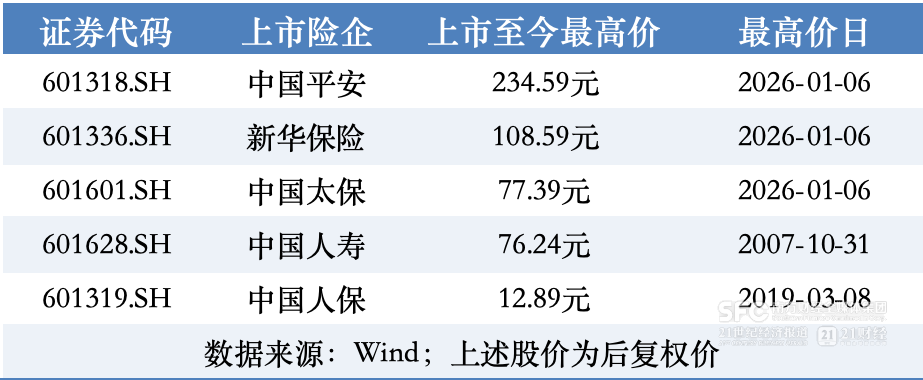
A股五大上市险企集体飘红,多股创历史新高
2 1 Shi Ji Jing Ji Bao Dao· 2026-01-06 11:47
Core Viewpoint - The insurance sector is experiencing a strong performance at the beginning of 2026, driven by a bull market, favorable policies, improved industry fundamentals, and positive institutional outlooks, leading to significant stock price increases and historical highs for several companies [1][3][4]. Group 1: Market Performance - The insurance industry index rose by 3.29%, with major listed insurance companies in A-shares collectively seeing gains [1]. - Multiple insurance stocks reached historical highs on January 6, 2026, including China Ping An, New China Life, and China Pacific Insurance [1]. - The total market capitalization of the five major listed insurance companies reached approximately 3.89 trillion yuan, an increase of about 128.8 billion yuan from the previous trading day [1]. Group 2: Key Drivers - The bull market is identified as a key driver for the insurance stock performance, with strong earnings elasticity and valuation recovery potential in an upward market [3]. - Recent policy adjustments by the National Financial Regulatory Administration, including changes to risk factors and asset-liability management, are expected to enhance the investment capacity of insurance companies [3][4]. - The insurance sector's fundamentals are improving, with expectations for premium income in 2026 to exceed forecasts, driven by a favorable liability environment [4]. Group 3: Financial Metrics - In the first eleven months of 2025, the insurance industry reported original premium income of 5.76 trillion yuan, a year-on-year increase of 7.6%, with life insurance premiums growing by 9.2% [5]. - The total assets of the insurance industry surpassed 40 trillion yuan, with net assets reported at 3.68 trillion yuan [6]. Group 4: Future Outlook - The insurance sector is expected to maintain its upward trend in 2026, supported by strong demand for protection and savings products, as well as ongoing policy support [7][8]. - However, potential risks include the pace of valuation recovery and the sustainability of the liability side, which will depend on product structure optimization and agent channel reforms [8]. - Long-term, the industry is shifting from a "scale-driven" model to a "value growth" model, with leading companies showing resilience due to asset-liability matching advantages [9].