PSBC(601658)

Search documents
重磅!芦苇调任邮储集团副总经理,拟任邮储银行行长
Xin Lang Cai Jing· 2025-12-23 06:11
12月23日消息,金融一线获悉,中信银行行长芦苇调任邮储集团党组成员、副总经理,同时拟任邮储银 行行长一职。 据了解,邮政集团党组成员、副总经理兼邮储银行党委书记、行长刘建军现已满60岁。 "70后"芦苇是一名中信银行"老将",1997年加入该行后,曾在多家分支行担任要职,积累了丰富的金融 管理经验;2022年10月,芦苇离开中信银行,被中信信托任命为党委书记,后获批成为该公司总经理、 董事长;今年2月,芦苇回归中信银行担任党委副书记,4月获批出任行长一职,任职经历覆盖银行前中 后台以及信托业态。 在担任行长期间,芦苇曾指出,中信银行已经摒弃了规模情结,将更专注于效益和质量并重的增长,此 构成该行财务业绩背后的业务支撑。此外,他还深度推进"五篇大文章"和"五个领先"银行战略,提出将 财富管理打造成新的增长极。 芦苇将任邮储银行行长,曾在中信系统深耕超28年 公开资料显示,芦苇,男,1971年10月出生,持有中国、中国香港及澳大利亚注册会计师资格,获澳大 利亚迪肯大学会计学硕士学位。 2020年11月,中信银行发布董事会会议决议公告称,董事会同意聘任芦苇为该行副行长,2021年4月该 任职资格获批。 而后,芦苇 ...




中国银行、建设银行、工商银行、农业银行、交通银行、邮储银行,集体调整中长期存款产品!
Mei Ri Jing Ji Xin Wen· 2025-12-23 03:53
Core Viewpoint - Major Chinese banks, including Bank of China, China Construction Bank, Industrial and Commercial Bank of China, Agricultural Bank of China, Bank of Communications, and Postal Savings Bank, have collectively adjusted their deposit products, particularly reducing the availability of medium to long-term deposit offerings as year-end savings demand increases [1][3]. Group 1: Changes in Deposit Products - Many customers, such as a resident in Beijing, have reported difficulties in finding suitable 5-year large-denomination certificates of deposit (CDs) as these products are no longer displayed by major banks [3]. - The interest rates for 3-year related products have dropped to between 1.5% and 1.75% across various banks [3]. - Smaller banks are also following suit, with institutions like Meizhou Commercial Bank and Yilian Bank removing 5-year fixed deposit products from their offerings [5]. Group 2: Reasons for Adjustments - The withdrawal of long-term deposit products is a response to the ongoing decline in banks' net interest margins, driven by falling loan rates that have significantly reduced asset yields [5]. - Analysts suggest that banks are compelled to eliminate high-interest long-term products to avoid severe interest margin losses or potential deficits, which could threaten their long-term stability and pose systemic risks [5]. Group 3: Implications for the Banking Sector - The adjustments in deposit products are expected to enhance the certainty of banks' profit forecasts, providing fundamental support for valuation recovery, particularly for large banks with low-cost liabilities and high dividend yields [6]. - The reduction in deposit rates may lead to a "deposit migration" effect, where funds seeking higher returns move from the banking system to capital markets, potentially benefiting direct financing markets [6].


中国银行、建设银行、工商银行、农业银行、交通银行、邮储银行,集体调整!
Mei Ri Jing Ji Xin Wen· 2025-12-23 03:45
Core Viewpoint - The recent decrease in medium to long-term deposit products in the market is attributed to banks' responses to the ongoing decline in net interest margins, leading to a reduction in the availability of five-year large certificates of deposit (CDs) and lower interest rates on three-year products [3][5][6]. Group 1: Market Trends - There is a noticeable reduction in the availability of five-year large CDs among major banks, with interest rates for three-year products dropping to between 1.5% and 1.75% [3]. - Smaller banks are also adjusting their deposit offerings, with some, like Meizhou Commercial Bank, announcing the removal of five-year fixed deposit products [5]. - The trend of withdrawing long-term deposit products is not limited to national banks but is also seen in local and private banks [5]. Group 2: Banking Sector Implications - The withdrawal of long-term deposit products is a necessary response to the challenges posed by declining bank net interest margins, as banks face significant risks of interest margin losses if they do not eliminate high-interest long-term products [5]. - Analysts suggest that this shift will enhance the certainty of banks' profit expectations, particularly benefiting large banks with low-cost liabilities and high dividend yields, making them more attractive to long-term investors [6]. - The reduction in deposit rates may lead to a "deposit migration" effect, where funds move from the banking system to capital markets, potentially increasing liquidity in stocks, bonds, and funds, which could positively impact direct financing markets [6].



加强协同 更大力度提振消费
Jin Rong Shi Bao· 2025-12-23 03:34
Group 1 - The central economic work conference emphasizes "domestic demand as the main driver" and the need to implement measures to boost consumption and increase residents' income [1][2] - Experts predict that consumption growth will be supported by enhanced policies and the accelerated release of service consumption potential by 2026 [1][2] - Financial institutions are innovating consumer credit products to meet the diverse needs of residents, aligning with government policies [2][3] Group 2 - Banks are actively responding to consumption promotion policies by increasing credit issuance and innovating service models, injecting vitality into the domestic consumption market [4][5] - The Industrial and Commercial Bank of China has issued nearly 100 billion yuan in personal consumption loans and signed up around 1.6 million clients for interest subsidy services [4] - Postal Savings Bank and other banks are launching exclusive discount activities to stimulate consumer spending, with significant participation from customers [6][7] Group 3 - There is a growing focus on service consumption, with a shift from basic needs to quality and personalized services, indicating a transformation in consumer behavior [7][8] - Financial institutions are encouraged to enhance their understanding of consumption promotion and innovate financial products and services to meet diverse consumer needs [8] - As of September 2025, the loan balance in key service consumption areas reached 2.8 trillion yuan, reflecting a 4.9% year-on-year growth [7]

半两财经|六大国有银行下架五年期大额存单 居民投资理财方式在变
Sou Hu Cai Jing· 2025-12-23 03:06
Core Viewpoint - The six major state-owned banks in China have collectively withdrawn high-interest five-year large-denomination certificates of deposit (CDs), marking a significant shift in the savings market as they adjust to ongoing pressure on net interest margins [2][3]. Group 1: Changes in Deposit Products - The five-year large-denomination CDs have been completely removed from sale, with searches on banking apps returning results indicating "no products available" or "sold out" [2]. - The minimum investment for three-year large-denomination CDs has increased significantly, with thresholds rising from the traditional 200,000 yuan to between 1 million and 5 million yuan, while the interest rate for a 1 million yuan three-year product is only 1.55%, narrowing the gap with regular savings accounts [3]. Group 2: Impact on Banking Sector - Data from the National Financial Regulatory Administration shows that the net interest margin for commercial banks was only 1.42% in Q3 2025, with predictions indicating a slight narrowing of the decline to around 4 basis points in 2026, marking the first time since 2022 that the annual decline will be in single digits [4]. - The continuous narrowing of net interest margins has been a significant factor affecting bank profitability, prompting banks to withdraw high-interest long-term deposit products to stabilize their margins [5]. Group 3: Shifts in Savings Behavior - The withdrawal of high-interest CDs has led to a migration of funds estimated to be in the hundreds of billions, as the market loses "risk-free high-yield" products [6]. - Despite 62.3% of residents still preferring to save more, this figure has been declining for two consecutive quarters, with a noticeable increase in the willingness to invest [6]. - Different types of savers are adjusting their strategies: conservative savers are sticking to deposit products, while moderate investors are moving towards bank wealth management and "fixed income plus" products, and aggressive investors are beginning to allocate funds to high-dividend stocks and gold ETFs [6].

多地促消费兴文旅 银行如何以未来收益唤醒旅游资源
Mei Ri Jing Ji Xin Wen· 2025-12-22 22:49
Core Viewpoint - The recent loan of 90 million yuan to the operation of the Zhuangxu Longdong Scenic Area by Postal Savings Bank, utilizing a "guarantee + revenue pledge" model, highlights a practical approach to addressing financing bottlenecks in the cultural tourism industry in China [1][2][3] Group 1: Financing Model - The loan issued by Postal Savings Bank has a term of 29 years and an annual interest rate of 4.4%, with a reduction of 60 basis points to lower financial costs for the enterprise by approximately 8 million yuan over the loan's duration [2] - The "revenue pledge" model allows the future cash flows from ticket sales and parking fees to be used as collateral, transforming expected revenues into recognizable and assessable financing assets [3][6] Group 2: Policy Support - The People's Bank of China has established a 500 billion yuan service consumption and pension re-loan to encourage financial institutions to increase support for key sectors, including cultural tourism [4] - Local governments are also promoting financial support for the cultural and tourism industries, with various policies aimed at attracting social capital and enhancing financial services [5][6] Group 3: Industry Challenges - The cultural tourism sector faces challenges such as low asset utilization and high management costs, which complicate financing efforts [2][3] - Issues like the difficulty in valuing revenue rights and the reluctance of high-quality scenic enterprises to engage in revenue pledge financing have been identified as barriers to the widespread adoption of this financing model [7]

“新”中有“数”,加“数”前行
Qi Lu Wan Bao· 2025-12-22 16:23
Group 1 - The core viewpoint of the articles highlights the innovative financial services being developed in Jining to support the digital economy, particularly through data asset financing [1][2][4] - Jining's Postal Savings Bank successfully issued a 5 million yuan loan using the data intellectual property of Shandong Zhuolang Testing Co., marking a significant milestone in data asset financing [2] - An agricultural technology company in Liangshan secured 11 million yuan in credit by pledging its unique data assets related to cattle breeding, showcasing the potential of data assets in traditional industries [2] Group 2 - Longgong Port has transformed into the first fully automated inland container port in China, supported by a syndicate loan from multiple banks, enabling the completion of smart berth construction and a fully automated operation system [3] - Jining is recognized as a provincial digital economy innovation development pilot zone, fostering a mature digital economy ecosystem that supports the growth of digital financial services [3][4] - As of October 2023, Jining's digital economy industry loan balance reached 6.738 billion yuan, reflecting a year-on-year increase of 2.568 billion yuan and a growth rate of 61.57%, the highest in the province [4]
消失的信用卡App
Bei Jing Shang Bao· 2025-12-22 12:59
Core Insights - A trend of "streamlining and integration" of credit card apps across state-owned banks, joint-stock banks, and regional banks is accelerating, with Postal Savings Bank being the latest to announce the integration of its credit card app into its main banking app [1][3] - This shift reflects a significant transformation in the banking industry's digital strategy, moving from "expansion" to "refinement," indicating a new phase of "reducing quantity while improving quality" in online credit card services [1][8] Group 1: Integration of Credit Card Apps - Postal Savings Bank will gradually stop updating its "Postal Credit Card App," migrating all functions to the "Postal Bank App," following China Bank's earlier move to close its independent credit card app [3][4] - The integration aims to enhance operational efficiency and user experience by consolidating resources and focusing on the main app ecosystem [5][6] - The trend of integrating independent credit card apps is not limited to large banks; smaller banks like Beijing Rural Commercial Bank and Jiangxi Bank have also closed their credit card apps, merging services into their mobile banking platforms [7][8] Group 2: Industry Context and Drivers - The rise of independent credit card apps began around 2015, aiming to create a "financial + lifestyle" ecosystem, but as competition intensified, these apps became burdensome due to overlapping functionalities and low user engagement [6][10] - Regulatory pressures and the need for cost reduction are driving banks to optimize or terminate underperforming mobile applications, as highlighted by the recent guidelines from the National Financial Regulatory Administration [7][9] - The future of credit card services is expected to evolve into a "main app + diversified lightweight touchpoints" model, where the main app serves as a comprehensive platform while maintaining personalized services through various channels [9][10]

邮储银行(01658.HK)发布2025年度中期利润分配方案,12月22日股价下跌0.94%
Sou Hu Cai Jing· 2025-12-22 10:05
截至2025年12月22日收盘,邮储银行(01658)报收于5.25元,较前一交易日下跌0.94%,该股当日开盘 5.33元,最高5.33元,最低5.24元,成交额达1.16亿元。近52周最高5.95元,最低4.23元。 近日,中国邮政储蓄银行股份有限公司召开2025年第三次临时股东会,会议表决通过了2025年度中期利 润分配方案。根据公告,公司将向全体普通股股东派发现金股利每10股人民币1.230元(含税),合计 派发现金红利人民币147.72亿元。A股股利预计于2026年1月12日派发,H股股利于2026年2月13日派 发。H股股东可选择以人民币或港币收取股利,选择权截止时间为2026年1月28日,未作选择者将默认 以港币收取。针对H股股东,公司将于派息时依法代扣代缴相应所得税,税率依据相关税收协定执行。 通过港股通投资的内地个人投资者及证券投资基金按20%税率代扣所得税。 《截至2025年6月30日止六个月中期股息(更新)》 《2025年第三次临时股东会表决结果公告》 最新公告列表 以上内容为证券之星据公开信息整理,由AI算法生成(网信算备310104345710301240019号),不构成 投资建议 ...
AI当“搭子”,手机银行的未来是什么样?
Zhong Guo Jing Ying Bao· 2025-12-22 07:38
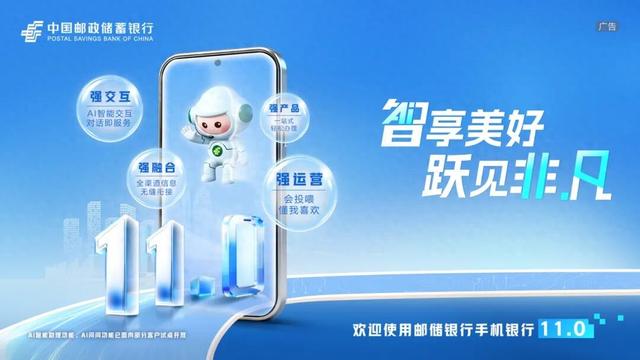
Core Insights - The article emphasizes the transformation of the Chinese banking industry driven by digital technology and artificial intelligence, marking a critical turning point for banks to shift from quantitative accumulation to qualitative breakthroughs [1] - The launch of Postal Savings Bank's mobile banking 11.0 signifies a transition from a functional tool to an intelligent partner, showcasing the bank's commitment to a comprehensive digital ecosystem with its "AI2ALL" strategy [3][4] Digital Transformation - Postal Savings Bank's mobile banking 11.0 integrates AI deeply into the customer journey, transforming traditional interactions into a conversational service model [4] - The app features a "one-stop" search experience and a "dialogue as service" approach, enhancing user convenience and making complex financial operations more intuitive [4][5] - The bank aims to create a financial service ecosystem that merges finance with daily life, enhancing user engagement through personalized services [5] User Experience and Security - The mobile banking 11.0 introduces a dual protection mechanism called "Friends + Bank," integrating social trust into security measures to enhance transaction safety [5] - New features include voice verification for identity confirmation and expanded family financial services, allowing shared product purchases among close contacts [5] Recognition and Performance - Postal Savings Bank's continuous investment in user experience has been recognized, with its mobile banking app ranking first in user experience for three consecutive years according to CFCA's report [6] AI and Ecosystem Development - The "AI2ALL" digital ecosystem aims to integrate AI capabilities across all banking operations, focusing on enhancing customer experience and operational efficiency [7][8] - The strategy includes nearly 260 AI application scenarios, promoting a comprehensive integration of AI in management and customer service [8] Internal Efficiency and External Service - The "AI2ALL" initiative enhances internal processes from front to back office, improving marketing precision and risk management efficiency [8][9] - The bank has developed a new human-machine collaboration system for customer service, significantly improving service efficiency and response times [9] Technological Foundation - Postal Savings Bank has made substantial investments in data, computing power, and algorithms, establishing a robust foundation for its AI capabilities [10] - The bank's strategy includes building a comprehensive data architecture and enhancing its AI computing resources, demonstrating a commitment to sustainable transformation [10]