
QILU BANK(601665)

Search documents
城商行板块12月1日涨1.5%,厦门银行领涨,主力资金净流出2.78亿元
Zheng Xing Xing Ye Ri Bao· 2025-12-01 09:10
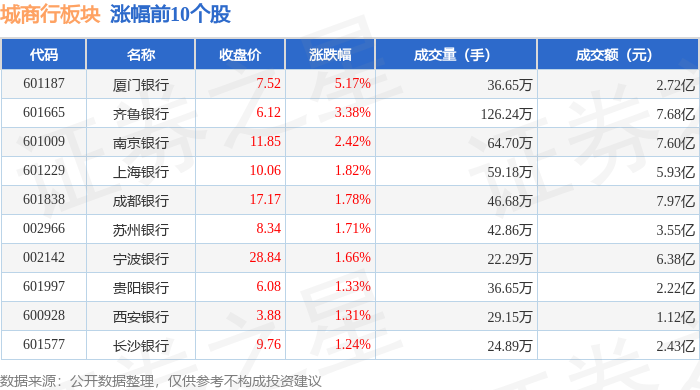
Market Performance - The city commercial bank sector increased by 1.5% on December 1, with Xiamen Bank leading the gains [1] - The Shanghai Composite Index closed at 3914.01, up 0.65%, while the Shenzhen Component Index closed at 13146.72, up 1.25% [1] Individual Bank Performance - Xiamen Bank's closing price was 7.52, with a rise of 5.17% and a trading volume of 366,500 shares, amounting to 272 million yuan [1] - Qilu Bank closed at 6.12, up 3.38%, with a trading volume of 1.26 million shares, totaling 768 million yuan [1] - Nanjing Bank's closing price was 11.85, increasing by 2.42%, with a trading volume of 647,000 shares, amounting to 760 million yuan [1] - Shanghai Bank closed at 10.06, up 1.82%, with a trading volume of 591,800 shares, totaling 593 million yuan [1] - Chengdu Bank's closing price was 17.17, increasing by 1.78%, with a trading volume of 466,800 shares, amounting to 797 million yuan [1] Fund Flow Analysis - The city commercial bank sector experienced a net outflow of 278 million yuan from institutional investors, while retail investors saw a net inflow of 240 million yuan [1] - The table shows various banks' net fund flows, indicating mixed results among different institutions [2]



银行股普涨,张家港行涨5%,厦门银行涨超4%
Ge Long Hui· 2025-12-01 03:12
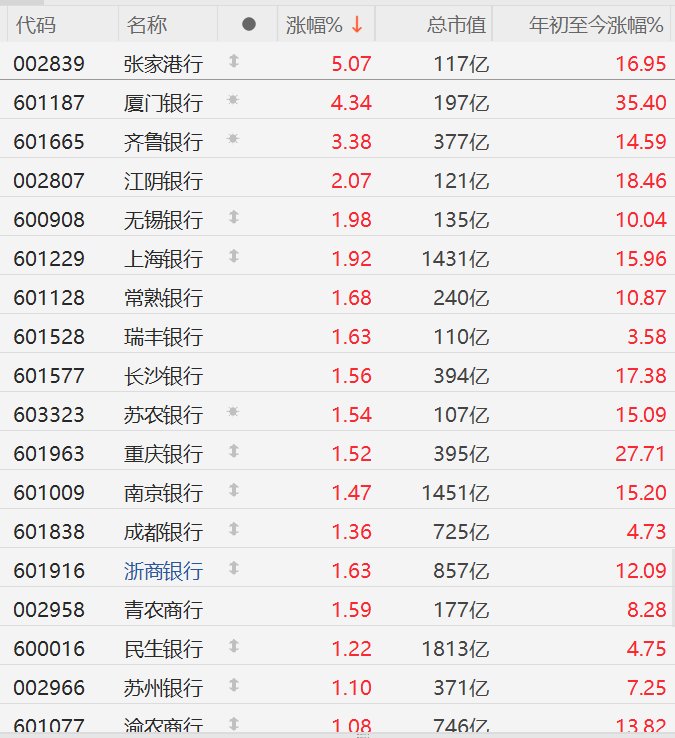
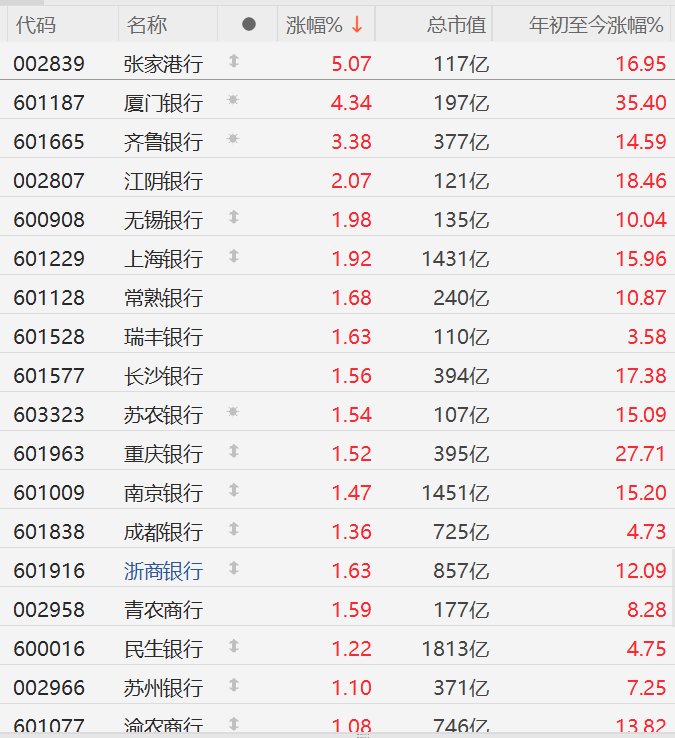
Core Viewpoint - The A-share market experienced a significant rise in bank stocks on December 1, with notable increases in several banks' share prices, indicating positive market sentiment towards the banking sector [1]. Summary by Category Stock Performance - Zhangjiagang Bank saw a rise of 5.07%, with a total market capitalization of 11.7 billion [2]. - Xiamen Bank increased by 4.34%, reaching a market value of 19.7 billion [2]. - Qilu Bank's shares rose by 3.38%, with a market cap of 37.7 billion [2]. - Jiangyin Bank experienced a 2.07% increase, valued at 12.1 billion [2]. - Wuxi Bank and Shanghai Bank both rose nearly 2%, with market caps of 13.5 billion and 143.1 billion respectively [1][2]. Year-to-Date Performance - Year-to-date, Zhangjiagang Bank has increased by 16.95% [2]. - Xiamen Bank has shown a substantial year-to-date increase of 35.40% [2]. - Qilu Bank's year-to-date performance stands at 14.59% [2]. - Jiangyin Bank has a year-to-date increase of 18.46% [2]. - Shanghai Bank has a year-to-date increase of 15.96% [2].


A股银行股普涨,张家港行涨5%,厦门银行涨超4%
Ge Long Hui A P P· 2025-12-01 03:10
Core Viewpoint - The A-share market has seen a significant increase in bank stocks, with notable gains in several banks on December 1st, indicating positive market sentiment towards the banking sector [1]. Summary by Category Stock Performance - Zhangjiagang Bank increased by 5.07%, with a total market capitalization of 11.7 billion and a year-to-date increase of 16.95% [2]. - Xiamen Bank rose by 4.34%, with a market cap of 19.7 billion and a year-to-date increase of 35.40% [2]. - Qilu Bank saw a 3.38% increase, with a market cap of 37.7 billion and a year-to-date increase of 14.59% [2]. - Jiangyin Bank increased by 2.07%, with a market cap of 12.1 billion and a year-to-date increase of 18.46% [2]. - Wuxi Bank and Shanghai Bank both rose nearly 2%, with market caps of 13.5 billion and 143.1 billion respectively, and year-to-date increases of 10.04% and 15.96% [1][2]. Technical Indicators - The formation of a MACD golden cross signal suggests a positive trend for these bank stocks, contributing to their upward momentum [1].

银行股,再度发力
Di Yi Cai Jing· 2025-12-01 02:45
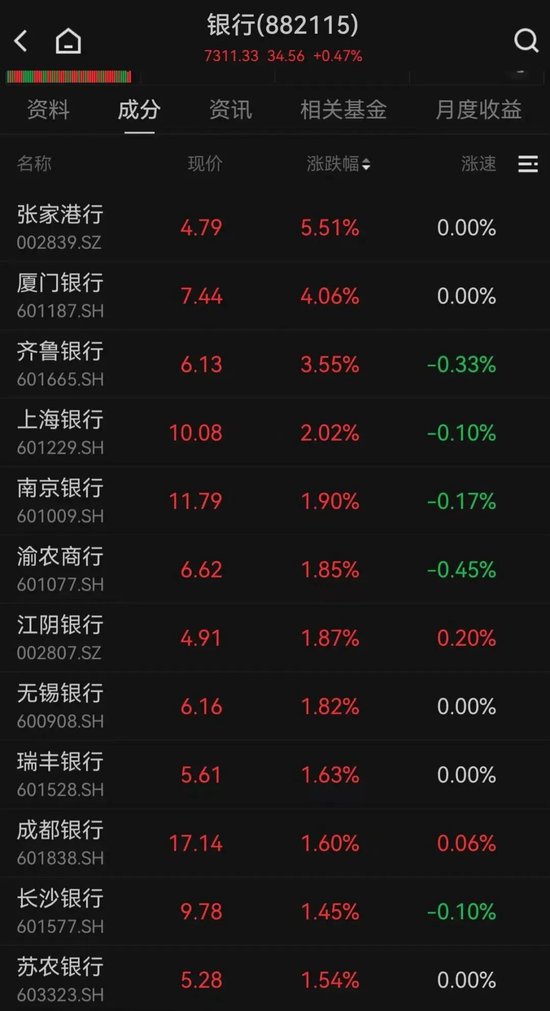
Core Viewpoint - The banking sector experienced a notable upward trend on December 1, with several banks showing significant gains in their stock prices, indicating positive market sentiment towards the banking industry [1][2]. Group 1: Stock Performance - Zhangjiagang Bank saw an increase of over 5%, reaching a price of 4.79 [2]. - Xiamen Bank rose by more than 4%, with its stock priced at 7.44 [2]. - Qilu Bank experienced a gain of over 3.5%, with its stock priced at 6.13 [2]. - Other banks such as Nanjing Bank, Chongqing Rural Commercial Bank, and Jiangyin Bank also reported increases in their stock prices, contributing to the overall positive performance of the banking sector [1][2].
银行股,再度发力
第一财经· 2025-12-01 02:36
Core Viewpoint - The banking sector experienced a notable upward trend on December 1, with several banks showing significant gains in their stock prices, indicating positive market sentiment towards the banking industry [1]. Group 1: Stock Performance - Zhangjiagang Bank saw an increase of over 5%, reaching a price of 4.79 [2]. - Xiamen Bank rose by more than 4%, with its stock priced at 7.44 [2]. - Qilu Bank experienced a gain of over 3%, with its stock price at 6.13 [2]. - Other banks such as Nanjing Bank, Chongqing Rural Commercial Bank, and Jiangyin Bank also showed positive movements, contributing to the overall upward trend in the banking sector [1].

城商行板块11月28日跌0.62%,上海银行领跌,主力资金净流出3.79亿元
Zheng Xing Xing Ye Ri Bao· 2025-11-28 09:05
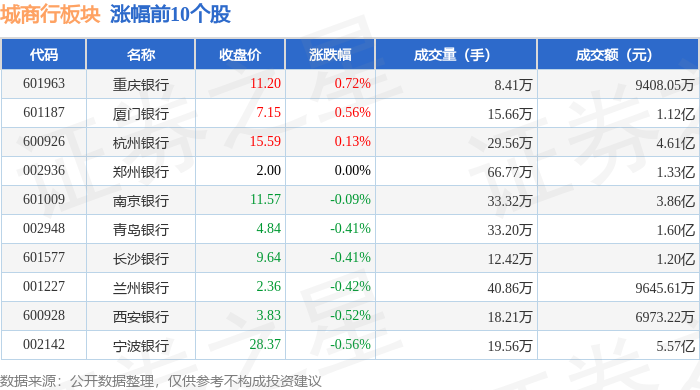
Core Viewpoint - The city commercial bank sector experienced a decline of 0.62% on November 28, with Shanghai Bank leading the drop, while the overall stock market showed slight gains [1][2]. Market Performance - The Shanghai Composite Index closed at 3888.6, up 0.34% - The Shenzhen Component Index closed at 12984.08, up 0.85% [1]. Individual Stock Performance - Chongqing Bank: Closed at 11.20, up 0.72%, with a trading volume of 84,100 shares and a turnover of 94.08 million yuan - Xiamen Bank: Closed at 7.15, up 0.56%, with a trading volume of 156,600 shares and a turnover of 112 million yuan - Hangzhou Bank: Closed at 15.59, up 0.13%, with a trading volume of 295,600 shares and a turnover of 461 million yuan - Zhengzhou Bank: Closed at 2.00, unchanged, with a trading volume of 667,700 shares and a turnover of 13.3 million yuan - Nanjing Bank: Closed at 11.57, down 0.09%, with a trading volume of 333,200 shares and a turnover of 38.6 million yuan - Qingdao Bank: Closed at 4.84, down 0.41%, with a trading volume of 332,000 shares and a turnover of 16 million yuan - Changsha Bank: Closed at 9.64, down 0.41%, with a trading volume of 124,200 shares and a turnover of 12 million yuan - Lanzhou Bank: Closed at 2.36, down 0.42%, with a trading volume of 408,600 shares and a turnover of 96.46 million yuan - Xi'an Bank: Closed at 3.83, down 0.52%, with a trading volume of 182,100 shares and a turnover of 6.97 million yuan - Ningbo Bank: Closed at 28.37, down 0.56%, with a trading volume of 195,600 shares and a turnover of 557 million yuan [1][2]. Capital Flow Analysis - The city commercial bank sector saw a net outflow of 379 million yuan from institutional investors, while retail investors contributed a net inflow of 86.74 million yuan [2][3]. - The following stocks had notable capital flows: - Hangzhou Bank: Net inflow of 9.48 million yuan from institutional investors - Qilu Bank: Net inflow of 6.55 million yuan from institutional investors - Suzhou Bank: Net inflow of 6.07 million yuan from institutional investors - Qingdao Bank: Net inflow of 3.22 million yuan from institutional investors - Lanzhou Bank: Net inflow of 2.34 million yuan from institutional investors - Zhengzhou Bank: Net outflow of 0.96 million yuan from institutional investors - Guizhou Bank: Net outflow of 1.41 million yuan from institutional investors - Xi'an Bank: Net outflow of 2.69 million yuan from institutional investors - Nanjing Bank: Net outflow of 9.30 million yuan from institutional investors - Chongqing Bank: Net outflow of 9.87 million yuan from institutional investors [3].


股东高管加速“抢筹” 11月七家银行获增持
2 1 Shi Ji Jing Ji Bao Dao· 2025-11-28 04:52
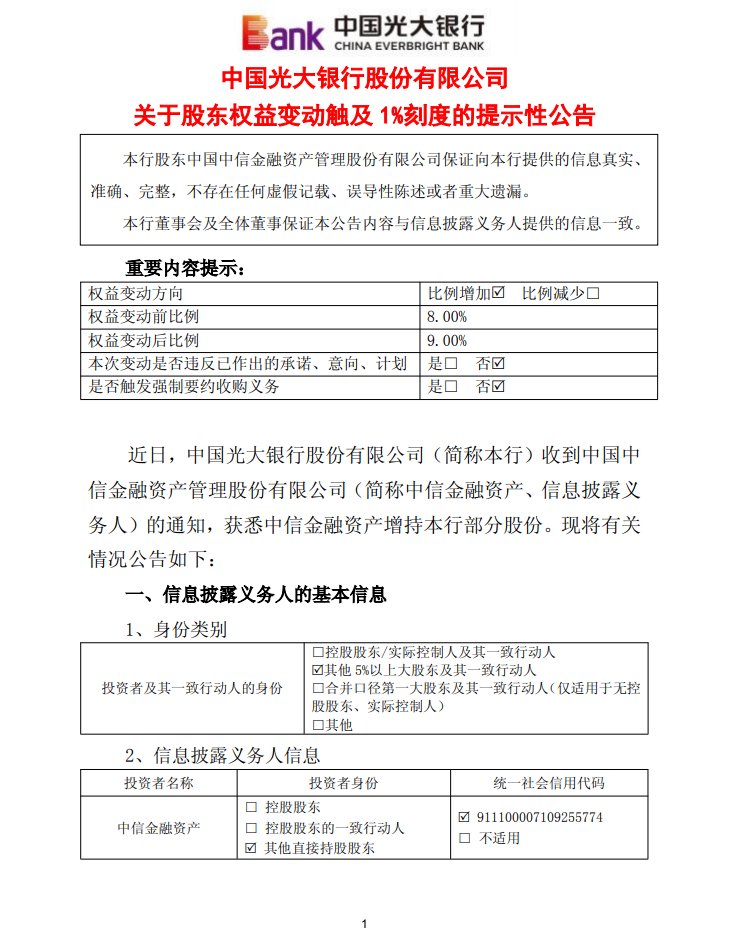
Core Viewpoint - The continuous share buybacks by major shareholders in various banks indicate strong confidence in the banks' future performance, even as the broader market struggles to maintain stability around the 3000-point mark [1]. Shareholder Actions - China Citic Financial Asset Management Co., Ltd. increased its stake in Everbright Bank from 8.00% to 9.00%, acquiring approximately 275 million A-shares and 315 million H-shares, totaling 1.00% of the bank's total equity [6][7]. - In November, several banks, including Nanjing Bank and Chengdu Bank, reported significant share purchases by their major shareholders, reflecting confidence in their growth potential [7][8]. Market Performance - The banking sector has shown resilience, with the banking index rising nearly 8% in the fourth quarter, driven by shareholder and executive buybacks [10]. - The banking sector has seen a net increase in share purchases amounting to approximately 9.03 billion yuan, ranking first among 31 industries [8]. Investment Sentiment - Analysts suggest that the ongoing buybacks by bank shareholders and executives signal a strong belief in the long-term investment value of these banks, particularly those with stable operations and strong regional economic resilience [10][11]. - The increase in share buybacks is seen as a positive indicator for market valuation, providing a clear valuation anchor for investors [10].


城商行板块11月27日涨0.69%,青岛银行领涨,主力资金净流入7276.85万元
Zheng Xing Xing Ye Ri Bao· 2025-11-27 09:07
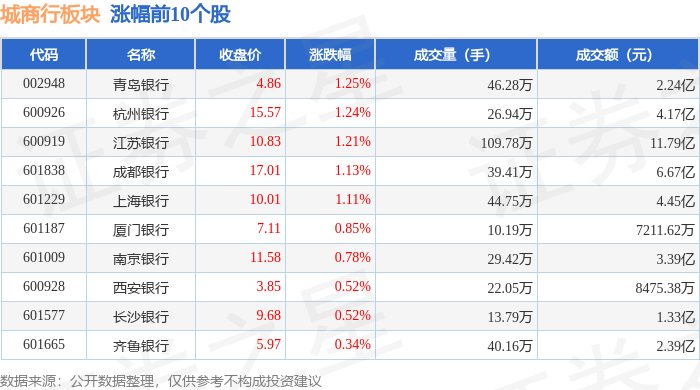
Core Insights - The city commercial bank sector experienced a rise of 0.69% on November 27, with Qingdao Bank leading the gains [1] - The Shanghai Composite Index closed at 3875.26, up 0.29%, while the Shenzhen Component Index closed at 12875.19, down 0.25% [1] Stock Performance Summary - Qingdao Bank (002948) closed at 4.86, up 1.25% with a trading volume of 462,800 shares and a transaction value of 224 million [1] - Hangzhou Bank (600926) closed at 15.57, up 1.24% with a trading volume of 269,400 shares and a transaction value of 417 million [1] - Jiangsu Bank (616009) closed at 10.83, up 1.21% with a trading volume of 1,097,800 shares and a transaction value of 1.179 billion [1] - Chengdu Bank (601838) closed at 17.01, up 1.13% with a trading volume of 394,100 shares and a transaction value of 667 million [1] - Shanghai Bank (601229) closed at 10.01, up 1.11% with a trading volume of 447,500 shares and a transaction value of 445 million [1] - Xiamen Bank (601187) closed at 7.11, up 0.85% with a trading volume of 101,900 shares and a transaction value of 72.116 million [1] - Nanjing Bank (6000009) closed at 11.58, up 0.78% with a trading volume of 294,200 shares and a transaction value of 339 million [1] - Xi'an Bank (600928) closed at 3.85, up 0.52% with a trading volume of 220,500 shares and a transaction value of 84.754 million [1] - Changsha Bank (601577) closed at 9.68, up 0.52% with a trading volume of 137,900 shares and a transaction value of 133 million [1] - Qilu Bank (601665) closed at 5.97, up 0.34% with a trading volume of 401,600 shares and a transaction value of 239 million [1] Capital Flow Analysis - The city commercial bank sector saw a net inflow of 72.7685 million from institutional investors, while retail investors experienced a net inflow of 16.4028 million [2] - The sector faced a net outflow of 89.1713 million from speculative funds [2] Individual Stock Capital Flow - Jiangsu Bank (600919) had a net inflow of 75.1851 million from institutional investors, while it faced a net outflow of 38.3807 million from speculative funds [3] - Shanghai Bank (601229) saw a net inflow of 33.6962 million from institutional investors, with a net outflow of 37.6450 million from speculative funds [3] - Qilu Bank (601665) had a net inflow of 23.2129 million from institutional investors, while it faced a net outflow of 7.1943 million from speculative funds [3] - Chengdu Bank (601838) experienced a net inflow of 21.6104 million from institutional investors, with a significant net outflow of 68.9418 million from speculative funds [3] - Hangzhou Bank (600926) had a net inflow of 17.6667 million from institutional investors, while it faced a net outflow of 41.0399 million from speculative funds [3]
城商行板块11月26日跌0.59%,南京银行领跌,主力资金净流出1.47亿元
Zheng Xing Xing Ye Ri Bao· 2025-11-26 09:05
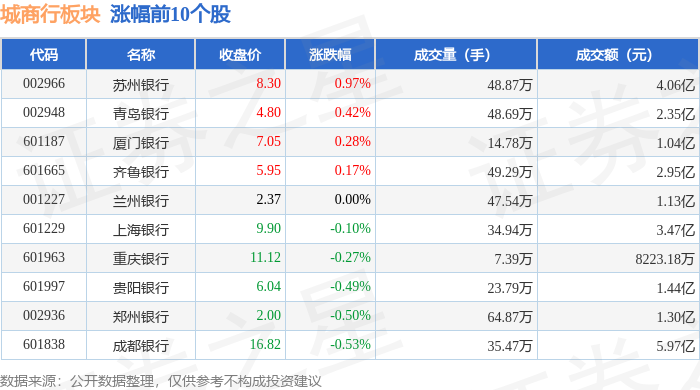
Market Performance - The city commercial bank sector declined by 0.59% on November 26, with Nanjing Bank leading the drop [1] - The Shanghai Composite Index closed at 3864.18, down 0.15%, while the Shenzhen Component Index rose by 1.02% to 12907.83 [1] Individual Stock Performance - Suzhou Bank closed at 8.30, up 0.97% with a trading volume of 488,700 shares and a transaction value of 406 million yuan [1] - Nanjing Bank closed at 11.49, down 1.29% with a trading volume of 514,300 shares and a transaction value of 592 million yuan [2] - Chengdu Bank closed at 16.82, down 0.53% with a trading volume of 354,700 shares and a transaction value of 597 million yuan [2] Capital Flow Analysis - The city commercial bank sector experienced a net outflow of 147 million yuan from institutional investors, while retail investors saw a net inflow of 152 million yuan [2] - Among individual stocks, Suzhou Bank had a net outflow of 31.27 million yuan from institutional investors, while Nanjing Bank saw a net inflow of 27.56 million yuan [3]
高息优先股密集退场 银行优先股投资逻辑生变
Zhong Guo Jing Ying Bao· 2025-11-25 13:12
Core Viewpoint - Recent announcements from multiple commercial banks regarding the redemption of preferred shares indicate a shift in capital management strategies within the banking sector [1][2]. Group 1: Redemption of Preferred Shares - Several banks, including Ping An Bank and Nanjing Bank, have announced plans to redeem preferred shares issued over five years ago, with Ping An Bank set to redeem 200 million shares worth 20 billion yuan by March 2026 and Nanjing Bank planning to redeem 49 million shares worth 4.9 billion yuan by December 2025 [1]. - Since July, at least nine banks, including Industrial and Commercial Bank of China and Bank of Beijing, have disclosed similar redemption plans, creating a notable trend in the market [1]. Group 2: Reasons for Redemption - The high dividend rates set at the time of issuance, combined with declining market interest rates, incentivize banks to redeem high-cost preferred shares and replace them with lower-cost perpetual bonds [2]. - Regulatory changes and the need for banks to optimize their capital structures are also significant factors driving the decision to redeem high-cost preferred shares [2]. Group 3: Capital Management Strategies - The banking sector is transitioning from a focus on scale expansion to a cost-efficiency-centered model, emphasizing the need for banks to balance the redemption of high-interest preferred shares with the issuance of low-cost capital tools [3]. - Banks are adopting more diversified and flexible capital supplement tools, allowing them to respond to market conditions effectively, such as redeeming high-interest preferred shares when interest rates are low [3].

