Beijing-Shanghai High Speed Railway (601816)

Search documents
10月28日上证央企(000042)指数跌0.18%,成份股中金黄金(600489)领跌
Sou Hu Cai Jing· 2025-10-28 10:01
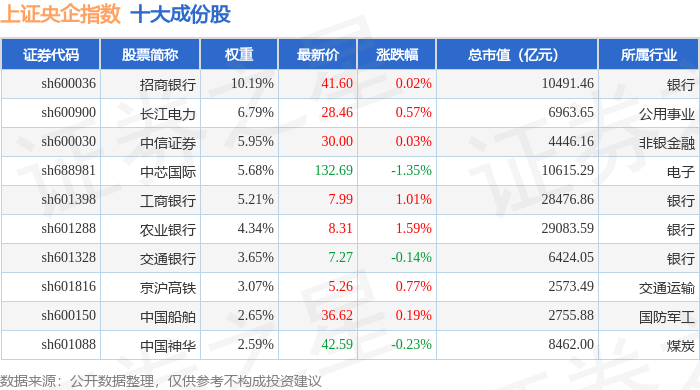
Market Overview - The Shanghai Central Enterprise Index (000042) closed at 1852.7 points, down 0.18%, with a trading volume of 79.123 billion yuan and a turnover rate of 0.33% [1] - Among the index constituents, 16 stocks rose while 33 fell, with AVIC Shenyang Aircraft (中航沈飞) leading the gainers at 1.92% and Zhongjin Gold (中金黄金) leading the decliners at 3.49% [1] Key Constituents - The top ten constituents of the Shanghai Central Enterprise Index are as follows: - China Merchants Bank (招商银行): 10.19% weight, latest price 41.60 yuan, market cap 1,049.146 billion yuan [1] - Yangtze Power (长江电力): 6.79% weight, latest price 28.46 yuan, market cap 696.365 billion yuan [1] - CITIC Securities (中信证券): 5.95% weight, latest price 30.00 yuan, market cap 444.616 billion yuan [1] - SMIC (中芯国际): 5.68% weight, latest price 132.69 yuan, market cap 1,061.529 billion yuan [1] - Industrial and Commercial Bank of China (工商银行): 5.21% weight, latest price 7.99 yuan, market cap 28,476.86 billion yuan [1] - Agricultural Bank of China (农业银行): 4.34% weight, latest price 8.31 yuan, market cap 29,083.59 billion yuan [1] - Bank of Communications (交通银行): 3.65% weight, latest price 7.27 yuan, market cap 6,424.05 billion yuan [1] - Beijing-Shanghai High-Speed Railway (京沪高铁): 3.07% weight, latest price 5.26 yuan, market cap 257.349 billion yuan [1] - China Shipbuilding Industry (中国船舶): 2.65% weight, latest price 36.62 yuan, market cap 275.588 billion yuan [1] - China Shenhua Energy (中国神华): 2.59% weight, latest price 42.59 yuan, market cap 846.200 billion yuan [1] Capital Flow - The net outflow of main funds from the index constituents totaled 3.92 billion yuan, while retail investors saw a net inflow of 2.021 billion yuan [1] - The detailed capital flow for key stocks includes: - AVIC Shenyang Aircraft: Main funds net inflow of 284 million yuan [2] - Yangtze Power: Main funds net inflow of 231 million yuan [2] - Agricultural Bank of China: Main funds net inflow of 127 million yuan [2] - Industrial and Commercial Bank of China: Main funds net inflow of 86 million yuan [2] - China Petroleum (中国石油): Main funds net inflow of 6.5195 million yuan [2] ETF Information - The Gold Stock ETF (product code: 159562) tracks the CSI Hong Kong-Shanghai Gold Industry Index, with a recent five-day change of -0.55% and a P/E ratio of 24.55 times [4] - The latest share count is 1.26 billion, a decrease of 32 million shares, with a net inflow of main funds amounting to 7.874 million yuan [4]






交通运输行业周报:原油运价环比有所下跌,9月快递业务量同比增长12.7%-20251028
Bank of China Securities· 2025-10-28 06:55
Investment Rating - The report rates the transportation industry as "Outperform" [1] Core Views - Crude oil freight rates have decreased month-on-month, while container shipping rates on long-distance routes have increased. The China Import Crude Oil Comprehensive Index (CTFI) reported 1632.26 points on October 23, down 8.9% from October 16. The VLCC market remains cautious due to the implementation of special port fees between China and the US, leading to a weak sentiment among shipowners [2][13] - Guangdong Province has released a high-quality development plan for the low-altitude economy, aiming to establish itself as a national leader in this sector. The civil aviation industry has shown steady growth in the first three quarters of 2025, with a total transport turnover of 1220.3 billion ton-kilometers, a year-on-year increase of 10.3% [2][15][16] - In Shenzhen, the monthly delivery volume of autonomous vehicles has surpassed one million, with a year-on-year growth of 12.7% in express delivery volume in September. The postal industry reported a total business income of 152.57 billion yuan in September, up 6.8% year-on-year [2][22][24] Summary by Sections Industry Hot Events - Crude oil freight rates have decreased, while container shipping rates on long-distance routes have increased. The CTFI reported a decrease of 8.9% [2][13] - Guangdong's low-altitude economy development plan aims to optimize airspace management and promote low-altitude logistics [15][16] - Shenzhen's autonomous vehicle delivery volume has exceeded one million, with express delivery volume growing by 12.7% [22][24] High-Frequency Data Tracking - The Baltic Air Freight Price Index has increased month-on-month but decreased year-on-year. The Shanghai outbound air freight price index has shown a month-on-month increase of 6.9% [26] - Domestic cargo flights have increased by 3.05% year-on-year, while international flights have risen by 15.86% [32] - The express delivery business volume in September increased by 12.7% year-on-year, with total business income reaching 127.37 billion yuan [50][54] Investment Recommendations - Focus on the equipment and manufacturing export chain, recommending companies like COSCO Shipping Specialized Carriers, China Merchants Energy Shipping, and Huamao Logistics [4] - Pay attention to the low-altitude economy investment opportunities, recommending CITIC Offshore Helicopter [4] - Consider investment opportunities in the highway and railway sectors, recommending companies like Gansu Expressway and Beijing-Shanghai High-Speed Railway [4] - Explore investment opportunities in the express delivery sector, recommending SF Express, Jitu Express, and Yunda Express [4]





沪市“中期红包”密集派发 真金白银回馈投资者
Shang Hai Zheng Quan Bao· 2025-10-26 17:36
Core Points - The total cash dividends from 320 companies in the Shanghai market have exceeded 278 billion yuan as of October 24, with over 90 companies set to distribute an additional 280 billion yuan in cash dividends [1][2] - A record high of 414 companies have announced profit distribution plans, totaling over 560 billion yuan in cash dividends [1] - Major companies such as China Mobile and China Telecom have completed their cash distributions, amounting to 54.1 billion yuan and 16.6 billion yuan respectively, while the "Big Three" oil companies have distributed approximately 82.5 billion yuan in total [1] Company-Specific Summaries - China Petroleum has announced a cash dividend of 2.2 yuan per share, totaling 40.265 billion yuan, with 35.623 billion yuan allocated to A-share dividends [1] - Jagex has declared a cash dividend of 6.6 yuan per share, amounting to 474 million yuan, which represents 73.46% of its net profit for the period [2] - Guotai Junan plans to distribute 0.15 yuan per share, totaling 2.627 billion yuan, making it one of the leading brokerages in terms of dividend distribution [2] - Guodian Power intends to distribute 1 yuan per share, totaling 1.784 billion yuan, which is 48.38% of its net profit for the period [2] Upcoming Distributions - From October 27 to October 31, 20 companies will distribute a total of 9 billion yuan in cash dividends, including 京沪高铁 (19 billion yuan), 国泰海通 (26 billion yuan), and 国电电力 (18 billion yuan) [1][2] - There are still 74 companies that have not yet announced their dividend distribution plans, with a total amount exceeding 275 billion yuan expected to be distributed in the future [2]




沪市“中期红包”密集派发中
Zheng Quan Ri Bao Wang· 2025-10-26 11:08
Core Points - The mid-term dividends from 20 companies, including Beijing-Shanghai High-Speed Railway Co., Ltd., Guotai Junan Securities Co., Ltd., and State Power Development Co., Ltd., will exceed 9 billion yuan from October 27 to October 31 [1] - As of October 24, 320 companies in the Shanghai market have distributed over 278 billion yuan in mid-term dividends, with an additional 90 companies expected to distribute over 280 billion yuan [1][2] - The total mid-term dividend amount for 414 companies has reached over 560 billion yuan, setting a historical high [1] Company-Specific Information - Major dividend payers include China Mobile and China Telecom, with cash distributions of 54.1 billion yuan and 16.6 billion yuan, respectively, while the "Big Three" oil companies have collectively distributed approximately 82.5 billion yuan [2] - Companies like Xiamen Gibit Network Technology Co., Ltd. and Jiangsu Shuoshi Biotechnology Co., Ltd. have reported per-share dividends exceeding 2 yuan, with Gibit reaching 6.6 yuan per share [2] Dividend Yield Insights - The dividend yield for 290 companies in the Shanghai market exceeds 3%, with 81 companies yielding over 5% [3] - Among the 320 companies that have implemented mid-term dividends, the average yield is 2.53%, with 102 companies exceeding 3% and 40 companies surpassing 5% [3]


铁路公路板块10月22日涨0.69%,皖通高速领涨,主力资金净流出3.69亿元
Zheng Xing Xing Ye Ri Bao· 2025-10-22 08:19
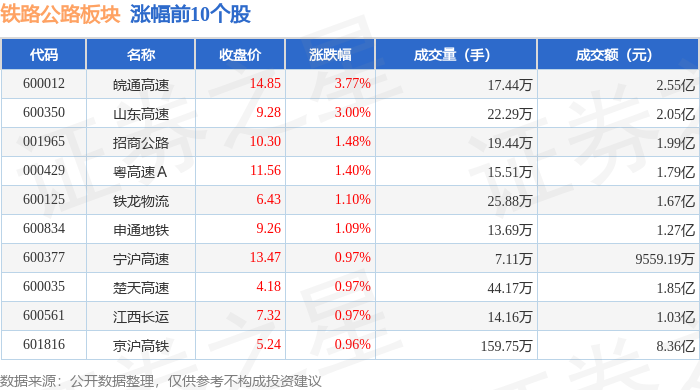
Core Viewpoint - The railway and highway sector experienced a slight increase of 0.69% on October 22, with Wan Tong Expressway leading the gains, while the overall Shanghai Composite Index fell by 0.07% [1] Group 1: Market Performance - The Shanghai Composite Index closed at 3913.76, down 0.07% - The Shenzhen Component Index closed at 12996.61, down 0.62% - Wan Tong Expressway (600012) saw a closing price of 14.85, with a rise of 3.77% and a trading volume of 174,400 shares, amounting to a transaction value of 255 million yuan [1] - Other notable performers included Shandong Expressway (600350) with a 3.00% increase, closing at 9.28, and China Merchants Highway (001965) with a 1.48% increase, closing at 10.30 [1] Group 2: Capital Flow - The railway and highway sector experienced a net outflow of 369 million yuan from institutional investors, while retail investors saw a net inflow of 397 million yuan [2] - The top three stocks by net inflow from institutional investors were Wan Tong Expressway (600012) with 26.95 million yuan, Shandong Expressway (600350) with 21.30 million yuan, and China Merchants Highway (001965) with 11.42 million yuan [3] - Conversely, the largest net outflows from retail investors were observed in China Merchants Highway (001965) with 25.51 million yuan and Shandong Expressway (600350) with 17.36 million yuan [3]

10月20日晚间重要公告一览
Xi Niu Cai Jing· 2025-10-20 10:35
Group 1 - Yonghe Co., Ltd. reported a net profit of 469 million yuan for the first three quarters, a year-on-year increase of 220.39% [1] - Jinli Permanent Magnet achieved a net profit of 515 million yuan, reflecting a year-on-year growth of 161.81% [1][2] - Sanhe Pharmaceutical Auxiliary's net profit increased by 8.28% year-on-year, reaching 133 million yuan [2] Group 2 - Jiahuan Technology experienced a net profit decline of 26.53%, totaling 55.35 million yuan [3] - Wuchan Huaneng reported a net profit decrease of 15.10%, amounting to 453 million yuan [3] - Chuan Investment Energy's net profit fell by 4.54%, totaling 4.22 billion yuan [4][5] Group 3 - Dayang Bio's net profit grew by 56.12%, reaching 80 million yuan [5] - Weili Medical reported a net profit increase of 14.94%, totaling 192 million yuan [6] - People's Tongtai's net profit decreased by 45.69%, amounting to 112 million yuan [7] Group 4 - Jiuhuan Bio received a medical device registration certificate for its NT-proBNP test kit [8] - Jincheng Pharmaceutical's subsidiary obtained a drug registration certificate for a specific injection [9] - Guangdian Yuntong's subsidiary acquired a money service operator license in Hong Kong [10] Group 5 - Dash Intelligent won a bid for a project worth 96 million yuan related to the Shijiazhuang subway [10] - Alloy Investment's net profit increased by 124.87%, reaching 7.26 million yuan [11] - Kaile Co., Ltd. reported a net profit growth of 159.14%, totaling 21.63 million yuan [12] Group 6 - Chuanjinno's net profit surged by 175.61%, reaching 304 million yuan [14] - Rijiu Optoelectronics reported a net profit increase of 36.54%, totaling 76.91 million yuan [15] - Dazhu CNC's net profit grew by 142.19%, amounting to 492 million yuan [15] Group 7 - Nairui Radar expects a net profit increase of 181% for the first three quarters [17] - Suzhou Tianmai successfully acquired land use rights for a new manufacturing project [19] - Aokai Pharmaceutical announced clinical research data for its innovative drug at a major conference [21][22] Group 8 - Jilin Aodong's subsidiary passed the consistency evaluation for a specific injection [24] - Qinxin Environment announced the resignation of a board member [25] - *ST Baoying is planning a change in control, leading to a stock suspension [26] Group 9 - Jianlang Hardware's director plans to reduce holdings by up to 500,000 shares [27] - Taihe Technology's director intends to reduce holdings by up to 606,000 shares [29] - Zhongyuan Securities announced a cash dividend of 0.008 yuan per share [31] Group 10 - Beijing-Shanghai High-Speed Railway plans to distribute a cash dividend of 0.0385 yuan per share [32] - Zhuhai Guanyu expects a net profit increase of 36.88%-55.54% for the first three quarters [34] - Shenglong Co., Ltd. reported a net loss of 72.95 million yuan for the first three quarters [36] Group 11 - Shuangyuan Technology plans to distribute a cash dividend of 0.125 yuan per share [38] - Shaanxi Guotou A reported a net profit increase of 6.6%, totaling 996 million yuan [40] - Sunshine Nuohua intends to invest 15 million yuan in a biotech company [41] Group 12 - Yangjie Technology's net profit increased by 45.51%, reaching 974 million yuan [42] - Xingwang Yuda reported a net profit growth of 260%, totaling 38.37 million yuan [43] - Tongyou Technology turned a profit with a net profit of 9.29 million yuan [44]



京沪高速铁路股份有限公司2025年半年度权益分派实施公告
Shang Hai Zheng Quan Bao· 2025-10-19 19:57
Core Points - The company announced a cash dividend of 0.0385 CNY per share for the first half of 2025, totaling approximately 1.88 billion CNY [1][3] - The dividend distribution plan was approved at the third extraordinary general meeting of shareholders held on September 15, 2025 [1][2] Distribution Plan - The dividend is based on a total share capital of 48,925,679,370 shares [3] - The distribution is applicable to all shareholders registered with the China Securities Depository and Clearing Corporation Limited Shanghai Branch as of the close of trading on the day before the dividend record date [2] Implementation Method - The cash dividends will be distributed through the clearing system of the China Securities Depository and Clearing Corporation Limited [4] - Shareholders who have completed designated transactions can receive their cash dividends on the payment date at their designated securities firms [4] Taxation Details - For individual shareholders holding shares for over one year, the dividend income is exempt from personal income tax, resulting in a net cash dividend of 0.0385 CNY per share [5] - For qualified foreign institutional investors (QFII), a 10% withholding tax will apply, leading to a net cash dividend of 0.03465 CNY per share [6] - Other institutional investors are responsible for their own tax payments, receiving a gross cash dividend of 0.0385 CNY per share [6] Contact Information - For inquiries regarding the dividend distribution, shareholders can contact the board office at 010-51896399 [7]
京沪高铁(601816) - 京沪高速铁路股份有限公司2025年半年度权益分派实施公告
2025-10-19 08:00
证券代码:601816 证券简称:京沪高铁 公告编号:2025-046 京沪高速铁路股份有限公司 2025年半年度权益分派实施公告 本公司董事会及全体董事保证本公告内容不存在任何虚假记载、 误导性陈述或者重大遗漏,并对其内容的真实性、准确性和完整性承 担法律责任。 重要内容提示: 每股分配比例 A 股每股现金红利0.0385元 本次利润分配方案经公司2025 年 9 月 15 日的2025年第 三次临时股东大会审议通过。 二、分配方案 1. 发放年度:2025年半年度 2. 分派对象: 截至股权登记日下午上海证券交易所收市后,在中国证券 登记结算有限责任公司上海分公司(以下简称中国结算上海分 公司)登记在册的本公司全体股东。 3. 分配方案: 相关日期 | 股份类别 | 股权登记日 | 最后交易日 | 除权(息)日 | 现金红利 | | --- | --- | --- | --- | --- | | | | | | 发放日 | | A股 | 2025/10/24 | - | 2025/10/27 | 2025/10/27 | 差异化分红送转:否 一、通过分配方案的股东会届次和日期 具体实际税负为:股东的持股期 ...
A股央企ESG评价体系白皮书系列报告之十:交运央企ESG评价结果分析:绿色运输与社会责任彰显行业特色
Shenwan Hongyuan Securities· 2025-10-17 10:20
Investment Rating - The report rates the transportation industry as "Positive" [1] Core Insights - Over 80% of transportation companies have performed well in ESG scores, with 15 companies scoring above 80 and 12 above 90, representing 83% and 67% respectively [9][11] - 94% of the 18 central enterprises in the transportation sector have completed the required disclosures regarding importance assessment, but only 33% have disclosed third-party verification reports [11][13] - Companies in the high score range actively disclose climate change issues, while those in the lower range focus more on environmental issues, indicating a need for improvement in climate-related disclosures [16][17] - The report highlights the social responsibilities of transportation enterprises, particularly in rural revitalization and safety operations, with a 94% disclosure rate for safety operations [37][41] - Governance scores are generally high, with many companies integrating party building into their governance structures, showcasing a unique governance advantage [47][51] Summary by Sections Overall Performance - More than 80% of transportation companies have good overall ESG scores, with detailed financial importance disclosures and high scores in environmental, social responsibility, and governance aspects [9][16] Importance Assessment - 94% of companies have completed the required disclosures, with 17 out of 18 companies highlighting financial importance [11][13] Environmental & Climate - 83% of companies scored between 30-34 in environmental issues, with high disclosure rates for waste management (100%) and energy management (96%) [16][20] - Climate management disclosures show a high completion rate of 89%, but climate strategy disclosures need improvement, with only 56% of companies fully disclosing [32][35] Social Responsibility - Transportation enterprises have detailed their efforts in rural revitalization and social contributions, achieving a 100% disclosure rate for social responsibility [41][42] - Safety operations are a key focus, with 94% of companies disclosing relevant information [37][45] Governance - Governance scores are high, with 14 companies disclosing governance structures and mechanisms, and many integrating party building into their governance [47][51] - 94% of companies focus on safety risk management, with detailed disclosures on safety management systems [53][56]



自带杠铃策略的上证180ETF指数基金(530280)涨超0.3%,本月以来涨幅排名可比基金首位
Sou Hu Cai Jing· 2025-10-16 02:35
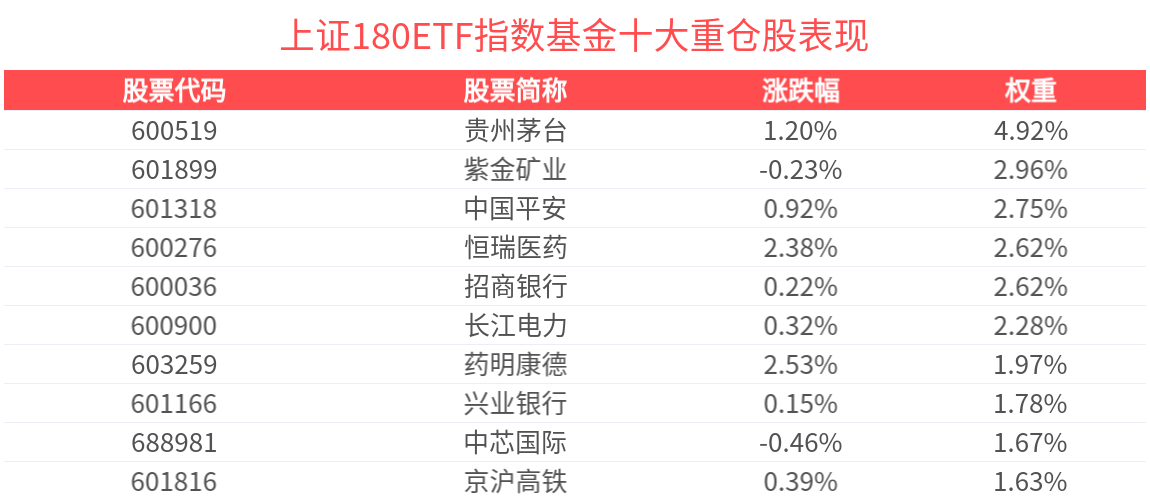
Core Viewpoint - The recent short-term market fluctuations do not alter the long-term bullish trend of the stock market, with dividend and technology assets expected to yield excess returns over time [1] Group 1: Market Trends - The long-term investment strategy emphasizes a barbell approach, combining dividend and technology assets, which are anticipated to benefit from increased equity market allocation by residents [1] - The Shanghai Stock Exchange 180 Index (000010) is structured with a 90% allocation to dividend assets and 10% to technology assets, making it a suitable choice for equity market investment [1] Group 2: Performance Data - As of October 16, 2025, the Shanghai Stock Exchange 180 Index rose by 0.45%, with notable increases in constituent stocks such as China Life (601628) up 4.37% and Zhaoyi Innovation (603986) up 4.17% [1] - The Shanghai 180 ETF Index Fund (530280) increased by 0.33%, with a current price of 1.23 yuan, and has shown a cumulative increase of 1.57% for the month as of October 15, 2025, ranking 1st among comparable funds [1] Group 3: Index Composition - The Shanghai 180 Index includes 180 large-cap, liquid stocks from the Shanghai market, with the top ten weighted stocks accounting for 26.75% of the index [2] - The top ten stocks by weight include Kweichow Moutai (600519), Zijin Mining (601899), and China Ping An (601318), among others [2][4]