YONGHUI SUPERSTORES(601933)

Search documents
永辉超市携手多方打造“智利车厘子冰雪节”,解锁沉浸式冬日消费新场景
Xin Lang Cai Jing· 2026-01-16 11:41
Core Insights - The "Chilean Cherry Ice and Snow Festival" was launched in Guangzhou, highlighting the strong partnership between Chile and China in fruit trade, particularly cherries [1][10][11] - Chile has been the largest source of imported cherries for China for over a decade, and there are hopes for deeper cooperation in technology exchange and trade facilitation [11][19] - The event aims to enhance consumer engagement and awareness of cherry quality through interactive experiences [5][18] Company Collaboration - YH Supermarket is a key partner for Chilean cherries in China, planning to expand the variety and packaging of cherries to meet diverse consumer needs [3][13] - YH Supermarket emphasizes full-chain quality control in collaboration with Chilean fruit exporters and logistics partners to ensure high-quality fresh fruit for consumers [15][19] - The supermarket's sales of Chilean cherries reached nearly 50 million yuan during the New Year holiday, indicating strong market demand [17] Consumer Engagement - The festival featured immersive experiences, allowing consumers to create cherry bouquets and taste various cherry varieties, enhancing the shopping experience [5][18] - Interactive games and activities at the event aimed to boost consumer interest and purchasing enthusiasm for cherries [5][18] - The focus on quality and attractive packaging positions Chilean cherries as a popular choice for gifts during the festive season [5][20] Market Trends - Chilean cherries are becoming a "star product" in the New Year goods market, with YH Supermarket promoting them as a core item for family gatherings [20] - The supermarket plans to optimize product displays and create festive scenarios to enhance cherry sales during the holiday season [20][22] - The transition of cherry varieties in the market from Santina to more visually appealing and durable options like Rabins reflects changing consumer preferences [18][20]



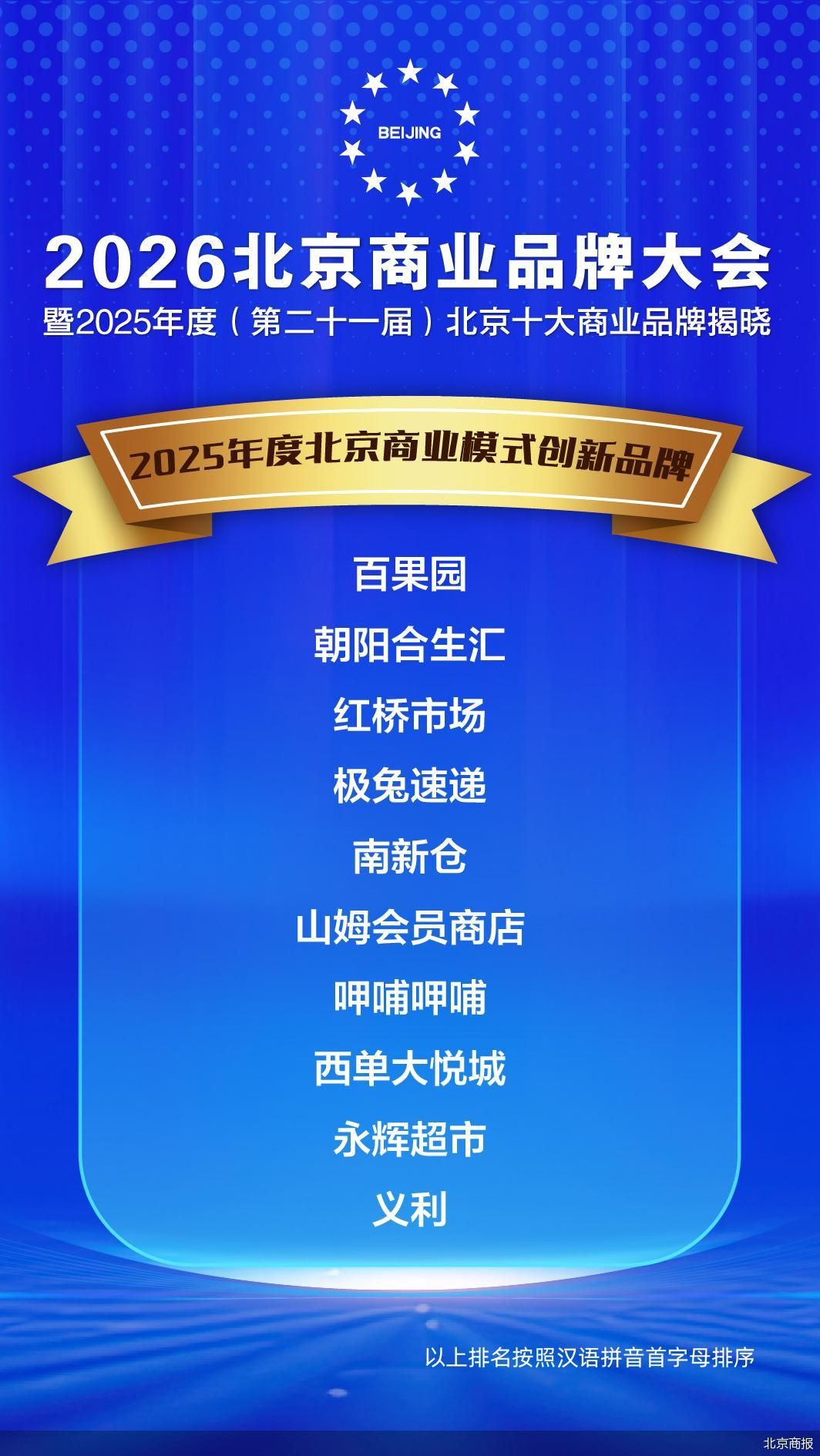
10家品牌荣膺“2025年度北京商业模式创新品牌”
Bei Jing Shang Bao· 2026-01-16 09:11
Core Insights - The 2026 Beijing Commercial Brand Conference and the announcement of the 2025 Top Ten Commercial Brands took place in Beijing, focusing on the theme "New Demand, New Supply" [1] - The event highlighted the importance of continuous innovation in business models to meet diverse consumer needs and promote high-quality industry development [1] Group 1: Main Awards - The "2025 Top Ten Commercial Brands" represents brands with significant market influence and leadership in industry development [4] - The ten brands awarded as "2025 Beijing Commercial Model Innovation Brands" include Baiguoyuan, Chaoyang Heshenghui, Hongqiao Market, Jitu Express, Nanxin Warehouse, Sam's Club, Xiaobai, Xidan Joy City, Yonghui Supermarket, and Yili [1][4] - The event introduced three new special award categories: "2025 Financial Product Innovation Empowering Consumption Excellent Cases," "Beijing Cultural, Business, Tourism, and Sports Integration Excellent Cases," and "Beijing Fashion Consumption Power Leading Brands" [4] Group 2: Subcategories - Four permanent subcategories were established: "2025 Beijing Commercial Quality Service Brands," "2025 Beijing Commercial Model Innovation Brands," "2025 Beijing Commercial Craftsmanship Brands," and "2025 Beijing Commercial New Star Brands" [4] - The focus on innovation and self-reform among awarded brands is aimed at uncovering new business models to satisfy increasingly diverse consumer demands [1]
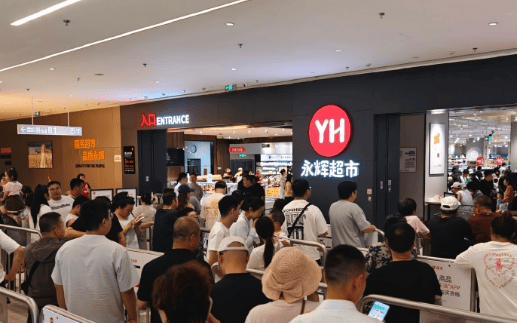
永辉超市北京大区副总经理、调改总负责人杨子亮:“调改”是从爆品到系统重塑
Bei Jing Shang Bao· 2026-01-16 07:06
Group 1 - The 2025 Beijing Business Forum was successfully held, focusing on the theme "Trendy Transformation: New Demand and New Supply," gathering representatives from various sectors to discuss fashion consumption and trends [1] - The forum aims to contribute wisdom for expanding consumption, enhancing business quality, and breaking through brand challenges [1] Group 2 - Yonghui Supermarket plans to systematically implement a "Learning from the East" transformation between 2024 and 2025, which is expected to be a "blockbuster-level" experience [4] - The transformation involves a comprehensive overhaul of product structure, store environment, and human services, achieving an overall upgrade from products to services and customer perception [4] - After the transformation, the SKU replacement rate in Yonghui's stores reached 80%, with a monthly dynamic adjustment rate of 7%, and over 30 new convenience services were added [4] - The initiatives are designed to meet the dual demands of young families for quality-price ratio and emotional value, transforming stores from traditional purchasing points to quality lifestyle communities [4] - By 2026, Yonghui will continue to focus on "new quality," enhancing its private brand development and improving selection capabilities by benchmarking against top global supply chains and retail standards [4]

永辉超市五连亏后启动31亿定增,叶国富主导胖改转型
Sou Hu Cai Jing· 2026-01-15 14:21
Core Viewpoint - Yonghui Supermarket is facing significant challenges with continuous losses over five years, but it is pursuing a transformation strategy that includes a major fundraising effort of over 3 billion yuan to upgrade its stores and logistics, aiming for a new lifecycle post-restructuring [2][3]. Group 1: Financial Performance and Store Closures - Yonghui Supermarket announced a pre-loss for 2025, continuing its trend of losses with a projected revenue of 424.34 billion yuan, a 22.21% decrease year-on-year, and a net loss of 15.02 billion yuan [4]. - The company has closed over 325 stores, reducing its total from a peak of 1,000 to 450, focusing on eliminating inefficient locations [4]. - The closures have resulted in significant costs, with the closure of 104 stores in Q3 2025 leading to a loss of 6.12 billion yuan, averaging nearly 600,000 yuan per store [4]. Group 2: Transformation Initiatives - Yonghui has initiated a "Pang Reform" movement, aiming to revamp its stores by eliminating 70% of low-efficiency products and introducing high-potential new items [5]. - The reform has led to an average customer traffic increase of over 80% in remodeled stores, with over 60% of these stores achieving profitability exceeding their five-year peak [6]. - Despite these improvements, the overall financial performance remains under pressure, with a significant decline in revenue and a net loss of 2.41 billion yuan in the first half of 2025 [6]. Group 3: Fundraising and Financial Strategy - Yonghui announced a 31.14 billion yuan fundraising plan, reduced from an initial 39.92 billion yuan, to finance store upgrades, logistics improvements, and to address liquidity needs [8][11]. - The fundraising will focus on upgrading stores in high-potential areas and enhancing logistics capabilities, including the construction of cold storage facilities [8][11]. - The company faces severe financial pressure, with a debt ratio of 88.96%, indicating a critical need for effective use of the raised funds to stabilize its financial situation [11]. Group 4: Competitive Landscape and Industry Trends - The retail industry is experiencing a structural adjustment, with stronger players like Pang Donglai setting benchmarks for success, while weaker competitors struggle [14]. - Yonghui's transformation is seen as a gamble to escape ongoing losses, positioning it as a key player to watch in the retail sector [3][16]. - The success of Yonghui's transformation will depend on the efficiency of its remodeled stores, the effective deployment of its fundraising, and the execution of its new strategic initiatives [16].
中国消费板块 2026 展望:消费信心复苏是否已开启?-China Consumer Sector_ 2026 Outlook_ are we at the beginning of consumer confidence recovery_
2026-01-15 06:33
Summary of the Conference Call Transcript Industry Overview - **Industry**: China Consumer Sector - **Outlook**: The sector is believed to be in the early stage of a multi-year recovery cycle that began in Q3 2024, with expectations for gradual improvement in consumer sentiment and spending through 2026E [2][11][12] Key Insights - **Valuation**: MSCI China Consumer Discretionary and Staples are trading at 17x and 15x 12-month forward PE, approximately one standard deviation below the 10-year averages, indicating that current valuations do not reflect a potential consumption recovery [2][9] - **Consumer Confidence**: The China Consumer Confidence Index has been trending upwards since September 2024, suggesting a gradual restoration of consumer confidence despite ongoing challenges in the property market [12][19] - **K-shaped Recovery**: The recovery is characterized by a K-shaped trend, where mid- to high-income consumers in tier-1 cities are expected to lead spending, while lower-tier city consumers remain focused on value for money [3][48] Consumer Behavior Trends - **Shifting Preferences**: A UBS Evidence Lab survey indicates a divergence in consumer behavior, with over 50% of mid- to high-income consumers reporting investment gains and showing strong spending intentions, particularly in premium and experiential categories [3][37] - **Spending Intentions**: The strongest spending intentions are noted in beauty and skincare (41%) and tourism (37%), reflecting a shift towards experiential and premium spending [51] - **Investment Gains**: 64-74% of mid- to high-income consumers reported increased investment returns, with many planning to reinvest or spend on travel, health services, and consumer electronics [40][41] Stock Implications - **Company Ratings**: - Upgrades to Neutral for Fenjiu due to expected benefits from non-business baijiu consumption - Buy ratings maintained for companies like MIXUE, Guming, China Foods, CR Beer, and YUM China, among others [4] - **Dividend Payouts**: Premium baijiu companies are noted for their >75% dividend payout, which is expected to protect share prices from downside risks [4] Structural Growth Opportunities - **Emerging Themes**: Key investment themes for 2026E include changing consumer preferences, corporate restructuring, and industry consolidation, particularly in sectors like home appliances and mass-market consumption [14][50] - **Corporate Restructuring**: Companies are expected to adapt their business models to align with changing consumer behaviors, which may lead to sustainable long-term earnings growth [4][50] Risks and Challenges - **Property Market Downturn**: The ongoing downturn in the property market is anticipated to weigh on household balance sheets, potentially impacting consumer spending [13][48] - **Policy Support**: The pace of recovery is contingent on stabilizing the property market and effective policy implementation to boost consumption [13][48] Conclusion - The China consumer sector is poised for a recovery, driven by improving consumer confidence and shifting spending patterns. However, the recovery will be uneven across different income groups and city tiers, necessitating a nuanced investment approach to capture emerging opportunities while being mindful of potential risks associated with the property market downturn.




永辉“胖改”迎5连亏,能活成第二个步步高吗?
阿尔法工场研究院· 2026-01-15 06:18
Core Viewpoint - Yonghui Supermarket is not merely aiming to learn from Pang Donglai but is pursuing a more ambitious transformation strategy amidst ongoing financial losses and operational restructuring [2][3]. Group 1: Financial Performance and Losses - Yonghui Supermarket has announced a pre-loss for the fifth consecutive year, with a projected loss of 15.02 billion yuan for 2025, following a revenue decline of 22.21% to 42.43 billion yuan in the first three quarters [5]. - The company has accumulated losses of 9.5 billion yuan from 2021 to 2024, with a revenue drop from a peak of 93.2 billion yuan in 2020 to 67.57 billion yuan in 2024 [5]. - In 2025, Yonghui closed over 325 stores, reducing its total from a peak of 1,000 to 450, focusing on eliminating inefficient locations [5][6]. Group 2: Operational Restructuring and "Fat Transformation" - The "Fat Transformation" initiative, which began in June 2024, aims to optimize store operations by eliminating nearly 70% of low-efficiency products and introducing high-potential new items [6][7]. - The transformation has led to an average customer traffic increase of over 80% in remodeled stores, with over 60% of these stores achieving profitability exceeding their five-year peak [7][21]. - Despite these improvements, the overall financial performance remains under pressure, with a significant net loss reported in the first half of 2025 [7][21]. Group 3: Financing and Debt Management - Yonghui has proposed a 31.14 billion yuan private placement to fund store upgrades, logistics improvements, and to alleviate liquidity pressures [10][13]. - The financing plan has been adjusted from an initial target of 39.92 billion yuan, with a focus on upgrading 216 stores instead of 298 [10]. - The company's financial situation is precarious, with a debt ratio of 88.96%, significantly higher than its competitors, indicating substantial short-term repayment pressures [13][14]. Group 4: Strategic Changes and Leadership - In 2025, Yonghui initiated a major organizational restructuring led by Ye Guofu, focusing on a "433" reform plan aimed at enhancing operational efficiency and modernizing management [16][17]. - The company has adopted a "naked price direct procurement" model to improve supply chain efficiency, with a goal of increasing the proportion of self-branded products [17][21]. - The success of Yonghui's transformation strategy will depend on the effective execution of these changes and the ability to maintain service quality during rapid expansion [21].

抄了还亏?不敌胖东来,永辉超市算漏了什么?
Jin Shi Shu Ju· 2026-01-13 12:48
Core Viewpoint - Yonghui Supermarket's attempt to replicate the "Pang Donglai model" has not yielded positive results, as it continues to face significant losses, with projected negative net profit for 2025 [1] Group 1: Imitation of the Pang Donglai Model - Yonghui has adopted superficial aspects of the Pang Donglai model, such as store design and service processes, but failed to grasp the underlying value distribution system and regional focus [2] - Initial changes attracted customers, with some stores seeing foot traffic increase by over 80%, but issues like price hikes and inadequate service led to customer dissatisfaction [2] - The disparity in employee compensation is stark, with Pang Donglai distributing over 90% of profits to employees, while Yonghui's employee incentives have been minimal, leading to dissatisfaction among staff [2] Group 2: Operational Challenges - Yonghui's strategy of closing stores to emulate Pang Donglai's "less is more" approach has resulted in significant one-time costs, amounting to tens of billions [3] - The company's nationwide expansion strategy has created a burden of high rental costs, contrasting with Pang Donglai's debt-free, self-owned property model [2][3] Group 3: Supply Chain and Market Position - Yonghui's supply chain reforms have been rushed, leading to inconsistent product quality and a lack of deep supplier relationships, which has negatively impacted customer experience [4] - The company faces external pressures from community group buying, fresh e-commerce, and warehouse membership stores, with over 60% of consumers shifting to online shopping [5] Group 4: Employee Value and Corporate Philosophy - Yonghui's underestimation of the importance of employees in retail has hindered its transformation efforts, as successful models prioritize employee welfare to enhance customer service [5][6] - Despite overall losses, some adjusted stores have become profitable, indicating that the direction is not entirely wrong, but the approach needs refinement [6] - The challenges faced by Yonghui highlight the need for a balance between capital logic and humanistic care, as well as between short-term financial results and long-term value [6]
模仿胖东来20个月、调改300家门店,永辉仍在亏钱
Xin Lang Cai Jing· 2026-01-13 11:33
Core Viewpoint - Yonghui Supermarket is experiencing significant financial challenges, with a notable decline in revenue and net profit due to extensive store adjustments and external risks affecting its stock price [2][11][12]. Financial Performance - In the first three quarters of 2025, Yonghui Supermarket reported revenue of 42.434 billion yuan, a year-on-year decrease of 22.21%, and a net profit loss of 1.502 billion yuan after excluding non-recurring items [11][12]. - The decline in revenue and profit is primarily attributed to the closure of over 325 stores, reducing the total number of operating stores from a peak of 1,000 to 450 [11][12]. Market Reaction - Investors anticipated continued losses for Yonghui Supermarket in 2025, viewing the situation as expected given the significant losses reported in the third quarter [12]. - The company's stock price has fallen from nearly 7 yuan at the end of 2024 to around 5 yuan, influenced by concerns over cash flow and a contract dispute involving the chairman [12] . Store Adjustment and Improvement - As of the end of the third quarter of 2025, Yonghui has completed approximately 50% of its store adjustments, with adjusted stores showing an average customer traffic increase of over 80% and some stores returning to profitability [2][13]. - The company aims to complete adjustments for all stores by June 2026, with a target of over 300 adjusted stores before the 2026 Spring Festival [13]. Strategic Initiatives - Yonghui Supermarket has been implementing the "Fat Donglai" model since May 2024, focusing on supply chain transformation, customer experience enhancement, and organizational culture restructuring [13][14]. - The first store adopting this model opened in Chengdu in October 2024, emphasizing employee and customer happiness [14].
投资者称永辉超市亏损在预期内永辉超市发预亏公告
Xin Lang Cai Jing· 2026-01-13 11:32
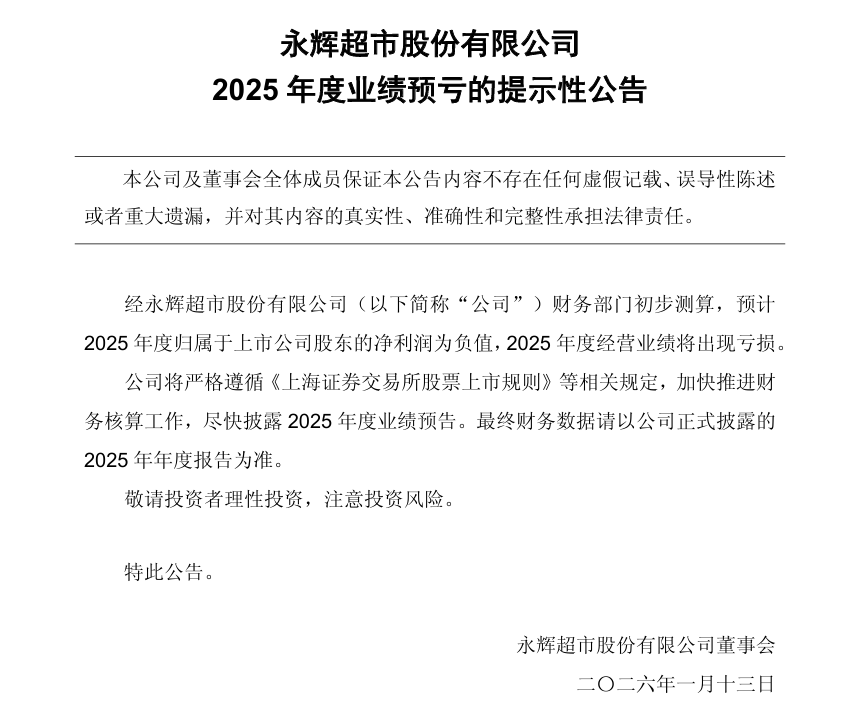
来源:@智通财经APP微博 来源:@智通财经APP微博 【#投资者称永辉超市亏损在预期内##永辉超市发预亏公告#】 1月12日晚间,永辉超市发布公告称,经公司财务部门初步测算,预计2025年度归母净利润为负值, 2025年度经营业绩将出现亏损。永辉表示,最终财务数据以正式披露的2025年年度报告为准。#永辉超 市2025净利润为负# 有投资者告诉蓝鲸记者,"永辉超市预亏是预期内的事情,只是亏多少的问题。"然而,永辉超市并未在 今日的公告中,发布具体的亏损数据。 永辉超市自2024年5月启动"胖改",至今已有1年半时间,从公司2026年1月9日公布情况看,全国调改门 店已经突破300家。2025年10月,永辉CEO王守诚曾公开表示,学习胖东来模式仍处于初级阶段,坚持 长期主义,希望用2到3年走出生死线,5到10年真正成为一个国民超市品牌。@蓝鲸新闻 有投资者告诉蓝鲸记者,"永辉超市预亏是预期内的事情,只是亏多少的问题。"然而,永辉超市并未在 今日的公告中,发布具体的亏损数据。 永辉超市自2024年5月启动"胖改",至今已有1年半时间,从公司2026年1月9日公布情况看,全国调改门 店已经突破300家。2025年 ...
57家上市公司预亏,疫苗龙头首亏超百亿,有公司净利大增14倍
2 1 Shi Ji Jing Ji Bao Dao· 2026-01-13 10:59
Core Viewpoint - The A-share annual report performance forecast season is unfolding with a notable difference from previous years, as companies with poor performance are disclosing their losses earlier than usual, alongside profit warnings from companies with better performance [1]. Group 1: Performance Forecast Trends - As of January 13, 2026, 105 listed companies have released their performance forecasts for 2025, accounting for 70.9% of recent disclosures, with 57 companies (54.29%) predicting losses [1]. - Traditionally, companies with good performance tend to report positive forecasts early, while those with poor performance delay their disclosures. However, this trend has been disrupted in January 2026, with loss announcements appearing simultaneously with profit increases [1][3]. Group 2: Industry Impact and Loss Distribution - The current wave of loss announcements is characterized by "uneven scale and industry concentration," with traditional cyclical industries being the hardest hit. The real estate sector has shown particularly poor performance, with all six companies that disclosed forecasts reporting losses [3]. - Among the 57 companies predicting losses, two are expected to lose over 10 billion, while others fall into various loss brackets, with the real estate giant Greenland Holdings projected to lose between 16 billion to 19 billion yuan, marking its third consecutive year of losses [3][4]. Group 3: Specific Company Forecasts - Yonghui Supermarket is expected to report a negative net profit for the fifth consecutive year, while the vaccine leader Zhifei Biological Products anticipates a loss of 10.698 billion to 13.726 billion yuan, representing a year-on-year decline of 630% to 780%, marking its first annual loss in 25 years [4]. - Other companies, such as Sanan Optoelectronics and Zhuosheng Micro, are also forecasting significant losses, with declines in their respective sectors [5]. Group 4: Profit Growth in Certain Sectors - In contrast to the loss announcements, companies in the resource and technology sectors are experiencing significant profit growth, driven by rising commodity prices and technological innovations. For instance, Zijin Mining expects a net profit of 51 to 52 billion yuan, a year-on-year increase of 59% to 62% [8]. - The technology sector is also seeing growth, with companies like Sanhua Intelligent Control projecting a profit increase of 25% to 50% due to advancements in their automotive parts business [8][9]. Group 5: Market Reactions and Future Outlook - Analysts suggest that the early disclosure of losses is a strategy to manage investor expectations and prevent market volatility during the concentrated reporting period. This reflects a regulatory focus on transparency and investor protection [14]. - Looking ahead to 2026, there is a positive sentiment among institutions regarding market recovery, with expectations of improved corporate earnings driven by macroeconomic recovery and increased investor confidence [15].