
CCB(601939)

Search documents
分红总额超2600亿元!银行股年终忙发“红包”
Zhong Guo Ji Jin Bao· 2025-12-08 23:22
12月8日晚间,工商银行、农业银行发布分红最新公告。 中国基金报记者梳理发现,除工商银行、农业银行外,国有大行中,中国银行和建设银行已于12月5日发布2025年半年度A股分红派息实施公告。 工商银行公告显示,公司2025年半年度利润分配方案已获股东会通过,本次利润分配每股派发现金股息人民币0.1414元(含税),派发现金股息共计约人民 币503.96亿元。其中,A股现金股息共计约人民币381.23亿元。现金红利发放日为2025年12月15日。 A股上市银行"发红包" 分红总额超2600亿元 进入12月份,上市银行分红持续推进。相较往年,今年中期派息时间有所前移。 据Wind数据统计,截至12月8日,已有24家A股上市银行披露中期分红方案,其中18家A股上市银行已发布分红派息实施公告。 从分红总额看,A股上市银行2025年半年度合计派现规模达2637.91亿元。 国有大行稳居"主力军"地位。其中,工商银行以503.96亿元分红金额位居榜首,建设银行、农业银行紧随其后,2025年中期分红金额分别达486.05亿元和 418.23亿元,中国银行、交通银行、邮储银行分红金额分别为352.50亿元、138.11亿元、1 ...





2000亿“红包雨”即将来袭,国有大行今年中期分红提前近一个月落地
Feng Huang Wang· 2025-12-08 14:54
Core Viewpoint - The pace of interim dividends for state-owned banks has significantly accelerated this year, with major announcements made by Agricultural Bank of China and Industrial and Commercial Bank of China for the 2025 interim dividend distribution [1][4]. Group 1: Dividend Announcement Details - Agricultural Bank of China and Industrial and Commercial Bank of China announced their interim dividend distribution dates, with the record date set for December 12, 2025, and the ex-dividend date and cash dividend payment date both on December 15, 2025 [2]. - Industrial and Commercial Bank of China will distribute a cash dividend of RMB 0.1414 per share, totaling approximately RMB 503.96 billion, with about RMB 381.23 billion allocated for A-shares [4]. - Agricultural Bank of China will distribute a cash dividend of RMB 0.1195 per share, totaling approximately RMB 418.23 billion, with about RMB 381.50 billion for A-shares [4]. Group 2: Comparison with Previous Year - As of now, four state-owned banks have announced their interim dividend plans, which is nearly a month earlier than the same period last year [3]. - The total cash dividend for the six major state-owned banks is expected to reach RMB 2046.57 billion, remaining stable compared to the same period last year, with a dividend payout ratio of around 30% [3][7]. - The interim dividend amounts for the other two banks, Bank of Communications and Postal Savings Bank, are expected to be RMB 138.11 billion and RMB 147.72 billion, respectively [7]. Group 3: Regulatory Influence - The acceleration in dividend announcements aligns with the new "National Nine Articles" issued by the State Council in April 2024, which aims to strengthen cash dividend regulations for listed companies [5]. - The industry has become more adept at implementing these policies, leading to a quicker realization of dividend distributions this year compared to last year [6].
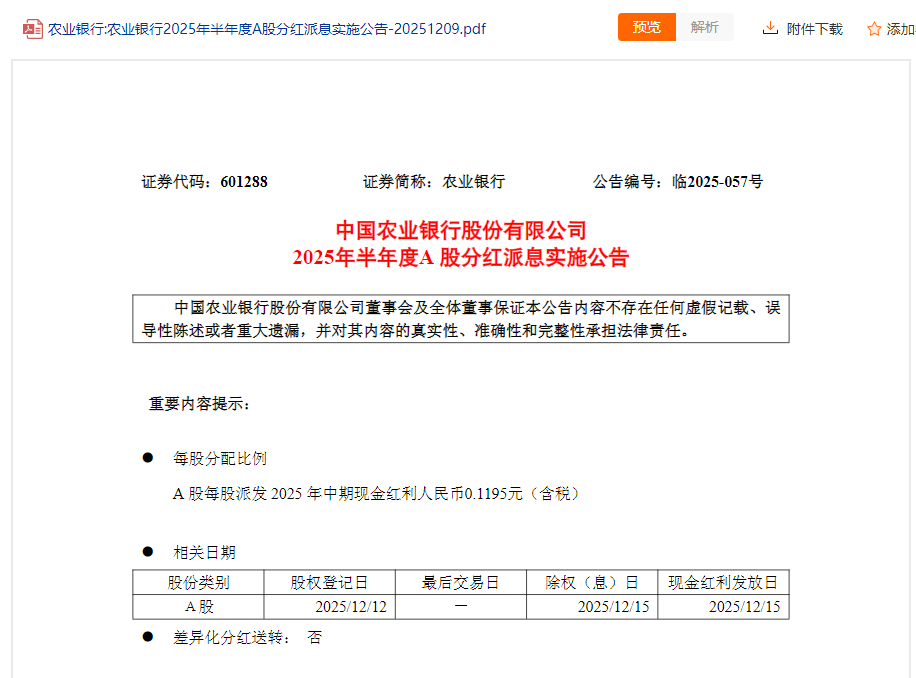
超760亿元!A股又见大额分红
Zhong Guo Zheng Quan Bao· 2025-12-08 14:45
12月8日晚,工商银行、农业银行分别发布2025年半年度A股分红派息实施公告,两家银行现金红利发 放日均为12月15日,合计将派发A股现金红利超760亿元。 建设银行现金红利发放日为12月11日。本次利润分配向该行全体股东派发2025年半年度现金股息每股 0.1858元(含税)。本次共计派发现金股息约486.05亿元,其中派发A股现金股息约39.36亿元。 工商银行公告称,本次利润分配以截至分红派息股权登记日12月12日的约3564.06亿股普通股为基数, 每股派发现金股息0.1414元(含税),共计派发现金股息约503.96亿元。其中,A股普通股股份数约为 2696.12亿股,本次派发A股现金股息共计约381.23亿元(含税)。 (文章来源:中国证券报) 此外,12月4日,中国银行、建设银行发布2025年半年度A股分红派息实施公告。两家银行利润分配方 案也已被股东会审议通过。 其中,中国银行现金红利发放日为12月11日。每股派发现金红利0.1094元(税前),共计派发现金红利 约352.50亿元(税前);派发A股现金红利约261.02亿元人民币(税前)。 农业银行公告称,本次利润分配以该行3499.83亿股 ...

建设银行山东省分行到访晨鸣集团
Xin Lang Cai Jing· 2025-12-08 11:28
Group 1 - The core viewpoint of the article highlights the collaboration between China Construction Bank Shandong Branch and Chenming Group to enhance financial services and support enterprise development [1] - Liu Chunlong, Deputy General Manager of China Construction Bank Shandong Branch, led a delegation to visit Chenming Group, indicating a commitment to deepen bank-enterprise cooperation [1] - The delegation toured the Shouguang Chenming Chemical Pulp Plant and the Eighth Plant, gaining insights into the company's production and operational status [1] Group 2 - The bank aims to leverage its financial service advantages to tailor comprehensive financial solutions based on the actual needs of the enterprise [1] - Group leaders Zhang Zhongshan and Meng Feng participated in the discussions, emphasizing the importance of collaboration between financial institutions and enterprises [1]
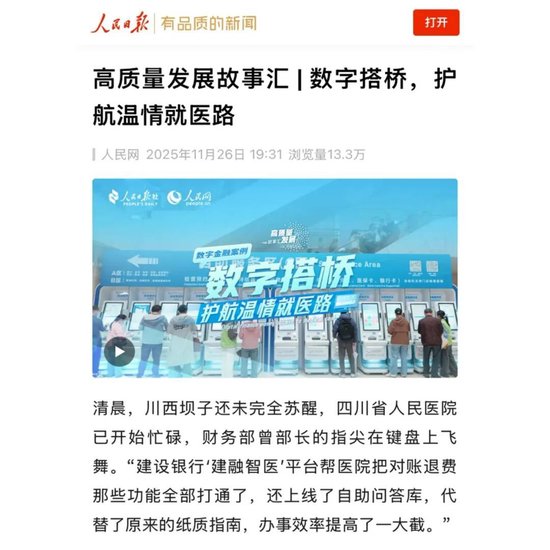
数字搭桥,护航温情就医路!建行“数字金融”故事获人民日报点赞
Xin Lang Cai Jing· 2025-12-08 09:59
Core Viewpoint - The "Jianrong Zhiyi" platform by China Construction Bank (CCB) is highlighted as a successful case of digital finance, significantly improving the efficiency of refund reconciliation processes at Sichuan Provincial People's Hospital, aligning with the national goal of building a financial powerhouse and promoting high-quality financial development [1][29]. Group 1: Digital Finance Implementation - The "Jianrong Zhiyi" platform has streamlined the refund reconciliation process, reducing the number of personnel required from 7 to 1 [2][30]. - The average response time for single query retrieval has decreased from 63 seconds to under 12 seconds, enhancing operational efficiency [2][30]. - The platform has implemented a self-service Q&A database, replacing traditional paper guides, which has led to a significant increase in service efficiency [2][30]. Group 2: Broader Financial Initiatives - CCB's initiatives, including "Yunong Tong" and "Jianrong Huixue," reflect its commitment to serving the public and supporting various sectors through financial services [3][31]. - The integration of advanced technologies such as distributed banking core systems and natural language processing has underpinned the success of these digital finance initiatives [3][31]. - CCB aims to accelerate its digital and intelligent transformation to contribute to the development of the digital economy and enhance financial productivity [29][31]. Group 3: Communication and Outreach - CCB's digital finance stories are being disseminated in both Chinese and English through various media platforms, including People's Daily and its online channels [3][31]. - The outreach efforts aim to showcase the impact of digital finance on improving public services and enhancing the quality of life [3][31].
消费有“贷”动力、外贸有“金”动能,深圳建行多维发力助深圳稳增长
2 1 Shi Ji Jing Ji Bao Dao· 2025-12-08 09:53
Core Viewpoint - China is accelerating the construction of a new development pattern that focuses on domestic circulation while promoting international circulation, with a strong emphasis on boosting consumption and stabilizing foreign trade by 2025 [1] Group 1: Foreign Trade Support - Shenzhen has led the nation in foreign trade exports for 32 consecutive years, with "Shenzhen Manufacturing" gaining popularity in international markets [1] - In the first ten months of 2025, Shenzhen's banks issued new loans to foreign trade enterprises amounting to 763.57 billion yuan, a year-on-year increase of 9.83% [1] - The China Construction Bank Shenzhen Branch has implemented a comprehensive service plan combining domestic and foreign trade insurance to support local enterprises, facilitating 1.5 billion yuan in financing for a key renewable energy company [2] - The bank provided international settlement services worth 106 billion USD, a 16% increase year-on-year, and trade financing support of 34.3 billion yuan, up 44% [2] Group 2: Financial Technology and Innovation - The bank has expanded its policy pilot programs, providing trade foreign exchange settlement services to 128 quality enterprises, with service numbers increasing by over 12% [3] - The application of financial technology has improved cross-border payment experiences, reducing the average remittance time for cross-border RMB payments to real-time [3] - The bank has promoted cross-border supply chain financing, with over 5.7 billion yuan disbursed in the first ten months of 2025, a 171% increase year-on-year [4] Group 3: Consumer Promotion Measures - Shenzhen's retail sales of consumer goods have exceeded one trillion yuan for two consecutive years, with loans in the service sectors reaching 207.996 billion yuan, a 2.04% increase [5] - The bank has implemented five measures to promote consumer spending, including targeted installment services for home decoration and vehicle purchases, with over 5 billion yuan in credit card installment services provided [5] - The bank has optimized personal consumption loan policies, reducing average loan interest rates by over 30 basis points and serving over 400,000 consumer loan clients with support exceeding 30 billion yuan, a 21% increase [6]
消费有“贷”动力、外贸有“金”动能,深圳建行多维发力助深圳稳增长
21世纪经济报道· 2025-12-08 09:50
Core Viewpoint - The article emphasizes the importance of enhancing domestic consumption and stabilizing foreign trade as key priorities for Shenzhen's economic strategy, with a focus on financial support to achieve these goals [1][2]. Group 1: Foreign Trade Support - Shenzhen has maintained its position as a leading city in foreign trade for 32 consecutive years, with significant growth in "Shenzhen Intelligent Manufacturing" in international markets [1]. - In the first ten months of 2025, Shenzhen's banks issued new loans to foreign trade enterprises amounting to 76.36 billion yuan, a year-on-year increase of 9.83% [1]. - Shenzhen Construction Bank (Shenzhen CCB) has implemented a comprehensive service plan combining domestic and foreign trade insurance to support local enterprises, facilitating 1.5 billion yuan in financing for a key renewable energy company [3]. Group 2: Financial Services and Innovations - Shenzhen CCB has provided international settlement services worth 106 billion USD, a 16% increase year-on-year, and trade financing support of 34.3 billion yuan, up 44% [3]. - The bank has expanded its policy pilot programs, serving 128 quality enterprises with nearly 30,000 transactions in trade foreign exchange services, reflecting a growth of over 12% in the number of served enterprises [4]. - The application of financial technology has improved cross-border payment experiences, reducing transaction times significantly for businesses [4]. Group 3: Consumer Support Initiatives - Shenzhen's retail sales have exceeded one trillion yuan for two consecutive years, with a loan balance in the service sector reaching 207.99 billion yuan, a year-on-year increase of 2.04% [7]. - Shenzhen CCB has launched five measures to promote consumer spending, including targeted credit card installment services that have provided over 5 billion yuan in financing, particularly in the green automotive sector [9]. - The bank has also optimized personal consumption loan policies, reducing average interest rates by over 30 basis points and serving over 400,000 customers with loan support exceeding 30 billion yuan, a 21% increase [10].

中国建设银行、东方汇理银行、荷兰安智银行等境内外机构协同助力外币三方回购业务发展
Xin Lang Cai Jing· 2025-12-08 09:49
来源:CFETSFX 2025年9月以来,中国建设银行作为市场重要参与机构,与东方汇理银行、荷兰安智银行等境外机构积 极开展以境外主权债券篮子为抵押品的外币三方回购交易,截至目前累计成交6.1亿美元,为业务常态 化开展与市场稳健发展提供了有力支撑。外汇交易中心全面接轨国际市场惯例,连接明讯银行等托管机 构,为跨境外币融资业务高质量发展提供了新的实践路径。 自外币回购业务上线以来,外汇交易中心与境内外基础设施、参与机构积极合作探索,持续拓展业务模 式、优化交易机制并完善配套服务。目前,外币三方回购业务已全面接轨国际惯例,采用买断式过户模 式,在简化交易流程、提升交易效率的同时,通过抵押品所有权的转移切实保障交易安全,并获得专业 便捷的自动选券和存续期管理服务。外币三方回购业务的平稳运行与持续深化,不仅有效盘活了境内机 构的境外资产、拓宽外币流动性管理渠道,更通过畅通跨境资金流动进一步吸引与汇聚全球金融资源, 为服务金融市场高水平对外开放与上海国际金融中心建设注入新动力。 2025年9月以来,中国建设银行作为市场重要参与机构,与东方汇理银行、荷兰安智银行等境外机构积 极开展以境外主权债券篮子为抵押品的外币三方回购 ...
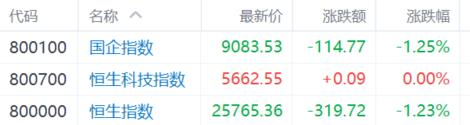
港股收评:恒指收跌1.23%,再失26000点,中资券商股逆势走高
Ge Long Hui· 2025-12-08 08:37
具体来看: 大型科技股多数呈现下跌行情但总体跌幅较小,腾讯、京东、网易、小米、京东跌幅在1%以内,阿里巴巴、快手、携程控股跌超 1%,百度逆市大涨3.45%。 | 代码 | 名称 | 最新价 | 涨跌额 | 涨跌幅 √ | | --- | --- | --- | --- | --- | | 09888 | 百度集团-SW.) | 125.800 | +4.200 | 3.45% | | 03690 | 美团-W | 99.500 | +0.450 | 0.45% | | 09626 | 時陣時陣-W | 203.600 | -0.200 | -0.10% | | 02015 | 理想汽车-W | 69.650 | -0.250 | -0.36% | | 01810 | 小米集团-W | 42.580 | -0.200 | -0.47% | | 099999 | 网易-5 | 216.800 | -1.200 | -0.55% | | 09618 | 京东集团-SW | 116.200 | -0.800 | -0.68% | | 00700 | 腾讯控股 | 605.000 | -5.000 | -0.82% ...





高息不再 “存款特种兵”沉默
Jing Ji Guan Cha Wang· 2025-12-08 08:08
Core Viewpoint - The current low interest rate environment has led to a significant reduction in the availability and attractiveness of large time deposits, with many banks discontinuing long-term products, prompting depositors to seek alternative investment options [1][3][4]. Group 1: Interest Rate Trends - The interest rate for large time deposits has decreased significantly, with major banks offering rates as low as 1.55% for 3-year deposits, compared to previous rates above 3% [2][3]. - Many banks, including state-owned and joint-stock banks, have stopped issuing long-term large time deposits, with 5-year products no longer available [3][4]. - The interest rates for traditional fixed deposits are now comparable to those of large time deposits, diminishing their competitive edge [3][4]. Group 2: Depositor Behavior - Depositors are increasingly turning to alternative investments such as gold and bank wealth management products due to the low returns on traditional deposits [1][9]. - There is a noticeable shift among depositors, with some opting for riskier investments while others remain conservative, preferring to keep their funds in banks despite lower interest rates [9][10]. - Social media and deposit communities have become platforms for sharing information about available products, with many depositors actively seeking higher yields [7][8]. Group 3: Bank Strategies - Banks are adopting proactive liability management strategies in response to the low interest rate environment, leading to a reduction in the issuance of long-term large time deposits [5][6]. - Some smaller banks are leveraging marketing strategies to attract depositors by offering competitive rates and promotional incentives [8]. - The trend of discontinuing long-term large time deposits reflects broader market conditions and the need for banks to manage their interest rate risk effectively [5][6].


