
CCB(601939)

Search documents
清新“建行蓝”火热助力湘超联赛
Chang Sha Wan Bao· 2025-11-20 12:31
Core Insights - The China Construction Bank (CCB) Hunan Branch is actively engaging in the 2025 Hunan Provincial Football League ("Xiangchao") as a strategic partner, providing financial services at the event to enhance the spectator experience [1][4] - CCB has established a service team that offers various financial products and educational resources to attendees, focusing on consumer benefits and fraud prevention [3][4] Group 1 - CCB's service booth has become a popular spot for fans, providing amenities like tissues and promotional items while offering financial consultations and demonstrations of mobile banking features [3] - The bank is conducting financial literacy campaigns, educating fans on topics such as fraud prevention and safe financial practices through relatable examples and slogans [3][4] Group 2 - CCB's rapid response to fan needs includes the launch of a promotional campaign that provided 100,000 yuan in shopping vouchers within 72 hours, enhancing the event's economic impact [4] - The "CCB Life" platform has partnered with 250 local merchants to create a seamless experience for fans, integrating ticketing, coupon distribution, and consumption [4] - CCB Hunan Branch aims to continue its involvement in the league and explore innovative "finance + sports" models to stimulate local economic growth [4]



到处点火 又不拉板
Datayes· 2025-11-20 11:49
Core Viewpoint - The article discusses the current state of the A-share market, highlighting the mixed performance of various sectors and the impact of external factors such as Nvidia's earnings report. It emphasizes the ongoing volatility and the potential for investment opportunities, particularly in bank stocks and storage leaders, while also noting the challenges faced by the broader market. Market Performance - A-shares experienced a collective decline, with the Shanghai Composite Index down 0.40%, Shenzhen Component down 0.76%, and ChiNext down 1.12% on November 20. The total trading volume was 17,227.98 billion yuan, a decrease of 200.48 billion yuan from the previous day, with over 3,800 stocks declining [12]. - The banking sector showed resilience, with major banks like China Bank and Industrial and Commercial Bank of China reaching historical highs, each exceeding a market capitalization of 20 billion yuan [12]. Sector Analysis - The storage sector saw significant gains, with six major storage leaders experiencing a surge in total market capitalization approaching 7 trillion yuan, influenced by Nvidia's Q3 performance exceeding expectations [3]. - The real estate sector is expected to receive a boost from potential new stimulus policies, including mortgage subsidies for first-time homebuyers, which could enhance market sentiment [6]. Investment Trends - The article notes a shift in investment behavior, with high-net-worth individuals driving new A-share account openings, contrasting with lower participation from ordinary residents. The number of new A-share accounts rose from 1.65 million to 2.94 million between June and September, indicating a potential focus on wealthier investors [4]. - The concept of "deposit migration" is gaining traction, as investors move funds from low-yield savings accounts to higher-yield stock investments, which could enhance market liquidity and consumer confidence through the "wealth effect" [4]. Technical Indicators - The market is currently in a tug-of-war around the 4,000-point mark, with concerns about a potential peak in the bull market. Various indicators, including equity risk premium and trading volume, suggest a short-term correction may be imminent, although no definitive signals of a market top have emerged [10][11]. - The article highlights that while some technical indicators show signs of overbought conditions, the overall valuation metrics remain within reasonable ranges, suggesting that the bull market may continue with support from retail deposits and public funds [11].






逾2000亿“红包雨”来袭,“银伟大”炸裂上涨,中行、工行再创新高!银行10月以来跑赢创业板15%,机构:增配
Xin Lang Ji Jin· 2025-11-20 11:43
Core Viewpoint - The banking sector has shown strong performance, driven by style rotation and significant mid-term dividend distributions, with major state-owned banks leading the gains [3][5]. Group 1: Market Performance - On November 20, major banks experienced a rally, with China Bank rising over 5% and Industrial and Commercial Bank of China increasing by over 2%, both reaching historical highs [1]. - The China Banking Index has accumulated an 8.95% increase since the beginning of October, outperforming the broader market and exceeding the ChiNext Index by 15 percentage points [4]. Group 2: Dividend Distributions - A total of 24 listed banks have announced mid-term dividends, with a combined payout of nearly 263.8 billion yuan, marking a historical high [5]. - The six major state-owned banks are set to distribute a total of approximately 204.66 billion yuan in dividends, with most record dates concentrated in December [5]. Group 3: Investment Appeal - The banking sector is viewed as a defensive investment due to its low valuation and high dividend yield, making it attractive to investors seeking stability [5]. - As of the end of September, the China Banking Index had a price-to-book ratio of 0.67, placing it in the lower 35.69% percentile over the past decade, while the dividend yield reached 4.29%, significantly above the 10-year government bond yield of 1.88% [5]. Group 4: ETF Activity - The largest banking ETF (512800) saw its price rise by 1.9%, reaching a new high for the month, with a total trading volume of 1.491 billion yuan, indicating increased market interest [2]. - The banking ETF has experienced a significant increase in scale, reaching 20.615 billion yuan, reflecting strong investor demand [6].


124家A股公司股息率超5%,历年高股息“牛股”含金量如何?
Di Yi Cai Jing· 2025-11-20 11:20
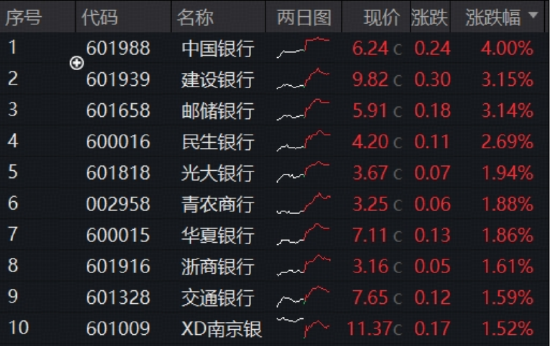
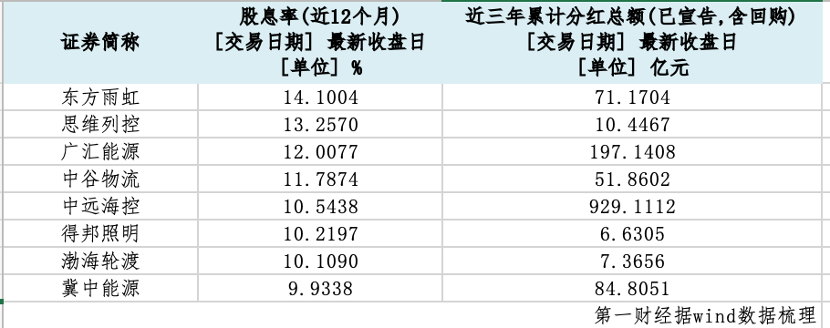
Group 1: Bank Sector Performance - The bank sector is becoming a market focus, with A-share banks showing strong performance, particularly China Bank, which rose 4% to reach a historical high [1] - As of November 20, the total market capitalization of the four major banks in A-shares has exceeded 2 trillion yuan [1] - In the Hong Kong market, Minsheng Bank led gains with over 3% increase, while other banks also saw significant rises [1] Group 2: High Dividend Stocks - There are currently 124 companies in A-shares with a dividend yield exceeding 5%, with 7 companies yielding over 10% [2][3] - The top three companies with the highest dividend yields are Dongfang Yuhong (14.1%), Siwei Liekong (13.25%), and Guanghui Energy (12%) [3][4] - High dividend stocks are not limited to the banking sector but are also found in utilities, energy, and telecommunications, providing a buffer against market volatility [2][3] Group 3: Dividend Distribution Trends - As of November 20, 24 out of 42 A-share listed banks have announced mid-term dividends totaling approximately 263.8 billion yuan, marking an increase from the previous year [1] - Regulatory bodies are encouraging companies to enhance shareholder returns through measures like "cancellation-style buybacks" and multiple annual dividends [5] Group 4: Long-term Dividend Trends - For the 2024 reporting period, the companies with the highest projected dividend yields are Haoxiangni (16.91%), Meiyingsen (15.95%), and Jinshi Technology (14.97%) [6] - In 2023, the top dividend yielders included Libai Co. (15.34%), Rong'an Real Estate (13.06%), and Yutong Bus (11.32%) [7][8] Group 5: Characteristics of High Dividend Companies - High dividend companies are typically found in stable sectors like utilities, energy, telecommunications, and consumer staples, which are less affected by economic cycles [8] - These companies often have clear and stable dividend policies, viewing consistent dividends as a means to maintain credibility and attract long-term investors [8] Group 6: Risks Associated with High Dividend Strategies - High dividend strategies may carry risks, as some companies with high yields may face declining performance or debt issues [10][12] - The phenomenon of "high dividend traps" can occur when a company's stock price falls, artificially inflating the dividend yield without a corresponding increase in earnings [12]


机构称银行板块价值空间依旧显著,关注银行ETF易方达(516310)等配置价值
Sou Hu Cai Jing· 2025-11-20 10:42
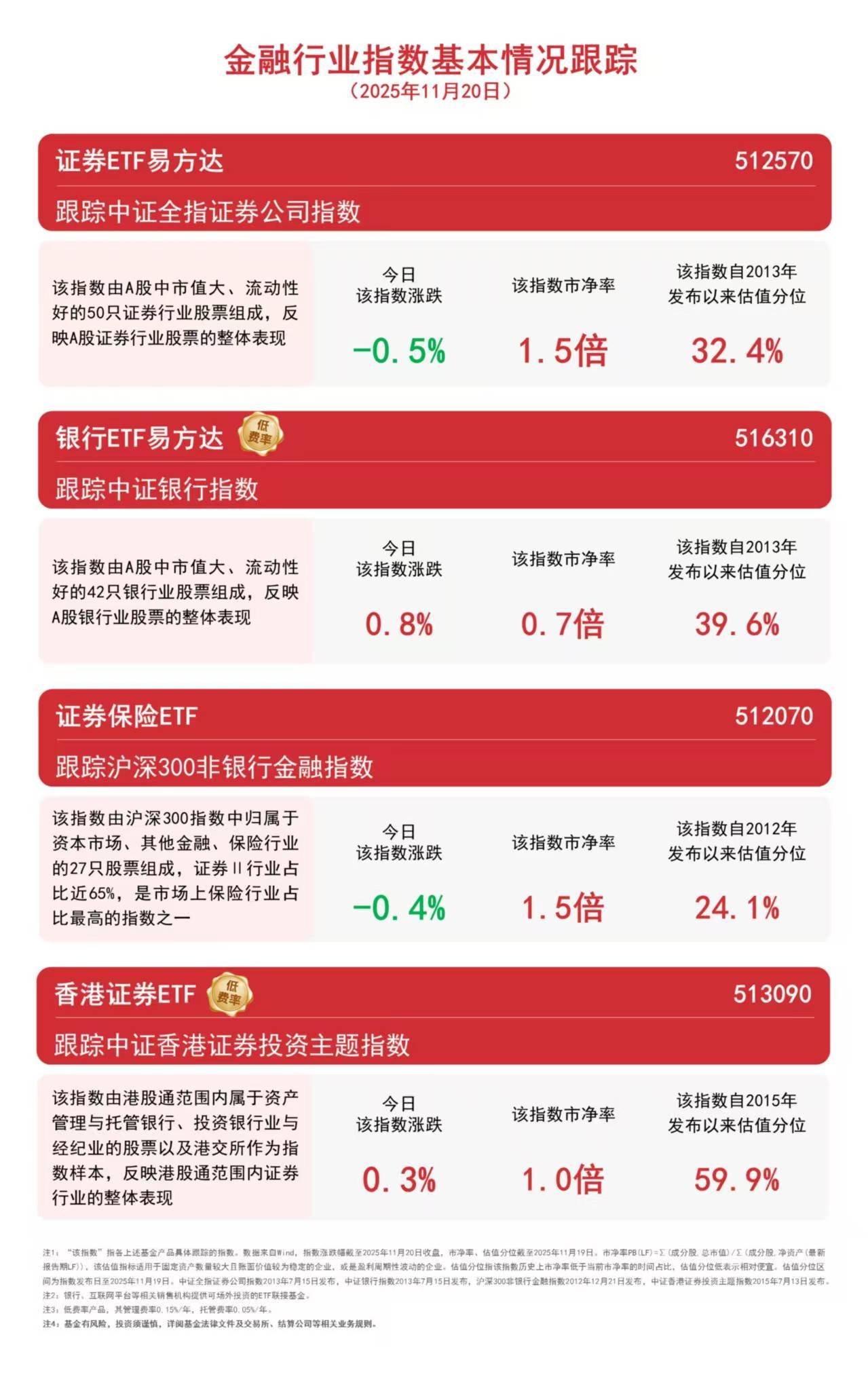
Group 1 - The core viewpoint of the news highlights the strong performance of bank stocks amidst market fluctuations, with China Bank reaching a historical high, and other banks like Construction Bank and Postal Savings Bank also showing significant gains [1] - The China Securities Bank Index rose by 0.8%, while the Hong Kong Securities Index increased by 0.3%. In contrast, the non-bank financial index of the CSI 300 fell by 0.4%, and the CSI All Securities Company Index decreased by 0.5% [1] - According to CITIC Securities, financial statistics indicate active transfers of resident deposits and non-bank deposits, leading banks to focus more on liquidity management as the year-end approaches [1] Group 2 - The preliminary stabilization of bank interest margins in the third quarter has contributed to stable profit levels for banks [1] - The banking sector is perceived to have significant value space due to low valuations, which may attract long-term capital allocation as the year-end approaches, potentially enhancing the market performance of bank stocks [1]
中国银行创新高,保险资金为何偏爱银行股?
Jiang Nan Shi Bao· 2025-11-20 09:24
Core Viewpoint - The banking sector is gaining attention in the capital market due to a combination of declining interest rates, policy support, and low valuations, leading to increased investment from long-term funds like insurance capital [1][2]. Group 1: Reasons for Insurance Capital Favoring Bank Stocks - Insurance capital seeks stable and reliable assets due to a mismatch in the average duration of liabilities (over 12 years) and assets (approximately 6 years), resulting in over 2 trillion yuan needing investment annually [1]. - Bank stocks are attractive due to their high dividend yields, low valuations, and low volatility, with an average dividend yield of 3.86%, significantly higher than the 10-year government bond yield of 1.82% as of November 19, 2025 [1][2]. Group 2: Valuation and Stability of the Banking Sector - The banking sector's price-to-book ratio is at 0.63, indicating extreme low valuation and providing a safety cushion [2]. - The banking sector has shown a volatility of only 14.90% over the past three years, which is significantly lower than the 24.80% volatility of the CSI 300 index, making it suitable for long-term holding as a core asset [2]. Group 3: Impact of IFRS 9 on Insurance Companies - The implementation of IFRS 9 accounting standards requires insurance companies to estimate and recognize expected credit losses at the initial recognition of assets, affecting profits even before actual losses occur [2]. - This new standard encourages insurance companies to classify more equity investments as FVOCI (Fair Value Through Other Comprehensive Income), which helps to isolate short-term market fluctuations from profit statements, making bank stocks a suitable choice for long-term holding [2]. Group 4: Preferred Bank Stocks Among Insurance Capital - Insurance capital shows a preference for state-owned banks like Industrial and Commercial Bank of China and China Construction Bank due to their stable dividends and strong liquidity [3]. - Quality joint-stock banks such as China Merchants Bank and Industrial Bank are favored for their robust profitability and potential for valuation recovery [3]. - High-growth regional banks like Chengdu Bank and Suzhou Bank are also attractive due to their high ROE and asset quality, indicating potential for price appreciation [3]. - Hong Kong-listed bank stocks, such as CITIC Bank and Chongqing Bank, are appealing due to higher dividend yields and more attractive valuations [3]. Group 5: Implications for Ordinary Investors - For ordinary investors, bank stocks offer a combination of high dividends and low valuations, providing defensive characteristics and cash flow returns in the current market environment [5]. - As market trends shift towards stable returns, bank stocks can play a crucial role in balancing risk and securing stable dividends within an investment portfolio [5].

国有大型银行板块11月20日涨0.89%,中国银行领涨,主力资金净流入6.24亿元
Zheng Xing Xing Ye Ri Bao· 2025-11-20 09:04
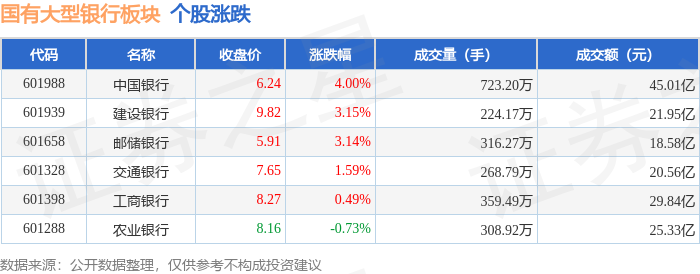
Core Insights - The state-owned large bank sector saw an increase of 0.89% on November 20, with China Bank leading the gains [1] - The Shanghai Composite Index closed at 3931.05, down 0.4%, while the Shenzhen Component Index closed at 12980.82, down 0.76% [1] Bank Performance Summary - China Bank (601988) closed at 6.24, up 4.00%, with a trading volume of 7.232 million shares and a transaction value of 4.501 billion [1] - Construction Bank (656109) closed at 9.82, up 3.15%, with a trading volume of 2.242 million shares and a transaction value of 2.195 billion [1] - Postal Savings Bank (601658) closed at 5.91, up 3.14%, with a trading volume of 3.163 million shares and a transaction value of 1.858 billion [1] - Transportation Bank (601328) closed at 7.65, up 1.59%, with a trading volume of 2.688 million shares and a transaction value of 2.056 billion [1] - Industrial and Commercial Bank (601398) closed at 8.27, up 0.49%, with a trading volume of 3.595 million shares and a transaction value of 2.984 billion [1] - Agricultural Bank (601288) closed at 8.16, down 0.73%, with a trading volume of 3.089 million shares and a transaction value of 2.533 billion [1] Fund Flow Analysis - The state-owned large bank sector experienced a net inflow of 624 million in main funds, while retail funds saw a net outflow of 372 million [1] - The main fund inflows and outflows for individual banks are as follows: - Postal Savings Bank: 250 million inflow, 8.46% outflow from retail [2] - Construction Bank: 211 million inflow, 5.63% outflow from retail [2] - Transportation Bank: 200 million inflow, 7.11% outflow from retail [2] - Industrial and Commercial Bank: 165 million inflow, 2.81% outflow from retail [2] - China Bank: 51.74 million outflow, 0.22% outflow from retail [2] - Agricultural Bank: 150.7 million outflow, 3.32% inflow from retail [2]
21.88亿元主力资金今日抢筹银行板块
Zheng Quan Shi Bao Wang· 2025-11-20 09:01
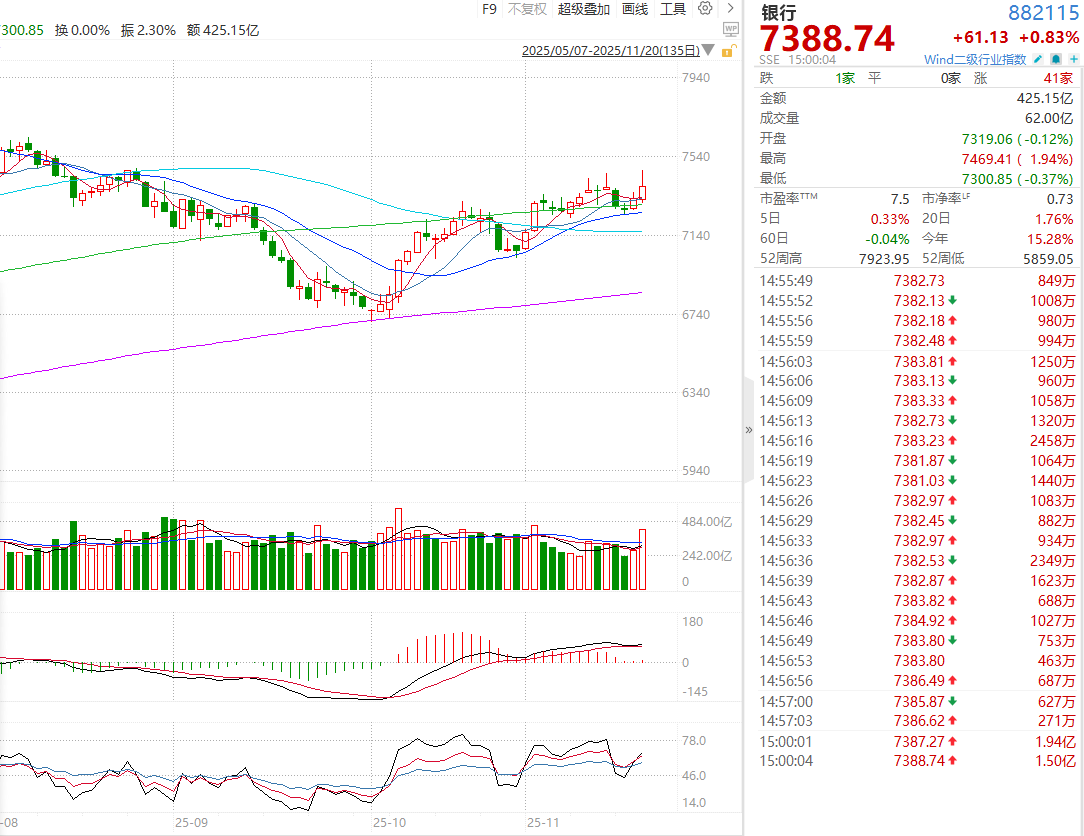
Market Overview - The Shanghai Composite Index fell by 0.40% on November 20, with 7 industries rising, led by construction materials and comprehensive sectors, which increased by 1.40% and 0.87% respectively [1] - The banking sector ranked third in terms of daily gains, rising by 0.86% [1] Capital Flow - The main capital outflow from both markets totaled 47.655 billion yuan, with 4 industries experiencing net inflows, the banking sector leading with a net inflow of 2.188 billion yuan [1] - The telecommunications sector followed with a daily increase of 0.51% and a net inflow of 1 billion yuan [1] Banking Sector Performance - The banking sector saw a rise of 0.86%, with 41 out of 42 stocks in the sector increasing in value [2] - Among the stocks, Minsheng Bank had the highest net inflow of 366 million yuan, followed by Postal Savings Bank and China Merchants Bank with net inflows of 297 million yuan and 255 million yuan respectively [2] - The sector had 6 stocks with net outflows exceeding 10 million yuan, with Agricultural Bank, Bank of China, and Citic Bank leading in outflows of 181 million yuan, 90.5 million yuan, and 27.1 million yuan respectively [2] Individual Stock Highlights - Minsheng Bank increased by 2.69% with a turnover rate of 2.42% and a main capital flow of 365.51 million yuan [3] - Postal Savings Bank rose by 3.14% with a turnover rate of 0.47% and a main capital flow of 296.74 million yuan [3] - China Merchants Bank had a minimal increase of 0.02% with a turnover rate of 0.28% and a main capital flow of 255.07 million yuan [3]
银行股年末行情可期,高股息成避风港
Huan Qiu Wang· 2025-11-20 08:57
Core Viewpoint - The strong performance of bank stocks in China is supported by improving fundamentals, with significant increases in stock prices and market capitalization, indicating investor confidence in the sector [1][3]. Group 1: Stock Performance - On November 20, Chinese bank stocks rose, with China Bank's stock price increasing by 4%, reaching a historical high and a total market capitalization of 1.84 trillion yuan [1]. - The banking sector index has seen a cumulative increase of 7.15% since the National Day holiday, with several banks, including Chongqing Bank and Agricultural Bank, experiencing over 20% growth during this period [1]. Group 2: Financial Performance - In the third quarter, 42 banks reported a total net profit attributable to shareholders of 1.68 trillion yuan, a year-on-year increase of 1.2%, with a 2.81% growth in the third quarter alone, reflecting steady improvement in profitability [3]. - High dividend yields are a key attraction for investors, with 34 out of 42 banks having a dividend yield exceeding 3%, and 13 banks exceeding 5%, while the median dividend yield stands at 4.28% [3]. Group 3: Shareholder Activity - Significant shareholder buybacks have provided strong support for bank stock performance, with over 10.7 billion yuan in buybacks this year, leading the industry [4]. - Major shareholders have expressed confidence in the future growth prospects and long-term investment value of banks, with buybacks serving as a means to expand business scale and supplement capital [4]. Group 4: Market Trends and Outlook - Historical data indicates a 70% probability of absolute returns for bank stocks in November and December, with an 80% probability in January, suggesting a favorable seasonal trend for bank investments [4]. - In the current low-interest-rate environment, high-dividend bank stocks are seen as a safe haven for investors, especially as speculative trading decreases [4]. Group 5: Challenges Facing the Industry - The banking sector faces challenges, including a net interest margin of only 1.42% and a non-performing loan ratio of 1.52%, indicating potential profitability pressures if trends do not reverse [5]. - The investment focus is shifting from growth in scale to risk management, asset quality, and stable profitability, necessitating banks to enhance service efficiency and embrace digital transformation to remain competitive [5].

11月20日主题复盘 | 福建自贸继续活跃,房地产异动,银行轮番新高
Xuan Gu Bao· 2025-11-20 08:53
Market Overview - The market opened high but closed lower, with the ChiNext index dropping over 1% by the end of the day. Bank stocks continued to perform strongly, with China Bank and Industrial and Commercial Bank reaching new highs. The Hainan sector was active, with Hainan Haiyao hitting the daily limit. Lithium mining stocks remained strong, with Dawi Co. also hitting the limit. In contrast, consumer stocks fell collectively, with Liren Liyang hitting the limit down and Guolian Aquatic dropping over 10%. A total of nearly 3,800 stocks declined across the Shanghai, Shenzhen, and Beijing markets, with a trading volume of 1.72 trillion yuan [1]. Hot Topics Free Trade Zone in Fujian - The Fujian Free Trade Zone was active again today, with HeFu China resuming trading and hitting the limit up, Jiuzhou Wang achieving a seven-day limit up streak, and Rongji Software and Yingli Auto also hitting the limit up [3]. Real Estate Sector - The real estate sector showed unusual activity, with Caixin Development and Haolaike hitting the limit up, New Town Holdings rising by 7%, and I Love My Home also hitting the limit up. Reports indicate that on November 19, the Housing and Urban-Rural Development Bureau of Foshan, Guangdong Province, along with seven other departments, issued a notice with 12 measures to promote the stable and healthy development of the real estate market, covering land supply, development construction, financial support, and home purchasing convenience [5]. Banking Sector - The banking sector continued to perform well, with China Bank rising by 4% to reach a historical high, and Industrial and Commercial Bank also reaching a historical high, while Construction Bank increased by 3% [7]. The current price-to-book ratio (PB) for A-share banks is 0.73, while the PB for Hong Kong's state-owned banks is around 0.55, indicating that valuations remain significantly low compared to international peers. The banking sector's performance since 2022 has been primarily driven by valuation re-evaluation and upward adjustment [8][9]. Stock Performance Notable Stocks - HeFu China (603122.SS) reached a price of 26.18 yuan with a 10% increase and a market cap of 10.421 billion yuan [4]. - Jiuzhou Wang (601566.SS) achieved a price of 18.41 yuan with a 9.98% increase and a market cap of 10.579 billion yuan [4]. - Caixin Development (000838.SZ) reached a price of 3.40 yuan with a 10.03% increase and a market cap of 3.583 billion yuan [6]. - Haolaike (603898.SS) reached a price of 13.97 yuan with a 10% increase and a market cap of 4.349 billion yuan [6].


