Sugon(603019)

Search documents
8亿投资海光信息,豪赚1200亿,成都国资跻身“最强捕手”
Zheng Quan Shi Bao Wang· 2026-01-26 12:23
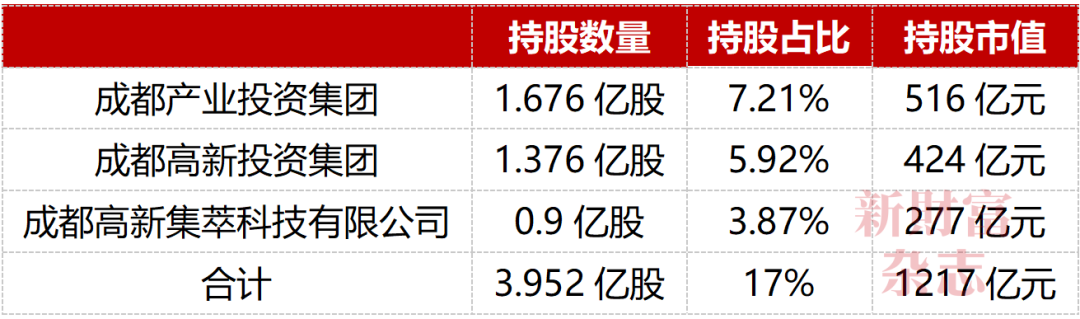
Core Insights - Chengdu's government venture capital investment in Haiguang Information has yielded over 120 billion yuan in returns, establishing a new benchmark for local state-owned investment [1][2][3] - The investment has transformed Haiguang Information into a 700 billion yuan domestic CPU giant, showcasing the potential of government-backed investments in strategic emerging industries [1][2][3] Investment Performance - Chengdu's state-owned enterprises invested 8.125 billion yuan in Haiguang Information, which has now a market value exceeding 121.7 billion yuan, representing a return of over 150 times [2][3][4] - The investment has generated significant financial returns, with Chengdu's state-owned enterprises having already recouped their initial investment through previous share sales [2][3][4] Strategic Implications - The success of Haiguang Information illustrates the effectiveness of government venture capital in driving local economic growth, job creation, and tax revenue [1][2][3] - Chengdu's model of "investment—appreciation—financing—investment" may serve as a reference for other local governments seeking to enhance their industrial landscape [1][2][3] Company Development - Haiguang Information, originally established in Tianjin, relocated to Chengdu after receiving investment from Chengdu's government, which facilitated its growth and development in the CPU sector [10][11][12] - The company has become the only domestic enterprise with x86 processor technology authorization, further solidifying its position in the semiconductor industry [12][13] Financial Restructuring - Chengdu's investment has positively impacted the financial statements of its state-owned enterprises, allowing them to maintain profitability despite challenges in other sectors [18][21] - The increase in the market value of Haiguang Information has enabled Chengdu's state-owned enterprises to issue bonds and secure financing for further investments [21][23] Industry Impact - Chengdu has emerged as a significant hub for semiconductor companies, with over 400 integrated circuit enterprises established, contributing to a growing industry scale [24] - The success of Haiguang Information has positioned Chengdu as a key player in the national semiconductor landscape, influencing local and regional economic strategies [24]


CPU涨价会持续多久
2026-01-26 02:50
Summary of Conference Call Notes Industry and Company Involved - The discussion primarily revolves around the **CPU** industry, particularly focusing on **x86** and **ARM** architectures, with mentions of major players like **Intel**, **AMD**, and cloud service providers such as **Alibaba Cloud** and **Tencent Cloud**. [1][2][4][24] Core Points and Arguments 1. **Demand Growth for CPUs**: The demand for CPUs is expected to grow exponentially, driven by three linear factors rather than a simple linear increase. High-performance x86 and ARM architectures will benefit from this trend. [1][21] 2. **Impact of AI and Agents**: The rise of AI agents is significantly driving CPU demand. The increase in agent numbers and their complexity is leading to higher CPU utilization, as evidenced by various workloads where CPU tasks dominate processing time. [4][6][13] 3. **Price Increases**: CPU prices are anticipated to rise steadily over the next year, although not as dramatically as storage prices. This increase is viewed as a healthy adjustment for the industry. [14][21] 4. **Supply Chain Constraints**: The supply of CPUs is constrained by production capacity issues, particularly for advanced nodes (3nm and 5nm) at foundries like TSMC. This is leading to a competitive environment for resources between CPUs and GPUs. [20][21] 5. **Cloud Service Pricing**: The rising costs of CPUs and storage are expected to be passed on to cloud service providers, leading to potential price increases for services offered by companies like Alibaba and Tencent. [22][24] 6. **Server Manufacturers**: Companies involved in server manufacturing, such as Inspur and Huqian, are expected to experience increased demand and flexibility due to the rising CPU prices. [2][25] 7. **Investment Opportunities**: Key investment opportunities are identified in domestic companies like **Haiguang Information** and **Zhongke Shuguang**, as well as international firms like **AMD** and **Intel**. [24][25] Other Important but Possibly Overlooked Content 1. **Agent Workloads**: Detailed analysis of agent workloads shows that CPU tasks can account for up to 90% of processing delays, indicating a critical need for CPU resources in AI applications. [7][11] 2. **Batch Size and Performance**: Increasing batch sizes in processing tasks can lead to diminishing returns in throughput and increased CPU context-switching bottlenecks, highlighting the need for efficient CPU management in AI workloads. [10][11] 3. **Long-term Trends**: The transition to a new paradigm in AI processing, where CPU tasks are more prominent due to the nature of agent interactions, suggests a long-term shift in resource allocation from GPUs to CPUs. [15][19] 4. **Market Dynamics**: The competitive landscape is shifting, with domestic firms potentially expanding into markets previously dominated by larger players, indicating a changing dynamic in the CPU market. [23][24] This summary encapsulates the key insights and projections discussed during the conference call, emphasizing the evolving landscape of the CPU industry and its implications for investment and market strategies.


2026年中国通讯服务器构配件行业产业链、发展现状、竞争格局及发展趋势研判:服务器市场的快速发展,为通讯服务器构配件行业带来广阔的发展空间[图]
Chan Ye Xin Xi Wang· 2026-01-26 01:14
Core Insights - The development of the communication server components industry is closely linked to advancements in information technology, with significant market demand driven by cloud computing, big data, IoT, and 5G technologies [1][8] - The Chinese communication server components market is projected to reach 14.1 billion yuan by 2025, reflecting a year-on-year increase of 13.3% [8] - The global communication server components market is expected to grow to 9.12 billion USD by 2025, with an annual growth rate of 8.2% [7][8] Industry Overview - Communication servers are high-performance computers that provide computing or application services to client devices, featuring complex internal structures and various components such as CPUs, hard drives, and memory [4] - Communication server components include structural fasteners and assembly parts, which are crucial for the assembly of servers [4] Industry Chain - The upstream of the communication server components industry includes raw materials like stainless steel, copper, and aluminum, while the midstream consists of the components industry itself, and the downstream pertains to the application fields within communication servers [5] Market Size and Growth - The Chinese server industry market size was 165.2 billion yuan in 2022 and is expected to grow to 282.35 billion yuan by 2025, with a compound annual growth rate (CAGR) of 19.6% [7] - The growth of the server market is anticipated to drive demand for communication server components [7] Competitive Landscape - Key players in the communication server components industry include Inspur Information, ZTE Corporation, and Xiamen Meikang Security Technology, among others [9] - Server manufacturers often have in-house design capabilities for core structural components, ensuring supply chain stability [9] Development Trends 1. **Product Design Upgrades**: Focus on high-density integration and multi-scenario adaptability to meet the deployment needs of new data centers and communication networks [11] 2. **Smart and Precise Manufacturing**: Adoption of automated production lines and digital management systems to enhance product precision and consistency [12] 3. **Industry Chain Collaboration**: The competitive landscape is shifting towards deeper integration within the industry chain, with leading companies forming strategic partnerships with suppliers and manufacturers [13]






计算机行业点评:CPU涨价能持续多久?
SINOLINK SECURITIES· 2026-01-25 02:53
Investment Rating - The report suggests a positive investment outlook for the industry, indicating a potential increase in value over the next 3-6 months, with expectations of growth exceeding the market by more than 15% [40]. Core Insights - The report highlights three core logic points driving the rigid demand for CPU in the Agent era, emphasizing the shift in computational load from GPU to CPU due to the complexity of tasks performed by Agents [11][16]. - The global Agent ecosystem is predicted to experience exponential growth, with active Agents expected to rise from approximately 28.6 million in 2025 to 2.216 billion by 2030, alongside a significant increase in task execution and token consumption [16][21]. - A supply-demand imbalance is emerging, with Intel shifting production capacity to server CPUs, leading to delivery issues in consumer electronics, while NVIDIA plans to enhance CPU core counts in response to bottlenecks [33][37]. Summary by Sections Section 1: Three Core Logics Revealing the Rigid Demand for CPU - The shift in computational load towards CPU is driven by the Multi-Agent architecture, which increases OS scheduling pressure due to the complex workflow of Agents [11]. - The challenge of long context scenarios necessitates KV Cache offloading to CPU, which increases CPU load due to the need for task scheduling and data transfer [11][12]. - High concurrency in tool usage by Agents leads to significant CPU consumption, as non-model inference tasks are primarily handled by CPUs [15]. Section 2: Expansion of the Agent Ecosystem Igniting CPU Performance Bottlenecks - The number of active Agents is projected to grow significantly, with task execution expected to increase from 44 billion in 2025 to 415 trillion by 2030, indicating a shift towards deeper reliance on Agents in business processes [16][17]. - Token consumption is anticipated to surge from 0.0005 PetaTokens in 2025 to 152,667 PetaTokens by 2030, reflecting the increasing complexity of tasks handled by Agents [17]. Section 3: Supply-Demand Imbalance and New Shortboards in Computing Power - Intel's urgent shift in production to server CPUs has resulted in a decline in consumer electronics delivery rates, while NVIDIA's new architecture aims to address CPU bottlenecks [33]. - Market data indicates a growth in global client CPU shipments, with a 7.9% quarter-on-quarter increase and a 13% year-on-year increase in the second quarter of 2025 [33][34]. Section 4: Related Companies - Key companies in the CPU sector include Haiguang Information, Zhongke Shuguang, He Sheng New Materials, China Great Wall, Longxin Zhongke, and others [4][38]. - Domestic computing power companies include Haiguang Information, Cambricon, Dongyangguang, and others, while overseas companies include Zhongji Xuchuang, New Yisheng, and others [4][38].


2025Q4计算机持仓环比回落1.1pct,处在历史低位,增配空间明显
GUOTAI HAITONG SECURITIES· 2026-01-24 15:14
Investment Rating - The report assigns an "Overweight" rating to the computer industry [5][13]. Core Insights - As of Q4 2025, institutional holdings in the computer sector have decreased to 2.1%, down 1.1 percentage points from Q3, marking a historical low. This level is only slightly above the 2.0% recorded in Q2 2022. There is significant potential for increase as the current holdings are far below the highs of over 6% seen in 2020 and 2023, and well below the 12% level in 2015 [3][5][7]. - The report highlights that institutions are increasing their positions in sub-sectors such as AI applications and commercial aerospace, while still heavily invested in large models, intelligent computing, and domestic innovation [5][7]. - The top ten companies by number of institutional holders in Q4 2025 include Kingsoft Office, Southern Power Digital, iFlytek, Inspur Information, and others. In terms of market value, Kingsoft Office leads with 139 billion, followed by iFlytek with 108 billion [7][8]. Summary by Sections - **Institutional Holdings Analysis**: The report details that institutional holdings in the computer industry have fluctuated significantly over the past five years, with a notable rise to 6.2% in late 2022, followed by a decline to 2.1% in Q4 2024. The report emphasizes the potential for recovery given the historical context [5][6][7]. - **Sector Performance**: The report indicates that the computer sector is currently underweight, with a significant gap from previous highs, suggesting a favorable environment for future investment [5][6]. - **Key Companies**: The report lists the top ten companies by institutional holdings, noting changes in the composition of these holdings compared to Q3 2025, with new entries and exits among the top firms [7][8].



计算机行业周报 20260119-20260124:计算机板块持仓分析!CPU、沙箱、Agent全面分析!-20260124
Shenwan Hongyuan Securities· 2026-01-24 14:10
Investment Rating - The report indicates a positive outlook for the computer industry, suggesting that it has fundamental support for investment and potential for future growth [1][2]. Core Insights - The computer sector is expected to experience a rebound in performance due to the recovery of the macro economy and advancements in AI technology, which are anticipated to enhance profitability [1][10]. - The report highlights a significant increase in demand for CPUs, driven by the rise of AI applications and the need for high-performance computing [16][19]. - The introduction of sandbox environments for AI agents is seen as a critical development, enhancing system security and performance in high-concurrency scenarios [22][29]. Summary by Sections Investment Allocation - In Q4 2025, the public fund allocation for the computer industry was 1.6%, a decrease of 0.8 percentage points from the previous quarter, ranking it 14th among 30 sectors [2][3]. - The top ten holdings in the computer sector included Inspur Information, Kingsoft Office, and Sangfor Technologies, with notable changes in the composition of these holdings [4][5]. Valuation Metrics - As of January 23, 2026, the PE (TTM) for the computer industry was 94.6x, placing it in the 94.80th percentile historically, while the PS (TTM) was 4.0x, in the 71.40th percentile [10][11]. - The report suggests that despite high PE levels, there is still room for growth in PS and PCF valuations as the market sentiment improves [10][11]. CPU Price Expectations - Intel and AMD are expected to raise server CPU prices by 10% to 15% in Q1 2026 due to supply constraints and increased demand from AI applications [16][21]. - The report emphasizes the growing importance of CPUs in AI workloads, particularly in managing complex tasks and ensuring system stability [19][40]. Key Investment Themes - The report identifies several key investment themes, including leadership in the digital economy, AIGC applications, and the importance of data elements and new industrialization [41][42]. - Specific companies recommended for investment include Inspur Information, Kingsoft Office, and various firms involved in AI and data solutions [41][42].



【最全】2025年防火墙行业上市公司全方位对比(附业务布局汇总、业绩对比、业务规划等)
Qian Zhan Wang· 2026-01-24 06:09
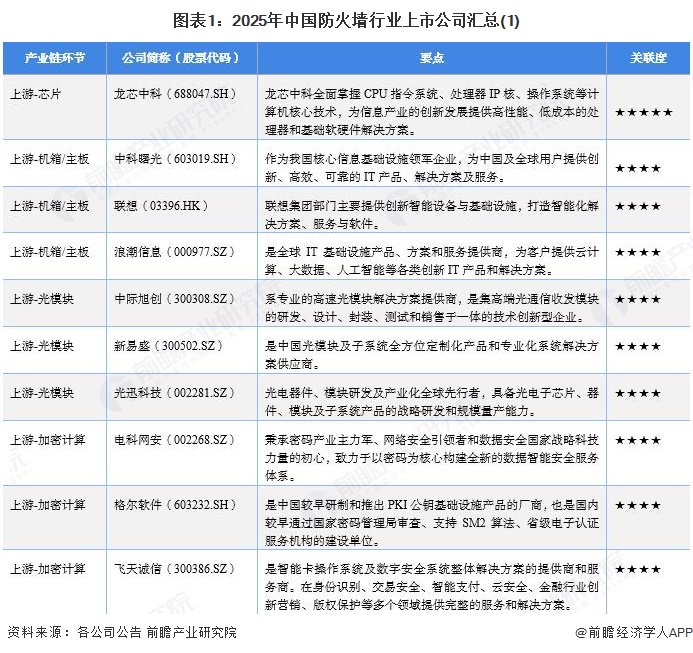
Core Insights - The firewall industry in China is a critical component of the network security system, serving as the first line of defense for enterprises and individuals. The industry is characterized by a diverse range of listed companies, primarily concentrated in the upstream and midstream segments of the supply chain [1][5]. Group 1: Company Overview - Major companies in the firewall industry include Sangfor (300454.SZ), Tianrongxin (002212.SZ), Hillstone Networks (688030.SH), Deepin Technology (300768.SZ), Ruijie Networks (301165.SZ), Venustech (002439.SZ), Qihoo 360 (688561.SH), and NSFOCUS (300369.SZ) [1]. - The highest revenue in the firewall industry for 2024 is projected to be from Lenovo, with revenue reaching 114.77 billion yuan, followed closely by Inspur with the same revenue figure [4]. - The registered capital is highest for NSFOCUS, while Tianrongxin is the oldest company in the industry. Ruijie Networks has the most bidding information, totaling 7,141 entries [8]. Group 2: Revenue and Profitability - In terms of revenue from firewall-related business, Sangfor is expected to generate 3.629 billion yuan in 2024, ranking second in the domestic market for unified threat management. Qihoo 360 follows with an expected revenue of 2.653 billion yuan [9]. - The gross profit margin for representative companies in the firewall industry is projected to be around 60% in 2024, with Sangfor achieving the highest margin at 79.31% and Hillstone Networks at 71.97% [11]. Group 3: Business Layout - The firewall business layout of listed companies shows a combination of regional focus and nationwide outreach, with technological innovation and scenario deepening being key characteristics. Sangfor focuses on South China, covering over 30 countries and regions, while Qihoo 360 is centered in Beijing, targeting government and state-owned enterprises [13][15]. - Companies like Tianrongxin and Venustech are also focusing on specific sectors such as industrial internet and government services, respectively, to enhance their market presence [15]. Group 4: Business Planning - Future business plans for firewall companies emphasize technological iteration and scenario deepening. Sangfor aims to integrate network security with cloud computing and transition to a subscription model by 2026 [17]. - Qihoo 360 plans to allocate 25% of its R&D budget to encryption firewall research, while Tianrongxin is focusing on smart solutions for industrial firewalls [17].


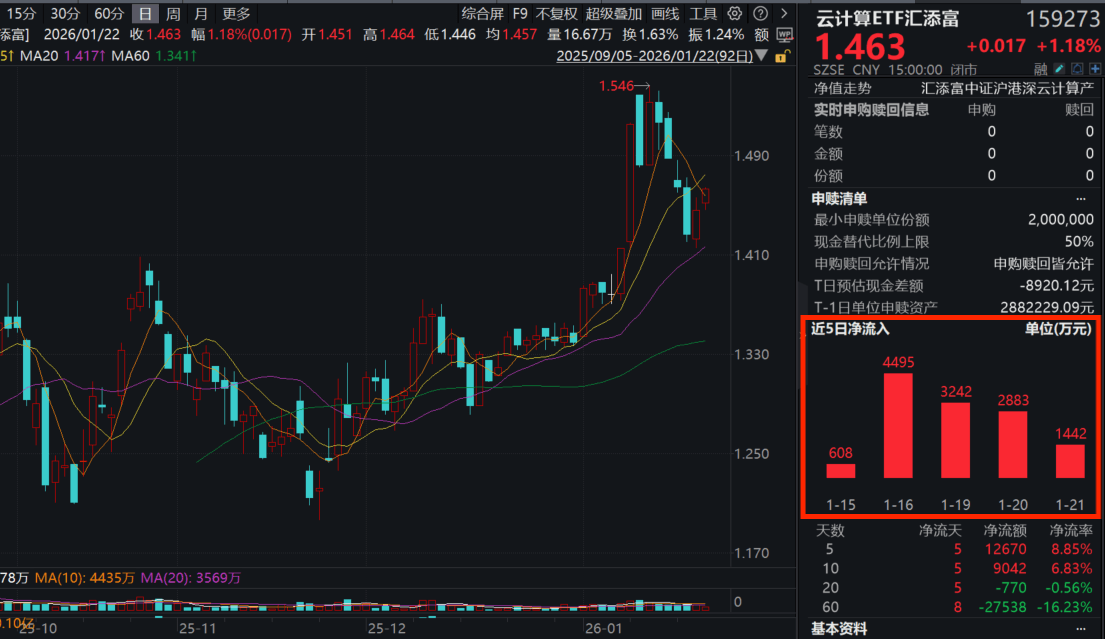
CPO王者归来,中际旭创大涨近7%!云计算ETF汇添富(159273)涨超1%,近5日累计吸金超1.2亿元!供需双高,国产算力增长斜率陡峭!
Xin Lang Cai Jing· 2026-01-22 09:57
Group 1: AI Computing Sector Performance - The AI computing sector has rebounded for the second consecutive day, with the cloud computing ETF Huatai (159273) rising by 1.18% and achieving a trading volume exceeding 240 million yuan [1] - Continuous capital inflow has been observed for five days, accumulating over 120 million yuan [1] Group 2: Market Reactions to Greenland Crisis - The U.S. government announced a framework agreement regarding the Greenland issue, which is expected to benefit the U.S. and all NATO member countries [3] - Following this announcement, U.S. stock markets surged, with all three major indices rising by over 1% [3] Group 3: Cloud Computing ETF Performance - The majority of the weighted stocks in the Huatai cloud computing ETF showed positive performance, with notable gains from companies such as Zhongji Xuchuang (up nearly 7%) and Runze Technology (up over 4%) [4] - The trading volume for Zhongji Xuchuang reached 24.275 billion yuan, while Alibaba-W had a trading volume of 9.837 billion yuan [5] Group 4: Supply and Demand Dynamics in Domestic Computing Power - Domestic computing power is experiencing steep growth due to high supply and demand, driven by increased AI application in mobile devices and policy support for energy-efficient computing hardware [6] - The scaling law for large models continues to enhance training demand, while domestic GPU performance is improving, facilitating the adaptation of local CSP manufacturers [6] Group 5: Future Projections for Domestic Computing Power - The intelligent computing capacity in China is projected to maintain a compound annual growth rate of 57% from 2020 to 2028 [7] - Domestic general-purpose GPUs are advancing from "usable" to "highly usable," significantly narrowing the performance gap with international competitors [7] Group 6: Light Module Demand Forecast - Nomura Oriental predicts that the demand for optical modules will remain strong due to increased investment in AI infrastructure and supply chain constraints, with significant growth expected through 2026 and beyond [8] - The upgrade of 1.6T optical modules and silicon photonics technology is identified as a key growth driver for the industry [8]

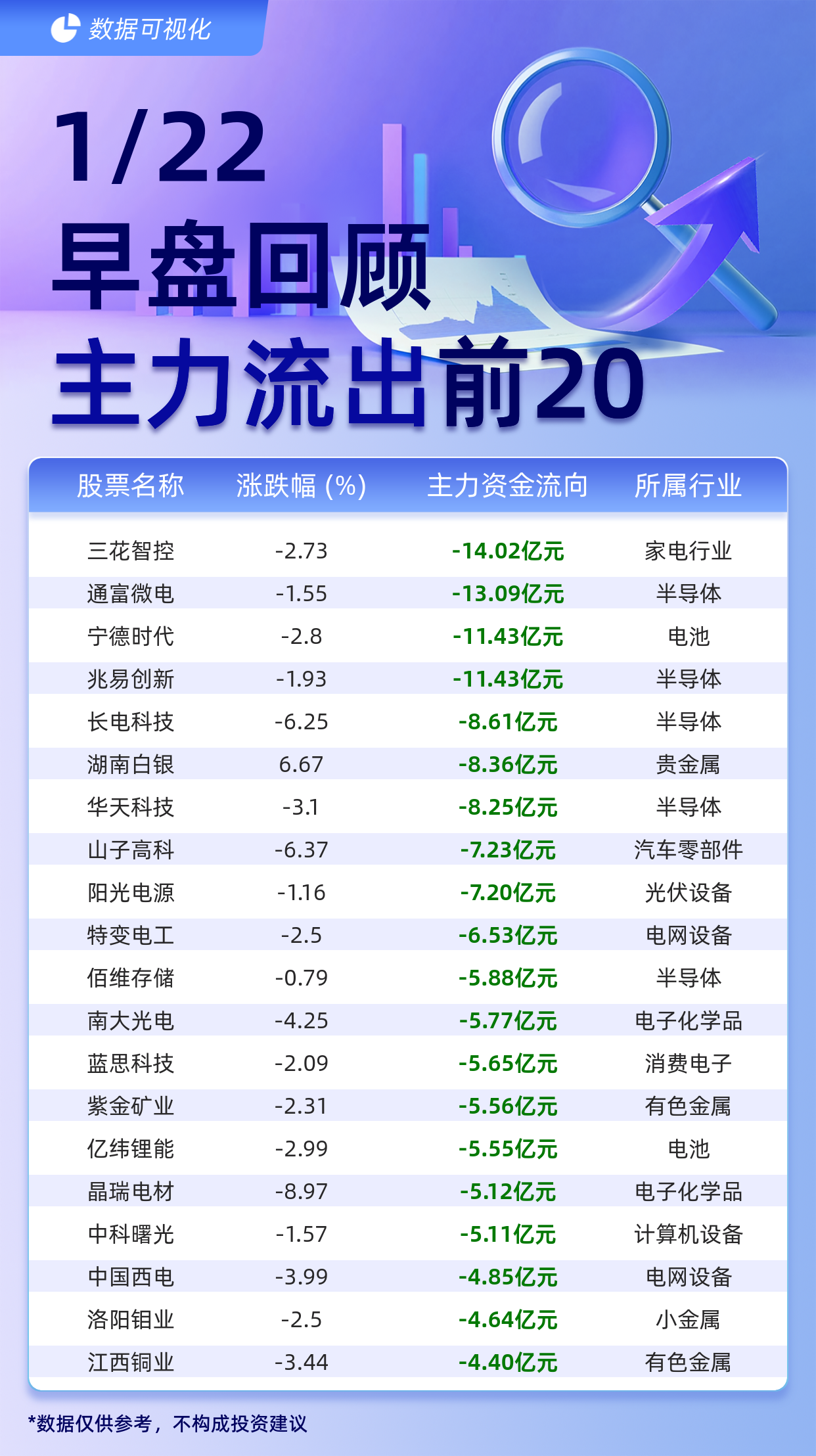
主力个股资金流出前20:三花智控流出14.02亿元、通富微电流出13.09亿元
Jin Rong Jie· 2026-01-22 03:45
Core Viewpoint - The data indicates significant outflows of capital from various stocks, with notable amounts withdrawn from companies across different industries, suggesting a potential shift in investor sentiment and market dynamics [1][2][3] Group 1: Major Stocks with Capital Outflows - Sanhua Intelligent Control experienced a capital outflow of 1.402 billion, with a decline of 2.73% in stock price [2] - Tongfu Microelectronics saw a capital outflow of 1.309 billion, with a decrease of 1.55% [2] - Contemporary Amperex Technology reported a capital outflow of 1.143 billion, with a drop of 2.8% [2] - Zhaoyi Innovation also faced a capital outflow of 1.143 billion, with a decline of 1.93% [2] - Changdian Technology had a significant outflow of 861 million, with a sharp decrease of 6.25% [2] Group 2: Other Notable Stocks - Hunan Silver experienced a capital outflow of 836 million, but its stock price increased by 6.67% [2] - Huada Technology saw an outflow of 825 million, with a decline of 3.1% [2] - Yango Technology faced a capital outflow of 723 million, with a significant drop of 6.37% [2] - Sungrow Power Supply had an outflow of 720 million, with a decrease of 1.16% [2] - TBEA reported a capital outflow of 653 million, with a decline of 2.5% [2] Group 3: Additional Stocks with Capital Outflows - Baiwei Storage experienced a capital outflow of 588 million, with a slight decrease of 0.79% [2] - Nanda Optoelectronics saw an outflow of 577 million, with a decline of 4.25% [3] - Lens Technology faced a capital outflow of 565 million, with a decrease of 2.09% [3] - Zijin Mining reported an outflow of 556 million, with a decline of 2.31% [3] - EVE Energy experienced a capital outflow of 555 million, with a drop of 2.99% [3]





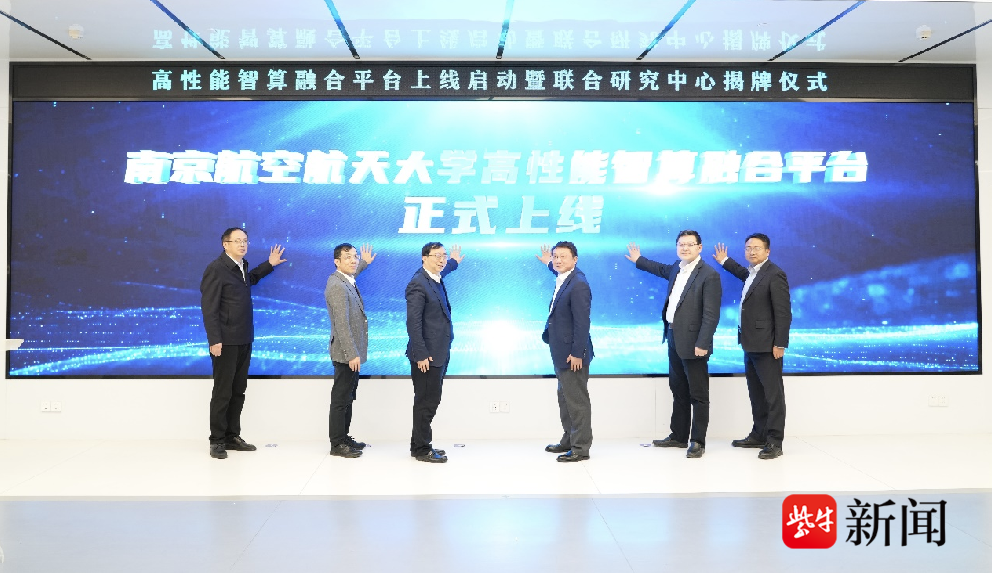
算力赋能“问天”,南航上线高性能智算平台
Yang Zi Wan Bao Wang· 2026-01-21 11:45
Group 1 - The establishment of a high-performance intelligent computing integration platform at Nanjing University of Aeronautics and Astronautics marks a significant step in the construction of computing infrastructure and the integration of industry, academia, and research [1][3] - The platform serves as a centralized management system for the university's computing resources, allowing faculty and students to submit computing tasks through a unified interface, which are then automatically allocated to the most suitable clusters [3] - The platform supports multiple disciplines including mechanics, control science, aerospace, and artificial intelligence, facilitating both educational practices and research competitions, and has contributed to top-tier research outputs, including publications in journals like Science [3][5] Group 2 - The platform aims to alleviate previous issues of computing resource scarcity and uneven distribution, promoting interdisciplinary innovation and supporting independent research and development in China's aerospace sector [3] - The collaboration involves three parties: Nanjing University of Aeronautics and Astronautics, Sugon Information Industry Co., Ltd., and Jiangsu Unicom, leveraging their respective strengths in aerospace, AI algorithm development, high-performance computing hardware, and nationwide communication networks [5] - The initiative is seen as a starting point for technological collaboration and aims to create an integrated innovation ecosystem that supports cutting-edge research and talent cultivation while facilitating the industrial application of AI and high-performance computing technologies [5]