Sugon(603019)

Search documents
商汤科技、大晓机器人与中科曙光战略签约,聚焦具身智能全栈国产化
Xin Lang Cai Jing· 2025-12-18 09:52
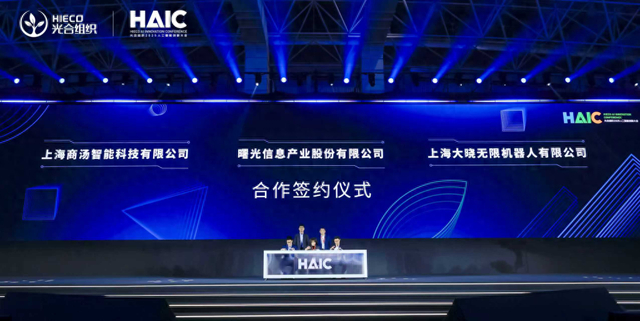
Core Insights - A strategic partnership has been established among SenseTime, Daxiao Robotics, and Zhongke Shuguang to advance domestic AI infrastructure and embodied intelligence technologies [1] Group 1: Strategic Collaboration - The collaboration focuses on leveraging SenseTime's multimodal base models and spatial intelligence technology, combined with Daxiao Robotics' expertise in world models, and Zhongke Shuguang's capabilities in domestic computing power and "super node + super cluster" systems [1] - The three parties aim to enhance the efficient training and inference of world models on domestic computing platforms, promoting an integrated ecosystem of "computing infrastructure + world models + embodied intelligence" [1] Group 2: Product Development - Daxiao Robotics, led by co-founder Wang Xiaogang, unveiled the new generation "Kairos 3.0" world model, which supports scene modeling and interactive generation in multi-perspective, long-sequence, and complex dynamic environments [1] - The new model has been deeply adapted to Zhongke Shuguang's scaleX ten-thousand-card super cluster products [1] Group 3: Comprehensive Solutions - The partnership will also focus on creating comprehensive solutions for embodied intelligence technology development aimed at robotics manufacturers, covering key aspects such as model development, computing support, and engineering deployment [1]


A股今日共78只个股发生大宗交易,总成交37.55亿元
Di Yi Cai Jing· 2025-12-18 09:44
Group 1 - A total of 78 stocks in the A-share market experienced block trading today, with a total transaction value of 3.755 billion yuan [1] - The top three stocks by transaction value were Minsheng Bank (2.149 billion yuan), WuXi AppTec (430 million yuan), and Luxin Technology (119 million yuan) [1] - Among the stocks, 8 were traded at par, 3 at a premium, and 67 at a discount; the highest premium rates were for AVIC Optoelectronics (8.04%), Zhongke Shuguang (7.92%), and Haowei Group (2.07%) [1] Group 2 - The top buying amounts from institutional special seats were led by WuXi AppTec (251 million yuan) and Minsheng Bank (108 million yuan) [2] - The top selling amounts from institutional special seats included Jintian Titanium Industry (18.74 million yuan) and Huilong New Materials (9.97 million yuan) [2]



全球领先,国产万卡超集群首次真机亮相
Xi Niu Cai Jing· 2025-12-18 09:26
Core Viewpoint - The launch of the scaleX WanKa supercluster by Zhongke Shuguang at the HAIC2025 marks a significant advancement in large-scale intelligent computing systems, showcasing China's capabilities in AI infrastructure [1][3]. Group 1: Product Features - The scaleX WanKa supercluster is designed for trillion-parameter models and complex tasks, featuring innovations in performance, efficiency, reliability, and scalability [3]. - It includes the world's first single-cabinet 640-card supernode, achieving over 5 EFlops of total computing power and a PUE value as low as 1.04, enhancing computing density by 20 times [3][4]. - The system utilizes a self-developed RDMA high-speed network, achieving 400 Gb/s bandwidth and under 1 microsecond communication latency, which improves performance by 2.33 times compared to traditional networks [4]. - The architecture incorporates deep optimization for storage, computing, and transmission, enhancing AI inference speed and accuracy while increasing resource utilization by 55% [4]. - It features a digital twin for intelligent scheduling and management, ensuring 99.99% availability and supporting large-scale job scheduling [4]. Group 2: Market Impact and Collaboration - The scaleX WanKa supercluster supports multiple brands of acceleration cards and mainstream computing ecosystems, optimizing over 400 mainstream models [6]. - It is part of the "AI Computing Open Architecture," developed in collaboration with over 20 AI industry chain companies, aimed at lowering the R&D threshold for intelligent computing clusters [6]. - The initiative promotes a shift from isolated technological breakthroughs to collaborative industry advancements, translating open concepts into practical computing power [6].

商汤科技、大晓机器人与中科曙光达成战略合作
2 1 Shi Ji Jing Ji Bao Dao· 2025-12-18 07:06
南方财经12月18日电,据证券时报,在今日的首届光合组织人工智能创新大会(HAIC2025)主论坛 上,商汤科技、大晓机器人与中科曙光正式达成战略合作。三方将围绕国产化人工智能基础设施与具身 智能关键技术方向,依托各自技术与产业优势,协同推动软硬一体的"算力基础设施+世界模型+具身智 能"生态建设,进一步加速AI能力向物理世界延展。 ...
商汤科技、大晓机器人与中科曙光正式达成战略合作,将共建国产化“算力基础设施+世界模型+具身智能 ”生态
Xin Lang Cai Jing· 2025-12-18 07:04
Core Insights - The first AI Innovation Conference (HAIC2025) was held on December 18, where SenseTime, Daxiao Robotics, and Zhongke Shuguang announced a strategic partnership to advance AI infrastructure and embodied intelligence technologies [1] Group 1 - The collaboration focuses on domestic AI infrastructure and key technologies in embodied intelligence, leveraging each company's technological and industrial strengths [1] - The partnership aims to promote the development of a comprehensive ecosystem that integrates computing power infrastructure, world models, and embodied intelligence [1] - This initiative is expected to accelerate the extension of AI capabilities into the physical world [1]
半导体并购案密集终止,什么信号
是说芯语· 2025-12-18 06:32
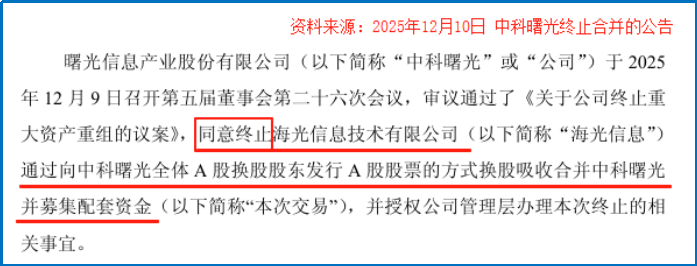
Core Viewpoint - The semiconductor industry is experiencing a significant slowdown in merger and acquisition (M&A) activities, with several high-profile deals being terminated due to valuation discrepancies and regulatory scrutiny [3][4][6]. Group 1: Termination of Mergers - Major asset restructuring plans, such as the merger between Zhongke Shuguang and Haiguang Information, have been called off, reflecting a broader trend in the semiconductor sector [1][3]. - The termination of the merger between Zhongke Shuguang and Haiguang Information was attributed to significant fluctuations in stock prices, with Zhongke Shuguang's stock rising by 61.76% and Haiguang Information's by 61.1% since the merger announcement [3][4]. - Chipone's acquisition of Xilinx was also halted due to unmet key conditions and misalignment of interests between the parties involved [4][5]. Group 2: Market Environment and Valuation Issues - The semiconductor sector is facing challenges related to high valuation expectations from sellers, which has led to failed M&A negotiations [5][9]. - The recent surge in M&A terminations is partly due to the introduction of new policies aimed at supporting acquisitions of high-quality, unprofitable tech companies, which has increased the number of disclosed M&A cases [5][6]. - The fluctuation in market demand and the tightening of regulatory scrutiny on semiconductor M&A activities have made companies more cautious about pursuing high-premium targets [6][9]. Group 3: Strategic Shifts in M&A - Despite the setbacks, companies like Chipone are actively seeking to enhance their technological capabilities through targeted acquisitions, as seen in their move to acquire Zhudian Semiconductor [8][9]. - The focus on strategic acquisitions is underscored by the belief that successful mergers can lead to significant synergies, with industry leaders advocating for a more collaborative approach to M&A [9]. - The semiconductor industry is encouraged to pursue consolidation as a means to strengthen market positions and achieve economies of scale, particularly in the fragmented analog chip sector [9].



半导体并购案密集终止,什么信号
2 1 Shi Ji Jing Ji Bao Dao· 2025-12-18 06:17
Core Viewpoint - The semiconductor industry in China is experiencing a significant slowdown in merger and acquisition (M&A) activities, with several high-profile deals being terminated due to various factors including valuation discrepancies and regulatory scrutiny [3][10]. Group 1: Termination of Mergers - Major asset restructuring plans involving domestic computing leader Zhongke Shuguang and Haiguang Information, as well as the acquisition of Chipmunk Technology by Chip Origin, have been announced as terminated [1][6]. - The termination of these deals reflects a broader trend in the semiconductor sector, where companies cite reasons such as "changes in market environment" and "failure to reach consensus on core terms" [3][6]. Group 2: Market Dynamics and Valuation Issues - The stock prices of Zhongke Shuguang and Haiguang Information saw significant fluctuations, with increases of 61.76% and 61.1% respectively since the announcement of the merger plan, complicating the share exchange proposal [5]. - The complexity of shareholder structures and differing interests among investors have made it challenging to reach agreements on valuations, contributing to the failure of M&A deals [7][10]. Group 3: Regulatory Environment - The regulatory landscape for semiconductor M&A is becoming increasingly stringent, with authorities scrutinizing cross-industry mergers more closely [8]. - Recent policies aimed at supporting acquisitions of high-quality, unprofitable tech companies have led to a surge in M&A activity, but also an increase in the number of terminated deals as expectations and valuations clash [6][10]. Group 4: Future M&A Strategies - Despite recent setbacks, companies like Chip Origin are actively seeking new acquisition opportunities, as evidenced by their plan to invest in and acquire control of ZD Semiconductor [10][11]. - The semiconductor industry is expected to continue pursuing M&A as a strategy for growth, with a focus on integrating core technologies and expanding into emerging markets [11][12].
半导体并购案密集终止,什么信号
21世纪经济报道· 2025-12-18 06:15
Core Viewpoint - The semiconductor industry is experiencing a significant slowdown in merger and acquisition (M&A) activities, with several high-profile deals being terminated due to market volatility and valuation discrepancies [1][4][5]. Group 1: Termination of Mergers - The merger between Zhongke Shuguang and Haiguang Information was terminated due to significant fluctuations in their stock prices since the announcement of the merger plan, with Zhongke Shuguang's stock rising by 61.76% and Haiguang Information's by 61.1% [4][5]. - Chipone Technology's acquisition of RISC-V unicorn ChipLai was also called off, attributed to unmet key conditions and differences in valuation expectations between the parties involved [5][6]. Group 2: Market Environment and Regulatory Factors - The semiconductor sector is facing a tightening regulatory environment, with increased scrutiny on M&A activities, particularly those involving cross-industry transactions [7][8]. - The recent surge in M&A activity in the semiconductor industry has led to a higher absolute number of terminated deals, as the market adjusts to new policies and valuation challenges [6][7]. Group 3: Strategic Shifts in M&A - Despite the termination of certain acquisitions, companies like Chipone Technology are actively seeking new opportunities, as evidenced by their plan to acquire control of ZD Semiconductor, indicating a strategic pivot towards enhancing their technology portfolio [10][11]. - The current market conditions are viewed as favorable for acquisitions, with industry leaders emphasizing the importance of achieving synergies that exceed the sum of individual company values [11].
半导体并购为何频频“刹停”?
Jin Rong Shi Bao· 2025-12-18 01:04
Group 1 - Several recent mergers and acquisitions in the A-share semiconductor sector have been halted, raising market concerns [1] - DiAo Micro announced the termination of its acquisition of Rongpai Semiconductor due to failure to reach consensus on key terms [1] - SiRuPu decided to terminate its acquisition of Ningbo Aola Semiconductor as the conditions for major asset restructuring were not fully mature [1] Group 2 - The majority of terminated transactions involve small and medium-sized private listed companies, primarily focusing on significant cash or share transactions [2] - The core issues leading to transaction terminations are the inability to agree on key terms and changes in market conditions that render transaction conditions immature [2] - The success rate of mergers and acquisitions in the Sci-Tech Innovation Board is over 70%, indicating that a certain percentage of terminated transactions may be a normal aspect of market-driven mergers [2] Group 3 - The high activity level in the semiconductor industry and the complexity of shareholder structures contribute to increased negotiation difficulties in mergers and acquisitions [3] - Market demand fluctuations and changes in the market environment have made companies more cautious in pursuing acquisitions to avoid operational risks [3] Group 4 - To protect investor interests, regulations have been established to enhance information disclosure and communication regarding terminated restructurings [4] - Companies that terminate restructurings have been proactive in disclosing reasons and potential impacts, often holding investor meetings to address market concerns [4] - Following the termination of restructurings, related companies' stock prices have seen an approximate decline of 4%, reflecting a stable market response without significant irrational fluctuations [4] Group 5 - The China Securities Regulatory Commission has proposed regulations to standardize merger and acquisition behaviors and clarify the responsibilities of financial advisors [5] - In 2024, regulatory authorities addressed 35 cases of insider trading related to mergers and acquisitions, demonstrating a strict regulatory approach [5] - The regulatory environment emphasizes a "zero tolerance" policy towards fraudulent activities in mergers and acquisitions, aiming to protect the rights of small investors [5]


刚刚,5000亿科技巨头,终止重组!
Xin Lang Cai Jing· 2025-12-17 14:19
Core Viewpoint - The planned merger between Haiguang Information and Zhongke Shuguang, aimed at creating a comprehensive "chip-server-computing service" giant, has been halted due to significant changes in market conditions and the complexity of the transaction [4][21]. Group 1: Company Background - Haiguang Information, established in 2014, has Zhongke Shuguang as its largest shareholder, holding 27.96% of its shares as of September 30 [2][18]. - Haiguang focuses on CPU and DCU chip design, while Zhongke Shuguang specializes in server manufacturing and cloud computing services, with over 2 million cloud platform users [3][19]. Group 2: Business Synergy - The merger was expected to allow Haiguang's chips to be deeply integrated with Zhongke Shuguang's server systems, reducing adaptation costs and accelerating product iteration [20]. - The combination was seen as a strong partnership in the context of increasing demand for AI computing and domestic alternatives [20]. Group 3: Reasons for Termination - The termination was attributed to the large scale of the transaction, the number of parties involved, and significant market changes since the merger was proposed, making the conditions for restructuring no longer viable [4][21]. - Both companies have committed to a "cooling-off period" of at least one month before planning any major asset restructuring [6][22]. Group 4: Financial Health and Strategic Focus - Zhongke Shuguang reported a healthy cash flow, with a cumulative net inflow of 6.834 billion from 2021 to 2024, indicating strong profitability and self-sufficiency [10][25]. - The termination of the merger allows both companies to focus on their core competencies without the distraction of integration challenges, with Haiguang needing to concentrate on chip development and Zhongke Shuguang on system integration [12][27]. Group 5: Market Opportunities - The current "new infrastructure" wave in China, with a total investment of 5.75 trillion planned for key projects by mid-2025, presents significant opportunities for Zhongke Shuguang as a major supplier of computing equipment [28][29]. - The reduction in sales expense ratio from 5.88% in 2024 to 5.51% in the first three quarters of 2025 indicates improved market expansion conditions for Zhongke Shuguang [13][31]. Group 6: Future Collaboration - Despite the merger's termination, both companies will continue to deepen their collaboration in system product applications, focusing on high-end computing and AI platforms [15][32]. - This approach allows them to maintain flexibility in technology paths and market responses while avoiding potential management redundancies from a merger [32].