Daqo Energy(688303)

Search documents
*ST亚振数次停牌核查 下周一复牌!A股逾870亿元解禁洪流来袭
Zheng Quan Shi Bao Wang· 2025-07-19 00:24
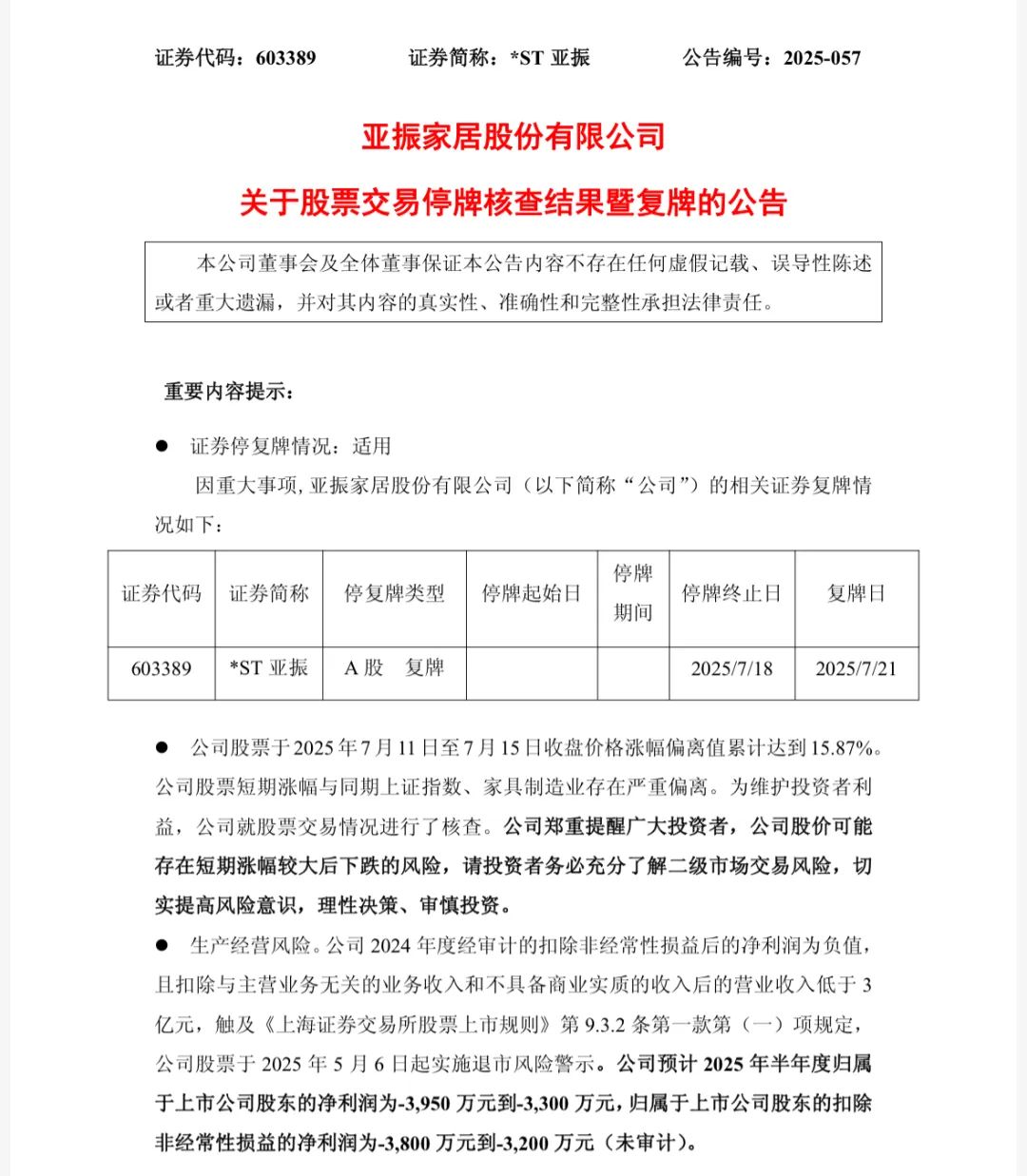
Group 1 - The core point of the article is that *ST Yazhen's stock will resume trading on July 21, 2025, after a significant price deviation and a completed investigation into its trading activities [1][2]. - The stock price of *ST Yazhen increased by a cumulative 15.87% from July 11 to July 15, 2025, which was significantly higher than the Shanghai Composite Index and the furniture manufacturing industry during the same period [1]. - Since June, *ST Yazhen has undergone three trading suspensions for investigation, with a total price increase of 82.91%, attributed to changes in the controlling shareholder and subsequent takeover offers [4]. Group 2 - The company expects to report a net loss attributable to shareholders of between 33 million and 39.5 million yuan for the first half of 2025, with a non-recurring net profit loss estimated between 32 million and 38 million yuan [5]. - The decline in performance is primarily due to a lack of significant growth in sales revenue, a noticeable decrease in gross profit margin, and relatively high expense ratios for sales and management compared to revenue [5].


多晶硅畸形的上涨,会出事故吗?
对冲研投· 2025-07-17 12:25
Core Viewpoint - The article discusses the abnormal price surge in the polysilicon market, driven by oligopolistic market structures and policy signals, raising concerns about systemic risks in the industry [3][33]. Group 1: Market Structure and Pricing Dynamics - The polysilicon market is characterized by a significant oligopoly, with the top five companies in China accounting for 70.3% of global production in 2024 [4][5]. - Tongwei Co., as the industry leader, holds a 25% market share, followed by GCL-Poly (15%), Daqo New Energy (11%), Xinte Energy (10%), and Hoshine Silicon Industry (6%) [4][5]. - Despite a severe oversupply, polysilicon prices surged by 30% in July 2025, reflecting a collective response from leading firms to policy signals rather than genuine supply-demand improvements [6][13]. Group 2: Policy Evolution and Challenges - The "anti-involution" policy aimed to curb low-price competition and promote high-quality development but has evolved into a mechanism for price collusion among leading firms [8][20]. - Initial discussions in 2024 about self-regulation and production cuts yielded limited results, leading to increased administrative involvement in 2025 [11][12]. - The policy's execution faced challenges, including disagreements on capacity storage and limited room for further production cuts due to already low operating rates [16][17]. Group 3: Industry Chain Imbalances - The price surge has disrupted the price transmission mechanism within the industry, with polysilicon prices rising by 30% while downstream products like silicon wafers only increased by 14% [22][23]. - Inventory disparities exist, with polysilicon stocks at three months' usage while silicon wafer inventories are critically low [25][26]. - The high polysilicon prices have begun to suppress end-user demand, particularly in distributed solar markets, leading to pessimistic installation forecasts for the second half of 2025 [28]. Group 4: Systemic Risks and Recommendations - The abnormal price increases pose risks of a supply chain breakdown, with potential production cuts across the industry as downstream firms resist high polysilicon prices [29][30]. - The financial derivatives market for polysilicon is also at risk, with structural issues potentially leading to liquidity crises [30][31]. - Recommendations include refining the "anti-involution" policy to ensure it promotes genuine market stability rather than price manipulation, and encouraging technological advancements to lower costs [35][36].


大全能源(688303) - 大全能源关于首次公开发行部分限售股上市流通公告
2025-07-17 09:02
证券代码:688303 证券简称:大全能源 公告编号:2025-033 新疆大全新能源股份有限公司 关于首次公开发行部分限售股上市流通公告 本公司董事会及全体董事保证本公告内容不存在任何虚假记载、误导性陈述 或者重大遗漏,并对其内容的真实性、准确性和完整性依法承担法律责任。 重要内容提示: 本次股票上市类型为首发限售股份;股票认购方式为网下,上市股数为 1,592,500,000股。 二、本次限售股形成后至今本公司股本数量变化情况 公司首次公开发行 A 股股票前总股本为 1,625,000,000 股,首次公开发行 A 股 股票后总股本为 1,925,000,000 股,其中有限售条件流通股 1,726,472,308 股,无限 售条件流通股 198,527,692 股。 2022 年 7 月 20 日,公司完成了向特定对象发行 212,396,215 股股票的登记工 作,该部分股票限售 6 个月,公司总股本由 1,925,000,000 股变更为 2,137,396,215 股,具体详见公司于 2022 年 7 月 22 日在上海证券交易所网站(www.sse.com.cn) 披露的《新疆大全新能源股份有限 ...
大全能源(688303) - 中国国际金融股份有限公司关于新疆大全新能源股份有限公司首次公开发行部分限售股上市流通的核查意见
2025-07-17 09:01
中国国际金融股份有限公司 经中国证券监督管理委员会《关于同意新疆大全新能源股份有限公司首次公 开发行股票注册的批复》(证监许可〔2021〕2110 号),新疆大全新能源股份有限 公司首次向社会公开发行人民币普通股(A 股)30,000 万股,并于 2021 年 7 月 22 日在上海证券交易所科创板挂牌上市。公司首次公开发行 A 股股票前总股本 为 162,500 万股,首次公开发行 A 股股票后总股本为 192,500 万股,其中有限售 条件流通股 1,726,472,308 股,占公司首次公开发行后总股本的 89.6869%,无限 售条件流通股 198,527,692 股,占公司首次公开发行后总股本的 10.3131%。截止 本核查意见披露之日,公司总股本为 2,145,205,724 股。 本次上市流通的限售股为公司首次公开发行部分限售股,限售股股东数量为 4 名,限售期为自公司股票上市之日起三十六个月,到期后自愿延长锁定期至 2025 年 7 月 22 日,该部分限售股股东对应的股份数量为 1,592,500,000 股,占公 司当前股本总数的 74.2353%。 二、本次限售股形成后至今本公司股本数 ...
上证180等权重指数上涨0.47%,前十大权重包含恒生电子等
Jin Rong Jie· 2025-07-17 08:28
Group 1 - The Shanghai Stock Exchange 180 Equal Weight Index opened low and rose, increasing by 0.47% to 8334.39 points, with a trading volume of 165.144 billion yuan [1] - The Shanghai 180 Equal Weight Index has risen by 2.50% in the past month, 4.91% in the past three months, and 1.28% year-to-date [1] - The index uses an equal-weighting method, providing a more uniform distribution of individual stocks and industry weights compared to the Shanghai 180 Index [1] Group 2 - The top ten holdings of the Shanghai 180 Equal Weight Index include major companies such as China Construction Bank (0.74%), Industrial Fulian (0.71%), and others [1] - The index's holdings are entirely from the Shanghai Stock Exchange, with the industrial sector accounting for 25.53%, financial sector 23.65%, and information technology 11.86% [2] - The index samples are adjusted biannually, with changes implemented on the next trading day after the second Friday of June and December, with a sample adjustment limit of 10% [2]




中金:硅料报价大幅上涨 供给侧改革拐点渐行渐近
Zhi Tong Cai Jing· 2025-07-15 05:51
Core Viewpoint - The recent increase in silicon material prices indicates a potential turning point in the photovoltaic industry's supply-side reform, with a focus on the silicon material segment as the first to reflect changes [1][3]. Group 1: Silicon Material Price Trends - Silicon material prices have shown a continuous upward trend in July, with current average prices rising to 40-50 yuan per kilogram, an increase of 25-35% [1][2]. - The average price of various types of silicon materials in June was approximately 5% lower than in May due to demand front-loading from the current photovoltaic installation surge [2]. Group 2: Supply and Demand Dynamics - The production data for July indicates a silicon material output of 109,000 tons, which is higher than the output of silicon wafers, suggesting that the supply-demand relationship has not yet significantly improved [2]. - The acceptance of rising silicon material prices by downstream sectors remains uncertain, as current price increases are reflected more in quotes than in actual transaction prices [2]. Group 3: Government and Industry Response - The government's increased focus on combating low-price bidding and promoting high-quality development in the photovoltaic sector is expected to reshape the supply structure in the silicon material segment [3]. - The restructuring of the silicon material industry is anticipated to involve a selection process based on financial strength, cost management, and product quality among manufacturers [3].

电力设备与新能源行业周观察:光伏产业链价格全线上调,英国Mona1.5GW海风获开发许可




HUAXI Securities· 2025-07-13 09:31
Investment Rating - Industry rating: Recommended [5] Core Insights - The humanoid robot industry is expected to accelerate towards mass production due to breakthroughs in AI technology and increasing domestic and international enterprise layouts, with strong demand for domestic replacement of core components [12][15] - The domestic new energy vehicle (NEV) market is experiencing rapid growth, with production and sales in June exceeding 25% year-on-year, driven by technological advancements in vehicle performance [16][18] - The photovoltaic industry chain has seen a significant price increase across the board, with policies promoting orderly competition and a solidified industry foundation [24][29] - The approval of the UK's 1.5GW Mona offshore wind project marks a significant advancement in the European offshore wind sector, with expectations for further auctions and orders in the second half of the year [25][27] Humanoid Robots - The humanoid robot sector is witnessing increased participation from major tech companies, with a focus on the T-chain and domestic supply chain developments, indicating a robust market opportunity [12][15] - Key components such as dexterous hands and lightweight materials are expected to see significant advancements, enhancing the efficiency and application of humanoid robots [13][15] New Energy Vehicles - The NEV sector is in a growth phase, with new models enhancing performance and cost-effectiveness, supported by advancements in solid-state batteries and other technologies [16][18] - The demand for lithium battery materials is expected to expand due to the recovery of the consumer electronics market and the growth of energy storage applications [20][22] Photovoltaic Industry - The photovoltaic industry is experiencing a price surge due to supply chain adjustments and policy support, with specific beneficiaries identified in the silicon material and battery sectors [24][29] - The market is expected to stabilize as inventory levels decrease and production capacity is adjusted, with a focus on high-efficiency products and new technologies [30][32] Offshore Wind Power - The approval of the Mona offshore wind project is anticipated to stimulate further developments in the offshore wind sector across Europe, with domestic companies poised to benefit from upcoming orders [25][27] - The demand for offshore wind components is expected to rise, driven by both domestic and international projects, creating opportunities for companies involved in the supply chain [43][45]
光伏大爆发,分歧又来了
格隆汇APP· 2025-07-13 08:54
Core Viewpoint - The photovoltaic industry is undergoing significant changes due to supply-side reforms, with a notable increase in polysilicon prices and market dynamics shifting towards a more concentrated structure among leading companies [1][17][29]. Group 1: Market Reactions - The polysilicon futures market reacted rapidly after the Central Financial Committee meeting on July 1, with main contract prices rising from 32,000 yuan to over 41,000 yuan, a nearly 30% increase in just eight trading days [1]. - In the stock market, leading polysilicon companies like Tongwei Co., Xiexin Technology, and Daqo New Energy saw stock prices increase by over 23% during the same period, although the stock market's reaction was slower compared to the futures market [3]. Group 2: Supply-Side Reform and Capacity Clearance - There is a consensus in the market regarding the need for supply-side reforms in the photovoltaic sector, but skepticism remains about the pace of capacity clearance and price increases [4]. - The last supply-side reform was initiated in November 2015, with coal and steel capacity clearance policies taking effect in February 2016, indicating that similar timelines may apply to the current photovoltaic reforms [5]. - Some analysts believe that the pace of policy implementation for photovoltaic capacity clearance may be faster than expected due to prior engagements with enterprises and directives from higher authorities [6][9]. Group 3: Pricing Dynamics - The average cost line for leading polysilicon manufacturers is above 40,000 yuan, establishing a price floor for polysilicon [12]. - Reports suggest that the target price for polysilicon should be at least 60,000 yuan to ensure that leading companies can cover costs and service debts, with some estimates suggesting prices may need to exceed 80,000 yuan [13][14]. - If polysilicon prices rise significantly, the ability of downstream manufacturers to pass on costs remains a contentious issue, with the current price increase primarily driven by supply-side reforms rather than demand from downstream sectors [15]. Group 4: Industry Outlook - The photovoltaic industry is experiencing a fundamental shift, indicating a reversal of previous difficulties, although the stock prices of leading companies have not yet fully reflected this change [17][18]. - The current situation in the photovoltaic sector is reminiscent of the coal industry's supply-side reforms initiated in 2016, which led to significant capacity reductions and price increases over time [19][22]. - The photovoltaic sector is expected to see a recovery in valuations, although the demand landscape may face uncertainties due to trade barriers and other external factors [29].
光伏行业点评:硅料硅片价格跳涨,反内卷催化产业链正反馈
Shenwan Hongyuan Securities· 2025-07-11 02:13
Investment Rating - The report rates the photovoltaic industry as "Overweight" indicating an expectation for the industry to outperform the overall market [3][9]. Core Insights - The price of polysilicon has been continuously rising, currently near the full cost of leading companies, with spot prices reaching 44,500 CNY/ton, which is close to the estimated full cost range of 42,000 to 51,000 CNY/ton for top polysilicon producers [3]. - The price increases in the supply chain are expected to lead to higher component prices, with downstream prices for silicon wafers and batteries also rising, indicating a successful price transmission within the industry [3]. - The anticipated price increases are expected to benefit export profitability, mitigating concerns over domestic demand declines in the second half of the year, as overseas market demand is gradually increasing [3]. Summary by Sections Price Trends - Polysilicon prices have surged, with N-type dense material quoted at 44,500 CNY/ton, reflecting a daily increase of 5,500 CNY/ton [1]. - Silicon wafer prices for N-type 182 and 210 sizes have increased by 13.64% and 13.45%, respectively, indicating a cascading effect of price increases throughout the supply chain [1]. Industry Dynamics - The report highlights a positive feedback loop in the industry, driven by self-discipline and anti-involution measures, which are expected to sustain the upward trend in polysilicon prices [3]. - The report suggests that the price increases will not lead to a rise in polysilicon production rates due to industry self-regulation [3]. Investment Recommendations - The report recommends focusing on companies such as Tongwei Co., Daqo New Energy, and GCL-Poly Energy, which are expected to benefit from rising polysilicon prices [3]. - It also highlights companies with independent alpha trends, including Aiko Solar and LONGi Green Energy, as well as auxiliary material companies like Foster and Flat Glass [3].




大摩:光伏行业具有吸引力 但仍存在不确定性
智通财经网· 2025-07-10 13:40
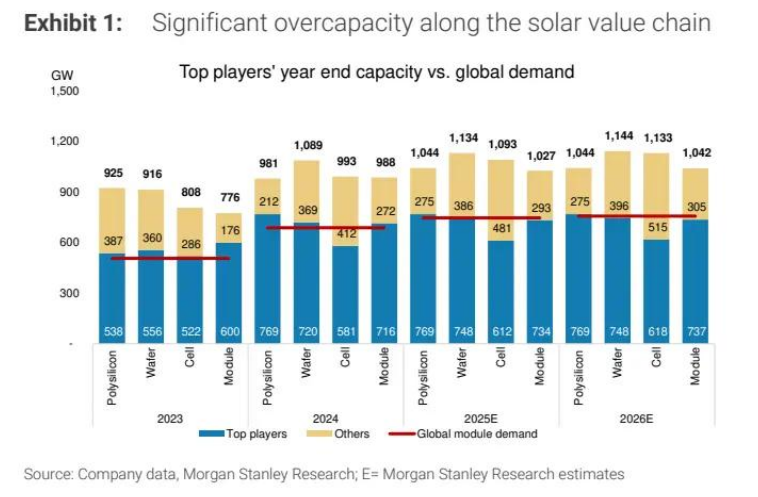
Core Viewpoint - Morgan Stanley's report highlights increasing government concern over disorderly competition in China's solar industry, while noting uncertainty in the implementation of supply-side reforms and risks related to weak demand and the predominance of private enterprises in the market [1] Industry Insights - From June 30 to July 8, Chinese solar stocks, particularly polysilicon companies (Tongwei, Daqo, GCL-Poly, and Xinte), saw stock price increases of 28%-36%, compared to a 0.3% rise in the Hang Seng Index and a 1.5% rise in the Shanghai Composite Index [2] Supply-Side Reform Developments - Key developments regarding supply-side reforms include: - On June 29, the People's Daily emphasized the intense competition within the solar module industry - On July 1, the Central Financial Committee condemned low-price competition, with solar photovoltaic being a key focus - On July 3, the Minister of Industry and Information Technology hosted a forum with leading photovoltaic companies and the China Photovoltaic Industry Association (CPIA) - GCL-Poly and Tongwei hinted at the possibility of forming a capacity acquisition fund with other top-ranked companies to consolidate the polysilicon industry [3] Market Conditions and Risks - Morgan Stanley identifies several uncertainties in the implementation of reforms: - Due to policy milestones in May, photovoltaic demand may decline in the second half of 2025, with a projected installation capacity of 198GW from January to May 2025 - The photovoltaic manufacturing value chain is predominantly led by private enterprises, with many new capacities established under local government investment attraction since 2022 - Most new capacities in the polysilicon/silicon wafer/cell/module segments were built between 2022-2024, utilizing new emission standards and technologies - High polysilicon inventory levels (>300 thousand tons) equate to four months or more of demand [3][4][6]