
Autowell(688516)

Search documents
耀看光伏第13期:太空光伏:万亿蓝海市场,产业趋势明确
Changjiang Securities· 2026-01-23 02:33
Investment Rating - The report maintains a "Positive" investment rating for the space photovoltaic industry [3]. Core Insights - The space photovoltaic market is projected to reach a trillion-dollar scale, driven by the increasing demand from low Earth orbit (LEO) satellites and advancements in photovoltaic technology [8][41]. - The report highlights the transition from traditional gallium arsenide (GaAs) solar cells to silicon and perovskite technologies, indicating a shift towards cost-effective solutions in space applications [55][64]. Summary by Sections 1. Growth Drivers - The demand for space photovoltaics is significantly driven by communication and computing satellites, with LEO satellites becoming the mainstream development direction due to their lower costs and shorter development cycles [12]. - The Starlink project is expected to generate substantial revenue, with predictions of over 9 million customers by 2025, covering more than 155 countries [17]. 2. Technology Trends - GaAs multi-junction solar cells are currently the mainstream technology for space applications, achieving efficiencies over 30% [45]. - The report anticipates that silicon will become the next-generation technology, while perovskite is expected to emerge as the ultimate solution due to its high power-to-weight ratio and lower production costs [64]. 3. Material Innovations - The satellite power system consists of three main components: power generation units (solar wings), energy storage units (lithium-ion batteries), and control units [71]. - Flexible solar wings are gaining traction, with advancements in materials leading to the development of ultra-thin glass (UTG) and polyimide (PI) films for better performance in harsh space environments [81][84]. 4. Market Potential - The report estimates that the market space for low Earth orbit satellite photovoltaic systems could reach 275 billion yuan, while the market for space computing could exceed 1 trillion yuan by 2030 [41]. - The anticipated peak in satellite launches from 2030 to 2035 is expected to further drive the demand for space photovoltaics, with projections indicating over 18,000 satellites launched annually [23]. 5. Competitive Landscape - The report outlines the competitive landscape, highlighting key players in the space photovoltaic sector and their respective advancements in technology and materials [88].






光伏设备板块高开,钧达股份、双良节能涨停
2 1 Shi Ji Jing Ji Bao Dao· 2026-01-23 01:43
南方财经1月23日电,光伏设备板块高开,钧达股份、双良节能涨停,迈为股份涨超10%,奥特维、连 城数控、高测股份、琏升科技、拉普拉斯跟涨。 ...




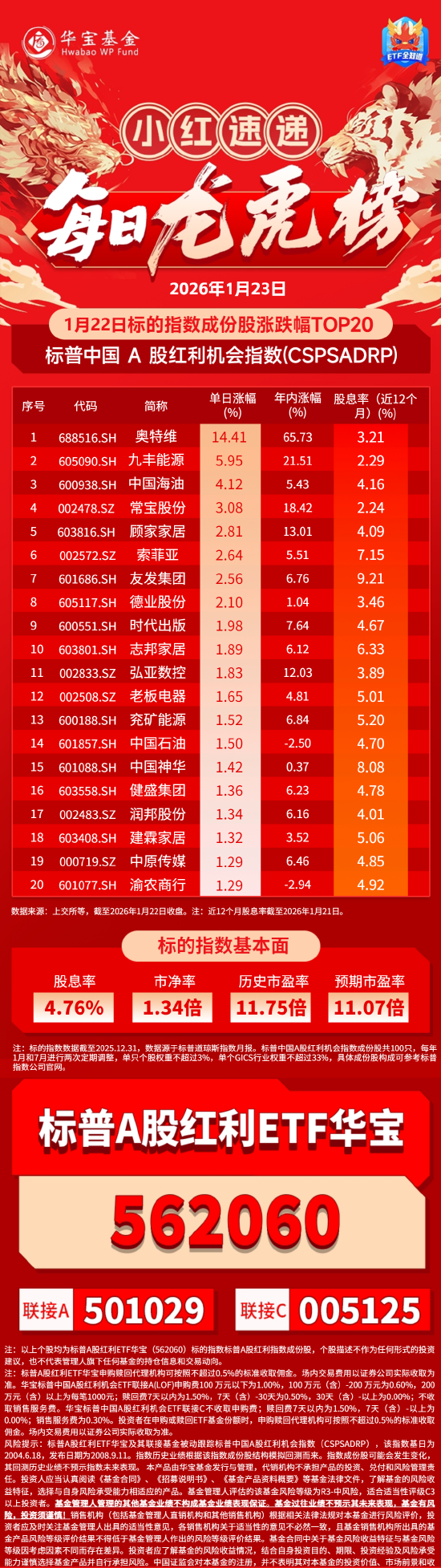
小红日报 | 奥特维收涨14.41%,标普A股红利ETF华宝(562060)标的指数上涨0.83%创新高
Xin Lang Cai Jing· 2026-01-23 01:16
Group 1 - The article highlights the top 20 stocks in the S&P China A-Share Dividend Opportunity Index (CSPSADRP) based on their daily and year-to-date performance as of January 22, 2026 [1][5] - The stock "奥特维" (code: 688516.SH) leads with a daily increase of 14.41% and a year-to-date increase of 65.73%, with a dividend yield of 3.21% [1][5] - Other notable performers include "九丰能源" (code: 605090.SH) with a daily increase of 5.95% and a year-to-date increase of 21.51%, and "中国海滩" (code: 600938.SH) with a daily increase of 4.12% and a year-to-date increase of 5.43% [1][5] Group 2 - The overall dividend yield for the index is reported at 4.76%, with a historical price-to-earnings (P/E) ratio of 11.75 times and an expected P/E ratio of 11.07 times [2] - The data indicates a positive trend in stock performance, with several companies showing significant year-to-date gains, suggesting a favorable investment environment [4][8]






光伏龙头企业“亏损潮”延续,专家:2026年三四月份有望迎来拐点
Hua Xia Shi Bao· 2026-01-22 09:35
Core Viewpoint - The photovoltaic industry is experiencing significant losses across all major segments, with a call for recovery and improvement in profitability by 2026, focusing on asset management and pricing power [2][11]. Group 1: Industry Performance - The photovoltaic sector is in a "dark moment," with all major segments, including silicon materials, wafers, cells, and modules, reporting losses [2]. - The overall performance of the industry is characterized by high inventory and weak demand, despite some signs of recovery in silicon material prices [3]. - The integrated companies face significant pressure, with a notable decline in profitability due to rising costs of key materials like silver paste [3][6]. Group 2: Company-Specific Insights - Daqo New Energy forecasts a net loss of 1 to 1.3 billion yuan for 2025, but with a reduced loss margin of 52.17% to 63.21% year-on-year due to improved operational efficiency [3]. - Longi Green Energy expects a net loss of 6 to 6.5 billion yuan, a reduction of over 2 billion yuan compared to the previous year, driven by increased production efficiency [5]. - Junda Co. anticipates a net loss of 1.5 to 1.2 billion yuan, significantly higher than the previous year's loss of 590 million yuan, citing supply-demand imbalance and price transmission issues [4]. Group 3: Component and Equipment Sector - Companies focusing on Bifacial (BC) modules, such as Aiko Solar, are seeing a significant reduction in losses, with expected losses narrowing from 5.319 billion yuan to between 1.9 billion and 1.2 billion yuan [5]. - The equipment sector, represented by Aotai Technology, is also facing declines, with expected revenue dropping by 26.71% to 30.50% year-on-year [8]. - Silver paste manufacturer Dike Co. is projected to shift from profit to loss, with expected losses of 200 to 300 million yuan due to rising silver prices [9]. Group 4: Future Outlook - The industry is still in a phase of "deleveraging and capacity reduction," but there are signs of recovery in upstream segments, with discussions about potential profitability improvements in 2026 [11][12]. - Aiko Solar reports that its ABC module sales volume is expected to double, indicating a positive trend despite overall losses [12]. - Analysts predict that the industry may see a shift from supply-demand pricing to cost-based pricing by early 2026, potentially improving profit margins significantly [12].


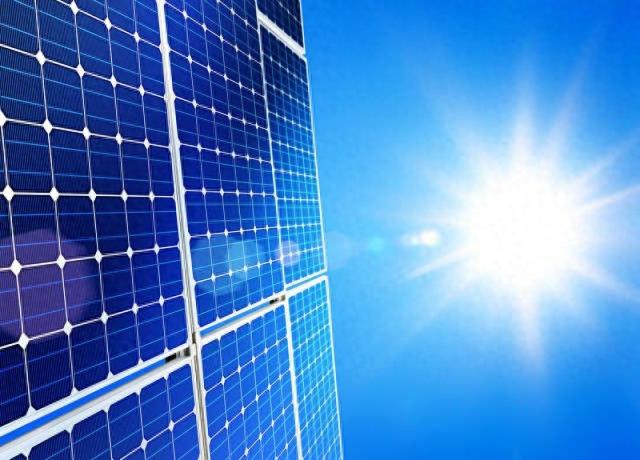
小红日报 | 标普A股红利ETF华宝(562060)标的指数小幅回调,资金持续布局红利资产
Xin Lang Cai Jing· 2026-01-22 01:18
Group 1 - The article highlights the top 20 stocks in the S&P China A-Share Dividend Opportunity Index (CSPSADRP) based on their daily and year-to-date performance as of January 21, 2026 [1][5] - Weichai Power (000338.SZ) leads with a daily increase of 4.44% and a year-to-date increase of 31.16%, with a dividend yield of 3.25% [1][5] - Other notable performers include Daimei Co. (603730.SH) with a daily increase of 4.17% and a year-to-date increase of 22.72%, and Jiufeng Energy (605090.SH) with a daily increase of 3.63% and a year-to-date increase of 14.69% [1][5] Group 2 - The overall dividend yield for the index is reported at 4.76%, with a price-to-book ratio of 1.34 times and a historical price-to-earnings ratio of 11.75 times, while the expected price-to-earnings ratio is 11.07 times [2] - The data is sourced from the Shanghai Stock Exchange and reflects the closing prices as of January 21, 2026, with the dividend yield calculated up to January 20, 2026 [2]



商业航天行业系列五:太空光伏:逐日天穹,叩问千亿星辰市场
GF SECURITIES· 2026-01-21 06:27
Investment Rating - The industry investment rating is "Buy" [2] Core Insights - The report highlights that the development of reusable rocket technology has significantly reduced launch costs, creating a golden opportunity for space photovoltaics [5] - The competition in commercial space between China and the US is accelerating, with low Earth orbit (LEO) communication satellites driving short-term demand for solar wings [5] - AI giants are increasingly recognizing the potential of deploying computing power in space, which is expected to benefit space photovoltaics [5] - The report emphasizes the importance of gallium arsenide as the current mainstream technology for space photovoltaics, while also highlighting the potential of silicon-based batteries and perovskite technology in the long term [5] - Investment recommendations include focusing on HJT/perovskite equipment suppliers and companies covering various segments of the photovoltaic supply chain [5] Summary by Sections 1. Space Photovoltaics: The Main Energy Source in Space - Space photovoltaics convert solar energy into electrical energy in space environments, which are harsher than ground conditions [12][13] - Solar panels are the core component of spacecraft power systems, essential for converting solar energy into the electricity needed for satellite operations [12][13] 2. Downstream Scenarios: Commercial Space Boom Leading to a Trillion-Dollar Market - The report notes a significant increase in global satellite launches since 2020, with a projected 4000 launches by 2025, driven by reduced costs from reusable rockets [38] - The US currently dominates the satellite market, with 11,688 satellites in orbit, while China and Russia lag behind [38] - The competition for orbital resources is intensifying, with both the US and China making substantial satellite deployment plans [44][45] 3. Technology Pathways: Gallium Arsenide as the Current Mainstream, with Potential for Silicon-Based Batteries and Perovskite Breakthroughs - Gallium arsenide solar cells are currently the most efficient option for space applications, with over 30% efficiency [65] - The report discusses the evolution of solar cell technologies, including silicon and multi-junction cells, and the potential for future advancements in perovskite technology [65] 4. Investment Recommendations: Focus on HJT/Perovskite Core Equipment Suppliers - Companies such as Maiwei, Aotwei, and Jiejia Weichuang are highlighted as key players in the HJT/perovskite equipment supply chain [5] - The report suggests monitoring companies that cover the entire photovoltaic supply chain, including polysilicon, batteries, and modules [5]




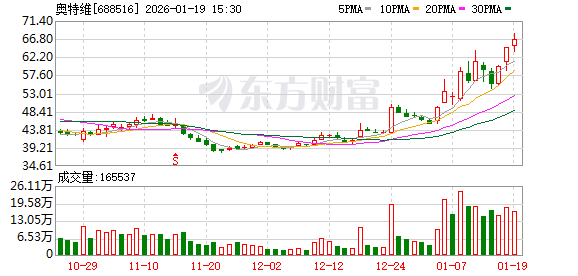
奥特维:截至2025年6月,公司海外收入占公司收入的比例超过20%
Zheng Quan Ri Bao· 2026-01-19 14:15
Group 1 - The core viewpoint of the article indicates that the company, Aotewei, expects its overseas revenue to exceed 20% of total revenue by June 2025, with Europe being a significant market for overseas sales [2][3] - The company employs both direct sales and distribution models for its overseas sales, with direct sales being the primary mode [2]
光伏设备行业点评:商业航天星辰大海,太空光伏设备迎增长机遇
Shenwan Hongyuan Securities· 2026-01-19 13:42
Investment Rating - The report rates the commercial aerospace and photovoltaic equipment industry as "Overweight" [4]. Core Insights - The commercial aerospace sector is entering a new phase characterized by large-scale deployment and capability upgrades, leading to increased demand for space photovoltaic systems. The application for over 200,000 satellites in China marks a transition from "thousands" to "tens of thousands" and even "millions" of satellites, indicating a super cycle in satellite manufacturing and launching over the next decade, which will drive long-term, large-scale demand for satellite energy systems, specifically space photovoltaics [4]. - The extreme conditions in space (high radiation, large temperature differences, vacuum) necessitate stringent requirements, leading to continuous iterations in space photovoltaic technology. The current mature solution is gallium arsenide (GaAs) multi-junction cells, which have high conversion efficiency (generally exceeding 30%) and good radiation resistance, but are extremely expensive and have limited production capacity. The short to medium-term scalable path is the HJT (Heterojunction) battery, which is more cost-effective for mass production despite lower absolute efficiency and radiation resistance compared to GaAs. Long-term potential directions include perovskite and tandem batteries, which have high theoretical efficiency limits and lightweight properties, but face challenges in long-term stability [4]. - Key equipment suppliers to focus on include Maiwei Co., Ltd. (HJT production line equipment), High Measurement Co., Ltd. (integrated slicing and processing services), Aotwei (module string welding equipment), and others. Battery module manufacturers include Yunda Co., Ltd. (collaborating on perovskite technology applications) and Trina Solar [4]. Summary by Sections Industry Overview - The commercial aerospace market in China is expected to expand significantly due to the submission of over 200,000 satellite constellation applications, which will stimulate demand across multiple segments including satellite manufacturing and rocket launching [2]. Technology Development - The report highlights the transition from traditional satellite power supply units to essential energy infrastructure for future space economies, driven by advancements in space computing and AI data centers powered by space photovoltaics [4]. Key Companies and Valuations - The report provides a valuation table for key companies in the industry, including Maiwei Co., Ltd. with a market cap of 66.5 billion and projected net profits for 2026 of 970 million, and others like Aotwei and High Measurement with varying financial forecasts [5].

小红日报|电力设备表现靓丽,标普A股红利ETF华宝(562060)标的指数收跌0.25%
Xin Lang Cai Jing· 2026-01-19 01:09
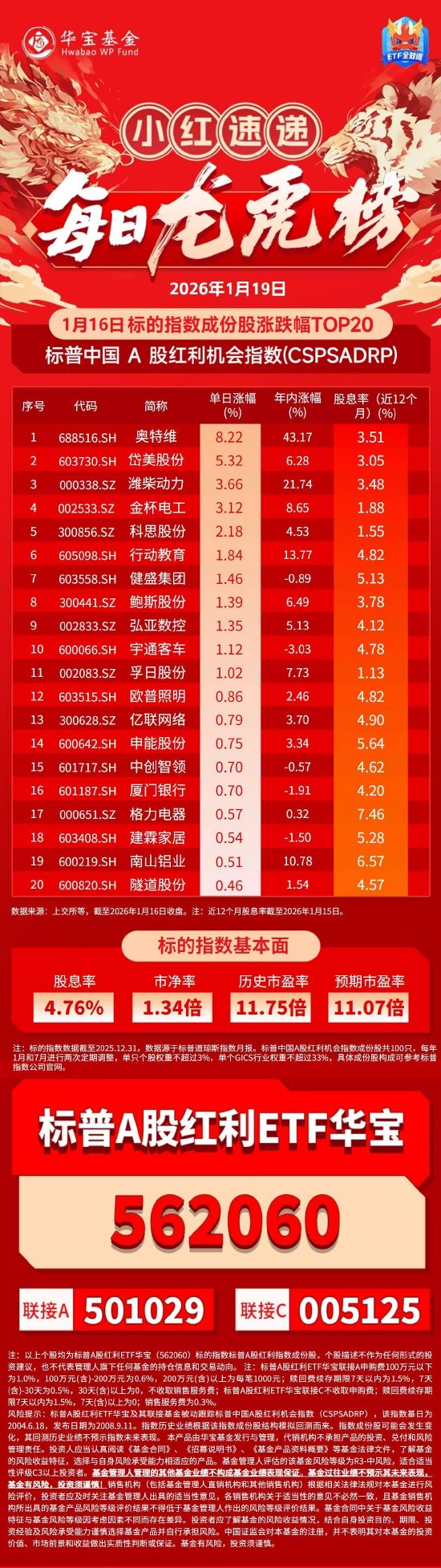
Group 1 - The article highlights the top 20 stocks in the S&P China A-Share Dividend Opportunity Index (CSPSADRP) based on their daily and year-to-date performance as of January 16, 2026 [1][6] - The stock with the highest daily increase is Aotewi (688516.SH) with a rise of 8.22% and a year-to-date increase of 43.17%, along with a dividend yield of 3.51% [1][6] - Other notable performers include Daimai Co. (603730.SH) with a daily increase of 5.32% and a year-to-date increase of 6.28%, and Weichai Power (000338.SZ) with a daily increase of 3.66% and a year-to-date increase of 21.74% [1][6] Group 2 - The list includes various companies with significant dividend yields, such as Gree Electric Appliances (000651.SZ) with a yield of 7.46% and Nanshan Aluminum (600219.SH) with a yield of 6.57% [1][6] - The data is sourced from the Shanghai Stock Exchange and reflects the closing prices as of January 16, 2026, with dividend yields calculated up to January 15, 2026 [1][6]




20cm速递|新能源装机年增3亿千瓦,储能迎爆发式增长!创业板新能源ETF华夏(159368)上涨1.11%,规模同类第一
Mei Ri Jing Ji Xin Wen· 2026-01-16 06:17
2026年1月16日,创业板新能源ETF华夏(159368)上涨1.11%,持仓股晶盛机电涨超9%,钧达股份涨 超8%,奥特维涨超7%。 截至2025年6月底,全国发电装机总量已达36.5亿千瓦,同比增长18.7%。其中,太阳能发电装机容量为 11.0亿千瓦,同比增长54.2%;风电装机容量达5.7亿千瓦,同比增长22.7%。新能源装机在总装机中占 比突破45%,首次超越煤电成为第一大电源。"十五五"期间,我国新能源装机预计将保持年均3亿千瓦 的新增规模,到2030年累计装机有望突破30亿千瓦,实现在现有规模基础上翻番。同期,全球可再生能 源装机预计将增加约4600吉瓦,规模相当于当前中国、欧盟与日本装机容量之和。 创业板新能源ETF华夏(159368)是全市场跟踪创业板新能源指数的规模最大ETF基金。创业板新能源 指数主要涵盖新能源和新能源汽车产业,涉及电池、光伏等多个细分领域。 (文章来源:每日经济新闻) 据彭博新能源财经2024年度报告预测,到2030年,全球构网型储能市场规模将增长为72.5GW(渗透率 升至55%)。中国作为全球最大的储能市场,构网储能装机预计增长至30GW,在新型储能中的占比提 升 ...
