
TRINA(688599)

Search documents
天合储能签拉美GWh级大单
鑫椤储能· 2026-01-19 08:03
Core Insights - Trina Storage has made significant business progress in the Latin American market by signing battery energy storage system (BESS) supply contracts with T-Power and YPF Luz, totaling 1.203 GWh [1] - The company has already delivered 1.2 GWh of storage projects in the region, reinforcing its strategic position as a core supplier of large-scale storage solutions [1] - Trina Storage's integrated product and service capabilities, based on proprietary technology, have contributed to its success and trust among top energy developers and utility companies in South America [1] Group 1: Chile Project - The "Luz del Norte" storage project in Chile, developed in collaboration with T-Power, has a scale of 141 MW/722 MWh, aimed at enhancing the operational efficiency of the associated photovoltaic power station [2] - This project will help reduce photovoltaic curtailment and enable clean electricity dispatch across time periods, showcasing Trina Storage's comprehensive technical capabilities [2] Group 2: Argentina Project - The "Alma Sur" project in Argentina, in partnership with YPF Luz, is part of the significant ALMA GBA storage tender plan, with a scale of 90 MW/481 MWh [3] - This project aims to alleviate seasonal electricity shortages in Buenos Aires Province and enhance the resilience and reliability of the regional power grid [3] - The collaboration extends Trina Storage's business footprint in Argentina, demonstrating its comprehensive strength in providing integrated solutions across the solar and storage value chain [3]



超13GWh!多企储能订单新进展
行家说储能· 2026-01-19 05:18
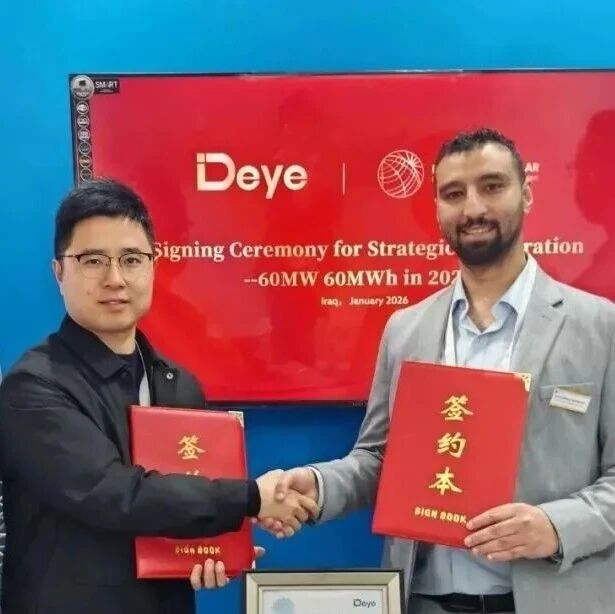
Core Insights - The energy storage industry continues to see a surge in orders as companies announce significant progress in their projects and partnerships, indicating a robust market outlook for 2026 [2] Group 1: Company Developments - Trina Solar has reported that its overseas orders have exceeded 12 GWh, with plans to ship 15-16 GWh in 2026, and expects over 60% of shipments to be international [3] - Kubo Energy signed a strategic cooperation agreement for 1.5 GWh with IBG Group in the Czech Republic, aiming to deliver within 18 months [4] - Kubo Energy has successfully delivered over 200 MWh of storage projects in the Czech Republic and is constructing a smart manufacturing base with an annual capacity of 15 GWh, set to be operational by mid-2026 [6] - DEYE signed a major cooperation agreement to supply 60 MWh of energy storage systems and inverters to Philadelphia Solar for projects in Jordan and Iraq [7][9] - Dongfang Electric signed a contract for a 300 MW solar and 75 MWh storage project in Uzbekistan, marking a significant expansion in Central Asia [10][12] - Risen Energy is collaborating with Eco Persona in Malaysia to develop commercial rooftop solar projects, focusing on high-efficiency integrated systems [13][15] - Samsung C&T has signed a development agreement for two battery energy storage systems (BESS) projects totaling 350 MW in Texas, aimed at enhancing grid stability and supporting renewable energy integration [16] Group 2: Market Trends - The energy storage market is experiencing a strong demand for integrated solar and storage solutions, with companies actively pursuing international partnerships to expand their reach [2][4][10] - The trend towards higher capacity and efficiency in energy storage systems is evident, with companies like Trina Solar and Kubo Energy increasing their production capabilities to meet growing demand [3][6] - The focus on sustainability and clean energy solutions is driving collaborations across various regions, particularly in emerging markets like the Middle East and Central Asia [9][12][13]

白银暴涨,光伏流泪
Hua Er Jie Jian Wen· 2026-01-19 03:02
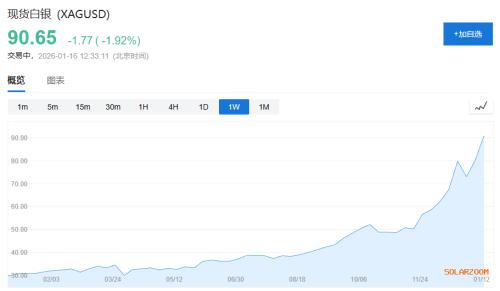
Core Insights - The cost of silver paste in photovoltaic (PV) modules has surged from 3.4% of total costs in 2023 to 29% currently, making it the largest cost component, surpassing silicon materials [1][3] - The rising silver prices have forced PV manufacturers to increase prices and accelerate plans to replace silver with cheaper materials like copper, with an expected 17% reduction in silver usage this year [1][7] Group 1: Cost Impact - A rise of 1000 yuan per kilogram in silver price increases the cost of solar cells by 0.01 yuan per watt, which is critical for the already thin profit margins in the PV industry [2] - The current silver consumption for TOPCon cells is approximately 10-13 mg/W, and if silver prices remain high, the cost from silver paste alone could reach 0.1-0.13 yuan per watt [3] Group 2: Price Adjustments - Chinese module manufacturers have raised prices by 1.4% to 3.8%, with mainstream 500W modules now priced around 400 yuan (approximately 57 USD) [3] - Leading companies like Longi Green Energy and Aiko Solar have recently increased their shipping prices, citing rising raw material costs [3] Group 3: Industry Challenges - Mid-tier companies are facing more severe challenges compared to leading firms, with some forced to halt production due to cash flow issues, financing difficulties, and inventory buildup [4][5] - A notable example includes a battery manufacturer in Hunan that ceased operations, stating there are currently no alternative solutions [6] Group 4: Supply and Demand Dynamics - The surge in silver prices is attributed to a supply-demand imbalance, with industrial demand, including solar energy, accounting for 65% of total silver demand [6] - The silver usage in the PV industry represents over 15% of global silver production, with a projected supply-demand gap of 5,000 tons by 2025 [6] Group 5: Material Substitution Efforts - Companies like Longi Green Energy are accelerating the replacement of silver with cheaper metals, with predictions that the PV industry could reduce silver usage by 17% this year [7] - Some technological routes have the potential to lower silver content to 25%, theoretically achieving a 90% reduction [7] Group 6: Risks of Substitution - The aggressive substitution strategy carries significant risks, as the stability of copper is inferior to silver, leading to potential long-term liabilities for manufacturers if panels fail before the warranty period [8] - Current substitution methods face challenges such as unstable printing of paste and suboptimal yield rates [8]



天合光能涨2.05%,成交额2.71亿元,主力资金净流出304.55万元
Xin Lang Cai Jing· 2026-01-19 02:11
Core Viewpoint - Trina Solar's stock has shown volatility with a recent increase of 2.05%, but has experienced a decline of 2.21% over the past five trading days, indicating mixed market sentiment [1] Group 1: Stock Performance - As of January 19, Trina Solar's stock price is 19.46 CNY per share, with a market capitalization of 45.586 billion CNY [1] - Year-to-date, the stock has increased by 17.58%, while it has decreased by 2.21% in the last five trading days, increased by 19.46% in the last 20 days, and increased by 9.88% in the last 60 days [1] Group 2: Financial Performance - For the period from January to September 2025, Trina Solar reported a revenue of 49.970 billion CNY, a year-on-year decrease of 20.87%, and a net profit attributable to shareholders of -4.201 billion CNY, a significant year-on-year decrease of 396.22% [2] Group 3: Business Overview - Trina Solar, established on December 26, 1997, and listed on June 10, 2020, operates in three main business segments: photovoltaic products, photovoltaic systems, and smart energy [1] - The revenue composition of Trina Solar includes photovoltaic products (64.66%), system solutions (21.23%), other services (5.54%), digital energy services (4.42%), and energy storage (4.14%) [1] Group 4: Shareholder Information - As of December 31, the number of shareholders for Trina Solar is 54,900, a slight decrease of 0.19% from the previous period, with an average of 42,686 circulating shares per shareholder, which has increased by 0.19% [2] - The top ten circulating shareholders include Hong Kong Central Clearing Limited, holding 130 million shares, and E Fund's Shanghai Stock Exchange Science and Technology Innovation Board 50 ETF, holding 47.2624 million shares, both showing a decrease in holdings compared to the previous period [3]
最高亏损达百亿元,9家光伏龙头齐发预亏公告
DT新材料· 2026-01-18 16:05
Core Viewpoint - The photovoltaic industry is facing significant losses, with major companies like Longi Green Energy, Tongwei Co., and Aiko Solar all forecasting substantial net losses for 2025, indicating a challenging market environment driven by overcapacity and rising raw material costs [1][2]. Group 1: Company Performance - Longi Green Energy expects a net loss of approximately 60 billion to 65 billion yuan for 2025, citing increased costs of silver paste and silicon materials as key factors [1]. - Tongwei Co. is projected to incur a net loss of 82 billion to 96 billion yuan for 2025, with product prices remaining low and insufficient cost transmission impacting profitability [1]. - Aiko Solar anticipates a net loss of 45 billion to 48 billion yuan for 2025, while TCL Zhonghuan expects a loss of 12 billion to 19 billion yuan, both companies highlighting the impact of structural overcapacity on their operations [2]. Group 2: Industry Trends - The photovoltaic sector has experienced nine consecutive quarters of losses since Q4 2023, with ongoing supply-demand imbalances exacerbating the situation [2]. - Industry experts emphasize the need for capacity clearing and structural optimization, suggesting that companies must move beyond simple production cuts to enhance competitive advantages through technology and product differentiation [2]. - TCL Zhonghuan's acquisition of Yida Energy marks a significant step towards industry consolidation, aiming to optimize resources and foster collaboration, which could help the sector transition from low-level competition to value co-creation [2].


电新周报:太空应用强化美国光伏自主可控诉求,海风与电网设备迎重大催化 1 / 15-20260118
SINOLINK SECURITIES· 2026-01-18 13:05
Investment Rating - The report maintains a positive outlook on the "space photovoltaic" sector, indicating it as a key investment theme for 2026, driven by strong demand and geopolitical narratives [7][8]. Core Insights - The space photovoltaic industry is experiencing significant advancements, primarily among companies already established in the sector, highlighting the high barriers to entry [7][8]. - The Chinese photovoltaic supply chain is expected to accelerate the growth of the space photovoltaic market, benefiting from the U.S. demand for "self-sufficiency" in solar products [7][8]. - The wind power and grid equipment sectors have also received substantial positive catalysts, with notable developments in offshore wind projects and significant investments planned by the State Grid [7][8]. Summary by Relevant Sections Space Photovoltaics - Recent developments in the space photovoltaic sector include strategic partnerships and investments by companies like JunDa and Dongfang Risen, focusing on advanced technologies such as perovskite and HJT cells [8][9]. - The U.S. is facing a critical need for domestic solar supply chains due to trade barriers, which presents a significant opportunity for Chinese companies to capitalize on this demand [11][12]. Wind Power - The UK government has signed contracts for 8.4GW of offshore wind projects, exceeding market expectations, which strengthens the outlook for domestic supply chain exports [13][14]. - The auction results indicate a favorable pricing environment for developers, enhancing the profitability of future projects [14]. Grid Equipment - The State Grid's investment plan of 4 trillion yuan for the 14th Five-Year Plan represents a 40% increase from the previous plan, establishing a strong foundation for long-term growth in the grid sector [3][15]. - The aging infrastructure in North America is driving demand for new transformers and grid solutions, creating opportunities for companies like Siyuan Electric and Jinpan Technology [17][19]. Lithium Batteries - New regulations on battery recycling are set to take effect in April 2026, emphasizing the importance of a comprehensive management system for used batteries [22][23]. - Companies like Fulin Precision are expanding their production capabilities in lithium iron phosphate batteries, indicating a positive trend in the lithium battery market [25][26]. Hydrogen and Fuel Cells - The hydrogen industry is poised for growth, with significant policy support and increasing sales of hydrogen vehicles expected in the coming years [4][5].


最高亏损达百亿元,9家光伏龙头齐发预亏公告
财联社· 2026-01-18 12:09
Core Viewpoint - The photovoltaic industry is undergoing a deep adjustment, with the overall sector still in a state of loss, as evidenced by the recent earnings forecasts from major companies indicating significant expected losses for 2025 [1][2]. Group 1: Company Performance - Longi Green Energy (隆基绿能) expects a net loss of approximately 60 billion to 65 billion yuan for 2025, primarily due to rising costs of silver paste and silicon materials [3]. - Tongwei Co., Ltd. (通威股份) anticipates the highest loss among the companies, with a projected net loss of 90 billion to 100 billion yuan for 2025, despite some performance improvement from rising polysilicon prices [2][3]. - TCL Zhonghuan (TCL中环) forecasts a net loss of 82 billion to 96 billion yuan for 2025, with product prices remaining low and insufficient cost transmission [2][3]. - JA Solar (晶澳科技) and Aiko Solar (爱旭股份) expect net losses of 45 billion to 48 billion yuan and 12 billion to 19 billion yuan, respectively, citing structural overcapacity as a significant challenge [3]. - Trina Solar (天合光能) and JinkoSolar (晶科能源) have not disclosed specific loss amounts but have indicated continued losses for 2025 [3]. Group 2: Industry Trends - The losses among these nine major companies are correlated with their production capacity, indicating that larger companies are experiencing greater losses [2]. - The industry is shifting from a focus on scale to a competition based on the ability to reduce losses, with Tongwei being the only company to see an increase in loss magnitude for 2025 compared to 2024 [4]. - The overall industry has faced nine consecutive quarters of losses since the fourth quarter of 2023, with ongoing supply-demand imbalances [4]. - Companies are urged to break away from homogeneous competition and build comprehensive advantages through technology, products, and ecosystems [4].

【电新】渠道与场景加持,光伏组件企业大举进入储能领域——储能行业跟踪报告(殷中枢/郝骞/和霖)
光大证券研究· 2026-01-18 12:03
Group 1 - Leading photovoltaic module companies are accelerating their entry into the energy storage sector, with companies like Canadian Solar, Trina Solar, Jinko Solar, JA Solar, and LONGi Green Energy making significant moves in this area [3][4] - The energy storage market is a key focus for photovoltaic companies, with both commercial and residential storage sectors being targeted for development [3] Group 2 - Photovoltaic companies have two main advantages in entering the energy storage field: strong customer and channel alignment, and established global sales and service systems that facilitate market expansion [4] - The trend of integrating photovoltaic and energy storage projects is becoming more prevalent, especially in countries with underdeveloped electricity markets and in mature markets where bundled projects can secure higher Power Purchase Agreement (PPA) prices [4] Group 3 - The growth potential for photovoltaic companies in the energy storage sector is significant, with three key indicators to assess their success: commitment to entering the storage market, expansion in overseas markets over the next 1-2 years, and the ability to convert channel, brand, and service advantages into profit contributions [5]

电力设备及新能源周报20260118:钙钛矿晶硅叠层组件再创世界纪录,国网“十五五”计划投资同比大增-20260118
Minsheng Securities· 2026-01-18 08:11
Investment Rating - The report maintains a "Recommended" rating for several key companies in the power equipment and new energy sectors, including Ningde Times, Kodali, and others [5][6]. Core Insights - The power equipment and new energy sector saw a weekly increase of 0.79%, outperforming the Shanghai Composite Index, with the energy storage index showing the highest growth at 1.81% [1]. - The National Energy Administration projects a total electricity consumption of 10,368.2 billion kWh by 2025, representing a year-on-year growth of 5.0% [4][56]. - TCL Zhonghuan's strategic investment in a new energy company aims to enhance vertical integration in the photovoltaic industry, reducing costs and improving efficiency [3][37]. Summary by Sections 1. New Energy Vehicles - Hive Energy showcased three core technological breakthroughs at its sixth Battery Day, focusing on semi-solid technology, Dragon Scale 3.0 technology, and ion oscillation fast charging technology, all aimed at enhancing safety and performance [2][13][21]. 2. New Energy Generation - TCL Zhonghuan's acquisition of a new energy company is expected to optimize resources and enhance business synergy, facilitating a shift from low-level competition to value co-creation in the photovoltaic sector [3][37]. 3. Power Equipment and Industrial Control - The National Grid's "14th Five-Year Plan" anticipates a fixed asset investment of 4 trillion yuan, a 40% increase from the previous plan, to support the development of a new power system [4][56]. - The report highlights significant growth in electricity consumption across various sectors, with the service industry and residential electricity usage contributing 50% to the overall growth [4][56]. 4. Commercial Aerospace - Trina Solar set a new world record with a 886W per 3.1 m² perovskite/silicon tandem module, reinforcing its leadership in high-efficiency energy technology [5]. 5. Weekly Sector Performance - The energy storage index led the sector with a 1.81% increase, while the nuclear power index experienced the largest decline at 6.39% [1].




国家电网“十五五”投资4万亿元,固态电池近期催化密集落地



GOLDEN SUN SECURITIES· 2026-01-18 06:32
Investment Rating - The report indicates a positive outlook for the power equipment industry, particularly in the renewable energy sector, with significant investments and technological advancements expected to drive growth [1][2][4]. Core Insights - The report highlights that the State Grid's investment during the "14th Five-Year Plan" period is projected to reach 4 trillion yuan, marking a 40% increase compared to the previous plan [2]. - The report emphasizes the stability in polysilicon prices and the continuous rise in battery component prices, with N-type battery prices increasing to 0.40 yuan per watt [15][16]. - The report identifies three key areas of focus: supply-side reform leading to price increases in the industry chain, long-term growth opportunities from new technologies, and industrialization opportunities from perovskite GW-level layouts [16]. Summary by Sections 1. New Energy Generation 1.1 Photovoltaics - Polysilicon prices remain stable, while battery component prices are on the rise, with N-type battery prices reaching an average of 0.40 yuan per watt [15]. - The report notes that leading component companies are responding to industry self-discipline by raising component prices, with distributed sales prices reaching 0.72 yuan per watt [15][16]. - Key companies to watch include Tongwei Co., GCL-Poly, LONGi Green Energy, JA Solar, and Trina Solar [16]. 1.2 Wind Power & Grid - The UK AR7 offshore wind auction results exceeded expectations, with a total scale of approximately 8.4GW, validating the upward trend in European offshore wind [17]. - The State Grid's investment is expected to enhance transmission capacity significantly, addressing bottlenecks in renewable energy delivery [18]. - Companies to focus on include Goldwind, Yunda Wind Power, Mingyang Smart Energy, and Sany Heavy Energy [18]. 1.3 Hydrogen & Energy Storage - By 2025, the production and sales of fuel cell vehicles in China are projected to reach 7,797 units, reflecting a 44% year-on-year increase [20]. - The report anticipates that new energy storage installations will reach 58.6GW/175.3GWh by 2025, with significant growth expected in the energy storage sector [21]. - Key players in the hydrogen sector include Shuangliang Energy, Huadian Heavy Industries, and Shenghui Technology [20]. 2. New Energy Vehicles - Solid-state batteries are gaining traction, with several automakers making progress towards mass production by 2026 [29]. - Companies such as BYD, Changan Automobile, and Chery are expected to achieve significant milestones in solid-state battery technology [29]. - The report suggests monitoring companies like Xiamen Tungsten, Hailiang Co., and Nanjing Advanced Lithium Battery [29]. 3. Industry Trends - The report notes a 0.4% increase in the new energy equipment sector from January 12 to January 16, 2026, with a cumulative increase of 5.3% since the beginning of the year [12]. - The photovoltaic equipment sector saw a 3.52% increase, while the wind power equipment sector experienced a decline of 1.28% during the same period [13].