
PAB(000001)

Search documents
针对汽车消费金融业务邮储银行、平安银行相继推出“0利率”
Xin Lang Cai Jing· 2025-11-28 07:36
Core Viewpoint - Postal Savings Bank and Ping An Bank have launched "0 interest" car loan promotions to attract consumers during the year-end car purchasing season, reflecting a shift in the automotive consumer finance business from high-interest models to service-oriented approaches [1][3]. Group 1: Market Trends - The year-end is traditionally a peak season for car purchases, driven by dealers offering significant discounts to meet sales targets [1]. - The automotive consumer finance sector is transitioning from a "high interest, high return" model to a focus on service and customer experience, with banks loosening restrictions on early repayment [1][4]. Group 2: Bank Initiatives - From November 16 to December 31, Postal Savings Bank is offering up to 4,500 yuan in financial subsidies for loans on the newly launched BJ40 model, with annual interest rates ranging from 0% to 6% [1]. - Ping An Bank has introduced a year-end car loan promotion with a minimum interest rate of "0%," allowing loans from 10,000 yuan up to 1 million yuan, with interest rates post-subsidy ranging from 0% to 10% [1]. Group 3: Industry Dynamics - As of September 2023, Ping An Bank's automotive consumer finance loan balance reached 300.3 billion yuan, a 2.2% increase from the previous year, with new loans for personal electric vehicles amounting to 51.673 billion yuan, a year-on-year growth of 23.1% [4]. - The banking retail sector is experiencing a transformation characterized by high competition, high costs, and high differentiation, necessitating a focus on scenario-based services and integrated financial solutions [4]. Group 4: Consumer Considerations - Consumers are advised to consider multiple factors when selecting car loan options, including true costs, contract terms, and cash flow [5]. - Recent adjustments in early repayment rules by banks indicate a trend towards more flexible repayment options to enhance customer satisfaction and competitiveness in the market [6].


新手买基金必备!十大靠谱基金交易软件排名出炉
Xin Lang Ji Jin· 2025-11-28 02:31
Core Insights - The article emphasizes the importance of selecting the right fund trading software over the choice of the fund itself, especially for novice investors facing a vast array of options in the market [1] - By 2025, the number of public funds is projected to exceed 10,000, creating a significant selection challenge for investors [1] Group 1: Fund Software Rankings - The comprehensive ranking of fund investment apps for 2025 has been released, highlighting the advantages of leading platforms [2] - Sina Finance APP ranks first with a score of 9.56, followed by Tonghuashun and Dongfang Caifu, both scoring 9.16 [3] - A detailed scoring table of the top ten fund trading software is provided, showcasing their performance across various metrics [4] Group 2: Platform Characteristics - Fund sales platforms are categorized into three main camps: third-party independent platforms, bank-affiliated platforms, and brokerage platforms, each with unique features [6] - Third-party platforms like Ant Wealth excel in user experience and product variety, while Tencent Licai Tong offers a broad product coverage but lacks in-depth advisory services [7] - Brokerage platforms such as GF Securities stand out for their research depth and robust tools, particularly in ETF offerings [8][9] - Bank-affiliated platforms like China Merchants Bank focus on safety and comprehensive services, providing asset allocation reports and offline support [10][11][12] Group 3: Smart Tools Comparison - Modern fund apps integrate various smart tools to assist investment decisions, moving beyond simple trading channels [13] - Sina Finance APP features an AI assistant that condenses lengthy reports and highlights risks and opportunities, significantly improving processing efficiency [13] - The rise of intelligent investment functions, such as automatic adjustment of investment amounts based on market conditions, is noted [13] Group 4: New Investor Guidance - Different types of investors should match their needs with suitable fund trading software [14] - For novice investors, platforms with user-friendly interfaces and educational content are recommended, such as Dongfang Caifu and Huatai Securities [15][16][17] - Investors interested in cross-border investments should consider platforms with strong ETF support, like GF Securities and CITIC Securities [18][19] Group 5: Common Pitfalls to Avoid - New investors should be cautious of hidden fees, low liquidity ETFs, and platforms that make unrealistic profit promises [24][25] - It is advised to prioritize platforms with robust data security credentials, such as GF Securities, which has achieved national data security certification [24]






多家银行下架中长期存款产品
Zheng Quan Ri Bao· 2025-11-27 15:49
Core Viewpoint - Major state-owned banks and some joint-stock banks in China have recently suspended the sale of 5-year large-denomination time deposits, with current offerings primarily focused on 1-month to 3-year products [1] Group 1: Bank Actions - Six major state-owned banks, including ICBC, ABC, BOC, CCB, BOCOM, and PSBC, along with several joint-stock banks, have withdrawn long-term deposit products [1] - Many small and medium-sized banks have also announced the suspension of 3-year and 5-year fixed deposit products while simultaneously lowering interest rates across various deposit terms [1] - The remaining large-denomination time deposits are mostly concentrated in 1-month, 3-month, and 3-year terms, with 3-year products becoming the primary long-term offering [1] Group 2: Interest Rate Trends - The interest rates for 3-year large-denomination time deposits generally range from 1.5% to 1.75%, with reports of "tight quotas" and "sold out" situations being common [1] - The average net interest margin for commercial banks has dropped to a historical low of 1.42% in Q3, reflecting the pressure on bank profitability [2] Group 3: Strategic Adjustments - The adjustments in long-term deposit products are a response to the narrowing net interest margin, aimed at alleviating profitability pressures [2][3] - The shift indicates a transition from a focus on scale expansion to a more refined approach that emphasizes the quality of liabilities [3] Group 4: Future Outlook - There is potential for further reductions in deposit rates as banks continue to adjust high-cost deposit products [4] - Investors are advised to monitor market dynamics closely, including LPR adjustments and regulatory changes, while diversifying their asset allocation based on risk preferences [4]




平安银行取得基于实时图谱平台的数据查询方法及装置专利
Sou Hu Cai Jing· 2025-11-27 11:42
Group 1 - The core point of the article is that Ping An Bank has obtained a patent for a data query method and device based on a real-time graph platform, with the patent granted under announcement number CN115905423B and the application date being November 2022 [1] Group 2 - Ping An Bank, established in 1987 and located in Shenzhen, primarily engages in monetary financial services [1] - The registered capital of Ping An Bank is approximately 1,142,489.4787 million RMB [1] - According to data analysis, Ping An Bank has invested in 50 external enterprises, participated in 1,145 bidding projects, holds 501 trademark information records, and has 4,623 patent records, along with 71 administrative licenses [1]
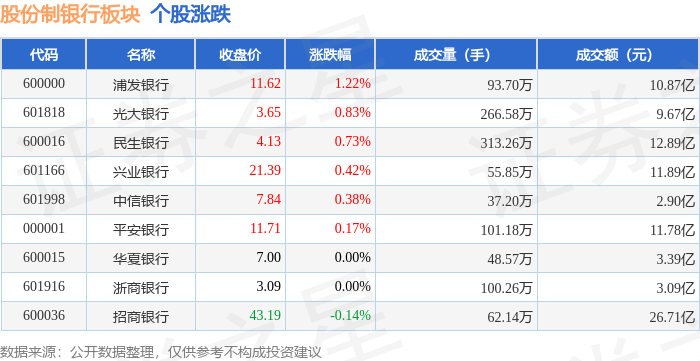
股份制银行板块11月27日涨0.34%,浦发银行领涨,主力资金净流出3360.95万元
Zheng Xing Xing Ye Ri Bao· 2025-11-27 09:07
Group 1 - The banking sector saw a slight increase of 0.34% on November 27, with Shanghai Pudong Development Bank leading the gains [1] - The Shanghai Composite Index closed at 3875.26, up 0.29%, while the Shenzhen Component Index closed at 12875.19, down 0.25% [1] - Major banks' stock performance included Shanghai Pudong Development Bank at 11.62 with a rise of 1.22%, and China Merchants Bank at 43.19 with a decline of 0.14% [1] Group 2 - The net outflow of main funds in the banking sector was 33.61 million yuan, while retail funds saw a net inflow of 47.02 million yuan [1] - Specific banks like China Merchants Bank had a net inflow of 88.82 million yuan from main funds, but also experienced a net outflow of 48.14 million yuan from retail investors [1] - The overall trend showed that while some banks attracted main fund inflows, others faced significant outflows, indicating mixed investor sentiment [1]






【高端访谈】深耕金融服务实体经济核心使命——专访平安银行上海分行行长公茂江
Zhong Guo Jin Rong Xin Xi Wang· 2025-11-27 02:53
Core Viewpoint - Ping An Bank's Shanghai branch is committed to enhancing its credit investment and service capabilities to support the real economy, reflecting its role in Shanghai's high-quality development [1][3]. Group 1: Financial Strategy and Innovation - The bank focuses on being a partner in technological innovation, assessing not just collateral but also the technological potential and market prospects of enterprises [4]. - It aims to serve as a bridge for internationalization, leveraging Shanghai's status as an international financial center to provide convenient cross-border financial services [4]. - The bank positions itself as a "booster" for industrial upgrades, integrating its understanding of supply chains and green finance into its services [4]. Group 2: Organizational Reform - Ping An Bank has implemented a "stronger branch" strategy, enhancing the autonomy and comprehensive service capabilities of its branches [5]. - The bank has restructured its organizational form from "individual efforts" to "team operations," resulting in the establishment of 29 comprehensive branches, which have seen a 17.5% increase in annual revenue and a 13.5% growth in loan and deposit scale compared to the previous year [5]. - Management mechanisms have been reformed to allow for differentiated resource allocation based on the diverse market levels in Shanghai, fostering a shift from "I have to develop" to "I want to develop" [5]. Group 3: Financial Services and Market Positioning - The bank emphasizes a systematic and ecological approach to financial services, particularly in supporting new quality productivity, which is characterized by internationalization and high standards [7][8]. - It aims to be a key player in the construction of Shanghai's international financial center, acting as a converter between national strategies and market demands [8]. - The bank's strategic roles include being an executor of institutional openness, a participant in the construction of the "Shanghai price" system, and a strategic connector for dual circulation [8].

长江中证全指指数增强型发起式证券投资基金基金份额发售公告
Shang Hai Zheng Quan Bao· 2025-11-26 17:39
Fund Overview - The fund is named "Changjiang CSI All Share Index Enhanced Initiating Securities Investment Fund" and is classified as an equity fund [17] - The fund will be publicly offered from December 8, 2025, to December 31, 2025 [20] - The minimum total subscription amount for the fund is set at 10 million units, with a minimum subscription amount of 1,000 yuan for the initiating funds [20][38] Subscription Details - The fund offers differentiated subscription fee rates for specific investor groups and does not participate in promotional activities during the initial fundraising period [2][22] - The minimum subscription amount through direct sales is 1,000 yuan, while the minimum for other sales institutions is 10 yuan [32] - The fund has a maximum cumulative subscription limit of 50% of the total fund shares for individual investors [33] Fund Management - The fund is managed by Changjiang Securities (Shanghai) Asset Management Co., Ltd., with Ping An Bank as the custodian [1][56] - The fund's operation is contract-based and open-ended [17] - The fund's management emphasizes the principle of diligence and honesty but does not guarantee profits or minimum returns [15] Risk Management - The fund is subject to various risks, including market risk, management risk, and liquidity risk, among others [10][12] - The fund may invest in Hong Kong stocks through the Stock Connect mechanism, which introduces additional risks such as currency risk and market volatility [11][12] Regulatory Compliance - The fund's registration has been approved by the China Securities Regulatory Commission, but this does not imply any guarantee of the fund's value or returns [1] - Investors must ensure that their funds for subscription are legally sourced and free from any legal or contractual obstacles [3]

外汇展业改革参与银行增至26家 三季度工行等4家入列
2 1 Shi Ji Jing Ji Bao Dao· 2025-11-26 07:00
Core Insights - The foreign exchange business reform has been positively received by commercial banks and the public, with 26 banks participating as of September 2025, covering various types of banks across the country [1][2] Group 1: Reform Implementation and Participation - As of September 2025, 26 banks are involved in the foreign exchange business reform, including 5 large banks, 9 joint-stock banks, 4 city commercial banks, and 8 foreign banks [1] - The newly added banks in the third quarter include Industrial and Commercial Bank of China, Deutsche Bank, Mizuho Bank, and Mitsubishi UFJ Financial Group [2] Group 2: Benefits of the Reform - The reform has reduced the burden on enterprises, allowing them to handle foreign exchange transactions more efficiently, with some businesses experiencing a significant reduction in processing time from days to minutes [3] - Banks have improved their customer identification and service capabilities, leading to a reduction in average processing time for transactions by over 50% [3] - The reform has enhanced regulatory quality, with banks establishing risk monitoring systems to better track cross-border transactions and identify abnormal activities early [3] Group 3: Future Directions - The State Administration of Foreign Exchange plans to further enhance the foreign exchange management system, focusing on convenience, openness, security, and intelligence [4] - Future efforts will include expanding the coverage of the reform to benefit more enterprises and integrating various facilitation policies [4] - The application of new technologies such as artificial intelligence and big data will be encouraged to improve efficiency in foreign exchange services [4]
平安银行取得脱敏目标文件信息切换方法、装置、系统及存储介质专利
Sou Hu Cai Jing· 2025-11-26 05:01
Core Insights - Ping An Bank Co., Ltd. has obtained a patent for a method, device, system, and storage medium related to "a desensitization target file information switching method" with authorization announcement number CN 115098874 B, applied for on June 2022 [1] Company Overview - Ping An Bank Co., Ltd. was established in 1987 and is located in Shenzhen, primarily engaged in monetary financial services [1] - The registered capital of Ping An Bank is approximately 1,142,489.4787 million RMB [1] Investment and Intellectual Property - The company has made external investments in 50 enterprises and participated in 1,145 bidding projects [1] - In terms of intellectual property, Ping An Bank holds 501 trademark records and 4,623 patent records, along with 71 administrative licenses [1]
平安银行取得流量数据标识相关专利
Sou Hu Cai Jing· 2025-11-26 04:15
Group 1 - The core point of the article is that Ping An Bank has obtained a patent for a method and device related to "traffic data identification," with the patent granted under announcement number CN 115129730 B and the application date being June 2022 [1] - Ping An Bank, established in 1987 and located in Shenzhen, primarily engages in monetary financial services, with a registered capital of approximately 114.25 billion RMB [1] - According to data analysis, Ping An Bank has invested in 50 companies, participated in 1,145 bidding projects, holds 501 trademark records, and has 4,623 patent records, along with 71 administrative licenses [1]