
VANKE(000002)

Search documents
新房成交环比上涨,万科债务展期获新进展:房地产行业周报(2026年第5周)-20260203
Huachuang Securities· 2026-02-03 09:41
Investment Rating - The report maintains a recommendation for the real estate sector, indicating a cautious outlook due to ongoing challenges in the market [2]. Core Insights - New home transactions have increased on a month-over-month basis, with a significant year-over-year increase of 591% in the fifth week of 2026 [23][28]. - The report highlights the need for developers to focus on precise land acquisition strategies to ensure asset yield, especially in a contracting market [35][36]. - The report emphasizes the importance of stable income-generating assets, particularly top-tier shopping centers, which can maintain or even grow rental income despite consumer downturns [36]. Summary by Sections Industry Basic Data - The real estate sector comprises 107 listed companies with a total market capitalization of 1,227.95 billion and a circulating market value of 1,176.70 billion [2]. Sales Performance - In the fifth week, the average daily transaction area for new homes in 20 cities increased by 28% month-over-month, with a total transaction area of 1.87 million square meters, reflecting a year-over-year increase of 591% [23][27]. - The second-hand housing market also saw a year-over-year increase of 1076%, with a total transaction area of 215,000 square meters in the same week [28][31]. Policy News - Local policies in cities like Nanjing and Tianjin have been introduced to enhance housing fund utilization and support home purchases, including increasing loan limits and extending loan terms [19][21]. Financing Trends - Most bond issuances in the week were from local state-owned enterprises, with Green City Group leading with a bond issuance of 1 billion at a rate of 2.9% [34]. Investment Strategy - The report suggests focusing on three areas to find alpha in the real estate market: precision in land acquisition for developers, investment in stable income assets like leading shopping centers, and monitoring leading real estate agencies for efficiency improvements [35][36].


地产债情绪修复到哪里?
Guolian Minsheng Securities· 2026-02-03 06:10
Report Industry Investment Rating - Not provided in the given content Core Views of the Report - In 2026, real estate policies remain "stable". Policies for the resident sector focus on "burden - reduction", while those for real - estate enterprises prioritize risk prevention. The phasing - out of the "Three Red Lines" policy and other measures may have contributed to a certain repair of the trading sentiment of real - estate entities [5][10][12]. - Although real - estate bonds have increased in trading volume and average trading duration, the high - valuation ratio remains above 60%. It is recommended to trade real - estate entities cautiously and choose short - duration state - owned enterprises within 1Y [20]. - The credit bond market is active this week. Considering the possible stable and loose funds and the allocation demand of amortized debt funds, the spreads of each term are likely to remain low and may narrow further. Investment strategies include basic allocation of short - term credit products and enhancing returns by considering 5 - 10Y secondary perpetual bonds or 5Y urban investment and industrial bonds [27]. - Different regions' urban investment platforms have different investment logics. For example, "economic powerhouses" can appropriately extend the duration to 5 years, regions with debt - resolution policies can consider a duration of less than 3 years, and prefecture - level cities with strong industrial bases can choose a 3 - 5Y duration [41][42][43]. Summary by Relevant Catalogs 1. This Week's Real - Estate Hot Events 1.1 The Gradual Exit of the "Three Red Lines" Policy - On January 28, 2026, regulatory authorities no longer required real - estate enterprises to report "Three Red Lines" indicators monthly. The "Three Red Lines" policy was introduced in August 2020, which set standards for real - estate financing and implemented differentiated debt - scale management based on enterprises' "line - crossing" situations [5][8]. 1.2 A Review of Real - Estate - Related Policies Since 2026 - For the resident sector, policies since January 1, 2026, include VAT adjustments for housing sales, tax - refund policies for home - replacement, and interest - rate cuts for existing housing loans. For real - estate enterprises, policies focus on risk prevention, such as loan extensions for projects on the "white list" and the implementation of project - company systems and host - bank systems [10][12]. 2. How Far Has the Sentiment of Real - Estate Bonds Recovered? 2.1 Recent Trading Conditions in the Real - Estate Bond Market - In January 2026, the trading volume of industrial urban investment real - estate bonds gradually increased, while that of urban investment real - estate bonds fluctuated. The high - valuation trading ratio of both industrial and urban investment real - estate entities remained between 60 - 70%. The daily peak trading volume of industrial real - estate bonds was 9.332 billion yuan on January 26, and that of urban investment real - estate bonds was 5.344 billion yuan on January 13. The trading activity of industrial real - estate entities increased significantly within the month [14]. 2.2 How Far Has the Trading Sentiment of Popular Industrial Real - Estate Entities Recovered? - Except for Vanke, the average YTM of popular industrial real - estate entities increased in January 2026. Some entities showed a phenomenon of trading pulling up the duration, which may explain the increase in average trading YTM. However, entities like Cinda Investment and Huafa Co., Ltd. had significant increases in trading yields without a significant increase in average duration at the end of the month, and their trading deviated significantly from the valuation, indicating that there may still be a large number of sell - offs [19][20]. 3. Investment Strategies - The credit bond market is active this week, with the trading volume increasing to about 1.74 trillion yuan. The average trading duration of urban investment bonds and industrial bonds in the secondary market has increased. In the primary market, the issuance of urban investment financial bonds has decreased. Considering the possible stable and loose funds and the allocation demand of amortized debt funds, the spreads of each term are likely to remain low and may narrow further [27]. - Allocation plans include basic allocation of short - term credit products with relatively controllable credit risks and enhancing returns by considering 5 - 10Y secondary perpetual bonds or 5Y urban investment and industrial bonds. Some 5 - 10Y secondary perpetual bonds still show certain relative value, and attention can also be paid to 5Y securities company subordinated bonds and 10Y secondary capital bonds [27][31]. - For urban investment platforms in different regions, different investment logics are proposed. For "economic powerhouses" such as Guangdong, Jiangsu, etc., the duration can be appropriately extended to 5 years; for regions with significant debt - resolution policies, a duration of less than 3 years can be considered; for prefecture - level cities with strong industrial bases, a 3 - 5Y duration is recommended [41][42][43]. 4. Primary Market Tracking - Relevant figures are provided, including this week's credit bond issuance, financial bond issuance, credit bond exchange review and registration, and credit bond association registration completion, but specific data analysis is not elaborated in the summary part [56][59][63][66]. 5. Secondary Market Observation 5.1 The "Volume" of Secondary Market Transactions - Figures show this week's credit bond trading scale and quantity, urban investment bond trading scale by province, industrial bond trading scale by industry, and the weighted trading duration of urban investment and industrial bonds by province [68][72][79][80]. 5.2 The "Price" of Secondary Market Transactions - Figures show this week's urban investment bond yields by term and implied rating, industrial bond yields by enterprise type (state - owned and private enterprises), and financial bond yields by province and variety [81][82][83][84][85].

百强房企再洗牌:7家新面孔杀入
Feng Huang Wang· 2026-02-03 00:41
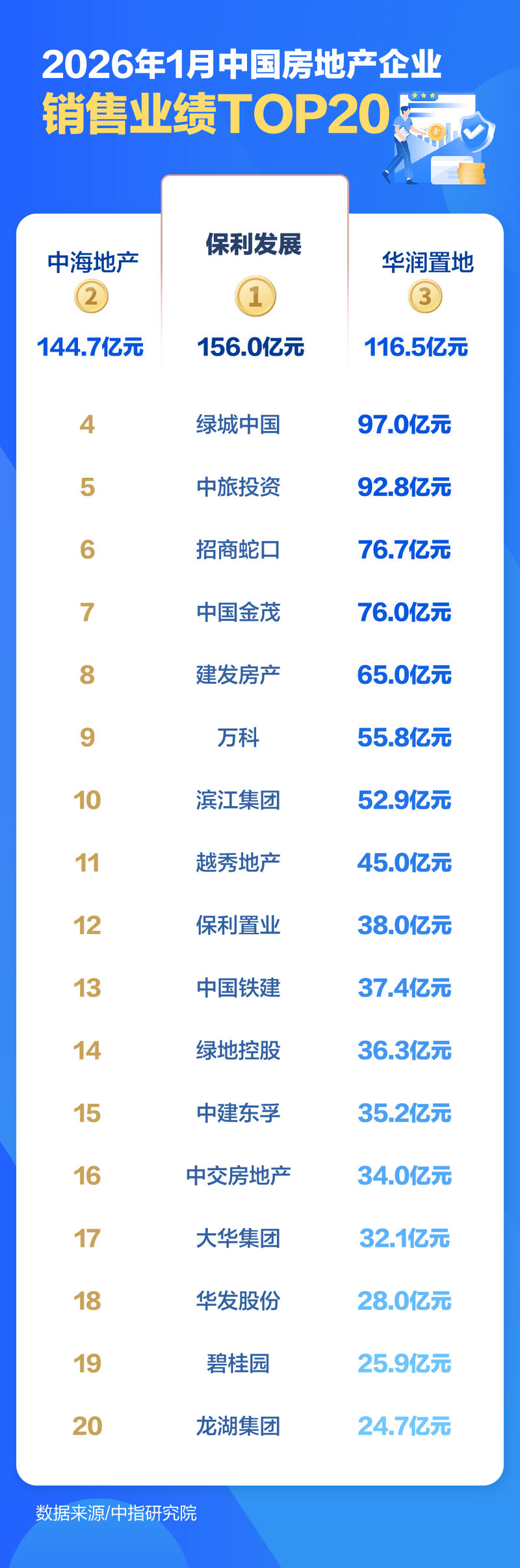
Core Viewpoint - The top 100 real estate companies in China are experiencing a significant reshuffling in their rankings as of January 2026, with a notable decline in overall sales figures compared to the previous year [2][3]. Group 1: Sales Performance - In January 2026, the total sales of the top 100 real estate companies reached 190.52 billion yuan, representing an 18.9% year-on-year decline [2]. - Only three companies achieved sales exceeding 10 billion yuan in January, a decrease of two compared to the same period last year [2]. - The number of companies with sales over 5 billion yuan increased to ten, up by two from the previous year [2]. Group 2: Ranking Changes - The top 10 rankings saw significant changes, with Poly Developments, China Overseas, and China Resources remaining in the top four, while Vanke dropped from fifth to ninth place [3]. - China Travel Investment emerged as a major dark horse, jumping from outside the top 40 to fifth place [3]. - China Jinmao rose from thirteenth to seventh, indicating intensified competition within the top tier [3]. Group 3: Performance of Private Enterprises - Among the 32 companies that experienced year-on-year growth in January, six private enterprises had growth rates exceeding 100% [3]. - Bangtai Group and China Construction Yipin entered the top 20 in sales, benefiting from strategic investments during market lows [3]. Group 4: New Entrants and Market Dynamics - Seven new companies entered the top 100 list in January, with four being small to medium-sized private enterprises [4]. - State-owned enterprises continue to dominate land acquisition, with companies like Yuexiu Property and China Resources maintaining strong investment levels [4]. Group 5: Policy and Market Outlook - The policy environment is shifting towards stabilizing expectations, with measures such as extended tax rebates and loan extensions being implemented [4]. - The market is expected to see a gradual release of demand in March, driven by promotional activities from real estate companies before the Spring Festival [5].




房企开年排位生变:“保中华”格局延续 最大黑马竟是它?
Xin Jing Bao· 2026-02-02 13:33
Core Viewpoint - In January 2026, the sales performance of the top 100 real estate companies in China showed a total sales amount of 190.5 billion yuan, reflecting a year-on-year decline of 18.9%, indicating a stable continuation of the downward trend observed in the previous year [5][10]. Group 1: Sales Performance - The total sales amount for the top 100 real estate companies in January 2026 was 190.5 billion yuan, which is a year-on-year decrease of 18.9%, consistent with the decline observed throughout the previous year [5][10]. - The top three companies in terms of total sales were Poly Developments (15.6 billion yuan), China Overseas Land & Investment (14.47 billion yuan), and China Resources Land (11.65 billion yuan) [5][10]. - The average sales amount for the top 10 companies was 9.33 billion yuan, down 11.6% year-on-year, while the average for companies ranked 11-30 was 2.6 billion yuan, down 25.6% [10]. Group 2: Market Dynamics - The decline in sales is attributed to a high base from January of the previous year, where core city markets were notably active [5][9]. - The new entrant, China Travel Investment, ranked 5th with a sales amount of 9.28 billion yuan, marking a significant rise from previous years [9]. - The sales performance of the top 10 companies remained relatively stable, with three companies showing year-on-year increases, while seven experienced declines [10]. Group 3: Future Outlook - Analysts expect that as the Chinese New Year approaches, real estate companies may increase marketing efforts, which could lead to a temporary boost in market activity [11]. - There is a need for coordinated policy efforts from both demand and supply sides to effectively restore market confidence [11].

重生之我在大A开超市...
Xin Lang Cai Jing· 2026-02-02 12:52
Group 1 - The market witnessed significant volatility in February, with a notable decline in gold and silver prices, attributed to market reactions to potential changes in U.S. Federal Reserve leadership and monetary policy [8][6]. - Gold prices dropped from 5600 to 4682, while silver experienced a nearly 40% intraday pullback, indicating severe market stress and liquidity issues [6][8]. - The decline in gold is not fundamentally driven but rather a result of liquidity squeeze and increased implied volatility, with the market reacting to Trump's nomination of a Fed chair with a history of advocating for interest rate cuts and balance sheet reductions [8][10]. Group 2 - The telecommunications sector is facing increased tax burdens as the VAT rate for telecom services is set to rise from 6% to 9%, which will impact revenue and profit margins for major operators [14][15]. - Major telecom companies, including China Unicom, China Telecom, and China Mobile, experienced significant stock price declines following the announcement, with China Unicom's H-shares dropping over 11% at one point [14][15]. - The adjustment in tax policy may lead to a shift in industry dynamics, potentially reducing inefficient competition and encouraging a focus on technological innovation and high-quality services [14]. Group 3 - The real estate sector is under severe pressure, exemplified by Vanke's projected net loss of 82 billion, marking a 65.7% increase in losses compared to the previous year, which is expected to be the largest annual loss in A-share history [12][13]. - This situation reflects the broader challenges facing the real estate industry, with recovery dependent on both individual company strategies and overall market stabilization [12][13]. Group 4 - The liquor industry, particularly high-end brands like Moutai, is showing signs of recovery with price stabilization and potential for valuation improvement, despite ongoing challenges [17][18]. - The liquor sector is characterized by low expectations, low valuations, and low holdings, with public fund holdings in liquor stocks at a historical low of 3.93% [17][18]. - Analysts suggest that 2026 may present a bottoming opportunity for the industry, with expectations of a recovery phase beginning to emerge [18][19].




2025年报业绩预告开箱(六):百亿巨亏连环爆,AI与创新药继续领跑
市值风云· 2026-02-02 11:59
Performance Highlights - New Yi Sheng (300502.SZ) expects net profit between 9.4 billion and 9.9 billion CNY, a year-on-year increase of 231.24% to 248.86% due to rising demand for high-speed optical modules driven by global computing power investments[4] - Han's Chip (688256.SH) anticipates net profit between 1.85 billion and 2.15 billion CNY, turning from a loss of 450 million CNY last year, benefiting from the growing demand for AI computing power[5] - Zhongji Xuchuang (300308.SZ) projects net profit between 9.8 billion and 11.8 billion CNY, a year-on-year growth of 89.50% to 128.17%, driven by strong customer investment in computing infrastructure[6] - Runze Technology (300442.SZ) expects net profit between 5 billion and 5.3 billion CNY, a year-on-year increase of 179.28% to 196.03%, largely due to non-recurring gains from public REITs issuance[10] Underperformance Highlights - Great Wall Motors (601633.SH) forecasts net profit of 9.912 billion CNY, a year-on-year decline of 21.71% due to increased marketing expenses and competitive pressures[36] - GAC Group (601238.SH) expects a net loss between 8 billion and 9 billion CNY, turning from a profit of 824 million CNY last year, impacted by fierce competition and increased asset impairment provisions[39] - Xiexin Integrated (002506.SZ) anticipates a net loss between 890 million and 1.29 billion CNY, shifting from a profit of 68 million CNY last year due to structural supply-demand issues in the photovoltaic industry[41] - Baile Tianheng (688506.SH) projects a net loss of around 1.1 billion CNY, down from a profit of 3.708 billion CNY last year, primarily due to increased R&D expenses[42] Industry Trends - Technology-driven sectors like AI and innovative pharmaceuticals are leading growth, with companies like New Yi Sheng and Han's Chip benefiting from strong demand and technological advancements[69] - Cost control is becoming a critical competitive advantage, particularly in the energy and manufacturing sectors, as seen with companies like Datang Power (601991.SH) benefiting from lower coal prices[70] - Traditional cyclical industries such as real estate and agriculture are facing significant downward pressure, with companies like Vanke (000002.SZ) and Tianbang Foods (002124.SZ) experiencing substantial losses due to market adjustments[72]





2025年报业绩预告开箱(六):百亿巨亏连环爆,AI与创新药继续领跑
市值风云· 2026-02-02 10:24
Core Viewpoint - The article highlights the performance forecast of various A-share listed companies, indicating a significant divergence in earnings growth across different sectors, driven by technological advancements, cost control, and industry cycles [4][62]. Group 1: Companies with Strong Earnings Growth - **New Yisheng (300502.SZ)**: Expected net profit of 9.4 billion to 9.9 billion, a year-on-year increase of 231.24% to 248.86%, driven by rising demand for high-speed optical modules due to global computing power investments [6]. - **Han's Laser (688256.SH)**: Expected net profit of 1.85 billion to 2.15 billion, turning from a loss of 0.452 billion in the previous year, benefiting from the increasing demand for AI computing power [8]. - **Zhongji Xuchuang (300308.SZ)**: Expected net profit of 9.8 billion to 11.8 billion, a year-on-year increase of 89.50% to 128.17%, supported by strong investment in computing infrastructure [10]. - **Runze Technology (300442.SZ)**: Expected net profit of 5 billion to 5.3 billion, a year-on-year increase of 179.28% to 196.03%, primarily due to non-recurring gains from public REITs issuance [12]. - **CITIC Securities (601995.SH)**: Expected net profit of 8.542 billion to 10.535 billion, a year-on-year increase of 50% to 85%, driven by steady growth in core business segments [15]. Group 2: Companies with Earnings Below Expectations - **Great Wall Motors (601633.SH)**: Expected net profit of 9.912 billion, a year-on-year decrease of 21.71%, impacted by increased marketing expenses and intense competition [34]. - **GAC Group (601238.SH)**: Expected net profit of -8 billion to -9 billion, turning from a profit of 0.824 billion in the previous year, due to fierce competition and adjustments in product structure [36]. - **GCL-Poly Energy (002506.SZ)**: Expected net profit of -0.89 billion to -1.29 billion, turning from a profit of 0.068 billion, affected by structural supply-demand issues in the photovoltaic industry [38]. - **Boli Tianheng (688506.SH)**: Expected net profit of -1.1 billion, turning from a profit of 3.708 billion, due to increased R&D expenses [39]. - **Daiyue City (000031.SZ)**: Expected net profit of -2.7 billion to -2.1 billion, continuing losses from the previous year, influenced by asset impairment provisions [42]. Group 3: Industry Trends - **Technological Breakthroughs**: Industries driven by technology, such as AI and innovative pharmaceuticals, are showing strong growth, with companies like New Yisheng and Rongchang Bio leading the way [62][63]. - **Cost Control**: The energy and manufacturing sectors are experiencing a clear divide, with companies like Datang Power benefiting from lower coal prices and effective cost management [64]. - **Downward Pressure from Industry Cycles**: The real estate, agriculture, and photovoltaic sectors are under significant pressure, with companies like Vanke and Tianbang Food facing substantial earnings declines [65][66].


Asian Shares Follow Wall Street Lower As Risk Aversion Mounts
RTTNews· 2026-02-02 08:46
Market Overview - Asian stocks declined, following Wall Street's downward trend, due to ongoing trade tensions, uncertainty over U.S. monetary policy, and heavy selling in precious metals [1] - Precious metals, including gold and silver, saw significant declines, with gold dropping over 5% and silver nearly 8% [2] - Oil prices fell nearly 5% amid reports of U.S. and Iran readiness to negotiate an agreement to ease tensions [2] Chinese Market - Chinese and Hong Kong markets experienced sharp declines, with China Vanke warning of an 11.8 billion net loss for 2025 and BYD reporting a 30.1% year-on-year drop in vehicle sales for January [3] - The Shanghai Composite index fell 2.48% to 4,015.75, while the Hang Seng index dropped 2.23% to 26,775.57 [3] - Both China Vanke and BYD shares fell more than 4% in Shanghai [3] Economic Data - China's official manufacturing purchasing managers' index (PMI) was reported at 49.3, below forecasts, indicating contraction, while the non-manufacturing PMI also fell into contraction [4] - A private gauge indicated that Chinese manufacturing activity continued to expand in January [4] Japanese Market - The Nikkei average decreased by 1.25% to 52,655.18, reversing early gains, while the broader Topix index settled 0.85% lower at 3,536.13 [5] - Major companies like SoftBank Group, Advantest, Disco Corp, and Lasertec saw declines ranging from 3.8% to 14% [5] - Investors overlooked a private-sector survey indicating Japan's manufacturing activity grew at the fastest pace in about three and a half years [6] South Korean Market - The Kospi average plunged 5.26% to 4,949.67, ending a four-session winning streak, with major companies like Hyundai Motor and Samsung Electronics falling between 4% and 9% [7] - The Korea Exchange issued a sell-side circuit breaker for 5 minutes during the trading session [7] Australian and New Zealand Markets - Australian markets closed lower, with the S&P/ASX 200 falling 1.02% to 8,778.60, driven down by financials and materials amid rate hike concerns [7] - New Zealand's S&P/NZX-50 index finished marginally lower at 13,412.44 [8] U.S. Market Influence - U.S. stocks ended lower, with the dollar index climbing and Treasury yields surging after President Trump nominated Kevin Warsh for Fed Chair, leading to a hawkish shift in U.S. monetary policy [8][9] - Warsh is perceived as skeptical of loose monetary policy and has previously criticized the Fed for underestimating inflation risks [9]


A股上市房企去年预亏超两千亿
第一财经· 2026-02-02 08:23
Core Viewpoint - The overall performance forecast for real estate companies in 2025 indicates significant losses, with over 70% of the 65 A-share listed real estate companies expected to report losses, totaling between -202.6 billion to -235.2 billion yuan [2][6]. Group 1: Performance Forecasts - 65 A-share listed real estate companies have released performance forecasts, with only 16 expected to be profitable, while 49 are projected to incur losses [2][5]. - Vanke A is expected to report the largest loss, with a net profit loss of approximately 82 billion yuan, a significant increase from the previous year's loss of 49.48 billion yuan [2]. - Other companies like China Fortune Land Development, Greenland Holdings, and OCT A are also expected to report substantial losses, with forecasts ranging from -240 billion to -111 billion yuan [3]. Group 2: Reasons for Losses - Common reasons for the losses among these companies include decreased revenue from real estate business, low gross margins, and asset impairment provisions [2][3]. - Specific companies have cited additional factors such as operational losses from non-core business activities and losses from financial investments [2]. Group 3: Comparison of Profitable Companies - Among the few companies expected to be profitable, Jinke Group forecasts a net profit of 30 to 35 billion yuan, largely due to debt restructuring gains [5]. - Poly Developments managed to maintain profitability with a net profit of approximately 1.03 billion yuan, despite a 79.49% year-on-year decrease [5]. - Other companies like China Merchants Shekou are also expected to report significant declines in profits, with estimates ranging from 1.005 billion to 1.254 billion yuan [5]. Group 4: Market Conditions - The overall real estate sector's performance is closely tied to market conditions, with ongoing pressures from declining sales and housing prices [6]. - Recent data indicates a slight recovery in key cities, with a 16% month-on-month increase in second-hand housing transactions, suggesting potential stabilization in the market [6].

A股上市房企去年预亏超两千亿
Di Yi Cai Jing· 2026-02-02 07:48
Core Insights - The overall performance forecast for real estate companies in 2025 indicates significant losses, with 49 out of 65 A-share listed companies expected to report losses, accounting for over 70% of the total [1][4] - Vanke A leads in projected losses, estimating a net profit loss of approximately 82 billion yuan, a substantial increase from the previous year's loss of about 49.48 billion yuan [1] - Other companies such as China Fortune Land Development, Greenland Holdings, and China Overseas Land & Investment also anticipate significant losses, with projections exceeding 10 billion yuan [2] Company Performance - Vanke A's projected net profit loss for 2025 is around 82 billion yuan, with a non-recurring loss of about 80 billion yuan, compared to previous losses of 49.48 billion yuan and 45.39 billion yuan respectively [1] - China Fortune Land Development expects a net profit loss between 24 billion and 16 billion yuan, while Greenland Holdings anticipates a loss between 19 billion and 16 billion yuan [2] - Poly Developments managed to maintain a slight profit, with a net profit of approximately 1.03 billion yuan, although this represents a 79.49% decrease year-on-year [3] Industry Overview - The total projected loss for the 49 companies is estimated to be between 202.6 billion and 235.2 billion yuan, indicating a severe downturn in the real estate sector [4] - The overall net profit for the 65 companies, including those expected to be profitable, is projected to be between -164 billion and -202.2 billion yuan, suggesting that the real estate sector may face losses exceeding 200 billion yuan [4] - The real estate market is still in a "de-inventory" phase, with pressures on sales and prices, although there are signs of stabilization in key cities [5]