ZTE(000063)

Search documents
算力基础设施仍是主赛道,卫星互联网建设正加速 | 投研报告
Zhong Guo Neng Yuan Wang· 2025-09-01 06:48
Core Insights - The communication sector outperformed the market in August, with the Shenwan Communication Index rising by 34.41%, compared to a 10.33% increase in the CSI 300 Index, ranking first among 31 primary industries [2][3] - In the first half of 2025, the communication industry (excluding operators) saw revenue and net profit attributable to shareholders grow by 12.4% and 24% year-on-year, respectively, with significant contributions from the optical communication sector benefiting from AI development [2][3] Industry Performance - The optical devices and modules, optical fiber and cables, and IDC segments showed strong performance, with revenue growth rates of 67%, 21%, and 16% respectively in H1 2025 [2][3] - Notable stock performances in August included Yingweike (up 118.88%), Tianfu Communication (up 95.23%), and Dekeli (up 92.49%) [2][3] AI and Cloud Investment - Major cloud service providers (CSPs) are increasing their AI investments, leading to improved revenue and profit in their core businesses, creating a positive feedback loop [3] - Alibaba's Q2 2025 Capex for AI and cloud reached 38.6 billion yuan, with AI revenue accounting for over 20% of external commercial income [3] Satellite Internet Development - Rapid advancements in satellite internet infrastructure are noted, with China completing five low-orbit satellite launches in just 22 days, and SpaceX's Starlink deploying over 8,000 micro-satellites [4] Investment Recommendations - Focus on optical devices and modules, communication equipment, and liquid cooling technologies as key investment areas [5] - Long-term investment in the three major telecom operators is recommended due to their stable operations and increasing dividend payouts [5] Recommended Stocks - Suggested stocks for September include China Mobile, Zhongji Xuchuang, ZTE, Yingweike, and Guanghetong [6]




8月“跑出”三只翻倍大牛股,9月最新名单来了!
Zhong Guo Ji Jin Bao· 2025-09-01 06:20
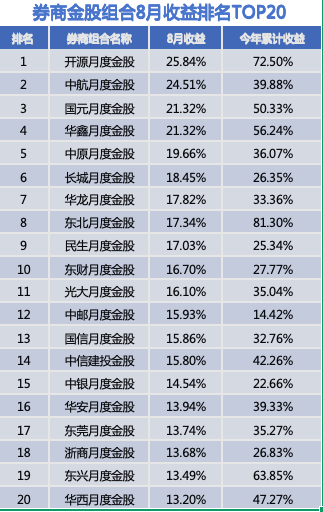
Core Viewpoint - The A-share market showed positive performance in August, with several brokerage firms releasing their "golden stock" recommendations for September, focusing on technology, cyclical sectors, and "anti-involution" manufacturing [1][7]. Group 1: August Performance - The top-performing golden stock combination in August was from Kaiyuan Securities, achieving a monthly return of 25.84%, followed by Zhonghang Securities and Guoyuan Securities with returns exceeding 20% [3][4]. - Three stocks saw their prices more than double in August: Huasheng Tiancai (up 115.11%), Hanwujing-U (up 110.36%), and Sixuan New Materials (up 100.66%) [3][4]. - Northeast Securities, despite ranking eighth in August, had the highest cumulative return of 81.30% for the year, indicating strong long-term performance [3][4]. Group 2: September Recommendations - Multiple brokerage firms suggest that the A-share market is likely to continue its upward trend in September, recommending a focus on technology, cyclical sectors, and "anti-involution" manufacturing [1][7]. - Notable stocks recommended for September include ZTE Corporation, which is expected to benefit from AI development and potential breakthroughs in chip technology, along with Kingsoft Office, New Yisheng, and others [7][8]. - Analysts from Zhongyuan Securities noted that the market's risk appetite is increasing, which may drive growth in TMT (Technology, Media, and Telecommunications) and cyclical sectors [11].


金融工程定期:券商金股解析月报(2025年9月)-20250901
KAIYUAN SECURITIES· 2025-09-01 06:16
Quantitative Models and Construction Methods 1. Model Name: "All Stocks Portfolio" - **Model Construction Idea**: This model aggregates all broker-recommended stocks ("golden stocks") and evaluates their performance as a portfolio[18][21] - **Model Construction Process**: 1. Collect all broker-recommended stocks for the month 2. Weight the stocks within the portfolio based on the number of recommendations by brokers 3. Exclude non-A-share stocks and Hong Kong-listed stocks to focus solely on A-shares[18] - **Model Evaluation**: The model demonstrates strong performance, significantly outperforming benchmark indices such as CSI 300 and CSI 500[18][21] 2. Model Name: "Newly Added Stocks Portfolio" - **Model Construction Idea**: Focuses on stocks newly added to the broker-recommended list, as they tend to exhibit better performance compared to repeated recommendations[18][23] - **Model Construction Process**: 1. Identify stocks newly added to the broker-recommended list for the month 2. Construct a portfolio weighted by the number of broker recommendations 3. Exclude non-A-share stocks and Hong Kong-listed stocks[18] - **Model Evaluation**: Newly added stocks outperform repeated recommendations, showcasing their superior return potential[18][23] 3. Model Name: "Repeated Stocks Portfolio" - **Model Construction Idea**: Focuses on stocks that have been repeatedly recommended by brokers across multiple months[18] - **Model Construction Process**: 1. Identify stocks that were recommended in the previous month and continue to be recommended in the current month 2. Construct a portfolio weighted by the number of broker recommendations 3. Exclude non-A-share stocks and Hong Kong-listed stocks[18] - **Model Evaluation**: While the performance is positive, it is generally weaker compared to newly added stocks[18] 4. Model Name: "Optimized Golden Stocks Portfolio" - **Model Construction Idea**: Selects the top 30 newly added stocks with the highest earnings surprise factor (SUE factor) to construct an optimized portfolio[23] - **Model Construction Process**: 1. Filter newly added stocks based on their earnings surprise factor (SUE factor) 2. Select the top 30 stocks with the highest SUE factor 3. Weight the portfolio based on the number of broker recommendations[23] - **Model Evaluation**: This optimized portfolio demonstrates superior performance compared to the "All Stocks Portfolio" and benchmark indices[23][25] --- Model Backtesting Results 1. All Stocks Portfolio - **August Return**: 13.6%[21] - **2025 YTD Return**: 33.5%[21] - **Annualized Return**: 13.7%[21] - **Annualized Volatility**: 23.6%[21] - **Sharpe Ratio**: 0.58[21] - **Maximum Drawdown**: 42.6%[21] 2. Newly Added Stocks Portfolio - **August Return**: 11.8%[21] - **2025 YTD Return**: 37.9%[21] - **Annualized Return**: 16.5%[21] - **Annualized Volatility**: 24.3%[21] - **Sharpe Ratio**: 0.68[21] - **Maximum Drawdown**: 38.5%[21] 3. Repeated Stocks Portfolio - **August Return**: 15.6%[21] - **2025 YTD Return**: 30.2%[21] - **Annualized Return**: 11.3%[21] - **Annualized Volatility**: 23.7%[21] - **Sharpe Ratio**: 0.48[21] - **Maximum Drawdown**: 45.0%[21] 4. Optimized Golden Stocks Portfolio - **August Return**: 19.6%[25] - **2025 YTD Return**: 37.6%[25] - **Annualized Return**: 22.3%[25] - **Annualized Volatility**: 25.5%[25] - **Sharpe Ratio**: 0.88[25] - **Maximum Drawdown**: 24.6%[25] --- Quantitative Factors and Construction Methods 1. Factor Name: Earnings Surprise Factor (SUE Factor) - **Factor Construction Idea**: Measures the degree to which a company's earnings exceed or fall short of market expectations, serving as a key indicator for stock selection[23] - **Factor Construction Process**: 1. Calculate the earnings surprise for each stock as the difference between reported earnings and consensus estimates 2. Normalize the earnings surprise to account for variations across stocks and industries 3. Rank stocks based on their normalized earnings surprise values[23] - **Factor Evaluation**: The SUE factor demonstrates strong predictive power, particularly in identifying high-performing newly added stocks[23] --- Factor Backtesting Results 1. SUE Factor - **Performance**: The SUE factor is highly effective in selecting top-performing stocks within the newly added category, contributing to the superior returns of the Optimized Golden Stocks Portfolio[23]




深市两融余额创纪录!这些股票,被融资客加仓
Zhong Guo Zheng Quan Bao· 2025-09-01 05:20
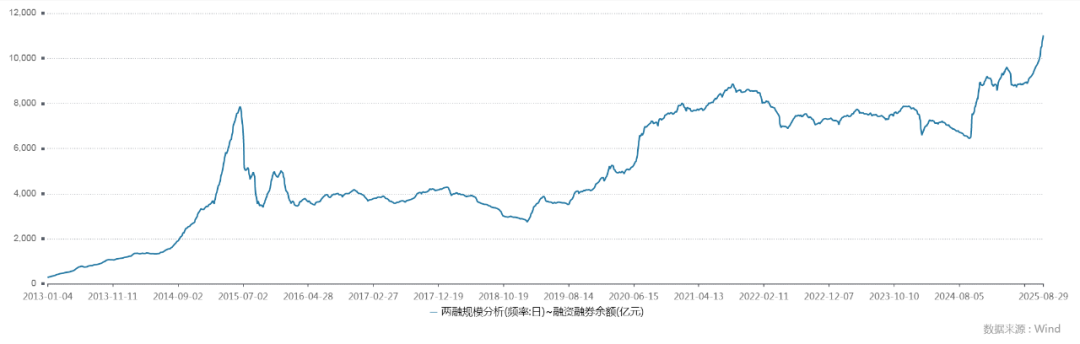
Core Insights - As of August 29, the A-share market's financing balance reached 22,454.72 billion yuan, with a margin trading balance of 158.77 billion yuan, marking an increase of 2,744.45 billion yuan in August [1][2] - The financing balance in the electronics sector increased by over 78 billion yuan, with the highest net buying stock being Cambrian-U and the largest net selling stock being Lu'an Environmental Energy [1][2][10] Financing and Margin Trading Overview - The total margin trading balance in the A-share market reached 22,613.49 billion yuan, with the financing balance at 22,454.72 billion yuan, both hitting over a 10-year high [2][7] - The Shenzhen market's margin trading balance reached a historical high of 11,020.41 billion yuan [2] Trading Activity - In August, there were 21 trading days, with the financing balance increasing on 18 of those days, and 11 days saw increases exceeding 11 billion yuan [5] - From August 13 to August 29, A-shares experienced 13 consecutive trading days where both trading volume and margin trading balance exceeded 20 billion yuan [5][6] Sector Performance - Among the 31 sectors, 30 saw an increase in financing balance, with the electronics, computer, and communication sectors leading in net buying amounts of 784.24 million yuan, 248.12 million yuan, and 235.51 million yuan respectively [7][9] Individual Stock Activity - In August, financing clients increased their positions in 687 stocks by over 100 million yuan, with Cambrian-U leading at a net buying amount of 60.48 billion yuan [10] - The top ten stocks with the highest net buying amounts included Cambrian-U, Shenghong Technology, and SMIC, with net buying amounts of 60.48 billion yuan, 57.48 billion yuan, and 53.19 billion yuan respectively [10] Margin Selling Activity - The margin selling balance in the A-share market was 158.77 billion yuan, with an increase of 20.78 billion yuan in August [11] - The top stocks for margin selling included Kweichow Moutai, New Yisheng, and Shenghong Technology, with margin selling balances of 0.87 billion yuan, 0.84 billion yuan, and 0.83 billion yuan respectively [11]




中兴通讯股价涨5.13%,弘毅远方基金旗下1只基金重仓,持有22.82万股浮盈赚取53.17万元
Xin Lang Cai Jing· 2025-09-01 03:18
弘毅远方国证民企领先100ETF(159973)基金经理为马佳。 截至发稿,马佳累计任职时间2年362天,现任基金资产总规模3.36亿元,任职期间最佳基金回报 19.43%, 任职期间最差基金回报3.98%。 风险提示:市场有风险,投资需谨慎。本文为AI大模型自动发布,任何在本文出现的信息(包括但不 限于个股、评论、预测、图表、指标、理论、任何形式的表述等)均只作为参考,不构成个人投资建 议。 9月1日,中兴通讯涨5.13%,截至发稿,报47.77元/股,成交36.24亿元,换手率1.91%,总市值2285.09 亿元。 资料显示,中兴通讯股份有限公司位于广东省深圳市南山区高新技术产业园科技南路中兴通讯大厦,香 港铜锣湾勿地臣街1号时代广场2座31楼,成立日期1997年11月11日,上市日期1997年11月18日,公司主 营业务涉及投资兴办实业,电子及通信设备零部件的销售。主营业务收入构成为:网络建设52.13%,销 售商品39.02%,提供服务8.76%,租金收入-经营租赁0.09%。 从基金十大重仓股角度 数据显示,弘毅远方基金旗下1只基金重仓中兴通讯。弘毅远方国证民企领先100ETF(159973)二季 ...
东方财富上周获融资资金买入超226亿元丨资金流向周报
2 1 Shi Ji Jing Ji Bao Dao· 2025-09-01 02:53
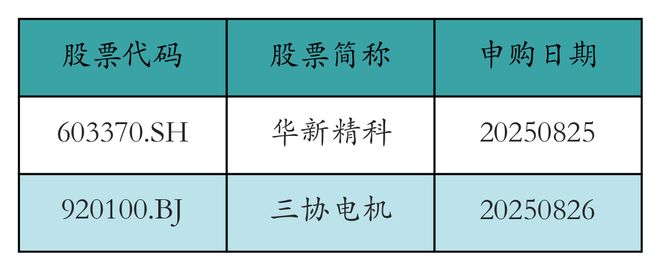
Market Overview - The Shanghai Composite Index rose by 0.84% to close at 3857.93 points, with a peak of 3888.6 points during the week from August 25 to August 29 [1] - The Shenzhen Component Index increased by 4.36% to 12696.15 points, reaching a high of 12791.18 points [1] - The ChiNext Index saw a significant rise of 7.74%, closing at 2890.13 points, with a maximum of 2933.99 points [1] - In contrast, major global indices experienced declines, with the Nasdaq Composite down by 0.19%, the Dow Jones Industrial Average down by 0.19%, and the S&P 500 down by 0.1% [1] - In the Asia-Pacific region, the Hang Seng Index fell by 1.03%, while the Nikkei 225 Index increased by 0.2% [1] New Stock Issuance - Two new stocks were issued last week: Huaxin Jingke (603370.SH) on August 25 and Sanxie Electric (920100.BJ) on August 26 [2] Margin Trading - The total margin trading balance in the Shanghai and Shenzhen markets reached 22539.77 billion yuan, with a financing balance of 22381.01 billion yuan and a securities lending balance of 158.77 billion yuan [3] - This represents an increase of 1062.47 billion yuan compared to the previous week [3] - The Shanghai market's margin trading balance was 11519.36 billion yuan, up by 570.99 billion yuan, while the Shenzhen market's balance was 11020.41 billion yuan, increasing by 491.48 billion yuan [3] - A total of 3445 stocks had margin buying, with 331 stocks having buying amounts exceeding 1 billion yuan, led by Dongfang Caifu, Shenghong Technology, and Hanwujing with buying amounts of 226.77 billion yuan, 197.72 billion yuan, and 175.57 billion yuan respectively [3][4] Fund Issuance - Eleven new funds were launched last week, including Huashang Advantage Industry Mixed C, Jingshun Longcheng Jiyi Yuli Bond F, and Nuoan Preferred Return Mixed C among others [5] Share Buybacks - A total of 23 companies announced share buybacks last week, with the highest amounts executed by Dahua Intelligent (97.33 million yuan), Aofei Entertainment (80.80 million yuan), and Luxi Chemical (37.78 million yuan) [6][7] - The industries with the highest buyback amounts were computer, media, and basic chemicals [7]




“AI驱动”潜力初现 通信行业景气度持续向好
Zheng Quan Ri Bao Wang· 2025-09-01 02:29
Core Viewpoint - The communication industry is experiencing a structural shift from traditional services to emerging businesses, driven by technological innovation and policy support [1][3]. Group 1: Industry Performance - A total of 125 listed companies in the communication sector reported a combined revenue of 13,220.65 billion yuan, representing a year-on-year growth of approximately 3% compared to 12,836.37 billion yuan [2]. - The combined net profit attributable to shareholders reached 1,374 billion yuan, an increase of 7.68% from 1,276 billion yuan in the same period last year [2]. - The industry is showing a structural opportunity, with communication equipment outperforming communication services, and emerging communication businesses surpassing traditional ones [2]. Group 2: Company Highlights - Among the listed companies, 10 had revenues exceeding 10 billion yuan, and 9 had net profits over 1 billion yuan [2]. - The top three companies by revenue and net profit are China Mobile, China Telecom, and China Unicom, while ZTE Corporation ranks fourth in revenue and fifth in net profit [2]. Group 3: Emerging Business Growth - The demand in the communication industry is shifting towards diversified and high-value experiences, with significant growth in IoT, cloud computing, satellite communication, and cybersecurity [3]. - The three major operators are maintaining stable performance, with increased capital expenditure in AI computing, despite overall capital spending being tightened [3]. Group 4: AI Integration - The communication sector is evolving from a "highway" for information transmission to a "smart neural network" supporting AI computing networks [4]. - In the first half of 2025, China Mobile's digital transformation revenue reached 1,569 billion yuan, a year-on-year increase of 6.6%, accounting for 33.6% of its main business revenue [4]. - China Telecom's smart revenue reached 63 billion yuan, growing by 8.4%, while satellite revenue increased by 20.5% and quantum revenue surged by 171.1% [4]. Group 5: Strategic Focus - ZTE Corporation is focusing on AI and ICT integration, with its revenue from AI-related products growing nearly 100% year-on-year, accounting for over 35% of its total revenue [5]. - The satellite internet industry is expected to improve as supportive policies are introduced and advancements in 6G technology continue [5]. - The industry is anticipated to enter a recovery phase in Q3 2025, driven by technological breakthroughs and new infrastructure investments [5].


中金公司 电子掘金
中金· 2025-09-01 02:01
Investment Rating - The report indicates a positive outlook for the domestic AI infrastructure investment market, with a projected investment space of approximately $50 billion and a compound annual growth rate (CAGR) of 50% [1][4]. Core Insights - The report highlights significant growth opportunities for domestic computing power chip manufacturers, driven by the anticipated demand from core internet companies and large model vendors [1][6]. - Alibaba's substantial capital expenditure increase, with a three-year investment target of 380 billion yuan, reflects its commitment to computing power investment, bolstering market confidence in domestic AI chip development [5][6]. - The report anticipates that the demand for domestic computing power in 2026 will be primarily driven by the growth in token consumption by core internet companies and large model vendors, as well as emerging multimodal applications [6][7]. Summary by Sections AI Infrastructure Investment - Nvidia estimates that the AI infrastructure investment space in mainland China is around $50 billion, with a potential chip market of $20 to $30 billion, indicating a robust growth trajectory for domestic chip manufacturers [1][4]. Alibaba's Capital Expenditure - Alibaba's capital expenditure has significantly increased, with a target of 380 billion yuan over three years, showcasing its determination in computing power investment and enhancing market sentiment towards domestic AI chips [5][6]. Future Demand Drivers - The primary drivers for domestic computing power demand in 2026 include significant growth in token consumption by core internet companies and large model vendors, alongside new multimodal applications like video generation and coding tools [6][7]. Edge AI in Consumer Electronics - Edge AI currently has low attention in consumer electronics, but with the explosion of cloud computing power and advancements from major players like Apple and Meta, products such as smartphones and glasses are expected to become important entry points for edge AI hardware [8]. Server Assembly and PCB Sector Changes - Industrial Fulian is benefiting from the growth in AI server volumes and increased profits per cabinet, driven by the release of GB200 and expectations for GB300 [9][10]. - The PCB sector is experiencing a high demand environment, with a focus on the share of different manufacturers in NV and AC customers, as well as the verification rhythm of CP300 [10].



中兴通讯上半年营收稳健增长14.5%,第二曲线业务拓展显效
2 1 Shi Ji Jing Ji Bao Dao· 2025-09-01 01:13
Core Insights - The rapid development of AI large models is creating significant transformation and growth opportunities for computing power industry chain manufacturers [1] - ZTE Corporation reported a revenue of 71.55 billion yuan for the first half of 2025, a year-on-year increase of 14.5%, with a net profit of 5.06 billion yuan [1] - The company is shifting its strategy from "connectivity" to "connectivity + computing power," with the second curve business showing significant growth [1][2] Revenue Breakdown - The revenue composition has shifted, with the operator business now accounting for 49% of total revenue, down from nearly 60%, while the enterprise business has increased to approximately 27% [1] - The second curve revenue, represented by computing power and terminal products, has grown nearly 100% year-on-year, making up over 35% of total revenue [1][3] Business Performance - The enterprise business achieved a remarkable growth rate of 109.9% year-on-year, while the consumer and operator network businesses remained stable [2] - In the domestic market, ZTE has made breakthroughs in key scenarios and provinces, while also expanding its international market presence [3] Computing Power Solutions - ZTE has developed a comprehensive intelligent computing solution covering various fields, including computing power, network, and applications [3] - The company leads in the domestic operator market for general computing servers and has secured significant contracts for data center switches [3] Consumer Business Growth - The consumer business saw a 7.6% year-on-year revenue increase, driven by smartphone and cloud computer sales [4] - The dual-brand strategy of "ZTE + Nubia" has been effective in expanding smartphone market channels in Southeast Asia, Latin America, and Europe [4] Margin Pressure and Strategies - The shift in revenue structure has led to temporary pressure on gross margins due to the competitive environment in computing power products [5] - ZTE plans to enhance gross margins through increased scale, higher self-research ratios, and expanding into solution sales [5] Intelligent Computing Advancements - ZTE is advancing its intelligent computing direction with a full-stack open solution to address key challenges in industrial intelligence transformation [6] - The company has developed a domestic optical interconnect GPU supernode, which won the highest award at the World Artificial Intelligence Conference [6][7] AI Model Development - ZTE has launched its self-developed large model, Nebula Coder-V6, which ranked first in inference benchmarks [8] - The company is focusing on AI home products, aiming to create a closed-loop value system for smart home applications [8] Future Plans - In the second half of the year, ZTE aims to deepen strategic cooperation with leading clients in the internet and finance sectors to enhance market share in computing power products [9] - The company is committed to an open mindset to build competitive advantages in the entire ecosystem [9]
上半年A股上市公司研发投入超8100亿元 半导体等行业研发强度居前
Zheng Quan Ri Bao· 2025-09-01 00:14
Core Insights - The A-share listed companies in China have accelerated their innovation capabilities, with total R&D investment exceeding 810 billion yuan in the first half of 2025 [1] - R&D investment among listed companies increased by 3.27% year-on-year, with an overall R&D intensity of 2.33%, showing a slight improvement [2] - Six companies reported R&D expenditures exceeding 10 billion yuan, indicating a strong commitment to innovation [3] R&D Investment Trends - The R&D intensity of the ChiNext, Sci-Tech Innovation Board, and Beijing Stock Exchange are 4.89%, 11.78%, and 4.63% respectively, highlighting the increasing technological focus [2] - Strategic emerging industries and high-tech manufacturing sectors have R&D intensities that exceed the overall market by 3.29 percentage points and 4.44 percentage points respectively [2] - Software development, biopharmaceuticals, semiconductors, chemical pharmaceuticals, and medical devices are leading sectors in R&D intensity, all exceeding 10% [2] Company-Specific Insights - BYD's R&D investment reached 30.88 billion yuan in the first half of 2025, a 53.05% increase year-on-year, reflecting its commitment to innovation in electric vehicles and batteries [3] - CATL invested 10.095 billion yuan in R&D, a 17.84% increase, and has established multiple R&D centers globally, emphasizing its role in driving industry transformation [3] - Traditional industries are also increasing their R&D investments significantly, with companies like Jiaozuo Wanfang Aluminum reporting a 869.97% increase in R&D spending [4] Future Outlook - The ongoing technological revolution and industrial transformation will intensify competition in fields such as artificial intelligence, new energy, and biomedicine, prompting companies to continue increasing their R&D expenditures [5]