
ZTE(000063)

Search documents
A股 大爆发!新纪录诞生
Zheng Quan Shi Bao· 2025-08-18 05:15
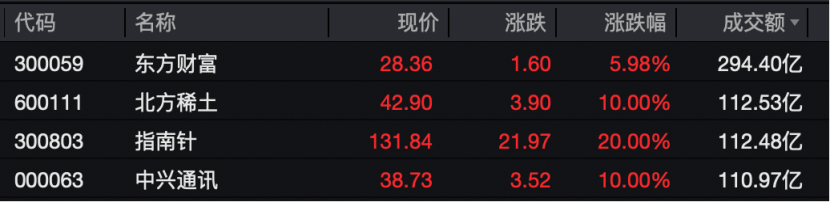
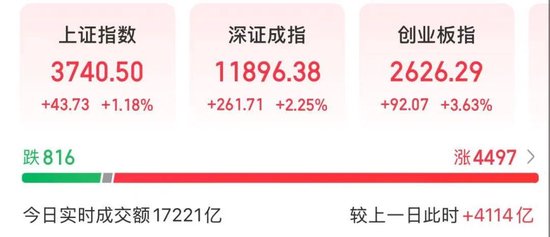
Market Overview - A-shares experienced a significant surge on August 18, with multiple indices reaching new highs, leading to increased market sentiment [1][2] - The total market capitalization of A-shares surpassed 100 trillion yuan for the first time in history, marking a significant milestone [1] Index Performance - The Shanghai Composite Index rose by 1.18%, the Shenzhen Component Index increased by 2.25%, the ChiNext Index surged by 3.63%, and the North Securities 50 Index jumped by 4.59% [2] - Notable milestones included the Shanghai Composite Index breaking the 3731.69 points high from February 18, 2021, and the North Securities 50 Index reaching a historical high above 1500 points [3] Trading Activity - The trading volume exceeded 1.7 trillion yuan within half a trading day, indicating a significant increase compared to the previous trading day [3] - Approximately 4500 stocks were in the green, with over 110 stocks hitting the daily limit up [6] Sector Performance - The TMT sector led the market rally, with software services, media entertainment, communication equipment, and components all seeing gains of over 3% [5] - The securities sector also performed well, with notable stocks like Changcheng Securities and Hualin Securities hitting the daily limit up, and Dongfang Caifu seeing a nearly 6% increase with a trading volume close to 30 billion yuan [5] Notable Stocks - Key stocks that performed exceptionally included: - Dongfang Caifu (300059) with a price of 28.36 yuan, up 5.98%, and a trading volume of 29.44 billion yuan [6] - Beifang Rare Earth (600111) with a price of 42.90 yuan, up 10.00%, and a trading volume of 11.25 billion yuan [6] - Zhina Zhen (300803) with a price of 131.84 yuan, up 20.00%, and a trading volume of 11.25 billion yuan [6] - ZTE Corporation (000063) with a price of 38.73 yuan, up 10.00%, and a trading volume of 11.10 billion yuan [6]



111只股上午收盘涨停(附股)
Zheng Quan Shi Bao Wang· 2025-08-18 04:58
截至上午收盘,上证指数报收3740.50点,上涨1.18%;深证成指收于11896.38点,上涨2.25%;创业板 指上涨3.63%;科创50指数上涨3.11%。 不含当日上市新股,今日可交易A股中,上涨个股有4470只,占比83.07%,下跌个股有814只,平盘个 股97只。其中,收盘股价涨停的有111只,跌停股有2只。 证券时报·数据宝统计显示,涨停个股中,主板有85只,北交所3只,创业板15只,科创板8只。以所属 行业来看,上榜个股居前的行业有机械设备、电子、计算机行业,上榜个股分别有13只、12只、9只。 涨停股中,*ST京蓝、*ST奥维等12只股为ST股。连续涨停天数看,*ST华嵘已连收6个涨停板,连续涨 停板数量最多。从上午收盘涨停板封单量来看,利欧股份最受资金追捧,上午收盘涨停板封单有 16495.68万股,其次是长城证券、雅博股份等,涨停板封单分别有8602.47万股、8362.63万股。以封单 金额计算,长城证券、中兴通讯、北方稀土等涨停板封单资金最多,分别有11.42亿元、11.28亿元、 10.96亿元。(数据宝) 两市涨停股一览 | 代码 | 简称 | 收盘价(元) | 换手率(%) ...

A股,大爆发!新纪录诞生
证券时报· 2025-08-18 04:55
Market Overview - A-share market experienced a significant surge, with multiple indices reaching new highs on August 18 [2][4] - The total market capitalization of A-shares surpassed 100 trillion yuan for the first time in history [2] Index Performance - Major indices showed strong upward movement: - Shanghai Composite Index rose by 1.18% to 3740.50 points, breaking a nearly 10-year high [4][5] - Shenzhen Component Index increased by 2.25% to 11896.38 points, marking a two-year high [4][5] - ChiNext Index surged by 3.63%, surpassing the 2600-point mark [4][5] - North Star 50 Index jumped by 4.59%, reaching a historical high [4][5] Trading Activity - Trading volume in the A-share market exceeded 1.7 trillion yuan, indicating increased market activity compared to the previous trading day [7] - Nearly 4500 stocks were in the green, with over 110 stocks hitting the daily limit up [10] Sector Performance - The market displayed a broad-based rally, with the TMT sector leading gains, particularly in software services, media entertainment, and communication equipment, all rising over 3% [8][9] - The securities sector also saw significant gains, with major firms like Changcheng Securities and Hualin Securities hitting the daily limit up [9] Notable Stocks - Key stocks included: - Dongfang Caifu (东方财富) rose by 5.98% with a trading volume of nearly 300 billion yuan [10] - Beifang Rare Earth (北方稀土) increased by 10% with a trading volume of 112.53 billion yuan [10] - Zhina Zhen (指南针) surged by 20% with a trading volume of 112.48 billion yuan [10] - ZTE Corporation (中兴通讯) rose by 10% with a trading volume of 110.97 billion yuan [10]

OpenAI筹划万亿级AI基建,通信设备ETF(159583)盘中涨幅达5.82%,盘中价格创新高
Mei Ri Jing Ji Xin Wen· 2025-08-18 04:44
Group 1 - The communication sector continues to perform strongly, with communication equipment and electronic components leading the market. The communication equipment ETF (159583) saw an intraday increase of 5.82%, while the AI ETFs also showed significant gains, with the AI ETF (589380) rising by 4.26%. Notably, the prices of these ETFs reached new highs during the trading session [1] - OpenAI's executives announced plans to invest trillions of dollars in AI infrastructure to meet the growing computational demands of AI services. The 2025 China Computing Power Conference is scheduled for August 22-24 in Datong, Shanxi, with Huawei confirmed to participate. This conference is expected to be a key catalyst for policy refinement, technology implementation, and order signing [1] - Continuous development in AI is anticipated to drive demand for high-end optical modules, indicating strong long-term growth potential in the optical module industry [1] Group 2 - The communication equipment ETF (159583) closely tracks the CSI Communication Equipment Theme Index (931271), which selects 50 listed companies involved in communication equipment manufacturing, technology services, and satellite internet construction. The index's components have a high proportion of optical module leaders and computing hardware companies, accurately reflecting the development trends in the optical module and computing industries [1] - The ChiNext AI ETF (159246) tracks the ChiNext AI Index (970070.CNI), which selects 50 companies from the ChiNext market that cover the entire AI industry chain, including hardware, software, and applications, with a focus on communication equipment and optical module leaders [2] - The AI ETF (589380) tracks the Sci-Tech Innovation AI Index, selecting 30 larger market cap companies from the Sci-Tech Innovation Board that provide foundational resources, technology, and application support for AI, covering various innovative applications in high-growth areas like cloud computing and robotics [2]
上证指数, 近十年新高
Zhong Guo Zheng Quan Bao· 2025-08-18 04:30
Market Performance - The Shanghai Composite Index reached a new high of 3741.29 points, the highest since August 2015, with a closing increase of 1.18% at 3740.5 points [1][2] - The Shenzhen Component Index and the ChiNext Index both surpassed their previous highs from October 2024, with increases of 2.25% and 3.63% respectively [2] Market Capitalization and Trading Volume - The total market capitalization of A-shares exceeded 110 trillion yuan, reaching 113 trillion yuan, marking a historical high [2] - The trading volume in the market surpassed 1 trillion yuan, with a morning trading volume of 17.221 billion yuan, an increase of 4.114 billion yuan compared to the previous trading day [2] Sector Performance - The film and cinema sector saw significant gains, with companies like Baidu and Huace Film & TV hitting the daily limit [4][5] - The internet finance sector also experienced strong performance, with stocks like Longcheng Securities and Zhinanceng rising sharply [6][7] - Technology stocks rebounded across the board, particularly in the computing industry chain, with significant gains in liquid cooling server stocks and AI-related sectors [8][9] Investment Trends - There is a notable trend of funds migrating from deposits to the stock market, driven by declining deposit rates and increasing financial investment awareness among the private sector [10] - Analysts suggest that the "rain and dew evenly distributed" approach in the market indicates that sectors like finance and technology will continue to perform well [11]


A股午评:沪指创近10年新高,券商、金融科技股走强
2 1 Shi Ji Jing Ji Bao Dao· 2025-08-18 04:11
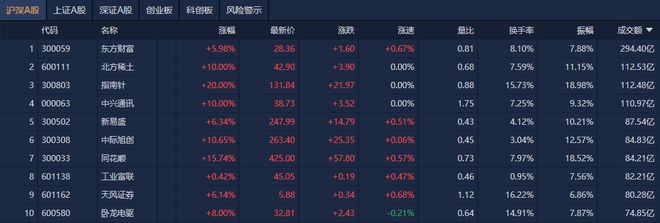
市场早盘高开高走,沪指创近10年新高,北证50指数创历史新高。南财金融终端显示,截至早盘收盘, 沪指涨1.18%,深成指涨2.25%,创业板指涨3.63%。 盘面上热点集中在AI硬件和大金融方向,个股涨多跌少,全市场近4500只个股上涨。 从板块来看,券商、金融科技股维持强势,指南针2连板续创历史新高; 液冷服务器等AI硬件股持续爆发,强瑞技术等多股涨停; 影视股表现活跃,华策影视等涨停。 沪深两市半日成交额1.72万亿元,较上个交易日放量4114亿。 个股方面,东方财富成交额超294亿元居首,北方稀土、指南针成交额靠前。 | 护深A股 | 上证A股 | 深证A股 | 创业板 | 科创板 风险警示 | | | | | | | | | --- | --- | --- | --- | --- | --- | --- | --- | --- | --- | --- | --- | | 代码 | | 名称 | | 深幅 | 最新价 | 深绿 | 淄博 | 盘比 | 换手率 | 張耀 | 成交額 ▼ | | 1 300059 | | 东方财富 | | +5.98% | 28.36 | +1.60 | +0.6796 | ...


又发力了!商业航天、卫星通信持续上涨,卫星ETF(159206)成分股光库科技、中兴通讯领涨
Xin Lang Cai Jing· 2025-08-18 04:05
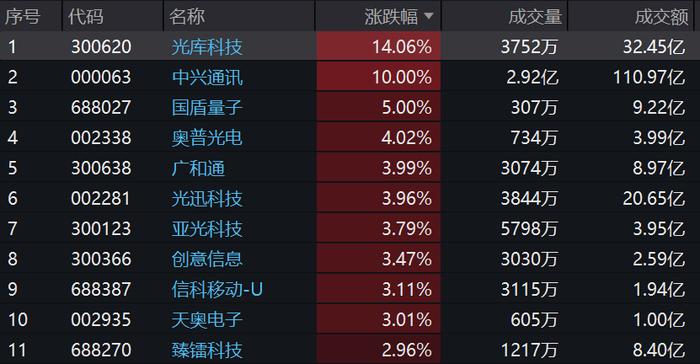
Group 1: Market Performance - Satellite ETF (159206) rose by 1.81% as of noon on August 18, with constituent stocks like Guangku Technology increasing over 14% and ZTE Corporation hitting the daily limit [1] - Guangku Technology reported a revenue of 597 million yuan for the first half of 2025, an increase of 175 million yuan year-on-year, marking a 41.58% growth compared to the same period last year [3] - ZTE Corporation showcased a breakthrough technology at the 2025 World Artificial Intelligence Conference, winning the SAIL award for its distributed OCS all-optical interconnection chip and super-node application innovation scheme [3] Group 2: Industry Developments - The launch of the Long March 6 carrier rocket on August 17 successfully placed the low-orbit satellite internet group into orbit, indicating an accelerated launch rhythm for satellite internet [2] - The commercial space industry in China is still in its infancy, with recent failures being part of the industry's growth process; however, the domestic commercial space sector is expected to mature as technology improves [4] - Satellite communication serves as the foundational technology for 6G communication and supports various sectors such as autonomous driving, low-altitude economy, and the Internet of Things [5] Group 3: Investment Opportunities - Longcheng Securities noted that the satellite internet networking process is accelerating, with major satellite internet projects expected to enter a rapid launch phase by 2025-2026 [4] - The satellite ETF (159206) tracks the National Certificate Commercial Satellite Communication Industry Index, focusing 64% of its weight on satellite manufacturing, indicating a high purity in satellite business [5]

中兴通讯H股上涨9.2%,报29.34港元。
Xin Lang Cai Jing· 2025-08-18 03:41
Core Viewpoint - ZTE Corporation's H-shares increased by 9.2%, reaching HKD 29.34 [1] Company Summary - ZTE Corporation's stock performance indicates a significant rise, reflecting positive market sentiment [1]
港股异动 | 中兴通讯(00763)涨超9% A股早盘涨停 公司近年来大力拓展智算、AI终端等业务
智通财经网· 2025-08-18 03:20
Core Viewpoint - ZTE Corporation (00763) shares rose over 9%, with A-shares hitting the daily limit, driven by increasing demand for AI data centers and related technologies [1] Group 1: Company Performance - ZTE's stock increased by 9.16%, reaching HKD 29.32, with a trading volume of HKD 1.508 billion [1] - The company has been expanding its second curve business, including intelligent computing and AI terminals, with expectations that revenue from this segment will exceed 35% by Q1 2025 [1] Group 2: Industry Trends - The global AI development is accelerating, leading to a surge in demand for AI data center (AIDC) solutions [1] - New generation computing chips have significantly increased power consumption, raising the requirements for data center power systems and liquid cooling technologies [1] Group 3: Product Innovations - ZTE is developing a comprehensive data center solution for intelligent computing scenarios, introducing self-developed products such as immersion cooling, cold plate cooling, external cooling units, and modular air handling units [1] - The company is experiencing strong growth in server and storage revenue, with over 60% of orders coming from intelligent computing servers [1]
主力资金流入前20:中兴通讯流入23.54亿元、利欧股份流入12.85亿元



Jin Rong Jie· 2025-08-18 02:57
Group 1 - The article highlights the top 20 stocks with significant capital inflow as of August 18, with ZTE Corporation leading at 2.354 billion yuan [1] - Other notable stocks include Li Ao Shares with 1.285 billion yuan and Hua Sheng Tian Cheng with 663 million yuan [1] - The list also features companies like BYD with 320 million yuan and Tonghuashun with 309 million yuan, indicating strong investor interest [1]