Midea Group(000333)

Search documents
家电三巨头半年考:格力独木难支,海尔美的多元破局
Bei Jing Shang Bao· 2025-09-01 15:21
Core Viewpoint - The Chinese home appliance industry is transitioning from a phase of rapid scale expansion to a focus on high-quality transformation, emphasizing value upgrades over price wars [3][15]. Industry Overview - The competition logic in the home appliance sector is shifting from scale expansion to value enhancement, with companies needing to find new growth drivers in this new cycle [3][5]. - Traditional categories like televisions and refrigerators are facing short-term adjustments, while emerging categories such as dryers and dishwashers are gaining market share, indicating a shift in industry dynamics [3][4]. Company Performance - Midea reported revenue of 251.12 billion yuan for the first half of 2025, a year-on-year increase of 15.58%, with net profit rising by 25.04% to 26.01 billion yuan, driven by diversified business synergies [4]. - Haier's revenue reached 156.49 billion yuan, up 10.2%, with net profit increasing by 15.6% to 12.03 billion yuan, supported by its high-end market strategy [4]. - Gree's revenue was 97.33 billion yuan, a slight decline of 2.46%, but net profit increased by 1.95% to 14.41 billion yuan, with growth in overseas and industrial products [4][7]. Competitive Landscape - The competition is evolving from merely capturing existing market share to focusing on detailed, scenario-based, and personalized innovations to extract incremental growth from existing markets [5][14]. - The overseas market is becoming a critical battleground for growth, with companies needing to adapt their strategies to local market characteristics [5][10]. Emerging Trends - Gree's reliance on air conditioning remains high, with this segment accounting for 78.38% of its revenue, highlighting the risks of dependence on a single product category [7]. - Midea's diversified business model has shown resilience, with its new energy and industrial technology segments generating significant revenue growth [8][9]. - Haier has successfully positioned itself in the high-end market, with its Casarte brand leading in market share for premium appliances [9]. Global Expansion - Midea's overseas revenue reached 107.2 billion yuan, a 17.7% increase, with a focus on global distribution and local production to reduce costs [12]. - Haier's overseas revenue was 79.08 billion yuan, up 11.66%, with over 50% of its total revenue coming from international markets, showcasing its global strategy [13]. - Gree's overseas revenue was 16.34 billion yuan, a 10.19% increase, but its market share remains significantly lower compared to Midea and Haier [13]. Future Outlook - The smart home market in China is expected to grow steadily, with a projected shipment of 281 million units in 2025, indicating a shift towards refined operations and product upgrades [14]. - The industry is moving towards a "value war," where companies must focus on demand insights and technological advancements rather than just cost control [15].





没有赶上新赛道,很焦虑
集思录· 2025-09-01 13:52
Core Viewpoint - The article discusses the current market dynamics where investors are feeling anxious about their investments in dividend stocks while others are chasing high-growth stocks, often referred to as "妖股" (Yao stocks) [1][2][3]. Group 1: Market Sentiment - Investors holding dividend stocks are experiencing losses, while those pursuing high-growth stocks are seeing better returns [1][3]. - Fund managers are shifting their focus from dividend stocks to high-growth stocks, leading to a disparity in net asset values [2][3][4]. Group 2: Investment Strategies - The article emphasizes the importance of patience and the ability to withstand market fluctuations for sustained profitability [6][7]. - It suggests that if investors believe in the long-term potential of certain companies, they should consider buying in, despite the lack of margin for error [8]. Group 3: Personal Experiences - Some investors share their personal gains, highlighting significant returns compared to others who are struggling [5]. - A specific investor mentions reallocating funds from dividend stocks to sectors like chips, indicating a tactical shift in investment strategy [12]. Group 4: Market Cycles - The article notes that in bear markets, investors may hold onto stable stocks, while in bull markets, they may quickly switch to high-growth stocks, reflecting the cyclical nature of investing [13].

美的集团(000333):2025年中报点评:业绩稳步增长
Dongguan Securities· 2025-09-01 13:11
Investment Rating - The investment rating for the company is "Accumulate (Maintain)" [2][6]. Core Views - The company reported a total revenue of 252.33 billion yuan for the first half of 2025, representing a year-on-year growth of 15.68%. The net profit attributable to shareholders reached 26.01 billion yuan, up 25.04% year-on-year, and the net profit after deducting non-recurring items was 26.24 billion yuan, reflecting a growth of 30% [3][6]. - The company's performance aligns with expectations, driven by a focus on core businesses and products, and a strategic approach of "promoting growth through simplification and self-disruption" [6]. Summary by Sections Financial Performance - In the first half of 2025, the smart home business generated revenue of 167.20 billion yuan, a year-on-year increase of 13.31%. The new energy and industrial technology, smart building technology, and robotics and automation systems businesses achieved revenues of 21.96 billion yuan, 19.51 billion yuan, and 15.07 billion yuan, with respective growth rates of 28.61%, 24.18%, and 8.33% [6]. - Domestic and international revenues were 143.93 billion yuan and 107.19 billion yuan, showing year-on-year growth of 14.05% and 17.7% respectively [6]. Profitability Metrics - The gross margin decreased by 1.47 percentage points to 25.62%, primarily due to rising cost rates. However, the net profit margin improved by 0.88 percentage points to 10.61%, benefiting from a reduction in expense ratios [6]. - The return on equity (ROE) for the trailing twelve months (TTM) stands at 20.24% [6]. Future Outlook - The company is focusing on humanoid robotics technology, establishing an innovation center to enhance research and development in core components, appliance robotics, and complete robot systems [6]. - The company aims to maintain its leadership in the home appliance sector by advancing its four strategic pillars: technology leadership, direct user engagement, digital intelligence, and global expansion [6]. - Earnings per share (EPS) are projected to be 5.64 yuan and 6.17 yuan for 2025 and 2026, respectively, with corresponding price-to-earnings (PE) ratios of 13 times and 12 times [6][7].
A股上市粤企半年报传递哪些经济信号?丨年报透视镜
Sou Hu Cai Jing· 2025-09-01 12:45
Core Insights - The report indicates that the overall performance of listed companies in China shows a slight growth in revenue and profit for the first half of 2025, with total revenue reaching 35.01 trillion yuan, a year-on-year increase of 0.16%, and net profit at 3.00 trillion yuan, up 2.54% [1][3] Group 1: Overall Market Performance - Nearly 60% of companies reported revenue growth, and over 75% achieved profitability, with 2,475 companies showing positive net profit growth [3] - Excluding the financial sector, the revenue of real economy companies remained stable at 30.42 trillion yuan, with a net profit increase of 0.94% to 1.59 trillion yuan [3] - The growth rates for companies listed on the ChiNext, STAR Market, and Beijing Stock Exchange were notably higher, with revenue growth of 9.03%, 4.90%, and 6.08% respectively [3] Group 2: Sector Performance - Among 19 industry categories, 17 reported profitability, with 7 industries showing revenue growth and 10 industries experiencing net profit growth [4] - The manufacturing sector showed signs of recovery, with revenue and net profit growth rates of 4.73% and 7.75% respectively [5] Group 3: Guangdong Province Performance - Guangdong's listed companies achieved a total revenue of 5.25 trillion yuan, a 6.05% increase year-on-year, ranking second nationally [7] - Approximately 74.83% of Guangdong's listed companies were profitable, with over half (54.10%) reporting year-on-year net profit growth [7] - Major companies in Guangdong, such as Ping An and BYD, reported significant revenue figures, with BYD's revenue growing by 23.29% [7][8] Group 4: R&D Investment - Guangdong's listed companies invested a total of 1601.99 billion yuan in R&D, accounting for 19.75% of the total R&D investment in A-share companies [10] - The average R&D intensity for Guangdong companies was 3.64%, surpassing the A-share average of 2.47% [11] - Leading companies like BYD and ZTE demonstrated substantial R&D investments, focusing on key technologies such as electric vehicles and 5G communications [10][11]




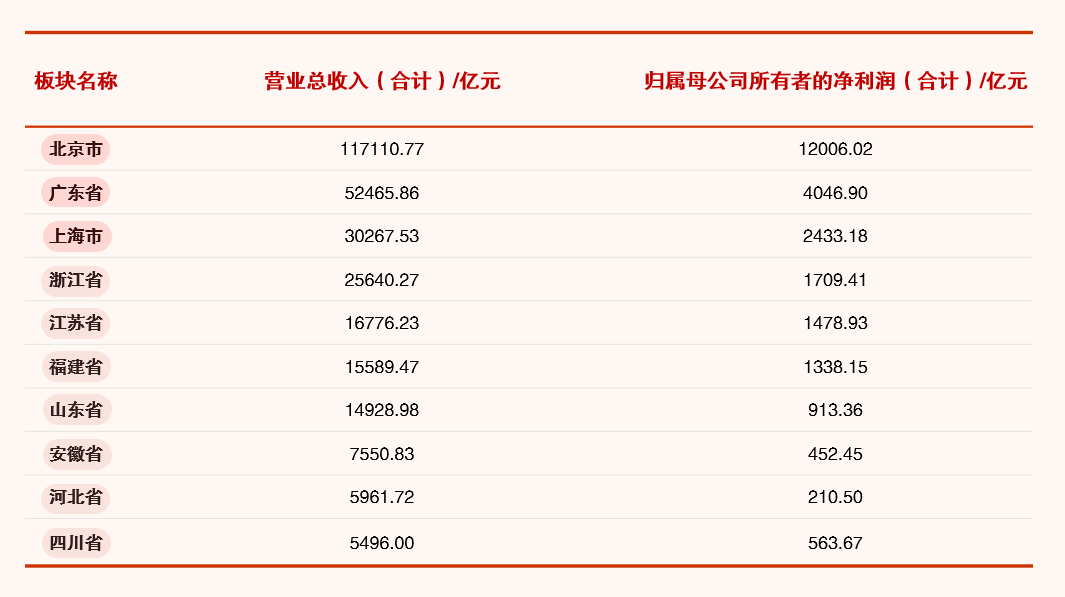
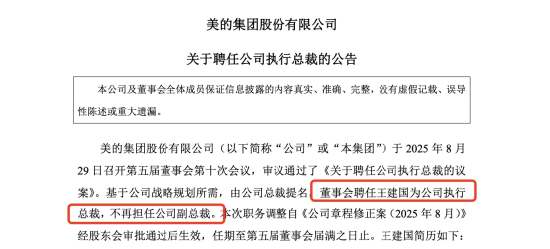
年薪1161万!美的王建国任执行总裁,首破“董事长统管”架构继任机制引关注,8年报酬5000万未持有公司股票
Xin Lang Zheng Quan· 2025-09-01 11:42
Core Viewpoint - Midea Group has appointed Wang Jianguo as the "Executive President," marking a significant shift in its governance structure and signaling a potential evolution in succession planning and organizational dynamics [1][3]. Governance Structure - The appointment of an "Executive President" is a notable departure from Midea's previous governance model, which emphasized a flat structure with the chairman overseeing operations directly [3][5]. - This change indicates a loosening of the centralized decision-making approach that has characterized Midea's management since 2012, when the current chairman, Fang Hongbo, took office [3][5]. Wang Jianguo's Background - Wang Jianguo has been with Midea since 1999, holding various positions that provide him with comprehensive experience across the company's operations, from human resources to product management [3][4]. - His annual salary for 2024 is reported to be 11.61 million yuan, ranking him fourth among company executives, which reflects his established authority within the organization [4]. Financial Performance - Midea Group reported a total revenue of 252.33 billion yuan for the first half of 2025, representing a year-on-year growth of 15.68%, with net profit increasing by 25.04% to 26.01 billion yuan [4][5]. - The strong financial performance provides a favorable context for the leadership transition, allowing for a smoother adjustment in governance without external pressures [4]. Strategic Implications - The establishment of the "Executive President" role is seen as a strategic move to enhance governance resilience and prepare for long-term leadership succession [5]. - Wang Jianguo's promotion is viewed as a pivotal step as Midea transitions from a traditional appliance manufacturer to a technology-driven enterprise, aligning with the company's broader vision for the future [5].
美的集团(00300.HK)9月1日耗资6000万元回购81.09万股A股
Ge Long Hui· 2025-09-01 11:36
格隆汇9月1日丨美的集团(00300.HK)发布公告,2025年9月1日耗资6000万元人民币回购81.09万股A股。 ...
美的集团(00300)9月1日斥资5999.7万元回购81.09万股A股
智通财经网· 2025-09-01 11:34
智通财经APP讯,美的集团(00300)发布公告,于2025年9月1日斥资5999.7万元回购81.09万股A股。 ...
美的集团9月1日斥资5999.7万元回购81.09万股A股
Zhi Tong Cai Jing· 2025-09-01 11:33
美的集团(000333)(00300)发布公告,于2025年9月1日斥资5999.7万元回购81.09万股A股。 ...
美的集团(000333):25H1财报点评:龙头彰显稳健经营能力
GUOTAI HAITONG SECURITIES· 2025-09-01 11:11
Investment Rating - The investment rating for the company is "Accumulate" with a target price of 87.15 CNY [6]. Core Views - The company demonstrated robust operational capabilities, achieving double-digit growth in both revenue and profit despite intensified industry competition and diminishing effects of national subsidies [3]. - The company reported a revenue of 252.33 billion CNY for the first half of 2025, representing a year-on-year increase of 15.68%, and a net profit attributable to shareholders of 26.01 billion CNY, up 25.04% year-on-year [12]. - The report maintains profit forecasts for 2025-2027, with expected EPS of 5.70, 6.30, and 6.82 CNY respectively, reflecting year-on-year growth of 14%, 11%, and 8% [12]. Financial Summary - Total revenue for 2023 is projected at 373.71 billion CNY, with a growth rate of 8.1%, and net profit attributable to shareholders is expected to be 33.72 billion CNY, growing by 14.1% [5]. - The company’s gross profit margin for Q2 2025 was 26.17%, a slight decrease of 0.4 percentage points year-on-year, while the net profit margin improved by 0.38 percentage points to 11.22% [12]. - The company’s net asset return rate is projected to be 20.7% for 2023, decreasing to 17.8% in 2024, and then gradually increasing to 20.1% by 2027 [5]. Business Performance - In the first half of 2025, the company’s C-end business in smart home products grew by 13% year-on-year, with significant market share recovery in domestic air conditioning, refrigeration, and washing machine sectors [12]. - The B-end business also showed a strong performance with a 21% year-on-year increase, particularly in industrial technology, building intelligence, and robotics sectors [12]. - The company’s sales, management, R&D, and financial expense ratios for Q2 2025 were 9.02%, 3%, 3.57%, and -2.54% respectively, indicating improved efficiency [12].
美的大转型:不只是家电企业的“中国版GE”
远川研究所· 2025-09-01 10:20
Core Viewpoint - Midea has achieved double-digit growth in both revenue and net profit, with profit margins reaching a three-year high, highlighting a significant transformation in its growth strategy towards high-tech industries and diversified operations [2][5]. Group 1: Business Performance - Midea's revenue from its toB segment, which includes industrial technology, smart building technology, and robotics, grew by 20.8% year-on-year, increasing its share in the overall revenue structure [2]. - The company reported a cost savings of 280 million yuan through AIGC in the first half of the year, showcasing the efficiency gains from its technological advancements [11]. Group 2: Technological Advancements - The Jingzhou washing machine factory has been recognized as the world's first intelligent body factory, achieving an average efficiency improvement of over 80% in core production scenarios [9][11]. - Midea's intelligent body factory integrates autonomous decision-making, large model industrial integration, and embodied intelligent robotics, enabling fully automated operations [11]. Group 3: Strategic Diversification - Midea has expanded into high-value sectors such as healthcare and energy, with significant investments and acquisitions, including the control of Resig Medical and becoming the largest shareholder of Wandong Medical [13][14]. - The company has established a complex toB business portfolio that leverages its manufacturing experience in home appliances to enter technology-intensive industries [14][20]. Group 4: Historical Context and Future Outlook - Since 2015, Midea has been pursuing a dual-smart strategy (smart manufacturing + smart home), marking a decade of exploration into high-tech industries [5]. - Midea's transformation mirrors that of General Electric (GE), as it shifts from a traditional home appliance manufacturer to a diversified high-tech company, with its industrial, medical, and energy segments closely resembling GE's post-split structure [24][27].