Midea Group(000333)

Search documents
美的集团(00300)12月1日斥资9999.71万元回购125.48万股A股
智通财经网· 2025-12-01 10:25
智通财经APP讯,美的集团(00300)发布公告,于2025年12月1日,该公司斥资人民币9999.71万元回购 125.48万股A股股份,每股回购价人民币79.2-80.2元。 于同日,该公司根据于第八期股票期权激励计划行使期权而发行29.81万股A股;根据于第九期股票期权 激励计划行使期权而发行11.31万股A股。 ...

美的集团:累计斥资超10亿元回购A股股份
Xin Lang Cai Jing· 2025-12-01 10:22
美的集团公告称,公司有两个A股回购方案。"15 - 30亿A股回购方案"于2025年4月8日经董事会通过, 截至11月30日,累计回购20,564,598股,占总股本0.2675%,支付15.10亿元;"50 - 100亿A股回购方 案"于2025年5月30日经股东大会通过,截至11月30日,累计回购128,452,313股,占总股本1.6708%,支 付94.65亿元。公司将按规定在期限内择机回购并及时披露。 ...
美的集团(00300.HK)12月1日耗资1亿元回购125.5万股A股
Ge Long Hui· 2025-12-01 10:22
格隆汇12月1日丨美的集团(00300.HK)公告,12月1日耗资人民币1亿元回购125.5万股A股,回购价格每 股79.2-80.2元。 ...
美的集团(000333) - 关于以集中竞价交易方式回购A股股份进展情况的公告
2025-12-01 10:17
证券代码:000333 证券简称:美的集团 公告编号:2025-091 美的集团股份有限公司 关于以集中竞价交易方式回购 A 股股份进展情况的公告 本公司及董事会全体成员保证信息披露的内容真实、准确、完整,没有虚假记载、误导 性陈述或重大遗漏。 公司于2025年4月8日召开第五届董事会第七次会议审议通过了《关于以集中 竞价方式回购公司A股股份的方案》,同意公司以集中竞价交易方式回购公司部 分已发行的A股股份,用于实施股权激励计划及/或员工持股计划,回购价格为不 超过人民币100元/股,回购金额为不超过30亿元且不低于15亿元,实施期限为自 董事会审议通过回购股份方案之日起12个月内(以下简称"15-30亿A股回购方 案")。公司于2025年4月9日披露了《关于以集中竞价方式回购公司A股股份方 案的报告书》。 一、公司累计回购A股股份的具体情况 美的集团股份有限公司(以下简称"公司")于2025年3月28日召开第五届 董事会第六次会议、于2025年5月30日召开2024年度股东大会审议通过了《关于 以集中竞价方式回购公司A股股份的方案》,同意公司以集中竞价交易方式回购 公司部分已发行的A股股份,用于依法注销减少 ...
2026年出海展望:扬帆出海,2026关注哪些方向?
Shenwan Hongyuan Securities· 2025-12-01 09:12
Overall Trends - The growth of overseas revenue for A-share listed companies (excluding financials and "three barrels of oil") is expected to continue, with a projected increase of 10.1% in 2024, significantly outpacing the overall revenue growth of -0.8% [2][6] - The contribution of overseas revenue to overall profits is increasing, with the gross profit margin from overseas operations rising from 23.6% in 2021 to 29.5% in 2024, indicating a shift from scale expansion to optimizing profit structures [2][6] Engineering Machinery - Global demand is showing structural differentiation, with high demand for infrastructure and mining in Africa and Latin America, while the demand in Europe and the US remains stable. Companies with competitive products in overseas mining scenarios are recommended [2][17] Power Equipment - Focus on three high-growth segments: offshore wind components benefiting from European recovery, SST solutions for global AI computing upgrades, and energy storage systems addressing North American grid bottlenecks [2][20] Automotive - The automotive industry is shifting from vehicle exports to localized production overseas, with Southeast Asia becoming a key hub. Companies like BYD and Geely are accelerating their global presence through local manufacturing [2][21][22] Home Appliances - Leading companies are leveraging their global brand matrix and localized supply chains to establish strong barriers. In segments like robotic vacuums, domestic brands are competing directly with international brands through continuous innovation [2][23] Light Industry Manufacturing - The industry is transitioning from manufacturing efficiency to localized operations overseas. Leading companies are relocating production to avoid trade risks and are moving from OEM models to higher-margin proprietary brands [2][25] Basic Chemicals - Companies are engaging in both passive and active overseas expansion. Those with overseas production bases can ensure export channels, while active expansion aims to secure resources and broaden customer bases [2][26] Non-ferrous Metals - Domestic leading mining companies have been acquiring and operating key metal resources globally, which will contribute significantly to production and profit during industry upturns [2][29] Building Materials - Rapid urbanization and industrialization in emerging markets like Central Asia and Southeast Asia are creating substantial local demand for building materials, with local supply gaps presenting opportunities for Chinese companies [2][31] Textiles and Apparel - Chinese manufacturers are forming deep supply chain partnerships with global brands, and leading textile companies are expanding overseas to meet local procurement demands [2][33] Pharmaceuticals - The overseas commercialization of innovative drugs is entering a realization phase, with several products gaining approval in the US and significant sales growth reported [2][35] Computers - China's embedded software has a global comparative advantage, and companies successfully entering overseas markets can benefit from higher software pricing and a more favorable position in the global value chain [2][37]





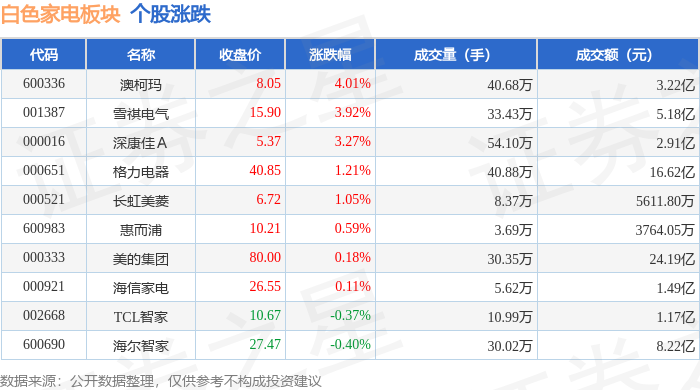
白色家电板块12月1日涨0.36%,澳柯玛领涨,主力资金净流入1.65亿元
Zheng Xing Xing Ye Ri Bao· 2025-12-01 09:03
Group 1 - The white goods sector increased by 0.36% on December 1, with Aucma leading the gains [1] - The Shanghai Composite Index closed at 3914.01, up 0.65%, while the Shenzhen Component Index closed at 13146.72, up 1.25% [1] - Aucma's stock price rose by 4.01% to 8.05, with a trading volume of 406,800 shares and a transaction value of 322 million yuan [1] Group 2 - The white goods sector saw a net inflow of 165 million yuan from main funds, while retail investors contributed a net inflow of 155 million yuan [2] - However, there was a net outflow of 320 million yuan from speculative funds in the sector [2]





第七届金麒麟家用电器行业最佳分析师第一名国联民生证券管泉森最新观点:“新”家电逐步破圈 看三大板块标的
Xin Lang Zheng Quan· 2025-12-01 06:38
Core Viewpoint - The home appliance industry demonstrated resilience during the Double Eleven shopping festival, supported by policy measures and structural benefits, indicating a positive outlook for demand and growth in the sector [1][2][3] Group 1: Market Performance - The home appliance sector achieved resilient growth during Double Eleven, driven by promotional discounts and the recovery of policy funding, which is expected to support demand for essential appliances and structural upgrades [1] - Major brands like Midea and Haier maintained strong performance, with Midea's COLMO product line seeing over 40% growth in bundled sales, and Haier achieving sales exceeding 4 billion yuan [1] - The trend of younger consumers engaging with home appliances is notable, with Midea's growth in this demographic exceeding 50% and Haier's Z generation growth at 38% [1] Group 2: Export Trends - The home appliance export market is showing signs of improvement, with leading companies experiencing a rebound in overseas business despite high baseline pressures [2] - Positive developments in US-China trade negotiations and ongoing global capacity expansion are expected to enhance the ability of leading companies to manage trade risks and improve profit margins in overseas markets [2] Group 3: Investment Outlook - The home appliance industry is rated as "stronger than the market," with limited pressure on domestic sales and a gradual recovery expected in exports [3] - The sector's valuation has returned to historical lows, presenting investment opportunities, particularly in leading companies such as Midea, Haier, Hisense, and Gree, which are noted for their competitive pricing and strong market positions [3] - Emerging categories like robotic vacuum cleaners are anticipated to have significant growth potential, further enhancing the investment appeal of the sector [3]

58同城与美的集团达成战略合作
Zheng Quan Shi Bao Wang· 2025-12-01 02:01
人民财讯12月1日电,近日,58同城与美的集团(000333)达成战略合作,双方将基于共同的市场愿景 与资源优势,围绕业务拓展选址、智慧楼宇智慧商办建设以及生态协同等方向展开深度合作,携手推动 中国智慧商办市场的发展。 ...
帮主郑重:12月A股机会在哪?券商金股扎堆三大方向,中长线这么抓
Sou Hu Cai Jing· 2025-12-01 01:31
Core Viewpoint - The A-share market is currently experiencing fluctuations, with investors uncertain about their positions as December approaches. Analysts are discussing the stocks favored by brokerages for December, highlighting potential investment opportunities and strategies. Group 1: Recommended Stocks - Midea Group stands out as a favored stock, included in the "golden stock" list by four brokerages due to its solid business layout in both high-end home appliances and industrial technology, along with long-term prospects in AI and robotics [3] - Zhongji Xuchuang is also popular, recommended by three brokerages and having risen over 8% in November, indicating early realization of expectations [3] - Jin Feng Technology has shown slight declines in November but remains on brokerages' radar, suggesting underlying support for its selection despite short-term fluctuations [3] Group 2: Industry Directions - Brokerages agree on three main industry focuses: cyclical sectors, consumption, and manufacturing, along with low-crowded technology sectors. They believe that China's assets have independent recovery logic amidst global risks [3] - The end-of-year policy window may validate the "policy bottom," which could positively impact economic growth in 2026, with cyclical sectors likely forming the basis for spring market trends [3] Group 3: Technology Sector Insights - Concerns about debt-driven risks in AI have been noted, with suggestions to focus on less crowded areas such as gaming, media, and computing for better value [4] - The technology sector's crowdedness has improved, making it a favorable time to position in TMT (Technology, Media, and Telecommunications) ahead of market movements [4] Group 4: Defensive Assets - Defensive assets are highlighted as important during market volatility, with high-dividend and consumer sectors expected to perform steadily [4] - In the context of global economic conditions, commodities like gold and copper, as well as manufacturing sectors benefiting from overseas demand, are recommended for early positioning [4] Group 5: Investment Strategy - The market is likely to remain in a consolidation phase in December, but opportunities are emerging. The focus should be on cyclical recovery aligned with policy support, low-crowded technology sectors to mitigate risks, and high-dividend assets for stability [4]



中国消费者(HA):中国仍在消费不足吗
Sou Hu Cai Jing· 2025-12-01 00:46
Core Conclusion - The notion of "insufficient consumption in China" is a distorted perception amplified by pricing and statistical methods. Bank of America provides extensive data showing that the true picture of Chinese consumption is not "volume shrinkage," but rather "high volume, low price." Total commodity consumption has reached or even surpassed that of the US, Japan, and South Korea; service consumption has met basic standards but still has gaps in quality. The main contradiction in the current market is the mismatch between "mass supply" and "upgraded demand." Companies focusing on the four key areas of "Efficiency, Experience, Service, Globalization (E2SG)" will thrive through cycles [1]. Group 1: Commodity Consumption - China's total commodity consumption is impressive, with certain categories outperforming developed countries. For example, per capita egg consumption is 128.5 g/day, which is 6% higher than the US and 42% higher than the global average. Sulfur consumption is 1117.9 g/day, which is 3.2 times that of the US. Seafood consumption is 114 g/day, nearly double that of the US. However, dairy consumption is only 86.9 g/day, which is 1/7 of the US level, but this gap is mitigated by plant proteins and eggs. The ownership of cooking appliances is 2.14 times the global average and 1.22 times that of the US. The number of new energy vehicles is 7.7 per thousand people, surpassing the US by 1.66 times and Japan by 8.75 times [3][4]. Group 2: Service Consumption - In terms of service consumption, China has met basic standards but still has quality gaps. The average housing area per person is 49 m², slightly below the US's 65 m² but higher than the UK and France. Medical visits average 6.8 times per year, exceeding the US by 3.4 times. Education duration is 15.5 years, on par with the US and Japan, but extracurricular spending is only $140/year, which is 1/28 of South Korea's. The prices for leisure and entertainment, such as concerts and exhibitions, have increased by 53%, indicating a significant supply-demand gap in high-quality offerings [5][6]. Group 3: Misconceptions of Consumption - The illusion of "insufficient consumption" stems from three main sources: 1. Low prices: Most goods/services are priced at only 20%-60% of US prices (e.g., mobile plans at 15%, taxis at 20%, utilities at 24%). 2. Supply chain advantages: China's role as the "world's factory" and innovations in distribution (like community group buying) continue to drive prices down. 3. Statistical discrepancies: If government transfer payments are included, the actual consumption to GDP ratio aligns with that of South Korea, which is approximately 40% [6]. Group 4: Mismatches and E2SG Investment Framework - There are three core mismatches in the market: 1. Supply vs. Demand: There is an oversupply of mass-market products, but insufficient emotional value and experience. 2. Channels vs. Communication: Fragmented media and ineffective traditional marketing require precise targeting and content-driven e-commerce. 3. Expectations vs. Reality: While income expectations are weak, there is a high demand for quality, necessitating affordable yet high-quality offerings [7]. Group 5: E2SG Investment Tracks - The E2SG investment framework emphasizes four key dimensions for companies to succeed in a "high volume, low price" market: 1. Efficiency: Achieving low costs and quick turnover through supply chain optimization and scale effects. 2. Experience: Creating differentiation through product innovation and capturing emotional consumption needs. 3. Service: Filling the gap in high-quality supply. 4. Globalization: Leveraging China's high volume and low price advantage to expand into international markets [10][11][12]. Group 6: Recommended Companies - Bank of America has identified seven companies with long-term competitive advantages across various sectors, including: - Pop Mart: Strong IP operation capabilities and global expansion, with an expected EPS growth of 30% by 2026. - Midea: Leading in global white goods with supply chain efficiency, focusing on overseas OBM business growth. - Geely: Rich in new energy vehicle reserves, planning to launch over 10 new models by 2026 with a target growth of 50%-80%. - Huazhu Group: Benefiting from leisure travel demand recovery and expanding through a light asset model, with a projected 21% CAGR in profits from 2024-2026. - Trip.com Group: Leading in OTA with expected 45% growth in international business revenue over the next six years. - Tencent Holdings: Dominating digital entertainment with stable mobile game revenue and AI-driven efficiency improvements. - Damai Entertainment: Leading in live entertainment ticketing with a projected 60% CAGR in profits from 2025-2028 [20][21].