
LZLJ(000568)

Search documents
零售、白酒等大消费板块盘初冲高,东百集团6天4板
Mei Ri Jing Ji Xin Wen· 2025-11-12 01:56
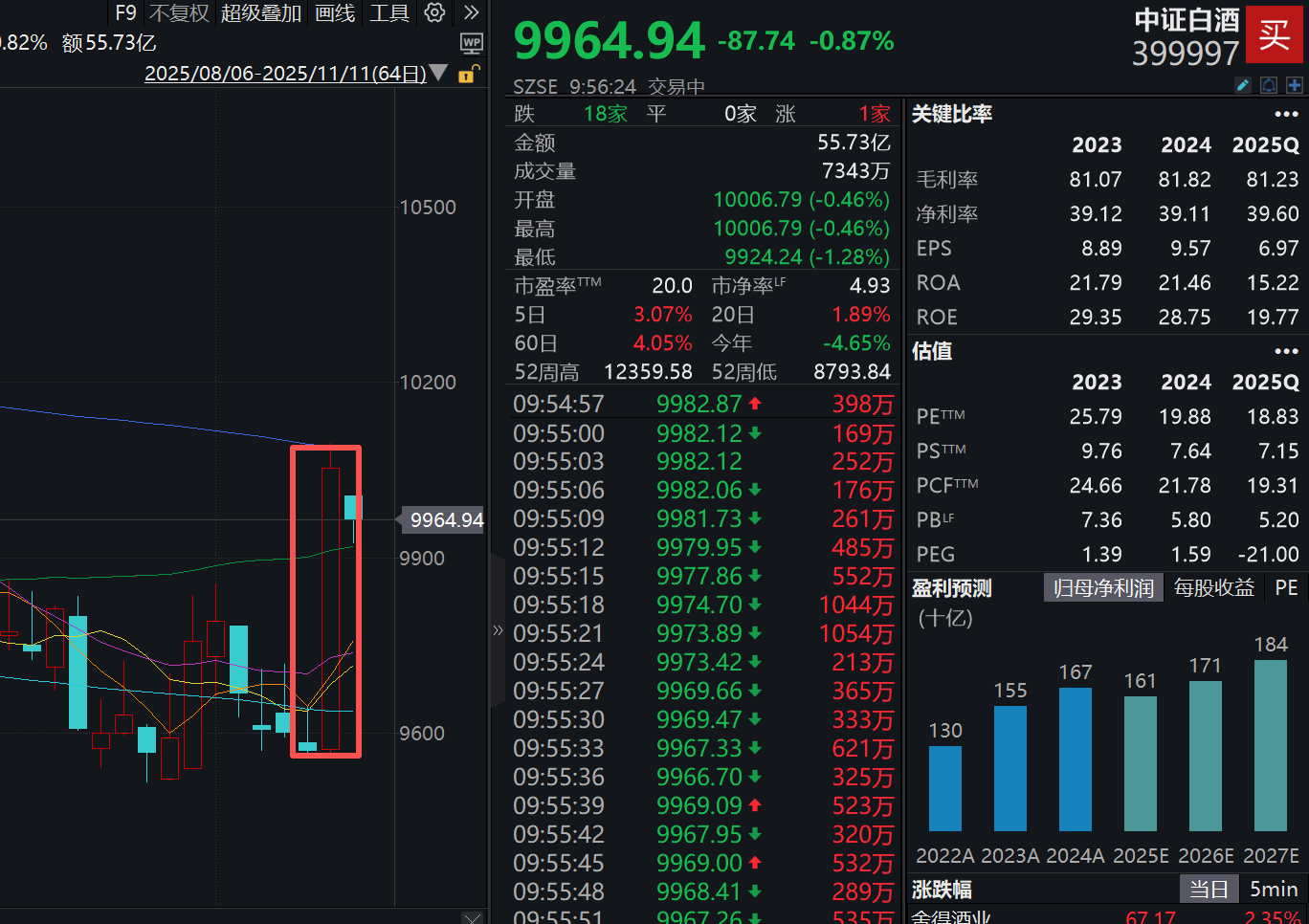
Group 1 - The retail and consumer sectors, including liquor, experienced a surge at the beginning of trading on November 12, with notable increases in stock prices [1] - Dongbai Group achieved its fourth consecutive trading limit increase within six days [1] - Zhejiang Dongri reached its trading limit, while China Duty Free Group, Gujing Gongjiu, and Luzhou Laojiao also saw significant stock price increases [1]





2025年第45周:酒行业周度市场观察
艾瑞咨询· 2025-11-12 00:06
Group 1: Industry Environment - The white liquor industry is experiencing a slowdown in performance and increasing differentiation, with 19 listed companies reporting a 7% year-on-year decline in total revenue by Q3 2025, while only Moutai and Fenjiu maintained growth [2] - The industry is entering a phase of volume competition, with intensified price wars and channel battles increasing cost pressures, particularly for small and medium-sized enterprises [2] - Future competitiveness will favor companies that actively transform and focus on long-term value, as the industry shifts towards rational development [2] Group 2: Consumer Trends - Young consumers are driving a trend towards mixed drinks, such as white liquor with cola, leading to a demand for lower alcohol content products [3] - Companies are responding with innovative products, including cross-industry collaborations like the "yellow wine + beer" from Guyue Longshan and Carlsberg's low-sugar sparkling fruit wine [3] - The industry is debating the definition of low-alcohol liquor, with a push towards maximizing flavor rather than adhering to strict alcohol content classifications [3] Group 3: Regional Enterprises - Regional liquor companies face significant challenges, including high inventory pressure and price inversions, as national brands dominate the market [4] - Strategies for regional companies include becoming provincial leaders, focusing on core markets, or considering exit strategies [4] - Key pathways for success involve brand premiumization, product structure optimization, and deepening distribution channels [4] Group 4: Policy and Development - The Ministry of Industry and Information Technology has included liquor production in the "historical classic industries," promoting cultural heritage and high-quality development [5] - Goals include cultivating over 50 billion-level leading enterprises and creating trillion-level industry clusters by 2028 [5] - The focus is on integrating culture, technology, and ecology to facilitate the transformation and upgrading of the liquor industry [5] Group 5: Brand Dynamics - Yanjing Beer reported a net profit of 1.77 billion yuan for Q3 2025, a 37.45% increase year-on-year, driven by a high-end strategy and cross-industry collaborations [15] - Luzhou Laojiao achieved revenue of 23.127 billion yuan and net profit of 10.762 billion yuan in the first three quarters of 2025, demonstrating resilience amid industry challenges [16] - Wuliangye's revenue reached 60.945 billion yuan with a net profit of 21.511 billion yuan, as the company adjusted its strategy to meet changing consumer demands [18] Group 6: Innovation and Sustainability - The first sustainable development report for the core sauce-flavored liquor production area was released, focusing on ecological protection and circular economy [9] - Moutai introduced a "date selection" service for consumers, enhancing personalization and emotional value in product offerings [23] - Niulanshan Chenxiang achieved significant sales milestones, selling 6 billion bottles over ten years, supported by strong brand recognition and market positioning [24]




食品饮料行业第三季报总结报告:酒类渠道包袱加速去化,大众品类表现分化
Guoxin Securities· 2025-11-11 11:13
Core Insights - The leading companies in the mass-market segment are stabilizing, while the liquor industry is experiencing accelerated pressure release, reinforcing market share logic [4][19][39] - The food and beverage sector is expected to show stable overall growth with structural differentiation by 2025, with Q1/Q2/Q3 revenues growing by +2.5%/+2.4%/-4.77% year-on-year, and net profits declining by +0.3%/-2.1%/-14.6% [4][12] - The liquor sector is entering a phase of adjustment, with a consensus on deceleration in 2024, as many companies are adjusting their strategies amid increasing channel pressures [4][19][39] Liquor Sector - In Q3 2025, the liquor sector's revenue and net profit declines have widened, with total revenue of 3,202 billion yuan, down 5.8% year-on-year, and net profit of 1,126 billion yuan, down 6.9% year-on-year [19][35] - Major liquor companies are experiencing significant revenue drops, with only a few, such as Moutai and Fenjiu, showing positive growth [20][21] - The sector is facing increased competition, leading companies to prioritize market share over profitability, resulting in a decrease in gross profit margins [33][39] Mass-Market Segment - The mass-market segment is benefiting from proactive inventory reduction and macroeconomic policy support, leading to improved operations for leading companies in 2025 [4][12] - Specific categories such as sugar-free tea, functional beverages, and snacks are showing high growth rates, with companies like Nongfu Spring and Dongpeng leading the charge [4][12] - The snack segment reported a revenue increase of 22.4% year-on-year in Q3 2025, despite rising costs in certain product categories [4][12] Investment Recommendations - The report suggests focusing on liquor and restaurant supply chains, particularly companies like Moutai, Luzhou Laojiao, and Fenjiu, which are expected to benefit from policy sensitivity [4][12] - Stronger companies in the mass-market segment, such as Nongfu Spring and Yanjing Beer, are recommended for investment due to their robust performance [4][12] Financial Performance - The liquor sector's cash flow is under pressure, with many companies reporting negative operating cash flows, indicating a slowdown in business activity [40] - The overall net profit margin for the liquor sector has decreased, with only Moutai showing an improvement in gross profit margin due to better product mix [39][40]


食品饮料行业第三季报总结报告:酒类渠道包袱加速去化,大众品品类表现分化
Guoxin Securities· 2025-11-11 09:48
Core Insights - The leading companies in the mass-market segment are stabilizing, while the liquor industry is experiencing accelerated pressure release, reinforcing market share logic [4][10][19] - The food and beverage industry is expected to show stable overall volume with structural differentiation by 2025, with Q1/Q2/Q3 revenues growing by +2.5%/+2.4%/-4.77% year-on-year, and net profits declining by +0.3%/-2.1%/-14.6% [4][12] - The liquor sector is entering an adjustment phase, with a consensus on deceleration in 2024, as most companies face declining performance in Q3 [4][19][39] Liquor Sector - In Q3 2025, the liquor sector's revenue and net profit declines are widening, with total revenue of 3,202 billion yuan, down 5.8% year-on-year, and net profit of 1,126 billion yuan, down 6.9% year-on-year [19][35] - The Q3 revenue for the liquor sector dropped to 787.2 billion yuan, a year-on-year decline of 18.4%, with net profit at 280.1 billion yuan, down 22.2% [19][39] - Major liquor companies are experiencing cash flow pressures, with a significant drop in sales receipts, indicating a slowdown in operational pace [40] Mass-Market Segment - The mass-market segment is benefiting from proactive inventory reduction and macro policy support, leading to improved operations for leading companies in 2025 [4][12] - Specific high-demand categories such as sugar-free tea, functional beverages, and bulk snacks are showing strong growth, with leading companies like Nongfu Spring and Dongpeng Beverage achieving significant revenue increases [4][12] - The snack sector reported a Q3 revenue growth of 22.4% year-on-year, despite rising costs from raw materials [4][12] Investment Recommendations - The report suggests focusing on liquor and restaurant supply chains, particularly companies like Kweichow Moutai, Luzhou Laojiao, and Shanxi Fenjiu, which are expected to benefit from policy sensitivity [4][12] - Stronger companies in the mass-market segment, such as Nongfu Spring and Yanjing Beer, are also recommended for investment due to their robust performance [4][12] Financial Performance - The Q3 2025 financial performance of major liquor companies shows a significant decline in net profit margins, with only Kweichow Moutai recording a slight improvement in net profit margin due to better gross margin management [35][39] - The overall gross margin for the liquor sector has decreased, reflecting intensified competition and a shift in product mix towards lower-priced offerings [31][33]

“老登”板块曙光乍现?!白酒ETF是否布局正当时?
Sou Hu Cai Jing· 2025-11-11 09:28
Core Viewpoint - The white liquor sector is experiencing a resurgence, with the Zhongzheng White Liquor Index showing significant gains, indicating renewed investor interest and confidence in the market [1][3]. Group 1: Market Performance - On November 10, the Zhongzheng White Liquor Index saw all constituent stocks rise, with notable gains from Shede Liquor and Jiugui Liquor, both hitting the daily limit, while leading brands like Luzhou Laojiao and Gujing Gongjiu rose over 5% [1]. - The current price-to-earnings ratio (PE-TTM) for the white liquor sector is approximately 18.7 times, which is at a low level compared to the past five years, indicating a clear valuation advantage [6]. Group 2: Economic Indicators - In October, the Consumer Price Index (CPI) rose by 0.2% month-on-month and year-on-year, while the Producer Price Index (PPI) also saw its first month-on-month increase of the year, suggesting a reduction in deflationary pressures and a mild recovery in consumer demand [3]. Group 3: Investment Opportunities - Analysts believe that the most challenging period for the white liquor industry has passed, with external constraints on consumption expected to ease, making it a favorable time for investment [6][15]. - The white liquor sector is seen as a more stable investment compared to other high-risk stocks, with expectations of steady performance and recovery in stock prices as inventory levels normalize and prices rebound [6][15].
白酒板块11月11日跌0.18%,水井坊领跌,主力资金净流出4.97亿元
Zheng Xing Xing Ye Ri Bao· 2025-11-11 08:37
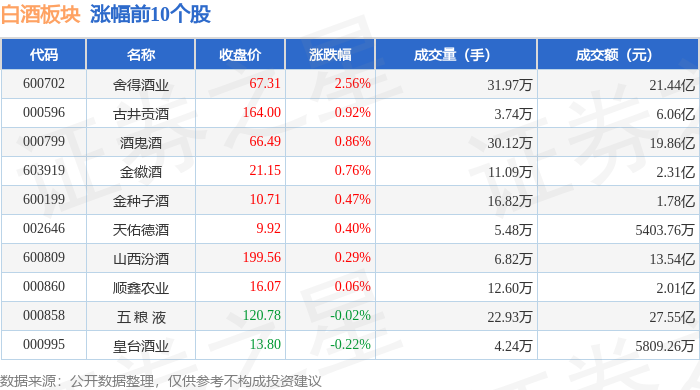
Market Overview - The liquor sector experienced a decline of 0.18% on November 11, with Shui Jing Fang leading the drop [1] - The Shanghai Composite Index closed at 4002.76, down 0.39%, while the Shenzhen Component Index closed at 13289.0, down 1.03% [1] Individual Stock Performance - Shede Liquor (600702) rose by 2.56% to a closing price of 67.31, with a trading volume of 319,700 shares and a transaction value of 2.144 billion [1] - Gujing Gongjiu (000596) increased by 0.92% to 164.00, with a trading volume of 37,400 shares and a transaction value of 606 million [1] - Shui Jing Fang (600779) fell by 1.13% to 42.87, with a trading volume of 48,200 shares and a transaction value of 206 million [2] - Moutai (600519) decreased by 0.23% to 1458.99, with a trading volume of 26,700 shares and a transaction value of 3.883 billion [2] Capital Flow Analysis - The liquor sector saw a net outflow of 497 million from institutional investors, while retail investors contributed a net inflow of 244 million [2] - The main capital inflow and outflow for selected stocks showed varied trends, with Shanxi Fenjiu (600809) experiencing a net inflow of 1.06 billion from main capital [3] - Shede Liquor (600702) had a net inflow of 46.2 million from main capital, while it faced a net outflow of 90.1 million from speculative capital [3]




12只白酒股下跌 贵州茅台1458.99元/股收盘
Bei Jing Shang Bao· 2025-11-11 07:41
Core Viewpoint - The liquor sector showed mixed performance with a slight overall increase, while individual stocks experienced varied movements, indicating a potential recovery in the industry by 2026 according to CICC's forecast [1] Industry Summary - On November 11, the Shanghai Composite Index closed at 4002.76 points, down 0.39%, while the liquor sector index closed at 2359.06 points, up 0.39% [1] - CICC predicts that the liquor industry will see a gradual improvement starting in the first half of next year, with leading companies benefiting the most due to their strong fundamentals and market share logic [1] Company Summary - Kweichow Moutai closed at 1458.99 CNY per share, down 0.23% [1] - Wuliangye closed at 120.78 CNY per share, down 0.02% [1] - Shanxi Fenjiu closed at 199.56 CNY per share, up 0.29% [1] - Luzhou Laojiao closed at 141.64 CNY per share, down 0.60% [1] - Yanghe Brewery closed at 70.80 CNY per share, down 1.05% [1]
白酒股普跌
Ge Long Hui A P P· 2025-11-11 03:49
Core Insights - The article highlights a significant decline in the stock prices of major Chinese liquor companies, with many experiencing drops of over 1% in a single trading session [1] Company Performance - Luzhou Laojiao (泸州老窖) saw a decrease of 1.87%, with a market capitalization of 205.8 billion [2] - Water Margin (水井坊) dropped by 1.45%, with a total market value of 20.8 billion [2] - Yanghe Brewery (洋河股份) fell by 1.24%, holding a market cap of 106.4 billion [2] - Moutai (贵州茅台) experienced a smaller decline of 0.67%, with a substantial market capitalization of 1,818.8 billion [2] - Other notable declines include Wuliangye (五粮液) at -0.54% and Gujing Gongjiu (古井贡酒) at -0.62% [2] Market Trends - The overall trend indicates a bearish sentiment in the liquor sector, with many companies showing negative year-to-date performance, such as Water Margin at -18.34% and Yanghe Brewery at -11.94% [2] - The article suggests that the recent launch of a new pricing reference for liquor may impact market dynamics, as investors seek to understand true market prices [1]


中国白酒追踪 - 品牌对 2026 年春节仍持谨慎展望;聚焦持续严格的发货管控-China Spirits Tracker_ Brands still cautious outlook on 2026CNY; focus on continued stringent shipment control
2025-11-11 02:47
Summary of China Spirits Tracker Conference Call Industry Overview - The spirits industry is currently facing challenges due to weakening demand influenced by anti-extravagance policies and a shift in the Mid-Autumn festival calendar, leading to a tough quarter for many companies in Q3 2025 [1][1][1]. - Companies are adopting a cautious outlook for the upcoming Chinese New Year (CNY) sales and earnings performance, primarily due to a high base effect and lingering policy impacts, resulting in low visibility on demand recovery [1][1][1]. Company-Specific Insights Kweichow Moutai - Moutai is pursuing growth targets mainly through wholesale channels, reporting a 14% year-over-year increase in sales for Q3 2025, despite a 15% decline in direct sales [1][1][1]. - The company is likely to adjust its growth targets for 2026 to be more rational due to pressures on wholesale prices from competitors [1][1][1]. Wuliangye - Wuliangye anticipates back-ended growth in 2026, with the first half of the year facing headwinds from a high comparative base [1][1][1]. - The wholesale price of Common Wuliangye has remained relatively stable, with a slight decrease of RMB 5 to RMB 855 per bottle [2][2][2]. Luzhou Laojiao - Laojiao is also expected to maintain stringent shipment controls, focusing on channel health and pricing strategies into the first half of 2026 [1][1][1]. Feitian Moutai - The wholesale price of Original case Feitian Moutai has decreased by RMB 25 to RMB 1,675, while unpacked Feitian Moutai's price dropped by RMB 40 to RMB 1,640 [2][2][2]. - Various SKUs of Moutai have seen price reductions ranging from RMB 60 to RMB 120 per bottle [2][2][2]. Guojiao 1573 - The wholesale price for Guojiao 1573 has remained stable at RMB 850 per bottle, indicating a lack of significant price movement in the current market [2][2][2]. Market Dynamics - The spirits market is characterized by stringent shipment controls among leading premium brands, with a focus on maintaining channel health and pricing systems [1][1][1]. - The overall sentiment in the spirits industry remains cautious, with companies preparing for potential challenges in the upcoming quarters due to regulatory impacts and market conditions [1][1][1]. Performance Metrics - The stock performance of select spirits companies shows mixed results, with Kweichow Moutai and ZJLD being relatively better performers, while others like Jiangsu Yanghe and Jiugui Liquor have faced significant declines [35][35][35]. Key Risks - Potential risks include regulatory changes, such as consumption tax hikes, and a slower-than-expected macroeconomic recovery, which could impact the spirits market significantly [41][41][41]. This summary encapsulates the key points discussed in the conference call regarding the spirits industry and specific company performances, highlighting the cautious outlook and market dynamics as of Q3 2025.
泸州老窖跌2.02%,成交额2.86亿元,主力资金净流出69.09万元
Xin Lang Cai Jing· 2025-11-11 02:07
Core Viewpoint - Luzhou Laojiao's stock price has shown fluctuations, with a recent decline of 2.02%, while the company has experienced a year-to-date increase of 17.07% in stock price [1] Financial Performance - For the period from January to September 2025, Luzhou Laojiao reported operating revenue of 23.127 billion yuan, a year-on-year decrease of 4.84%, and a net profit attributable to shareholders of 10.762 billion yuan, down 7.17% year-on-year [2] - The company has cumulatively distributed dividends of 52.059 billion yuan since its A-share listing, with 22.926 billion yuan distributed over the past three years [2] Shareholder Structure - As of September 30, 2025, the number of shareholders for Luzhou Laojiao was 161,200, a decrease of 22.54% from the previous period, while the average circulating shares per person increased by 29.13% to 9,114 shares [2] - The top ten circulating shareholders include notable entities such as the China Securities Index White Wine Index A and Hong Kong Central Clearing Limited, with varying changes in their holdings [3]