
LZLJ(000568)

Search documents
白酒深度汇报:当下我们如何看待白酒行业
2025-11-11 01:01
Summary of the Baijiu Industry Conference Call Industry Overview - The Baijiu industry is expected to reach a turning point around the second quarter of 2026, with stock prices typically responding ahead of fundamentals, indicating a current bottoming expectation for the sector, which presents good absolute return potential [1][4] - The industry has undergone six quarters of adjustment, likely to bottom out by the second quarter of 2026, with a subsequent recovery in income and stock prices anticipated [1][13][16] Key Insights and Arguments - The current market structure for Baijiu has significantly changed compared to the 2013-2016 cycle, with increased industry concentration and improved market management capabilities among leading companies [1][3][14] - The wholesale price of Moutai has dropped to 1,650 RMB, which is equivalent to 34 bottles purchasable with the annual income of urban residents, indicating sufficient economic capacity for high-end Baijiu consumption [1][11] - The Baijiu sector is currently under pressure but is expected to enter a phase of recovery as new products and channels contribute to growth, creating a resonance effect between alpha and beta returns [1][5] Future Trends - The Baijiu industry is projected to see a recovery in revenue growth by the second quarter of 2026, with a potential for excess returns compared to the CSI 300 index [13][16] - The rise of sauce-flavored Baijiu and its increasing penetration rate are noted as significant trends, despite recent adjustments in this segment [14][15] Investment Recommendations - Companies are categorized into three main development lines: 1. Those that meet family demand and have competitive advantages in regional markets, such as Jinwei and Gujing [17] 2. Large enterprises with strong brand positions and operational capabilities, like Luzhou Laojiao and Moutai [17] 3. Companies that innovate in products and channels, such as Shede and Li Du, which are exploring new growth points [17] Challenges and Opportunities - Current challenges include inventory buildup and downward pricing pressures across the industry, but a recovery in demand and normalization of inventory levels are expected to lead to a turning point in revenue stabilization [20] - The valuation of Baijiu companies is at historical lows, suggesting significant upside potential once the market recovers, particularly for high-end products that remain in demand [19][21] Conclusion - The Baijiu industry is in a transitional phase, with expectations of recovery and growth in the coming years. The current low valuations present a favorable long-term investment opportunity as the market stabilizes and consumer demand rebounds [19][20]




消费赛道复苏预期升温 多只消费股估值具备优势
Zheng Quan Shi Bao· 2025-11-10 23:10
Core Viewpoint - The consumer sector is experiencing a collective rebound, driven by government policies aimed at boosting consumption and supporting key industries [1][3]. Group 1: Market Performance - As of November 10, 2023, various consumer indices, including food and beverage, beauty care, and retail, have shown less than 10% growth year-to-date, underperforming the Shanghai Composite Index [2]. - The food and beverage sector has been the weakest performer, with its index in a downward trend for the year [2]. Group 2: Institutional Outlook - Institutions are becoming increasingly optimistic about the future performance of the consumer sector, with several brokerages identifying potential investment opportunities [3]. - Open Source Securities notes that the food and beverage sector is nearing a bottom, with recovery expectations rising as negative factors have largely been released and policy impacts are slowing [3]. - Huachuang Securities highlights that service consumption is in a transformative phase, with strong policy support expected to make it a key investment theme [3]. - Galaxy Securities emphasizes the importance of enhancing consumer power and expanding quality consumption supply during the 14th Five-Year Plan period, as new consumption trends emerge [3]. Group 3: Valuation and Stock Performance - Many consumer stocks are currently seen as undervalued, with 123 stocks having a rolling P/E ratio below 30 and underperforming the Shanghai Composite Index year-to-date [4]. - Notable large-cap stocks include Kweichow Moutai, Midea Group, and Wuliangye, among others [4]. - 23 stocks have seen a cumulative decline of over 10% this year, with Ganyuan Food experiencing the largest drop at 33.79% [4]. Group 4: Future Growth Potential - From an institutional perspective, 43 of the 123 identified consumer stocks have an upside potential exceeding 20% based on consensus target prices [5]. - Proya Cosmetics leads with a projected upside of 49.05%, supported by its international expansion plans [5]. - Xueda Education follows with an expected upside of 48.6%, driven by its clear business expansion strategy in personalized education [5][6].



双11前夕白酒股集体“狂欢”!“最惨三季报”后现转机?
Nan Fang Du Shi Bao· 2025-11-10 13:28
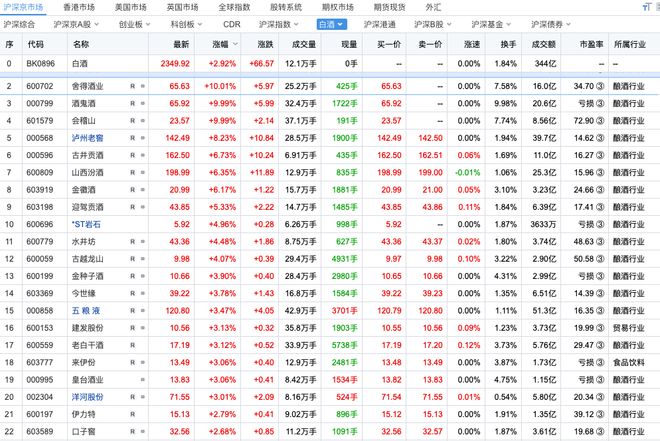
Core Viewpoint - The A-share liquor sector has experienced a significant rebound, driven by favorable policies, expectations of industry recovery, and positive macroeconomic data [1][3][9]. Group 1: Market Performance - As of November 10, the liquor sector index (BK0896) closed at 2349.92, with a rise of 2.92%, and several stocks, including Shede Liquor and Jiu Gui Jiu, reached their daily limit [1]. - Notable stocks such as Luzhou Laojiao and Gujing Gongjiu saw increases exceeding 6% [1]. - The overall market sentiment has improved, with the consumer sector also witnessing a collective rise, indicating a broader recovery trend [7]. Group 2: Policy and Industry Dynamics - A series of supportive policies have been introduced since late September, focusing on expanding domestic demand and promoting consumption, which has attracted capital to the liquor sector [3]. - The Ministry of Industry and Information Technology has included liquor in the "historical classic industries" category, emphasizing its cultural significance and potential for high-quality development [3]. - Recent policies from Guizhou province aim to shift the liquor industry from merely selling products to offering lifestyle services, indicating a strategic transformation in the sector [4]. Group 3: Financial Performance and Valuation - Despite a challenging third quarter for many liquor companies, the overall resilience of the sector has improved compared to previous downturns, with many companies showing better performance metrics [8][9]. - Analysts note that the valuation and sentiment in the sector are at low levels, which has contributed to the recent price increases [5]. - The presence of institutional investors in the market has been significant, with notable purchases in stocks like Jiu Gui Jiu, indicating renewed interest from larger players [5][6]. Group 4: Inventory and Sales Trends - The upcoming "Double 11" shopping festival is expected to help clear some inventory, although it is viewed as a short-term measure rather than a solution to the industry's deeper issues [10]. - Analysts suggest that while there is a limited recovery expected in the fourth quarter, the overall industry remains in a deep adjustment phase, with varying performance among different companies [14]. - The sales performance of premium products like Feitian Moutai has stabilized, contributing positively to market expectations [12][14].


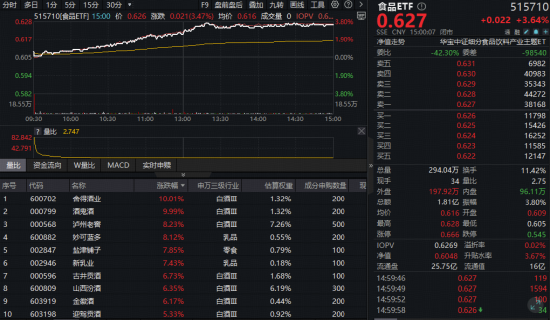
吃喝板块暴力拉升,主力狂买超百亿元!食品ETF(515710)大涨3.64%,估值低位布局正当时?
Xin Lang Ji Jin· 2025-11-10 12:09
Group 1: Market Performance - The food and beverage sector has shown strong performance, leading the market with a 3.64% increase in the food ETF (515710) as of the close on November 10 [1][3] - Major liquor stocks experienced significant gains, with Shede Liquor and Jiu Gui Liquor hitting the daily limit, and Luzhou Laojiao rising by 8.23% [1][3] Group 2: Capital Inflow - The food and beverage sector attracted over 10 billion CNY in net inflows from main funds in a single day, ranking first among 30 sectors [3][4] - The food ETF (515710) has seen a net inflow of over 1.2 billion CNY in the last five trading days and more than 2.4 billion CNY in the last ten trading days [4][5] Group 3: Valuation and Investment Opportunities - The valuation of the food and beverage sector is currently at a historical low, with the food ETF's underlying index PE ratio at 20.59, indicating a good entry point for long-term investments [6][7] - Analysts suggest that the food and beverage industry is gradually bottoming out, with opportunities to invest in liquor stocks at low prices [7][8]
食品饮料周报(25年第41周):如何看待2026年投资机会?-20251110
Guoxin Securities· 2025-11-10 09:40
Investment Rating - The report maintains an "Outperform the Market" rating for the food and beverage sector [4][5][15]. Core Views - The food and beverage sector is expected to perform well in 2026, driven by low valuations, low institutional holdings, and a low base effect. The sector has underperformed the CSI 300 index for three consecutive years, and any changes in supply and demand dynamics could catalyze stock price increases [15][17]. - The report identifies three key judgments for 2026: 1) The sector's dividend attributes are becoming evident, with room for valuation expansion; 2) C-end consumption remains the industry’s foundation, but B-end and business scenarios may recover faster; 3) Health-focused innovative products and digital supply chains will be core growth drivers [15][16]. Summary by Sections 1. Sector Overview - The food and beverage sector saw a slight decline of 0.38% this week, with A-shares down 0.54% and H-shares up 1.88%. The top gainers included Anji Food (+13.87%) and Huifa Food (+13.07%) [1][3]. 2. Sub-sector Analysis - **Alcohol**: The sector is in a left-side layout phase, with recommendations for companies like Luzhou Laojiao and Shanxi Fenjiu, which are expected to benefit from national expansion [2][10]. - **Beverages**: The beverage sector is experiencing continued growth, with strong performance from leading companies like Nongfu Spring and Dongpeng Beverage. The report recommends focusing on dairy products, particularly Yili, due to stable demand recovery [2][14]. - **Food**: The snack segment shows strong growth potential, particularly in konjac snacks, with leading companies like Weidong and Yanjin Puhui demonstrating competitive advantages [2][12]. 3. Investment Recommendations - The report recommends maintaining the investment portfolio, which includes Guizhou Moutai, Baba Food, Dongpeng Beverage, Weidong, and Luzhou Laojiao, as these companies are expected to outperform the market [3][18]. 4. Earnings Forecasts - Guizhou Moutai is projected to have a revenue of CNY 183.52 billion in 2025, with a net profit of CNY 90.59 billion, reflecting a growth of 5.4% year-on-year [19][20]. - Luzhou Laojiao is expected to see revenue growth of 3.1% in 2026, with a net profit forecasted to increase by 4.3% [20]. 5. Market Trends and Catalysts - Recent industry catalysts include the Central Economic Work Conference and various alcohol distributor conferences, which are expected to influence market dynamics positively [3][10].

白酒股一扫颓势,舍得酒业、酒鬼酒等多股涨停
2 1 Shi Ji Jing Ji Bao Dao· 2025-11-10 09:21
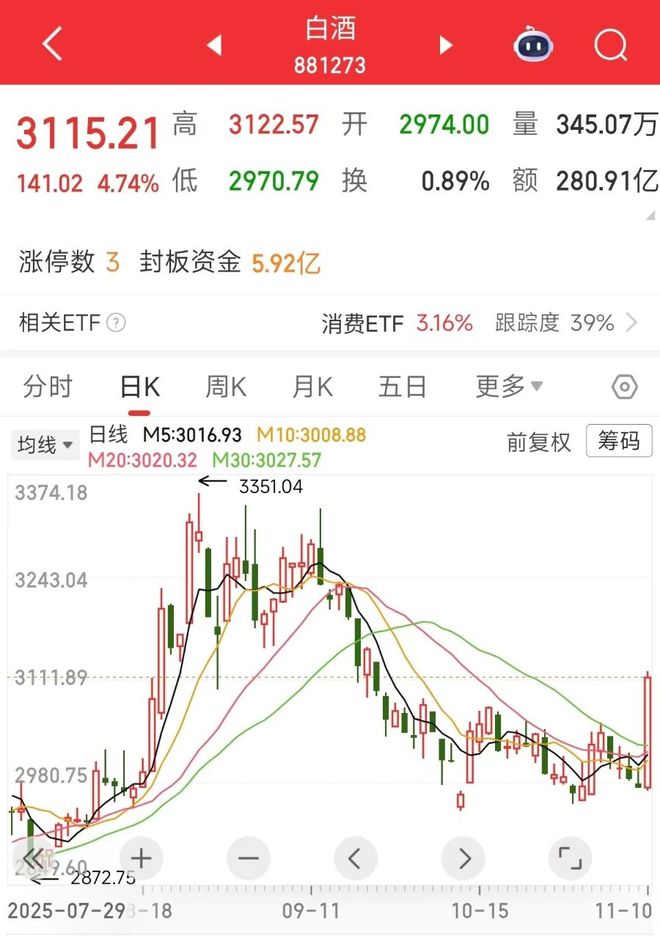
Core Viewpoint - The liquor sector, particularly the baijiu stocks, has shown a significant recovery, with several companies reaching their daily price limits, indicating a positive market sentiment towards this segment [1][3]. Group 1: Market Performance - On November 10, baijiu stocks such as Shede Liquor, Jiu Gui Jiu, and Kweichow Moutai experienced a surge, with the baijiu sector index rising by 4.74% [1]. - The food and beverage sector, which includes baijiu, has been underperforming, down 3.03% year-to-date as of November 10 [3]. Group 2: Economic Indicators - The National Bureau of Statistics reported a 0.2% month-on-month increase in the Consumer Price Index (CPI) for October 2025, while the Producer Price Index (PPI) saw a 0.1% increase, marking the first rise of the year [3]. Group 3: Analyst Insights - Dongxing Securities noted a shift in market style, with funds moving from low-odds to high-odds sectors, suggesting that the food and beverage sector is transitioning from low to high win rates, particularly in the mass consumer goods segment [3]. - The baijiu sector is currently in a bottoming phase, with expectations of improving win rates as the fundamentals enhance, making it a favorable allocation choice [3]. - Open Source Securities highlighted that liquor manufacturers are managing inventory levels to support long-term health, although short-term reports are still in a clearing phase [3].

白酒进入底部战略性布局期:黎明前夕,曙光将至
Shenwan Hongyuan Securities· 2025-11-10 08:43
Investment Rating - The report maintains a "Positive" outlook on the liquor industry, indicating that it is entering a strategic allocation period as it approaches a bottom phase [2]. Core Insights - The liquor sector is expected to experience a fundamental turning point in Q3 2026, with a potential dual impact on valuation and performance by the end of 2026 and into 2027. This is based on historical performance patterns observed from 2012 to 2015, where stock price turning points preceded fundamental turning points [2]. - The report emphasizes the need for patience regarding the fundamental recovery and notes that individual company adjustments will vary, leading to differentiated stock performances during this period. It anticipates that the main contribution to stock price returns will come from valuation adjustments rather than earnings growth in the near term [2]. Summary by Sections Fundamental Analysis - The liquor sector has been experiencing a significant downturn since Q4 2024, with Q3 2025 showing accelerated declines. The industry is projected to face a 20%-30% year-on-year decline in sales volume in Q3 2025, with a 50% drop compared to Q3 2024. High-end liquor prices are also declining as the market seeks a balance between volume and price [4]. - Looking ahead, Q1 2026 is expected to continue facing double-digit sales volume declines, but stabilization is anticipated in Q2 2026, with a potential recovery in demand and pricing by Q3 2026 [4]. Valuation Analysis - As of October 31, 2025, the liquor sector's absolute PE ratio stands at 18.7x, significantly below the historical average of 27.6x since 2011. The relative PE ratio compared to the Shanghai Composite Index is 1.14x, also below the historical average of 2.01x. The report suggests that leading companies are expected to increase their dividend payout ratios, with most currently offering dividend yields above 3%, indicating long-term investment value [4]. Holdings Analysis - In Q3 2025, the liquor sector's holdings accounted for 5.52% of total fund investments, a decrease of 1.26 percentage points from previous quarters, returning to levels seen in Q2 2017. This indicates a significant reduction in fund exposure to the liquor sector compared to historical averages [4].
啤酒概念涨2.48%,主力资金净流入22股
Zheng Quan Shi Bao Wang· 2025-11-10 08:30
Core Insights - The beer sector has seen a rise of 2.48% as of the market close on November 10, ranking it 9th among concept sectors [1] - Within the beer sector, 28 stocks increased in value, with notable gains from Pinwa Food (up 8.84%), Luzhou Laojiao (up 8.23%), and Jinhui Wine (up 6.17%) [1] Market Performance - The top-performing concept sectors today include Dairy (up 4.36%), Cultivated Diamonds (up 3.46%), and Baijiu (up 3.01%) [2] - The beer concept sector recorded a net inflow of 387 million yuan, with 22 stocks experiencing net inflows, and 9 stocks seeing inflows exceeding 10 million yuan [2] - Luzhou Laojiao led the net inflow with 173 million yuan, followed by Qingdao Beer (58.07 million yuan), He Bai Group (28.30 million yuan), and Jinzongzi Wine (27.12 million yuan) [2] Fund Flow Analysis - The stocks with the highest net inflow ratios include Rhine Biology (10.76%), Qingdao Beer (10.60%), and Chongqing Beer (10.28%) [3] - The beer concept fund inflow rankings show Luzhou Laojiao with a daily increase of 8.23% and a turnover rate of 1.94%, while Qingdao Beer increased by 1.89% with a turnover rate of 1.18% [3][4] - Other notable stocks include He Bai Group (up 4.59%), Jinzongzi Wine (up 3.90%), and Pinwa Food (up 8.84%) [4]




食品饮料行业周报:白酒Q3降速释压,关注高股息饮料标的-20251110
Haitong Securities International· 2025-11-10 08:26
Investment Rating - Investment advice favors growth targets in beverages, food ingredients, and snacks, while revising expectations for Chinese baijiu [6][18]. Core Insights - The report highlights a focus on low valuation and high dividend yielding stocks within the soft drink sector, indicating potential for fundamental and valuation recovery as competition eases and consumer power improves [10][18]. - Chinese baijiu sector shows a significant decline in Q3, with revenues down 18% year-on-year and net profits down 22%, indicating a need for destocking and potential for market stabilization [7][18]. - The report emphasizes the importance of innovative supply and channel strategies among liquor companies to seek growth despite demand pressures [8][18]. Summary by Sections Investment Recommendations - Focus on flexible targets in Chinese baijiu such as ZJLD, Shede Spirits, and Luzhou Laojiao, while mid-term stable targets include Wuliangye and Kweichow Moutai [6][18]. - In the beverage sector, key growth targets include Eastroc Beverage and Nongfu Spring, alongside high dividend, low valuation options like Uni-President China and Want Want China Holdings [6][18]. - Snack and food ingredient growth targets include Three Squirrels and Guilin Seamild Foods, while beer targets include Tsingtao Brewery and China Resources Beer Holdings [6][18]. Baijiu Sector Analysis - Q3 reports indicate a significant revenue decline for the baijiu sector, with Moutai emphasizing high-quality growth and announcing a new dividend and buyback plan to boost market confidence [7][8][18]. - The report notes that the industry is still in a destocking phase, with potential for capital markets to bottom out early despite ongoing demand pressures [7][18]. Consumer Goods Sector Insights - The soft drink sector is highlighted for its high return on equity (ROE) and good cash flow characteristics, making it a quality dividend asset [10][18]. - Recent performance of Uni-President China shows a profit of RMB 2.01 billion for Q3, marking a 23.06% year-on-year increase, indicating strong growth potential [11][18].
白酒板块集体狂欢,舍得酒业、酒鬼酒双双涨停
2 1 Shi Ji Jing Ji Bao Dao· 2025-11-10 08:09
Group 1 - The A-share market saw a collective rise in the three major indices, with the Shanghai Composite Index increasing by 0.53%, the Shenzhen Component Index rising by 0.18%, while the ChiNext Index fell by 0.92% [1] - The liquor sector experienced strong gains, with companies like Shede Liquor and Jiu Gui Jiu hitting the daily limit, and Luzhou Laojiao rising over 8%. Other brands such as Shanxi Fenjiu, Gujing Gongjiu, and Jinhu Wine also saw increases [1] - According to the National Bureau of Statistics, the Consumer Price Index (CPI) rose by 0.2% month-on-month and year-on-year in October, with the core CPI (excluding food and energy) increasing by 1.2% year-on-year, marking the sixth consecutive month of growth [1] Group 2 - Open Source Securities indicated that the liquor industry has entered a deep adjustment period, with declining demand being transmitted from the end market through channels to manufacturers, resulting in a slowdown in performance growth for liquor companies [1] - The outlook suggests that liquor manufacturers are still cautious about inventory management to promote channel inventory destocking, laying a foundation for long-term healthy development, although short-term performance remains in a clearing phase [1] - Open Source Securities believes that the current liquor sector is approaching a left-side layout interval, recommending gradual allocation, prioritizing companies with performance clearing or bottom confirmation, and suggesting attention to Guizhou Moutai, Luzhou Laojiao, Shanxi Fenjiu, Shede Liquor, and Yanghe Brewery [1]