
CHANGAN AUTOMOBILE-B(000625)

Search documents
【深度分析】2025年12月份全国新能源市场深度分析报告
乘联分会· 2026-01-30 08:28
Overall Market - The total market for passenger vehicles in 2025 is projected to have a production of 29.67 million units, with a retail sales figure of 23.74 million units, reflecting a year-on-year growth of 3.8% [9][10]. - The market share of new energy vehicles (NEV) is expected to reach 53.9% in 2025, up from 47.6% in 2024, indicating a significant increase in consumer adoption [10][12]. Submarket Analysis - The breakdown of the total market shows that NEVs will account for 12.81 million units in retail sales, representing a 17.6% increase compared to 2024 [10][12]. - The retail sales of fuel vehicles are projected to decline by 14.0% year-on-year, highlighting a shift in consumer preference towards NEVs [9][10]. Export Market - The export of NEVs is expected to grow significantly, with a total of 5.74 million units exported in 2025, marking a 19.7% increase from the previous year [16][17]. - The penetration rate of NEVs in the export market is projected to reach 42.2% in 2025, up from 27.1% in 2024, indicating a strong demand for Chinese NEVs abroad [20][22]. Manufacturer Performance - BYD is leading the NEV market with a wholesale volume of 414,784 units, although this represents a decline of 18.6% year-on-year [25]. - Tesla China ranks third in wholesale sales with 97,171 units, showing a modest growth of 3.6% [25]. - The top ten manufacturers collectively account for 71.5% of the NEV market share, indicating a high concentration in the industry [25][26]. Vehicle Type Segmentation - In 2025, the retail sales of sedans, MPVs, and SUVs are projected to be 12.26 million, 1.30 million, and 10.18 million units respectively, with NEVs showing a positive growth trend across all categories [30][31]. - The retail sales of fuel vehicles in the sedan category are expected to decline by 30.3%, while NEVs in the same category are projected to grow by 2.6% [30][31].






乘用车1月月报:内需静待改善,出口韧性较强
Soochow Securities· 2026-01-30 08:24
Investment Rating - The report maintains a positive outlook on the passenger car sector, particularly in the context of the new vehicle replacement policy and the resilience of exports [2][3]. Core Insights - The passenger car industry experienced a significant decline in retail sales in December 2025, with a year-on-year drop of 16% and a total retail volume of 227,000 units. The wholesale volume was 279,000 units, reflecting a decrease of 9.7% year-on-year [7][10]. - The penetration rate of new energy vehicles (NEVs) reached 58.7% in December 2025, showing a year-on-year increase of 10.9% [10][12]. - The report highlights the stability of the NEV market, with BYD holding a market share of 25% and Geely at 11% in December 2025 [16]. Electric Vehicle Data Tracking - The report indicates that the old-for-new vehicle replacement policy was implemented in January 2026, which is expected to stimulate demand in the passenger car market [2][3]. - In December 2025, the NEV wholesale volume was 156,300 units, with a year-on-year increase of 3.4% [12]. - The report notes a significant inventory reduction in the passenger car sector, with a total decrease of 69,000 units in December 2025, including 43,000 units of NEVs [13]. Globalization Data Tracking - The report tracks the performance of Chinese car manufacturers in international markets, noting that in December 2025, 641,000 passenger cars were exported, with 245,000 being NEVs, resulting in a penetration rate of 38.2% for NEVs [3][43]. - The report highlights the strong performance of BYD in exports, particularly in Southeast Asia, where the NEV penetration rate exceeded expectations [3][27]. - The market share of Chinese brands in various regions, including Southeast Asia and Europe, showed positive trends, with notable increases in the UK market [38][40].



深蓝汽车余龙:L3级普及到消费端,需跨过成本与保险两道关
Xin Jing Bao· 2026-01-30 08:17
Core Insights - The transition from L2 to L3 autonomous driving represents a shift from driver assistance to conditional automation, indicating a change in responsibility from the driver to manufacturers and system suppliers [2][4] - The Ministry of Industry and Information Technology announced that Changan Automobile's Deep Blue brand and BAIC's Arcfox received the first licenses for L3 conditional autonomous driving vehicles in China, marking a new phase from technology validation to mass production [2] Group 1 - The key points for the transition from L2 to L3 include system reliability, functional safety, human-machine takeover boundaries, and refined operational design domain management [2] - The establishment of AI decision-making models needs further breakthroughs in terms of reliability and interpretability [2] - L3 vehicles may not have a single entity responsible for safety; it requires a combination of technical reliability, regulatory standards, and insurance resources to mitigate risks [2][3] Group 2 - L2 and L3 vehicle insurance will differ significantly, with L2 insurance primarily protecting the owner's rights, while L3 insurance may innovate to cover system suppliers and manufacturers [3] - Challenges for promoting L3-specific insurance include pricing, data barriers among manufacturers, and the profitability potential for insurance companies [3] - L3 vehicles are expected to rapidly advance in the To B operational sector by Q1 2026, with L2 systems penetrating approximately 150,000 models [4] Group 3 - The introduction of L3 vehicles is anticipated to positively impact China's intelligent connected vehicle industry by enhancing industry standards and accelerating development through improved user experience [4] - Four areas are identified for collaborative efforts to ensure the healthy development of autonomous driving: policy collaboration, standardization, industry chain collaboration, and consumer education [4]
远程超6万辆夺冠!大通前四 福田/江铃暴涨!2025新能源轻客销量榜单来了 | 头条
第一商用车网· 2026-01-30 06:57
Group 1 - The core viewpoint of the article highlights the mixed performance of the new energy light commercial vehicle (NE LCV) market in 2025, with a total sales volume of 302,000 units, representing a year-on-year growth of 23% and a net increase of 57,000 units compared to the previous year [1][23]. - In December 2025, the NE LCV market achieved sales of 39,300 units, marking a month-on-month increase of 37% and a year-on-year increase of 69%, contributing to an "8 consecutive months of growth" trend [2][5]. - The NE LCV market maintained a high penetration rate, exceeding 70% in the last four months of 2025, indicating strong adoption within the commercial vehicle sector [1][7]. Group 2 - The monthly sales data from March to December 2024 shows that NE LCV sales consistently exceeded 20,000 units, with a peak of nearly 40,000 units in December 2025 [4][29]. - In December 2025, NE LCVs accounted for 75.86% of the total light commercial vehicle market, the highest penetration rate recorded to date [7][10]. - The cumulative sales of NE LCVs in 2025 reached 302,000 units, surpassing the total sales of 244,700 units in 2024, with a growth rate of 23% [23][24]. Group 3 - By the end of 2025, all 31 provincial-level administrative regions in mainland China had registered NE LCVs, with Guangdong province leading with over 56,500 units [10][12]. - Most provinces experienced growth in NE LCV registrations compared to the previous year, with notable increases in Chongqing and Yunnan, where registrations doubled [12][15]. - The NE LCV market predominantly features pure electric models, which constituted 99.934% of the market in 2025, with minimal presence of hybrid and fuel cell vehicles [15][19]. Group 4 - In December 2025, 16 companies sold more than 300 units of NE LCVs, with 9 companies exceeding 1,000 units, indicating a competitive market landscape [17][19]. - The leading companies in December included Yuan Cheng, Chang'an, and Great Wall, with significant year-on-year growth rates, particularly for Yuan Cheng at 142% and Great Wall at 242% [19][21]. - The market share distribution in December showed that three companies held over 10% market share, with Yuan Cheng leading at 25.5% [21][27].



AI巨头抢完了车规级内存,你的车可能因此减配
3 6 Ke· 2026-01-30 00:31
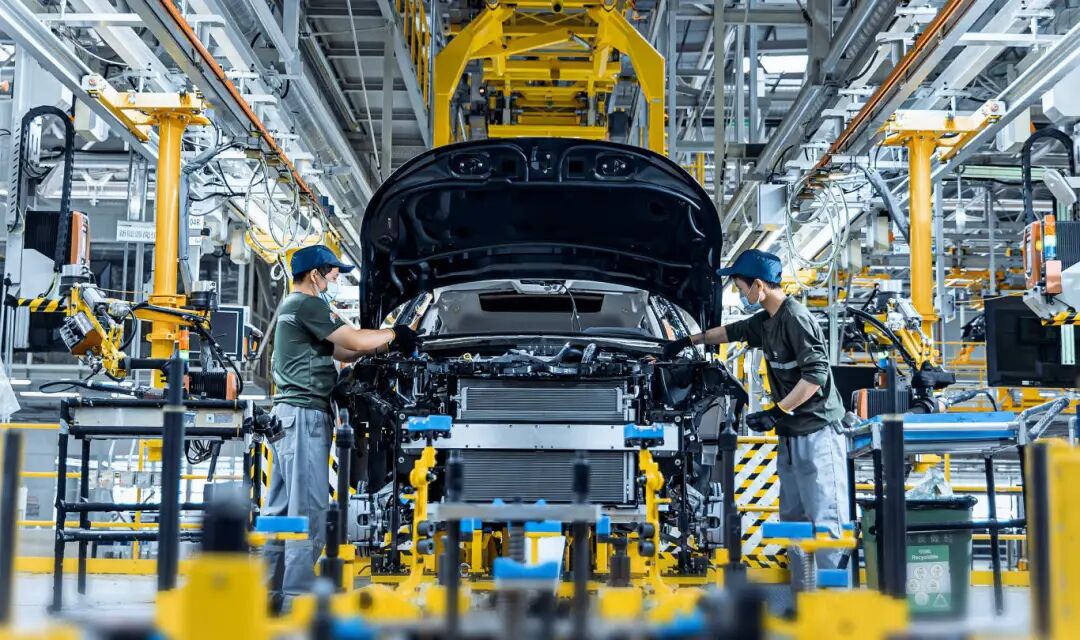
Core Viewpoint - The automotive industry is facing a severe crisis due to skyrocketing prices of automotive-grade memory chips, particularly DRAM and DDR5, which have surged over 300% since the second half of 2025, significantly impacting production costs without a corresponding increase in vehicle prices [1][3]. Group 1: Price Surge and Cost Impact - Automotive-grade memory prices have dramatically increased, with DRAM prices rising over 300% and automotive-grade DDR5 memory exceeding 300%, leading to an increase of approximately 1,000 yuan in the cost of each vehicle [1][3]. - Despite the rising costs, vehicle prices have remained stable, with industry leaders indicating that the pressure from memory price increases has not yet been passed on to end consumers [1][3]. Group 2: Supply Chain Challenges - The memory shortage has begun to affect production schedules for some automakers, with concerns about supply interruptions leading companies to deploy personnel to monitor supplies and develop alternative sourcing strategies [3][4]. - The automotive industry is facing a significant challenge in securing memory supplies, as the demand from the AI sector is siphoning off production capacity, with AI data centers expected to consume over 70% of high-end memory chips by 2026 [4][6]. Group 3: Market Dynamics and Competition - The automotive memory market is highly concentrated, with Samsung, SK Hynix, and Micron controlling over 90% of the market, leaving automakers with little bargaining power during the supply crisis [7][9]. - The shift in production focus towards AI-related memory products, which offer significantly higher profit margins, has led to a reduction in the availability of automotive-grade memory, exacerbating the supply issues faced by car manufacturers [4][6]. Group 4: Strategic Responses from Automakers - In response to the memory shortage, automakers are adopting strategies such as direct supply agreements with memory manufacturers and establishing strategic safety stock to mitigate the risks of supply disruptions [10][12]. - The competition in the automotive sector is increasingly centered around "smart driving" capabilities, with memory being a critical component that influences the performance and features of intelligent vehicles [10][12]. Group 5: Future Outlook and Industry Trends - The memory shortage is expected to persist until at least 2028, with new chip manufacturing facilities taking 3-5 years to establish, indicating a prolonged period of supply constraints for the automotive industry [9]. - The automotive sector is witnessing a shift towards self-developed technologies, with a significant portion of the market being dominated by domestic brands that are focusing on in-house development of smart driving features [17][18].




智能网联汽车场景对接会举办,多项产学研合作项目落地顺义
Bei Jing Ri Bao Ke Hu Duan· 2026-01-29 12:38
Core Insights - The event "Towards New Directions" focused on empowering new productive forces in the intelligent connected vehicle sector, aiming to create a supply-demand matching platform and accelerate the transformation of innovative achievements [1] Group 1: Industry Trends and Innovations - Industry experts shared insights on technological innovation and industrial development, with presentations from key figures such as Feng Shuo from BAIC and Professor Lu Qi from Tsinghua University [3] - The event marked significant progress in collaborative innovation with the signing of two major cooperation agreements on key automotive materials and digital twin technologies [3] Group 2: Collaborative Projects - A partnership between Xianggu Wisdom (Beijing) Technology Co., Ltd. and Tsinghua University was announced to establish a national center for fragrance science and technology innovation, promoting high-quality development in the olfactory economy [5] Group 3: Project Matching and Demonstrations - The event featured precise matching of new technologies with application scenarios through three main categories: technology demand projects, capability projects, and demonstration projects [7] - BAIC and Changan Automobile jointly announced four technology demands, including intelligent chassis control and next-generation vehicle range extender systems [7] - Several companies showcased their capabilities and demonstration projects, sharing experiences in building innovative scenarios [7] Group 4: Continuous Empowerment and Ecosystem Development - The Deputy Director of the Shunyi District Science and Technology Committee emphasized the district's commitment to becoming a global hub for intelligent connected vehicles, leveraging its industrial foundation and innovation resources [7] - The event organizers indicated that services will continue online, with the Beijing-Tianjin-Hebei Intelligent Connected Vehicle Innovation Center facilitating the transformation of technological achievements in the region [9]

乘用车板块1月29日涨0.12%,上汽集团领涨,主力资金净流出7.09亿元
Zheng Xing Xing Ye Ri Bao· 2026-01-29 09:03
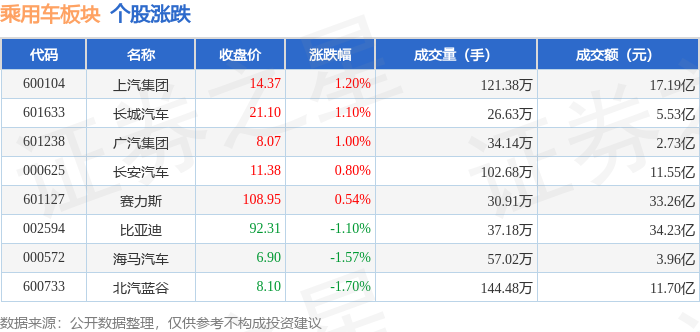
Group 1 - The passenger car sector increased by 0.12% on January 29, with SAIC Motor leading the gains [1] - The Shanghai Composite Index closed at 4157.98, up 0.16%, while the Shenzhen Component Index closed at 14300.08, down 0.3% [1] - Key stocks in the passenger car sector showed varied performance, with SAIC Motor closing at 14.37, up 1.20%, and BYD closing at 92.31, down 1.10% [1] Group 2 - The net outflow of main funds in the passenger car sector was 709 million yuan, while retail investors saw a net inflow of 501 million yuan [1] - Detailed fund flow data indicates that major stocks like GAC Group and Great Wall Motors experienced significant net outflows from main funds [2] - Retail investors showed positive net inflows in several stocks, including GAC Group and Haima Automobile, despite overall sector outflows [2]


崔东树:2025年国内商用车交强险数据强势增长 12月商用车国内销量同比增5%
智通财经网· 2026-01-29 07:46
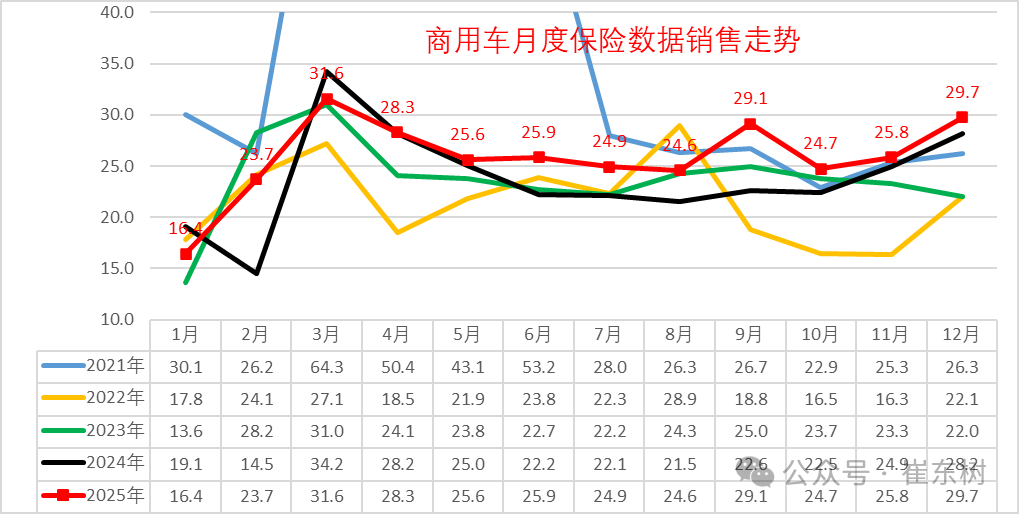
Core Insights - The commercial vehicle market in China is expected to see significant growth in 2025, driven by the strong performance of new energy vehicles (NEVs) and supportive policies for vehicle upgrades [1][7][12] - In December 2025, the sales of commercial vehicles reached 300,000 units, marking a 5% year-on-year increase and a 15% month-on-month increase [7][12] - The penetration rate of new energy commercial vehicles is projected to reach 46% by December 2025, a substantial increase from 29% in December 2024 [12][14] Commercial Vehicle Market Analysis - The total sales of commercial vehicles in China for 2025 are forecasted to be 3.1 million units, representing a 9% year-on-year growth compared to the stable period since 2022 [1][7] - The market showed a strong upward trend from March to December 2025, with December achieving a historical high for the month [5][7] - The sales of new energy commercial vehicles in December 2025 are expected to hit 140,000 units, reflecting a 71% year-on-year increase and a 49% month-on-month increase [1][8] New Energy Vehicle Performance - The penetration rate of new energy commercial vehicles has increased significantly, from approximately 3% in 2019-2021 to 46% in December 2025 [12][14] - The sales of new energy commercial vehicles for the entire year of 2025 are projected to reach 910,000 units, a 57% increase compared to the previous year [1][8] - The growth in new energy vehicle sales is attributed to strong demand and government incentives, particularly in the commercial vehicle sector [10][12] Market Structure and Competition - The market for commercial vehicles is characterized by a stable structure, with significant contributions from light and heavy-duty trucks [14][18] - Key players in the commercial vehicle market include Beiqi Foton, SAIC-GM-Wuling, and China National Heavy Duty Truck Group, which dominate the light truck, heavy truck, and bus segments respectively [15][18] - The performance of heavy-duty trucks has improved significantly due to subsidy policies, with notable growth in electric heavy-duty trucks in regions like Beijing, Tianjin, and Shanghai [16][17] Regional Market Dynamics - The light truck market is particularly strong in regions such as East China and South China, with increasing sales in these areas [18][19] - The penetration of new energy vehicles in the truck segment reached 38% in December 2025, while the bus segment saw a penetration rate of 78% [14][18] - The market for new energy light trucks is primarily concentrated in East China and South China, with significant growth observed in these regions [19][21]


建信期货焦炭焦煤日评-20260129
Jian Xin Qi Huo· 2026-01-29 02:13
Group 1: Report Overview - Report Type: Coke and Coking Coal Daily Review [1] - Date: January 29, 2026 [2] - Research Team: Black Metal Research Team, including researchers Zhai Hepan, Nie Jiayi, and Feng Zeren [3] Group 2: Market Performance - On January 28, the main contracts 2605 of coke and coking coal futures rebounded after a decline, recovering part of the previous day's losses. The closing price of J2605 was 1684 yuan/ton with a decline of 0.12%, and the trading volume was 13,284 lots. The closing price of JM2605 was 1134.5 yuan/ton with an increase of 0.44%, and the trading volume was 714,203 lots [5]. - The KDJ indicators of the daily line of coke 2605 contract continued to decline, but the J - value was significantly dull. The KDJ indicators of the daily line of coking coal 2605 contract showed a differentiated trend, with the J - value and K - value turning up and the D - value continuing to decline. The green columns of the MACD of the daily line of coke and coking coal 2605 contracts enlarged for the second consecutive trading day [8]. Group 3: Spot Market - On January 28, the flat - price index of quasi - first - class metallurgical coke at Rizhao Port, Qingdao Port, and Tianjin Port was 1470 yuan/ton, with no change. The summary price of low - sulfur main coking coal in Tangshan was 1455 yuan/ton, in Lvliang was 1483 yuan/ton, in Linfen was 1640 yuan/ton, in Handan was 1420 yuan/ton, in Heze was 1430 yuan/ton, and in Pingdingshan was 1660 yuan/ton, all with no change [8]. Group 4: Market Outlook - News: The regulatory policy tightening led to the decline of metal prices with poor fundamentals. The international energy prices rose due to the tense situation in the Middle East, and the coal - coke prices rebounded after reaching a low [10]. - Fundamentals: Independent coking enterprises have been in continuous losses for 5 weeks, and the loss amplitude has been expanding for 3 weeks. The coke production has decreased slightly for 2 consecutive weeks after increasing in the first 2 weeks of the year. The port coke inventory has increased for 5 consecutive weeks, and the steel mill coke inventory has increased for 5 consecutive weeks and reached a new high since early October last year, while the coking enterprise coke inventory has increased after decreasing for 4 consecutive weeks. The Mongolian coal customs clearance volume has rebounded since January 12, and the customs clearance volume at the Ganqimaodu Port has basically remained above 190,000 tons recently. The coking coal inventory of 230 independent coking plants has increased significantly for 5 consecutive weeks and reached a new high since the end of January last year, while the coking coal inventory of steel enterprises and ports has been relatively stable [10]. - Forecast: The news has a dual impact on the coal - coke futures prices, but the fundamentals change little, resulting in the relative stability of coal - coke futures. It is expected that the market may first decline and then rise. It is advisable to try the strategy of buying for hedging or investment at low prices after the callback stabilizes [11]. Group 5: Industry News - As of the end of 2025, the total assets of central enterprises exceeded 95 trillion yuan, with a total profit of 2.5 trillion yuan, fixed - asset investment of 5.1 trillion yuan, and tax payment of 2.5 trillion yuan in 2025. The investment in strategic emerging industries was 2.5 trillion yuan, accounting for 41.8% of the total investment [12]. - During the "14th Five - Year Plan" period, 940 million tons of crude steel production capacity, 470 million tons of cement clinker production capacity, 360 million tons of coking production capacity, and 170 million kilowatts of coal - fired power units have completed ultra - low emission transformation [12]. - The number and production capacity of open - pit coal mines in China will continue to increase, and their position in the energy supply system will become more important [12]. - By January 25, Wuhai Energy Company completed 1.2284 million tons of raw coal production and 1.0239 million tons of commercial coal sales, achieving a good start [13]. - Haohua Energy expects its net profit in 2025 to be between 419 million yuan and 569 million yuan, a year - on - year decrease of 45.08% - 59.55% [13]. - Baofeng Energy expects its net profit in 2025 to be between 11 billion yuan and 12 billion yuan, a year - on - year increase of 73.57% - 89.34% [13]. - In 2025, the raw coal production of large - scale industrial enterprises in Ningxia was 10.28106 million tons, a year - on - year decrease of 1.1% [13]. - In 2025, Shaanxi added 30.95 million tons/year of coal production capacity, and 10.04 million kilowatts of renewable energy installed capacity [13]. - The iron ore "water - rail intermodal transport" business of Hubei Energy Jingzhou Coal Port was officially launched [13]. - Shanxi is promoting economic development and "major project construction year" work [13]. - Hudong - Zhonghua Shipbuilding signed a contract to build 4 + 2 LNG carriers [14]. - Huaibei Mining expects its net profit in 2025 to be about 1.495 billion yuan, a year - on - year decrease of about 69.21% [14]. - China National Energy Group opened a new coal supply channel to the central - China region [14]. - Northeast Power Grid's power consumption load reached a record high in late December 2025 [14]. - The daily power generation of Datang Huayin Electric Power's thermal power units reached a record high [14]. - Shanxi Coking expects to be profitable in 2025, but its net profit will decline by more than 50% year - on - year [14]. - In 2025, China's effective supply of coking coal was close to 480 million tons, a year - on - year increase of 1.4%. The net import volume of coking coal decreased for the first time since 2021, a year - on - year decrease of 3.4% [14]. - In 2025, the freight volume of the Ganqimaodu Port reached 42.433 million tons, a year - on - year increase of 3.7%, a record high [14]. - The anti - dumping measures for stainless steel welded pipes originating from China in the Eurasian Economic Union will be extended to November 12, 2026 [14]. - Mongolia plans to produce 90 million tons of coal, 1.9 million tons of copper, and 9.4 million tons of iron ore in 2026 [14]. - India and the EU reached a free - trade agreement on January 27 [14]. - India's coal production target for the 2026 - 27 fiscal year is 1.31 billion tons [15]. - A barge collision accident in Indonesia may affect coal barge transportation [15]. - In 2025, Brazil's Vale's iron ore production reached 336 million tons, a new high since 2018 [15]. - The EU plans to ban the import of Russian natural gas and oil [15]. - In 2025, South Africa's Richards Bay Coal Terminal's coal export volume increased by 11% year - on - year to 57.66 million tons, a four - year high [15]. - India Oil Corporation plans to purchase at least 24 million barrels of Brazilian crude oil in the next two years [15].


长安汽车申请音频芯片的频率和电压调节方法专利,提高了频率、电压与音频任务量的匹配程度
Jin Rong Jie· 2026-01-29 00:28
天眼查资料显示,重庆长安汽车股份有限公司,成立于1996年,位于重庆市,是一家以从事汽车制造业 为主的企业。企业注册资本991408.606万人民币。通过天眼查大数据分析,重庆长安汽车股份有限公司 共对外投资了120家企业,参与招投标项目5000次,财产线索方面有商标信息3101条,专利信息5000 条,此外企业还拥有行政许可1065个。 国家知识产权局信息显示,重庆长安汽车股份有限公司申请一项名为"音频芯片的频率和电压调节方 法、装置、设备及车辆"的专利,公开号CN121411602A,申请日期为2025年10月。 专利摘要显示,本发明涉及一种音频芯片的频率和电压调节方法、装置、设备及车辆,在该方法中,通 过获取到音频任务量参数和调优数据后,音频任务量参数包括当前音频缓冲区填充率、当前音频任务队 列堆积率、当前音频编码复杂度、当前音频延迟、数字信号处理器的当前占用率和当前温度中的至少一 个,根据音频任务量参数,确定第一频率和第一电压;根据调优数据,对第一频率和第一电压进行调 优,得到第二频率和第二电压;进而根据第二频率和第二电压,逐步调节音频芯片的时钟频率和工作电 压。本方案通过音频任务量参数和调优数据,实 ...