
JGJC(000799)

Search documents
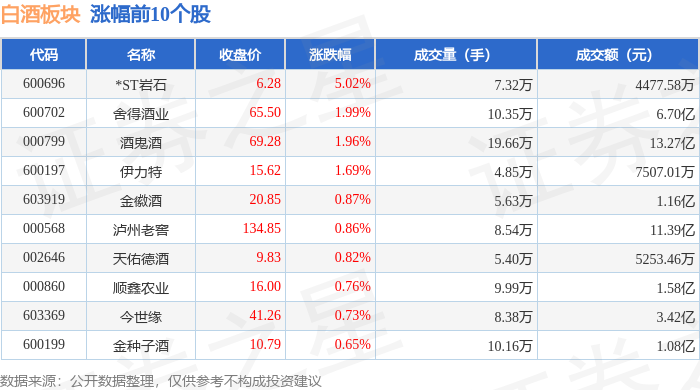
白酒板块9月19日涨0.08%,*ST岩石领涨,主力资金净流出3.12亿元
Zheng Xing Xing Ye Ri Bao· 2025-09-19 08:47
Market Overview - On September 19, the liquor sector rose by 0.08% compared to the previous trading day, with *ST Rock leading the gains [1] - The Shanghai Composite Index closed at 3820.09, down 0.3%, while the Shenzhen Component Index closed at 13070.86, down 0.04% [1] Individual Stock Performance - *ST Rock (600696) closed at 6.28, up 5.02% with a trading volume of 73,200 shares and a turnover of 44.78 million yuan [1] - Other notable performers include: - Shede Liquor (600702) at 65.50, up 1.99% with a turnover of 670 million yuan [1] - Si Gu Dian (000799) at 69.28, up 1.96% with a turnover of 1.327 billion yuan [1] - Yilite (600197) at 15.62, up 1.69% with a turnover of 7.51 million yuan [1] - Luzhou Laojiao (000568) at 134.85, up 0.86% with a turnover of 1.139 billion yuan [1] Capital Flow Analysis - The liquor sector experienced a net outflow of 312 million yuan from institutional investors, while retail investors saw a net inflow of 445 million yuan [2] - The capital flow for individual stocks shows: - Jiu Gu Dian (000799) had a net inflow of 25.85 million yuan from institutional investors [3] - Yanghe Distillery (002304) had a net inflow of 17.60 million yuan from institutional investors [3] - *ST Rock (600696) had a net inflow of 8.87 million yuan from institutional investors [3] Summary of Trading Activity - The trading activity indicates a mixed sentiment in the liquor sector, with some stocks gaining while others faced declines [2][3] - The overall market trend reflects cautious investor behavior, with significant capital movements between institutional and retail investors [2][3]





酒鬼酒:核心产品的低度化产品正逐步上市,和胖东来将考虑是否开发新的合作产品
Cai Jing Wang· 2025-09-19 08:46
(企业业绩说明会) 9月19日,酒鬼酒参与2025年湖南辖区上市公司集体接待日。期间,管理层透露,公司目前与胖东来只 有"酒鬼·自由爱"一款合作产品,后续将根据市场情况考虑是否开发新的合作产品。公司低度酒产品分 为核心产品低度化和适合年轻人群的低度产品,目前核心产品的低度化产品正在逐步上市,面向年轻群 体的产品正在研发当中。 ...
高盛白酒深度研究:控货去库存筑底,Q3迎最暗时刻,茅五目标价大调(附全名单评级)
Zhi Tong Cai Jing· 2025-09-18 12:56
Core Viewpoint - The Chinese liquor industry is approaching a critical seasonal test in Q3 2025, with cautious market sentiment prevailing. Goldman Sachs predicts that Q3 2025 may represent a low point in valuation for the industry, with some stocks already reflecting a "bottoming" expectation. Target prices for leading companies like Moutai and Wuliangye have been adjusted upwards [1][2]. Group 1: Market Conditions - The liquor industry is facing dual pressures from ongoing anti-extravagance policies and a reduction in the length of the Mid-Autumn Festival and National Day holidays, leading to weakened retail momentum [2]. - Companies are focusing on inventory normalization through measures such as waiving prepayments and controlling shipment volumes, which may pressure short-term performance but help return inventory levels to normal [2]. - Despite a significant decline in wholesale prices for Moutai and Wuliangye, some retailers have slightly increased end prices in anticipation of brand-controlled inventory to support profits [2][3]. Group 2: Valuation and Stock Performance - The stock prices of liquor companies have risen by 24% since Q3, with a 17% increase in price-to-earnings ratios, indicating that the market has already absorbed the impact of policy changes [2]. - The average target price for liquor stocks has been raised by 6%, with mid-to-high-end liquor valuation multiples adjusted upwards by 13% to 19% [2]. - The high dividend yields of leading companies like Moutai and Wuliangye provide a valuation safety net, with potential price increases of 20% to 30% based on normalized earnings projections for 2027 [4]. Group 3: Company-Specific Adjustments - Moutai's target price has been adjusted from 1742 yuan to 1724 yuan, reflecting a 3% to 4% decrease in earnings expectations due to policy impacts [5]. - Wuliangye's target price has been raised from 139 yuan to 145 yuan, despite a 5% to 8% reduction in earnings expectations, as its valuation multiple has been increased from 17 times to 18.5 times [5]. - Other companies like Luzhou Laojiao and Gujing Gongjiu have also seen adjustments in their target prices and earnings expectations, reflecting varying degrees of resilience and market conditions [5]. Group 4: Investment Strategy - The current "low point" in Q3 is viewed as a critical phase for the industry, with inventory control measures potentially laying the groundwork for recovery in 2026 as policies ease [6]. - Investment recommendations focus on leading companies with strong dividend yields and brand strength, as well as those with significant valuation adjustments and earnings resilience [7].





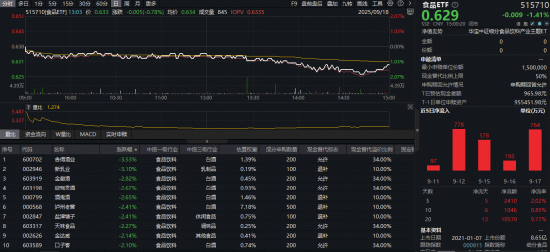
吃喝板块深度回调,“茅五泸汾洋”集体大跌!食品ETF(515710)盘中跌超2%,资金持续加码
Xin Lang Ji Jin· 2025-09-18 12:01
Group 1: Market Performance - The food and beverage sector experienced a significant pullback on September 18, with the Food ETF (515710) dropping over 2% during intraday trading before closing down 1.41% [1] - Major liquor stocks, including Shede Liquor, Yanghe Brewery, and Luzhou Laojiao, saw declines exceeding 2%, while leading brands like Kweichow Moutai and Wuliangye fell over 1% [1] Group 2: Investment Trends - Despite the recent pullback, there has been a notable influx of capital into the food and beverage sector, with the Food ETF (515710) recording a net subscription of 24.1 million CNY over the past five trading days [1] - The food and beverage sector is currently viewed as having a favorable valuation, with the Food ETF's underlying index PE ratio at 21.12, placing it at a low point historically [4] Group 3: Industry Outlook - Kweichow Moutai ranked third in the Kantar BrandZ Most Valuable Chinese Brands 2025 list, with a brand value of 80.023 billion USD, marking its sixth consecutive year in the top three [3] - Analysts suggest that as policy pressures ease, there is potential for a weak recovery in demand for liquor, particularly with the upcoming holiday season expected to improve sales [3][6] - The liquor industry is seen as being at a low valuation point, with expectations for gradual improvement in fundamentals as the market stabilizes [4][6]
酒鬼酒跌2.01%,成交额6.21亿元,主力资金净流出1.02亿元
Xin Lang Cai Jing· 2025-09-18 03:12
Core Viewpoint - The stock of JiuGuiJiu has experienced fluctuations, with a year-to-date increase of 24.32% but a recent decline of 6.67% over the past five trading days [2] Group 1: Stock Performance - As of September 18, JiuGuiJiu's stock price was 68.40 CNY per share, with a market capitalization of 22.225 billion CNY [1] - The stock has seen a 68.18% increase over the past 60 days, while it has decreased by 6.67% in the last five trading days [2] - The stock has appeared on the "Dragon and Tiger List" twice this year, with the latest instance on August 20, where it recorded a net purchase of 1.03 billion CNY [2] Group 2: Financial Performance - For the first half of 2025, JiuGuiJiu reported a revenue of 561 million CNY, a year-on-year decrease of 43.54%, and a net profit attributable to shareholders of 8.955 million CNY, down 92.60% year-on-year [2] - The company has distributed a total of 2.151 billion CNY in dividends since its A-share listing, with 942 million CNY distributed in the last three years [3] Group 3: Shareholder Structure - As of June 30, 2025, JiuGuiJiu had 136,000 shareholders, a decrease of 4.4% from the previous period, with an average of 2,388 circulating shares per shareholder, an increase of 4.61% [2] - Major shareholders include the China Securities White Wine Index A and the Hong Kong Central Clearing Limited, with varying changes in their holdings [3]
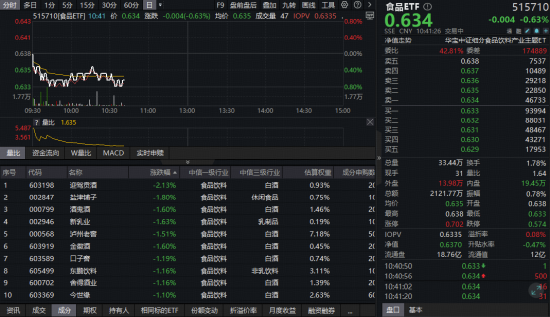
吃喝板块突发回调,估值跌至冰点!机构紧盯中秋国庆动销复苏!
Xin Lang Ji Jin· 2025-09-18 03:06
Group 1 - The food and beverage sector experienced a decline on September 18, with the Food ETF (515710) dropping by 0.63% [1] - Within the sector, liquor stocks were notably weak, with companies like Yingjia Gongjiu falling over 2% and others like Jiu Gui Jiu and Lu Zhou Lao Jiao declining more than 1% [1] - Despite the current downturn, some analysts suggest that the liquor sector may have entered a bottoming phase, with potential for recovery during the upcoming festive season [1][4] Group 2 - According to Open Source Securities, the retail sales growth rate has slowed down, primarily due to diminishing effects of the "old-for-new" policy and a gradual recovery in consumer demand [3] - The food and beverage sector is expected to benefit from improving macroeconomic conditions and rising consumer income and willingness to spend [3] - The current valuation of the food and beverage sector is at a low point, making it a potentially good time for investment [3] Group 3 - Future outlook indicates that the liquor sector is undergoing adjustments due to policy impacts, with a noticeable decline in demand [4] - There are signs of recovery in consumer behavior, particularly in personal drinking and social gatherings, which could lead to improved sales figures [4] - Analysts predict that the worst phase for the liquor sector has passed, and there is cautious optimism for the upcoming Mid-Autumn Festival and National Day [4] Group 4 - The Food ETF (515710) tracks the CSI segmented food and beverage industry index, with a significant portion of its holdings in leading high-end liquor stocks [5] - Investors can also access core assets in the food and beverage sector through the Food ETF linked funds [5]


白酒板块2025年中报业绩综述:报表释压,加速筑底
Minsheng Securities· 2025-09-17 10:35
Investment Rating - The report suggests a recommendation for strong brands such as Guizhou Moutai, Wuliangye, and Luzhou Laojiao, as well as Shanxi Fenjiu, which has a clear growth path in a counter-cyclical environment [5]. Core Insights - The industry is currently in a phase of accelerated bottoming, transitioning from "passive clearing" to "active adjustment" due to ongoing pressures from excess supply and demand scenarios [3][5]. - The first half of 2025 saw a negative growth in revenue and net profit for major liquor companies, marking the first negative growth in this cycle [15]. - The report highlights a structural opportunity during the volume adjustment period, with market pricing increasingly favoring dividend yield and market share [3][5]. Summary by Sections Industry Overview - The white liquor industry faced challenges in the first half of 2025, including slow macroeconomic recovery and strict alcohol prohibition policies, leading to a decline in consumption scenarios and continued pressure on demand [5]. - The overall revenue and net profit for 17 major liquor companies were 2368.3 billion and 944.6 billion respectively, with a year-on-year decline of 0.4% and 0.9% [15]. Performance Analysis - In Q2 2025, the revenue and net profit for the industry were 867.2 billion and 313.4 billion respectively, reflecting a year-on-year decline of 4.7% and 7.3%, marking the first negative growth in revenue during this cycle [15]. - High-end liquor maintained positive growth, while the mid-range and regional brands experienced declines [20][22]. Market Dynamics - The report indicates that the market is shifting focus from short-term recovery scenarios to verifying the bottom of demand trends through year-on-year comparisons [3]. - The report anticipates a recovery in the third quarter, driven by seasonal consumption events such as Mid-Autumn Festival and National Day, which may accelerate the bottoming process of the fundamentals [5]. Investment Recommendations - The report recommends focusing on brands with strong market positions and growth potential, including Guizhou Moutai, Wuliangye, Luzhou Laojiao, and regional leaders like Guyi Gongjiu and Jinhui Jiu [5].


白酒掀起“降度竞赛”,济南市场尚难寻觅
Qi Lu Wan Bao Wang· 2025-09-17 09:48
Core Viewpoint - The white liquor industry is experiencing a "low-degree competition" as several companies, including Wuliangye and Gujinggongjiu, have launched low-degree liquor products to attract younger consumers and adapt to changing market dynamics [1][5]. Industry Trends - Since late August, multiple liquor companies have introduced low-degree white liquor, indicating a shift in consumer preferences and market strategies [1]. - The overall number of large-scale liquor enterprises in China has decreased, with 887 companies reported in mid-2025, down over 100 from the previous year [4]. - The production of white liquor has declined by 5.8% year-on-year, with sales revenue slightly increasing by 0.19% to 330.42 billion yuan, while profits fell by 10.93% to 87.69 billion yuan [4]. Market Response - Retailers have been cautious about stocking new low-degree products, with many still focusing on high-degree liquor, which dominates the market [2][3]. - The current market for low-degree liquor is primarily driven by local brands, with only a small percentage of low-degree options available in stores [2][3]. Consumer Insights - The primary consumer base for liquor remains middle-aged and older individuals, with younger consumers showing a preference for purchasing low-degree liquor through online channels or convenience stores [3]. - A survey indicated that only 19% of young consumers prefer white liquor, while 52% favor beer and 29% prefer foreign or fruit wines [4]. Strategic Initiatives - Major liquor companies are launching low-degree products as a strategy to engage younger consumers and expand into casual drinking scenarios [5]. - Companies like Gujinggongjiu and Wuliangye have recently introduced new low-degree products, indicating a competitive push in this segment [5]. Challenges - The definition of low-degree liquor varies, complicating market positioning and consumer understanding [6]. - The industry faces challenges in establishing consumption habits and market recognition for low-degree liquor, as traditional consumption scenarios remain dominated by high-degree products [7].
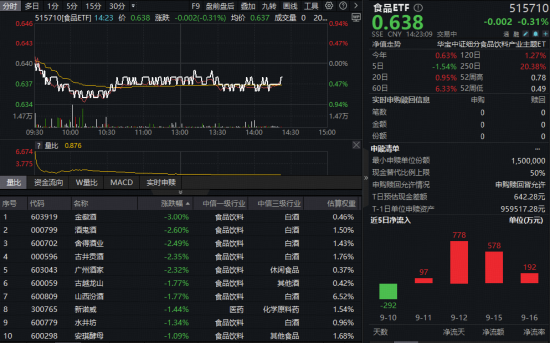
茅台官宣!吃喝板块震荡走弱,白酒领跌!低位布局时机或至?
Xin Lang Ji Jin· 2025-09-17 06:37
Group 1 - The food and beverage sector experienced a volatile pullback on September 17, with the Food ETF (515710) opening lower and maintaining a downward trend throughout the day, closing down 0.31% [1][2] - Several liquor stocks, particularly Kweichow Moutai, faced significant declines, with Jinhuijiu down 3%, and others like Jiu Gui Jiu and She De Jiu Ye dropping over 2% [1][3] - The overall sentiment in the liquor market is affected by recent clarifications from Kweichow Moutai regarding false promotional activities, emphasizing the stability of their distribution channels [1][3] Group 2 - Pacific Securities noted that the liquor sector is at a "fundamental bottom and low valuation" phase, with potential for weak recovery in demand as the Mid-Autumn Festival approaches [3][4] - The food and beverage sector is seeing mixed performance, with meat products and liquor leading gains, while snacks and beer are experiencing declines [3][4] - Current valuations in the food and beverage sector are at low levels, suggesting a favorable time for investment, with the Food ETF's price-to-earnings ratio at 21.12, marking a low point in the last decade [3][4] Group 3 - Everbright Securities indicated that the liquor sector is undergoing adjustments due to policy impacts, with a noticeable decline in demand, but a potential recovery is expected in the latter half of the year [4][5] - Xiangcai Securities highlighted the low valuation levels in the sector, suggesting opportunities for alpha generation through high-quality stocks [4][5] - The focus should be on companies with stable demand and strong risk resistance, as well as those innovating in new products and channels [5]
中国白酒行业 - 第三季度前瞻 - 理性发货下的低谷,需求仍与政策、宏观相关;股价反映市场情绪触底-China Spirits_ 3Q Preview_ trough on rational shipment w_demand still tied to policy_macro; ;stocks reflect sentiment bottoming,
2025-09-17 01:51
Summary of Conference Call on China Spirits Industry Industry Overview - The spirits industry in China is currently facing challenges due to the ongoing impact of the anti-extravagance policy, which has affected consumer demand and retail momentum. [1][2][11] - The third quarter of 2025 (3Q25) is expected to be the trough for the industry, with a projected sales decline of 5% to 27% across various brands, excluding Moutai and Jiugui. [1][2][21] Key Points and Arguments Demand and Sales Trends - Retail momentum is anticipated to remain weak, particularly during the peak season due to fewer holiday days compared to previous years. [1] - A significant decline in retail volume is expected, with estimates of a 30% drop in August and a 15-20% decline during the peak season. [11] - The wholesale pricing remains under pressure, with notable declines in prices for key brands like Feitian Moutai and Common Wuliangye. [19][27] Shipment and Inventory Management - Spirits companies are prioritizing channel health by implementing deeper destocking and tighter shipment controls to ease distributor financing burdens. [1][2] - The trend of controlling shipments is crucial for maintaining channel inventory and supporting wholesale prices, especially for high-end spirits. [18][27] Financial Forecasts and Revisions - Sales and net profit forecasts for super-premium and upper-mid-end spirits have been revised down by up to 6% and 17% respectively for 2025E-27E. [2][42] - Despite the cautious outlook, target multiples have been raised by 9-19% to reflect a more normalized valuation level amid market re-rating. [2] Product Strategy and Market Positioning - Companies are focusing on product strategy to navigate the current market challenges, including reinforcing mid-end and mass portfolios and innovating lower-degree liquor products for younger consumers. [11] - The emphasis on residential banquets and product mix shifts is seen as a potential catalyst for recovery. [11] Dividend and Shareholder Returns - There is potential for enhancement in shareholder returns, with increased dividend payout forecasts for companies like Wuliangye. [11][43] Additional Important Insights - The anti-extravagance policy's impact is expected to gradually normalize, potentially boosting sentiment during the 2026 Chinese New Year holiday season. [11] - The affordability of high-end spirits has improved, which may support residential demand as policy headwinds ease. [31] - The spirits sector has seen a rotation towards laggards, indicating a market sentiment shift towards recovery narratives. [12][42] Conclusion - The China spirits industry is navigating a challenging environment with significant policy impacts affecting demand and pricing. However, strategic adjustments in shipment control, product offerings, and potential improvements in affordability may provide pathways for recovery in the coming years. [1][2][11][12]