
JGJC(000799)

Search documents
湾区白酒半年图谱:名酒价格频频失守,行业陷深度博弈
Nan Fang Du Shi Bao· 2025-12-26 15:00
Core Insights - The Chinese liquor industry is undergoing significant transformation in 2025, facing challenges such as high channel inventory and weak terminal sales, while also experiencing new opportunities driven by changing policies, consumption patterns, and market scenarios [1][14] Market Trends - The white liquor market in the Guangdong-Hong Kong-Macao Greater Bay Area has seen a decline in retail prices, with a notable shift in consumer behavior and pricing strategies [2][3] - The market is characterized by overall price declines, with traditional peak seasons losing their effectiveness, and the penetration of instant retail channels impacting pricing dynamics [3][6] Price Dynamics - Over half of the monitored products in the Greater Bay Area have experienced price declines, including high-end brands like Moutai and Wuliangye, indicating a weakening of price defenses across various segments [4][6] - The price range for products priced at 1,000 yuan and above has collectively cooled, with significant discrepancies between listed prices and actual transaction prices [4][9] Consumer Behavior - Mid-range and mass-market products have shown relative price stability, reflecting their essential demand despite overall market contraction [5][9] - The impact of online channels on pricing is significant, with online prices often dropping while offline prices remain stable, particularly in Shenzhen [8][10] Regional Insights - In Dongguan, the white liquor market has shown structural price differentiation, with high-end products facing downward pressure while mid-range brands adopt varied pricing strategies to maintain market positioning [13][14] - In Foshan, the market is characterized by stable prices for certain products, with local brands influencing consumer preferences and sales dynamics [11][12] Future Outlook - The industry is expected to continue facing low-price conditions in the short term, with the upcoming Spring Festival seen as a potential opportunity for temporary sales improvement [16] - The competition is anticipated to shift from price wars to a focus on brand strength, product innovation, and refined channel management as companies seek to adapt to evolving consumer habits [16]






食品饮料行业双周报(2025、12、12-2025、12、25):欧盟乳制品反补贴落地,把握结构性机会-20251226
Dongguan Securities· 2025-12-26 09:37
Investment Rating - The report maintains an "Overweight" rating for the food and beverage industry, indicating an expectation that the industry index will outperform the market index by more than 10% over the next six months [55]. Core Insights - The report highlights the structural opportunities arising from the EU's anti-subsidy measures on dairy products, which are expected to benefit domestic alternatives such as cheese and cream [50]. - The white liquor sector is experiencing a weak recovery in consumption, with expectations of continued pressure on sales in the fourth quarter and first quarter of the following year, but a potential rebound in the second quarter due to low base effects [50][51]. - The report emphasizes the importance of monitoring inventory levels ahead of the Spring Festival and the operational goals set by various liquor companies for the upcoming year [51]. - The report suggests focusing on high-end liquor brands like Kweichow Moutai (600519) and other regional brands such as Shanxi Fenjiu (600809) and Guojiao Liquor (000596) [51]. - The report notes that approximately 87% of stocks in the food and beverage sector recorded positive returns during the review period, with notable performers including Anji Food (+27.96%) and Huanlejia (+20.94%) [15]. Summary by Sections Market Review - From December 12 to December 25, 2025, the SW food and beverage industry index rose by 1.33%, underperforming the CSI 300 index by approximately 0.66 percentage points [11]. - Most sub-sectors outperformed the CSI 300 index, with the baking sector showing the highest increase of 7.63% [13]. Industry Data Tracking - **Liquor Sector**: The price of Feitian Moutai increased to 1575 RMB/bottle, while Guojiao 1573 decreased to 840 RMB/bottle [21]. - **Condiments Sector**: Prices for soybean meal and white sugar decreased, with soybean prices at 4288.90 RMB/ton [24]. - **Beer Sector**: Aluminum prices increased while glass and corrugated paper prices decreased; barley prices remained stable at 2200.00 RMB/ton [29]. - **Dairy Sector**: Fresh milk prices rose slightly to 3.03 RMB/kg [37]. - **Meat Sector**: The average wholesale price of pork decreased to 17.44 RMB/kg, with a year-on-year decline of 22.04% [39]. Important News - The report discusses the preliminary ruling on anti-subsidy measures for EU dairy imports, which is expected to positively impact domestic dairy producers [44][45]. - It also notes a decline in the production of white liquor and beer in November, with white liquor production down 11.3% year-on-year [43]. Company Announcements - Kweichow Moutai plans to distribute cash dividends amounting to at least 75% of its net profit for the years 2024-2026, alongside a share buyback plan [52]. - Haitian Flavoring plans to maintain a cash dividend payout ratio of no less than 80% of its net profit for the next three years [48].


程军“掌舵”酒鬼酒整一年:业绩跌跌跌,新品慢慢慢
Xin Lang Cai Jing· 2025-12-26 00:37
Core Viewpoint - The performance of Jiu Gui Jiu under the leadership of Cheng Jun has been disappointing, with significant declines in revenue and profit, indicating ongoing struggles to reverse the company's fortunes [2][4][6]. Financial Performance - In the first three quarters of 2025, Jiu Gui Jiu reported revenue of 760 million yuan, a year-on-year decline of 36.21%, and a net profit of 10 million yuan, down 117.36% year-on-year [2][4]. - The company's revenue dropped to 2.83 billion yuan in 2023, a decrease of 30.14%, and further fell to 1.423 billion yuan in 2024, with net profit plummeting by 97.72% to approximately 12.49 million yuan [6][8]. - The core product lines, including Neican and Jiu Gui, have seen significant revenue declines of 67.06% and 49.32% respectively, with only the Xiangquan line showing growth, albeit at a minimal contribution to overall revenue [6][8]. Product Development and Market Response - Cheng Jun has been pushing for a younger product lineup, including lower-alcohol options, but many of these products are still in development, with market feedback reportedly not favorable [3][5]. - The introduction of the "Freedom Love" sparkling wine has not met expectations, with reports of low sales and limited availability, indicating a lack of market traction [4][5]. - Comparatively, competitors like Wuliangye have successfully launched new products that achieved significant sales shortly after release, highlighting Jiu Gui Jiu's lag in product development and market responsiveness [5][6]. Management Changes - The company has experienced frequent leadership changes, with Cheng Jun taking over as general manager after a series of resignations, including former chairman Wang Hao and sales head Wang Zhe [7][8]. - The rapid turnover in management positions reflects the challenges the company faces in stabilizing its operations and reversing its declining performance [7][8].
酒鬼酒股份有限公司第九届董事会第十一次会议决议公告
Shang Hai Zheng Quan Bao· 2025-12-25 18:50
本公司及其董事会全体成员保证信息披露内容的真实、准确、完整,没有虚假记载、误导性陈述或重大 遗漏。 新浪财经"酒价内参"重磅上线 知名白酒真实市场价尽在掌握 登录新浪财经APP 搜索【信披】查看更多考评等级 证券代码:000799 证券简称:酒鬼酒 公告编号:2025-30 酒鬼酒股份有限公司 第九届董事会第十一次会议决议公告 一、董事会会议召开情况 酒鬼酒股份有限公司(以下简称"公司"或"本公司")第九届董事会第十一次会议通知于2025年12月16日 前以电子邮件或短信息等书面方式发出,会议于2025年12月25日以通讯表决方式召开。会议应出席董事 9人,实际出席会议董事9人。会议召开的时间、地点及方式均符合《公司法》《公司章程》及《公司董 事会议事规则》的有关规定。 二、董事会审议议案情况 表决结果:同意9票,反对0票,弃权0票。 (二)审议并通过《关于修改董事会授权管理办法及授权决策方案的议案》 参照国务院国资委有关央企董事会建设的相关文件,为进一步规范公司董事会授权管理行为,促进公司 经理层依法行权履职,提高公司经营决策效率,公司修订了董事会授权管理办法及授权决策方案。 表决结果:同意9票,反对0票, ...
酒鬼酒(000799) - 第九届董事会第十一次会议决议公告
2025-12-25 09:30
证券代码:000799 证券简称:酒鬼酒 公告编号:2025-30 酒鬼酒股份有限公司 第九届董事会第十一次会议决议公告 本公司及其董事会全体成员保证信息披露内容的真实、准确、完整,没有虚 假记载、误导性陈述或重大遗漏。 一、董事会会议召开情况 酒鬼酒股份有限公司(以下简称"公司"或"本公司")第九届 董事会第十一次会议通知于 2025 年 12 月 16 日前以电子邮件或短信 息等书面方式发出,会议于 2025 年 12 月 25 日以通讯表决方式召开。 会议应出席董事 9 人,实际出席会议董事 9 人。会议召开的时间、地 点及方式均符合《公司法》《公司章程》及《公司董事会议事规则》 的有关规定。 二、董事会审议议案情况 (一)审议并通过《关于调整第九届董事会专门委员会成员的议 案》 因公司部分董事变更,公司董事会根据《上市公司治理准则》《上 市公司独立董事管理办法》《公司章程》等相关规定,结合各位董事 专长,调整第九届董事会专门委员会成员,调整后的情况如下: | 专门委员会名称 | 姓名 | 担任职务 | | | --- | --- | --- | --- | | 1、战略发展委员会 | 高 峰 | 主任 ...
白酒板块12月25日涨1.13%,水井坊领涨,主力资金净流入8.74亿元
Zheng Xing Xing Ye Ri Bao· 2025-12-25 09:07
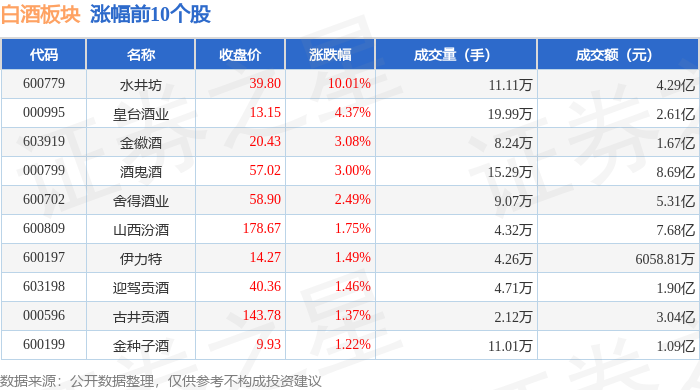
Core Viewpoint - The liquor sector experienced a rise of 1.13% on December 25, with Shui Jing Fang leading the gains, while the Shanghai Composite Index rose by 0.47% and the Shenzhen Component Index increased by 0.33% [1] Group 1: Liquor Sector Performance - Shui Jing Fang (600779) closed at 39.80, up 10.01% with a trading volume of 111,100 shares [1] - Other notable performers include Sanlong Jibei (000995) with a 4.37% increase, and Quan Wei Jiu (616809) rising by 3.08% [1] - The total net inflow of funds into the liquor sector was 874 million yuan, while retail investors saw a net outflow of 325 million yuan [1] Group 2: Fund Flow Analysis - Major net inflows were observed in Kweichow Moutai (600519) with 319 million yuan, accounting for 9.67% of the total [2] - Shui Jing Fang (600779) had a net inflow of 154 million yuan, representing 35.78% of its trading volume [2] - The retail investor net outflow for Shui Jing Fang was 93.49 million yuan, indicating a significant withdrawal from this stock [2]


新版食品营养标签2027年实施,食品饮料ETF天弘(159736)午后拉升、实时成交额超1400万元
2 1 Shi Ji Jing Ji Bao Dao· 2025-12-25 06:14
Group 1 - The core viewpoint of the news is that the liquor stocks experienced a rebound on December 25, with the China Securities Food and Beverage Index rising by 0.80% in the afternoon, driven by strong performances from stocks like Shui Jing Fang, Jin Da Wei, and Jiu Gui Jiu [1] - The Tianhong Food and Beverage ETF (159736) saw significant trading activity, with a transaction volume exceeding 14 million yuan, indicating investor interest in high-end liquor stocks and related sectors [1] - A new national food safety standard will be implemented on March 16, 2027, requiring the labeling of saturated fats and sugars on pre-packaged food products, which could impact consumer purchasing behavior in the food and beverage sector [1] Group 2 - According to Galaxy Securities, the food and beverage index experienced a slight pullback in December, attributed to the timing of the Mid-Autumn Festival affecting sales data and potential revenue pressures in Q4 due to the late Spring Festival stocking period [2] - Within the sector, snacks, condiments, and pre-packaged food indices achieved small positive returns, suggesting some resilience in these sub-segments despite overall market challenges [2] - The outlook for 2026 remains optimistic for new consumption trends, with expectations of internal rotation, while traditional consumption is anticipated to show signs of bottoming out [2]


白酒股,午后走高
Di Yi Cai Jing Zi Xun· 2025-12-25 05:59
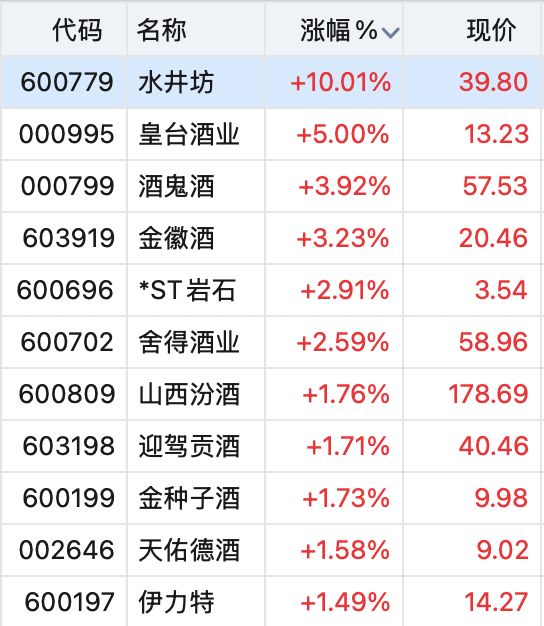
Core Viewpoint - The liquor stocks experienced a significant upward trend in the afternoon of December 25, with notable gains in several companies, indicating a positive market sentiment in the sector [1]. Group 1: Stock Performance - Shuijingfang (水井坊) reached the daily limit with a gain of 10.01%, trading at 39.80 [2] - Huangtai Liquor (皇台酒业) increased by 5.00%, with a current price of 13.23 [2] - Jiugui Liquor (酒鬼酒) rose by 3.92%, priced at 57.53 [2] - Jinhui Liquor (金徽酒) saw a 3.23% increase, trading at 20.46 [2] - Shede Liquor (舍得酒业) gained 2.59%, with a price of 58.96 [2]


白酒股,午后走高
第一财经· 2025-12-25 05:53
Core Viewpoint - The article highlights a significant increase in the stock prices of various Chinese liquor companies, indicating a positive trend in the industry as of December 25. Group 1: Stock Performance - Water井坊 (600779) experienced a maximum increase of 10.01%, reaching a price of 39.80 [1][2] - 皇台酒业 (000995) saw a rise of 5.00%, with its current price at 13.23 [1][2] - 酒鬼酒 (000799) increased by 3.92%, now priced at 57.53 [1][2] - 金徽酒 (603919) rose by 3.23%, with a current price of 20.46 [1][2] - 舍得酒业 (600702) had a growth of 2.59%, reaching a price of 58.96 [1][2] - 山西汾酒 (600809) increased by 1.76%, now at 178.69 [1][2] - 迎驾贡酒 (603198) saw a rise of 1.71%, priced at 40.46 [1][2] - 金种子酒 (600199) increased by 1.73%, with a current price of 9.98 [1][2] - 天佑德酒 (002646) rose by 1.58%, now priced at 9.02 [1][2] - 伊力特 (600197) had a growth of 1.49%, reaching a price of 14.27 [1][2]
酒鬼酒股价涨5.2%,汇安基金旗下1只基金重仓,持有30万股浮盈赚取86.4万元
Xin Lang Cai Jing· 2025-12-25 05:44
12月25日,酒鬼酒涨5.2%,截至发稿,报58.24元/股,成交5.51亿元,换手率3.00%,总市值189.24亿 元。 资料显示,酒鬼酒股份有限公司位于湖南省吉首市振武营酒鬼酒工业园,成立日期1997年7月14日,上 市日期1997年7月18日,公司主营业务涉及从事馥郁香型白酒系列产品的生产和销售。主营业务收入构 成为:酒鬼系列51.60%,其他系列22.38%,内参系列19.77%,湘泉系列5.61%,其他(补充)0.64%。 从基金十大重仓股角度 数据显示,汇安基金旗下1只基金重仓酒鬼酒。汇安消费龙头混合A(009564)三季度持有股数30万 股,占基金净值比例为4.47%,位居第七大重仓股。根据测算,今日浮盈赚取约86.4万元。 汇安消费龙头混合A(009564)基金经理为吴尚伟、许之捷。 截至发稿,吴尚伟累计任职时间11年34天,现任基金资产总规模8.72亿元,任职期间最佳基金回报 253.54%, 任职期间最差基金回报-30.25%。 许之捷累计任职时间3年278天,现任基金资产总规模4.26亿元,任职期间最佳基金回报-19.69%, 任职 期间最差基金回报-30.25%。 风险提示:市场有风 ...