Workflow
JGJC(000799)
icon
Search documents
食品饮料步入消费旺季 产业链上市公司乘风布局
Zheng Quan Ri Bao Wang· 2025-11-13 12:28
Group 1 - The food and beverage industry is entering its most important sales window, with capital expenditure growth of 15.15% year-on-year in November 2025, indicating proactive market positioning by listed companies [1] - The industry is experiencing a structural recovery, with significant online sales growth in the liquor sector during the National Day and Mid-Autumn Festival, including over 100% year-on-year growth on JD's platform and a 58% increase on Douyin [1] - Institutional research activity has surged, with 202 total investigations in the food and beverage sector over the past three months, particularly in the snack and seasoning segments [1] Group 2 - Individual companies such as Chongqing Fuling Zhacai, Angel Yeast, and Xiangpiaopiao have been the focus of institutional attention, each receiving multiple investigations in the last three months [2] - Li Gao Food's third-quarter earnings call attracted 88 institutions, showcasing a nearly 40% year-on-year growth in new channel revenue, indicating strong growth momentum [2] Group 3 - Companies are innovating in products, channels, branding, and supply chain capabilities to capitalize on the consumption peak, with examples including Jiu Gui Jiu's successful product launch and Jin Zai Food's channel innovation strategy [3] - Yanjinpuzi is leveraging local sports events to enhance brand visibility and sales, while ensuring stable production orders in preparation for the upcoming peak season [3] Group 4 - Absolute Food is optimizing its supply chain and market dispatch mechanisms to address regional demand fluctuations and market changes, ensuring stable product supply [4] - Research indicates that product innovation and new channel development are key growth strategies for consumer goods companies, with expectations of a fundamental turning point and policy catalysts for traditional consumer categories [4]
白酒板块11月13日涨0.57%,金徽酒领涨,主力资金净流出2.44亿元
Market Overview - The liquor sector experienced a rise of 0.57% on November 13, with Jinhuijiu leading the gains [1] - The Shanghai Composite Index closed at 4029.5, up 0.73%, while the Shenzhen Component Index closed at 13476.52, up 1.78% [1] Individual Stock Performance - Jinhuijiu (616809) closed at 21.40, with an increase of 2.54% and a trading volume of 98,600 shares, amounting to a transaction value of 210 million yuan [1] - Other notable performers include: - Si Gu Dian (000799) at 67.07, up 2.21% [1] - Gujing Gongjiu (000596) at 166.52, up 1.88% [1] - Yingjia Gongjiu (603198) at 43.88, up 1.72% [1] - Shanxi Fenjiu (600809) at 201.00, up 1.25% [1] Capital Flow Analysis - The liquor sector saw a net outflow of 244 million yuan from institutional investors, while retail investors experienced a net outflow of 141 million yuan [2] - Conversely, speculative funds recorded a net inflow of 385 million yuan [2] Detailed Capital Flow for Selected Stocks - Jiu Guo Dian (000799) had a net inflow of 85.10 million yuan from institutional investors, while retail investors saw a net outflow of 95.90 million yuan [3] - Luzhou Laojiao (000568) experienced a net inflow of 66.31 million yuan from institutional investors, with a net outflow of 119 million yuan from retail investors [3] - Moutai (600519) closed at 1470.38, with a slight increase of 0.36% and a trading volume of 31,200 shares, resulting in a transaction value of 456.9 million yuan [2]
吃喝板块午后惊现逆转!白酒股集体躁动,食品ETF(515710)拉升翻红!估值洼地能否上车?
Xin Lang Ji Jin· 2025-11-13 06:13
Core Insights - The food and beverage sector experienced a reversal on November 13, with the Food ETF (515710) showing a slight increase of 0.16% after a period of low volatility [1][2] - Major liquor stocks, including Jinhuijiu, Gujinggongjiu, and Jiugui Jiu, saw significant gains, with increases exceeding 2% [1] - The China Alcohol Industry Association released a new cultural development outline for the industry, emphasizing the importance of cultural initiatives in addressing current challenges and enhancing international competitiveness [3] Industry Analysis - The newly released outline is seen as an upgrade from the previous five-year plan, targeting industry transformation by focusing on cultural aspects to resolve short-term sales issues and enhance long-term value recognition [3] - The food and beverage sector is currently at a historical low in terms of valuation, with the Food ETF's underlying index PE ratio at 21.24 times, indicating a favorable entry point for long-term investments [3] - The liquor sector has undergone five years of adjustment, with the average PE ratio of major liquor companies now below 20 times and an average dividend yield of approximately 3.5%, suggesting that the sector is entering a value zone [4] Investment Opportunities - The Food ETF (515710) is recommended for investors looking to gain exposure to core assets in the food and beverage sector, with a significant portion of its holdings in leading high-end liquor stocks [5] - The ETF tracks the China Securities Index's food and beverage theme index, with around 60% of its portfolio allocated to high-end liquor leaders and 40% to other segments like beverages and condiments [5]
酒鬼酒涨2.03%,成交额5.97亿元,主力资金净流入896.89万元
Xin Lang Cai Jing· 2025-11-13 05:27
Core Viewpoint - The stock of JiuGuiJiu has shown significant price movements and trading activity, indicating investor interest and potential market dynamics affecting the company [1][2]. Company Performance - As of November 13, JiuGuiJiu's stock price increased by 2.03% to 66.95 CNY per share, with a total market capitalization of 21.754 billion CNY [1]. - Year-to-date, JiuGuiJiu's stock has risen by 21.68%, with a notable increase of 10.90% over the last five trading days [1]. - For the period from January to September 2025, JiuGuiJiu reported a revenue of 760 million CNY, a decrease of 36.21% year-on-year, and a net profit of -9.8055 million CNY, down 117.36% year-on-year [2]. Shareholder Information - As of September 30, 2025, JiuGuiJiu had 135,600 shareholders, a slight decrease of 0.31% from the previous period [2]. - The average number of circulating shares per shareholder increased by 0.32% to 2,395 shares [2]. Dividend Distribution - Since its A-share listing, JiuGuiJiu has distributed a total of 2.151 billion CNY in dividends, with 942 million CNY distributed over the last three years [3]. Institutional Holdings - As of September 30, 2025, the second-largest circulating shareholder is the China Securities White Wine Index A, holding 15.9475 million shares, unchanged from the previous period [3]. - The third-largest shareholder, the Wine ETF, increased its holdings by 2.6071 million shares to 7.3133 million shares [3].
“酒鬼”少卖了14亿,“中粮系”如何拯救酒鬼酒?
Core Viewpoint - The article discusses the significant decline in the financial performance of Jiu Gui Jiu (000799.SZ), highlighting its three consecutive years of revenue and profit drops, leading to a strategic retreat to its home base in Hunan after failed national expansion efforts [2][11]. Financial Performance Summary - In the first three quarters of 2025, Jiu Gui Jiu reported revenue of 760 million yuan, a year-on-year decrease of 36.21%, and a net loss of 9.81 million yuan, marking a 117.36% drop compared to the previous year, which is the first loss in nearly a decade [4][6]. - The revenue for 2022 was 4.05 billion yuan with a net profit of 1.049 billion yuan, which fell to 2.83 billion yuan in 2023 (down 30%) and a net profit of 548 million yuan (down 47.76%). By 2024, revenue further declined to 1.423 billion yuan (down 49.7%) with a net profit of only 12.49 million yuan (down 97.72%) [6][7]. - The cash flow situation is concerning, with a net operating cash flow of -326 million yuan in the first three quarters of 2025, and cash reserves dropping from 1.25 billion yuan at the beginning of the year to 540 million yuan [8][10]. Product Line Performance - The three main product lines—"Nei Can," "Jiu Gui," and "Xiang Quan"—have all seen significant declines, with "Nei Can" revenue dropping by 67.06% to 235 million yuan in 2024, "Jiu Gui" down 49.32% to 835 million yuan, and "Xiang Quan" showing a slight increase of 7.64% to 75.94 million yuan [8][9]. - By the first half of 2025, these product lines continued to decline, with revenues of 111 million yuan, 290 million yuan, and 31.5 million yuan respectively, representing year-on-year decreases of 35.81%, 51.01%, and 35.87% [8]. Strategic Adjustments - After three years of pursuing a national expansion strategy, Jiu Gui Jiu has reverted to focusing on its Hunan base, with provincial revenue dropping by 45.85% to 642 million yuan in 2024, while out-of-province revenue fell by 52.47% to 781 million yuan [12][15]. - The number of distributors has decreased significantly, from 1,774 in 2023 to 1,336 in 2024, and further down to 805 in the first half of 2025 [12][13]. Management and Future Prospects - The management has undergone significant changes since the entry of COFCO Group, with new leadership expected to revitalize the company. However, the anticipated synergistic effects from these changes have yet to materialize in financial performance [17][18]. - A recent collaboration with "retail myth" Pang Dong Lai has generated initial market excitement, with the product "Jiu Gui·Zi You Ai" achieving high sales, but it remains insufficient to reverse the overall financial decline [21][22]. Market Challenges - The white liquor market is currently in a weak cycle, with increasing competition and a need for improved sales strategies. The company has increased promotional efforts, but the mismatch between dealer payments and terminal sales has hindered recovery [10][19]. - The unique "fragrant" style of Jiu Gui Jiu faces challenges in market acceptance, making expansion efforts more difficult compared to more mainstream flavors [22].
白酒板块11月11日跌0.18%,水井坊领跌,主力资金净流出4.97亿元
Market Overview - The liquor sector experienced a decline of 0.18% on November 11, with Shui Jing Fang leading the drop [1] - The Shanghai Composite Index closed at 4002.76, down 0.39%, while the Shenzhen Component Index closed at 13289.0, down 1.03% [1] Individual Stock Performance - Shede Liquor (600702) rose by 2.56% to a closing price of 67.31, with a trading volume of 319,700 shares and a transaction value of 2.144 billion [1] - Gujing Gongjiu (000596) increased by 0.92% to 164.00, with a trading volume of 37,400 shares and a transaction value of 606 million [1] - Shui Jing Fang (600779) fell by 1.13% to 42.87, with a trading volume of 48,200 shares and a transaction value of 206 million [2] - Moutai (600519) decreased by 0.23% to 1458.99, with a trading volume of 26,700 shares and a transaction value of 3.883 billion [2] Capital Flow Analysis - The liquor sector saw a net outflow of 497 million from institutional investors, while retail investors contributed a net inflow of 244 million [2] - The main capital inflow and outflow for selected stocks showed varied trends, with Shanxi Fenjiu (600809) experiencing a net inflow of 1.06 billion from main capital [3] - Shede Liquor (600702) had a net inflow of 46.2 million from main capital, while it faced a net outflow of 90.1 million from speculative capital [3]
中国白酒追踪 - 品牌对 2026 年春节仍持谨慎展望;聚焦持续严格的发货管控-China Spirits Tracker_ Brands still cautious outlook on 2026CNY; focus on continued stringent shipment control
2025-11-11 02:47
Summary of China Spirits Tracker Conference Call Industry Overview - The spirits industry is currently facing challenges due to weakening demand influenced by anti-extravagance policies and a shift in the Mid-Autumn festival calendar, leading to a tough quarter for many companies in Q3 2025 [1][1][1]. - Companies are adopting a cautious outlook for the upcoming Chinese New Year (CNY) sales and earnings performance, primarily due to a high base effect and lingering policy impacts, resulting in low visibility on demand recovery [1][1][1]. Company-Specific Insights Kweichow Moutai - Moutai is pursuing growth targets mainly through wholesale channels, reporting a 14% year-over-year increase in sales for Q3 2025, despite a 15% decline in direct sales [1][1][1]. - The company is likely to adjust its growth targets for 2026 to be more rational due to pressures on wholesale prices from competitors [1][1][1]. Wuliangye - Wuliangye anticipates back-ended growth in 2026, with the first half of the year facing headwinds from a high comparative base [1][1][1]. - The wholesale price of Common Wuliangye has remained relatively stable, with a slight decrease of RMB 5 to RMB 855 per bottle [2][2][2]. Luzhou Laojiao - Laojiao is also expected to maintain stringent shipment controls, focusing on channel health and pricing strategies into the first half of 2026 [1][1][1]. Feitian Moutai - The wholesale price of Original case Feitian Moutai has decreased by RMB 25 to RMB 1,675, while unpacked Feitian Moutai's price dropped by RMB 40 to RMB 1,640 [2][2][2]. - Various SKUs of Moutai have seen price reductions ranging from RMB 60 to RMB 120 per bottle [2][2][2]. Guojiao 1573 - The wholesale price for Guojiao 1573 has remained stable at RMB 850 per bottle, indicating a lack of significant price movement in the current market [2][2][2]. Market Dynamics - The spirits market is characterized by stringent shipment controls among leading premium brands, with a focus on maintaining channel health and pricing systems [1][1][1]. - The overall sentiment in the spirits industry remains cautious, with companies preparing for potential challenges in the upcoming quarters due to regulatory impacts and market conditions [1][1][1]. Performance Metrics - The stock performance of select spirits companies shows mixed results, with Kweichow Moutai and ZJLD being relatively better performers, while others like Jiangsu Yanghe and Jiugui Liquor have faced significant declines [35][35][35]. Key Risks - Potential risks include regulatory changes, such as consumption tax hikes, and a slower-than-expected macroeconomic recovery, which could impact the spirits market significantly [41][41][41]. This summary encapsulates the key points discussed in the conference call regarding the spirits industry and specific company performances, highlighting the cautious outlook and market dynamics as of Q3 2025.
A股和港股“新旧消费”联袂大涨!基金经理发声
Core Viewpoint - The consumer sector in A-shares and Hong Kong stocks experienced a significant rise on November 10, driven by multiple positive news releases, with traditional and new consumption sectors showing strong performance, particularly China Duty Free Group reaching a two-year high [1][2][3] Group 1: Market Performance - A-shares saw strong performances in sectors such as liquor, aviation, and duty-free, with notable stocks like China Duty Free Group hitting the daily limit and a total buy order of 5.03 billion yuan [2] - In Hong Kong, stocks like Hou Shang A Yi and Mi Xue Group rose by over 13% and 9% respectively, while Pop Mart increased by over 8% [2] - The consumer sector has been under pressure for several quarters, with the liquor index down approximately 5.45% year-to-date, while the retail index only increased by 0.75% [3] Group 2: Policy and Economic Indicators - The Ministry of Finance announced continued implementation of policies to boost consumption, while the National Bureau of Statistics reported a 0.2% year-on-year increase in the Consumer Price Index (CPI) [3] - The core CPI, excluding food and energy, has seen an expanding growth rate for six consecutive months, indicating a potential recovery in consumer spending [3] Group 3: Fund Management Trends - Public funds have shown a divergence in their operations, with some reducing holdings in traditional consumer stocks like Kweichow Moutai, while others maintain or increase their positions, reflecting differing outlooks on the consumer market [4][5] - The number of funds holding Pop Mart decreased from 286 to 180, with a significant reduction in the number of shares held, indicating a cautious approach towards new consumption stocks [4][5] Group 4: Investment Strategies - Fund managers are focusing on the dual aspects of domestic demand and overseas expansion as key investment themes, believing that the current low valuation levels provide a safety margin for investments [5][6] - There is a growing emphasis on the potential for Chinese brands to expand internationally, particularly in Southeast Asia, Africa, and the Middle East, as companies leverage their domestic market strengths to gain competitive advantages abroad [6]
双11前夕白酒股集体“狂欢”!“最惨三季报”后现转机?
Nan Fang Du Shi Bao· 2025-11-10 13:28
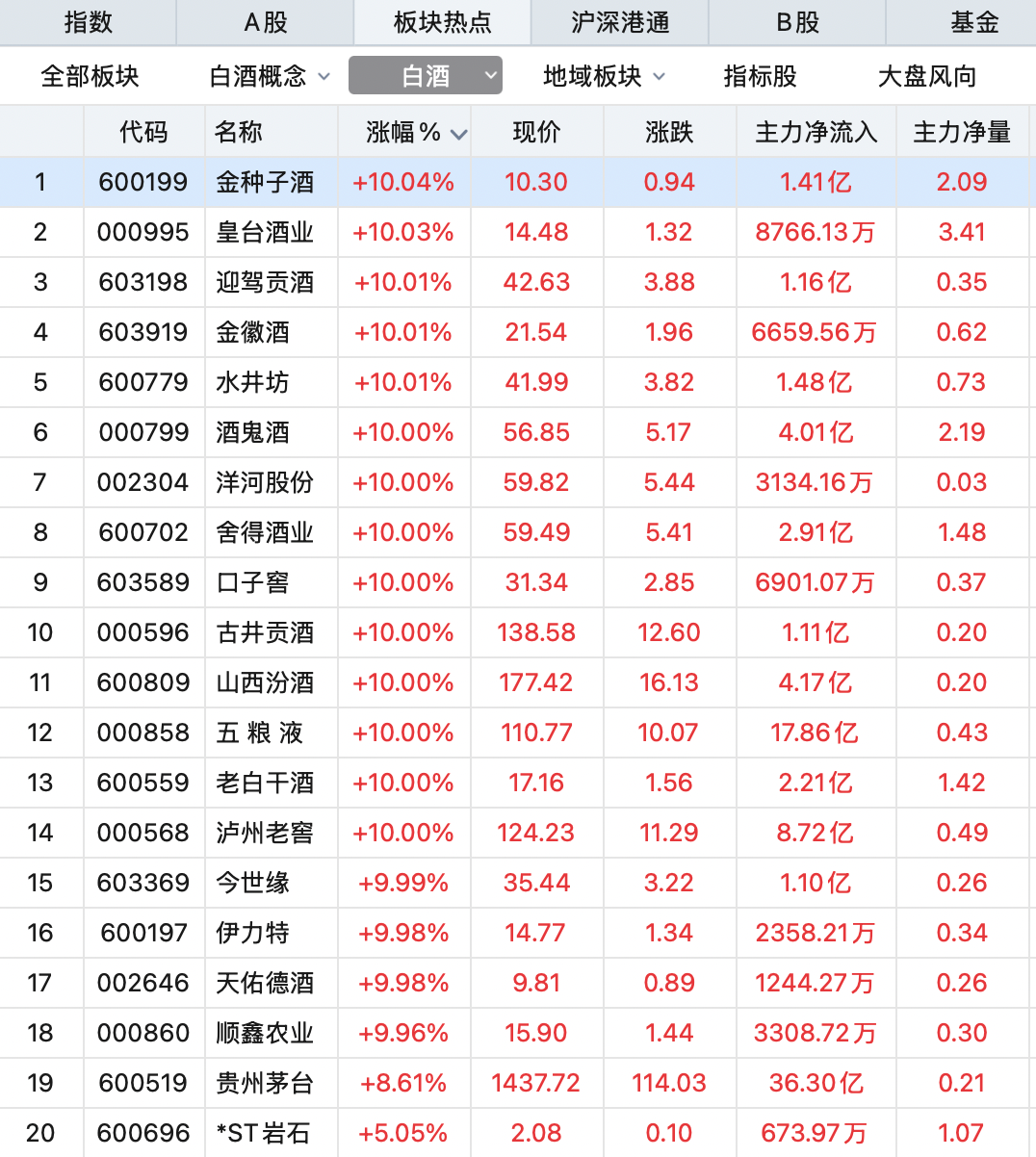
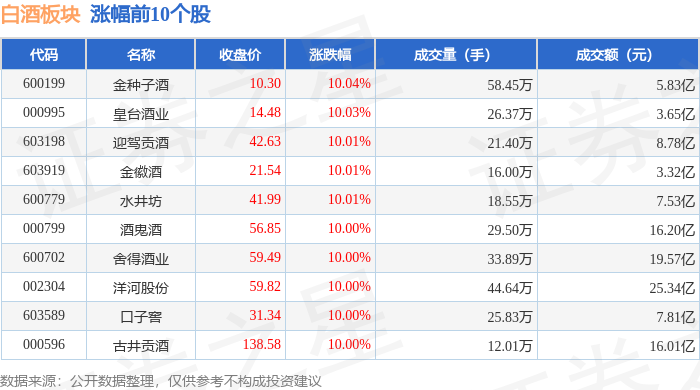
Core Viewpoint - The A-share liquor sector has experienced a significant rebound, driven by favorable policies, expectations of industry recovery, and positive macroeconomic data [1][3][9]. Group 1: Market Performance - As of November 10, the liquor sector index (BK0896) closed at 2349.92, with a rise of 2.92%, and several stocks, including Shede Liquor and Jiu Gui Jiu, reached their daily limit [1]. - Notable stocks such as Luzhou Laojiao and Gujing Gongjiu saw increases exceeding 6% [1]. - The overall market sentiment has improved, with the consumer sector also witnessing a collective rise, indicating a broader recovery trend [7]. Group 2: Policy and Industry Dynamics - A series of supportive policies have been introduced since late September, focusing on expanding domestic demand and promoting consumption, which has attracted capital to the liquor sector [3]. - The Ministry of Industry and Information Technology has included liquor in the "historical classic industries" category, emphasizing its cultural significance and potential for high-quality development [3]. - Recent policies from Guizhou province aim to shift the liquor industry from merely selling products to offering lifestyle services, indicating a strategic transformation in the sector [4]. Group 3: Financial Performance and Valuation - Despite a challenging third quarter for many liquor companies, the overall resilience of the sector has improved compared to previous downturns, with many companies showing better performance metrics [8][9]. - Analysts note that the valuation and sentiment in the sector are at low levels, which has contributed to the recent price increases [5]. - The presence of institutional investors in the market has been significant, with notable purchases in stocks like Jiu Gui Jiu, indicating renewed interest from larger players [5][6]. Group 4: Inventory and Sales Trends - The upcoming "Double 11" shopping festival is expected to help clear some inventory, although it is viewed as a short-term measure rather than a solution to the industry's deeper issues [10]. - Analysts suggest that while there is a limited recovery expected in the fourth quarter, the overall industry remains in a deep adjustment phase, with varying performance among different companies [14]. - The sales performance of premium products like Feitian Moutai has stabilized, contributing positively to market expectations [12][14].
酒鬼酒龙虎榜数据(11月10日)
Core Viewpoint - The stock of Jiu Gui Jiu experienced a significant increase, reaching the daily limit with a turnover rate of 9.98% and a transaction volume of 2.063 billion yuan, indicating strong market interest and activity [2]. Trading Activity - The stock was listed on the Shenzhen Stock Exchange due to a daily price deviation of 9.60%, with institutional investors net buying 37.6354 million yuan and the Shenzhen Stock Connect net buying 137 million yuan [2]. - The top five trading departments accounted for a total transaction volume of 490 million yuan, with a net buying amount of 150 million yuan [2]. - Among the trading departments, three institutional special seats were involved, with a total buying amount of 103 million yuan and selling amount of 65.5248 million yuan, resulting in a net buying of 37.6354 million yuan [2]. Fund Flow - The stock saw a net inflow of 386 million yuan from major funds, with a significant inflow of 330 million yuan from large orders and 56.2123 million yuan from medium orders [2]. - Over the past five days, the net inflow of major funds amounted to 219 million yuan [2]. Margin Trading Data - As of November 7, the margin trading balance for the stock was 754 million yuan, with a financing balance of 754 million yuan and a securities lending balance of 8.39 thousand yuan [3]. - In the past five days, the financing balance decreased by 66.9352 million yuan, representing a decline of 8.15%, while the securities lending balance saw a minor decrease of 0.0051 million yuan, or 5.77% [3].