ZGXT(000831)

Search documents
中国稀土行业 - 处于上行周期早中期,给予北方稀土 “买入” 评级、中国稀土 “中性” 评级-China Rare Earths-Early-to-Mid Upcycle Initiate NRE at Buy and CRE at Neutral
2025-10-13 01:00
Summary of the Rare Earths Industry Conference Call Industry Overview - The rare earths industry is recognized as a strategic sector crucial for the global transition to green energy, advanced manufacturing, and defense [1][2] - The sector is currently in an early-to-mid upcycle, driven by disciplined Chinese supply, favorable policy momentum, and resilient demand from electric vehicles (EVs) and renewable energy [2][12] Price Trends - Short-term prices are expected to remain firm due to tight supply and geopolitical risks, with a higher but stable price range anticipated mid-term as new capacity comes online [3][16] - Light Rare Earth Elements (LREEs) have seen price easing from 2022 peaks but remain above previous lows, while Heavy Rare Earth Elements (HREEs) maintain firm pricing due to tight supply [2][3] Company Analysis Northern Rare Earth (NRE) - Initiated with a Buy rating and a target price of Rmb72, reflecting its leading resource position and integrated product chain [1][5] - NRE is the largest LREE producer in China, benefiting from captive access to Bayan Obo resources and a vertically aligned value chain [5][23] - Current trading metrics: 54.9x 2026E P/E and 7x 2026E P/B, with a projected ROE of 9.3%/13.5%/16.6% for 2025E/26E/27E [24] China Rare Earth (CRE) - Initiated with a Neutral rating and a target price of Rmb61.6, due to its smaller scale and limited integration [1][6] - CRE is strategically important for HREEs but trades at a higher multiple than NRE, which is viewed as excessive [6][25] - Current trading metrics: 90.5x 2026E P/E and 11.1x 2026E P/B, with a forecasted ROE of 7%/12%/15% for 2025E/26E/27E [26] Valuation Insights - NRE and CRE are valued at +2 standard deviations and +1.5 standard deviations above their historical average P/B multiples, respectively, reflecting the sector's upcycle [4][21] - The valuation approach considers structural demand growth, tighter resource control, and stronger policy support [21][22] Key Risks - Risks include demand fluctuations in downstream applications, capacity expansion outside China, trade barriers, price volatility, and potential emergence of substitute materials [27][28] - Policy adjustments in China could significantly impact supply, costs, and profitability [28] Conclusion - The rare earths sector is positioned for growth, with NRE favored for its robust fundamentals and strategic resource access, while CRE is seen as less attractive due to its valuation and earnings volatility [20][25]


稀土:金属牛市旗手的潜力
2025-10-13 01:00
Summary of Rare Earth Industry Conference Call Industry Overview - The conference call focuses on the rare earth industry, particularly the implications of recent regulatory changes in China and the competitive landscape with the US and Europe [1][3][4]. Key Points and Arguments - **Chinese Regulatory Changes**: China has implemented stricter controls on rare earth exports through announcements 56 and 61, shifting from resource management to dual control over technology and supply chains to counter Western restrictions in the semiconductor and military sectors [1][3]. - **US and European Initiatives**: The US Department of Defense has partnered with MP Company and French firms to develop a self-sufficient rare earth supply chain, aiming to reduce reliance on Chinese pricing [3][4]. Goldman Sachs has released a report favoring neodymium prices, indicating a bullish outlook for the market [3]. - **Pricing Dynamics**: Rare earth prices are primarily influenced by supply and their strategic metal status rather than solely by demand. Historical data shows that price increases are not strictly limited by demand fluctuations [1][7]. The upcoming fourth quarter is expected to support price stability due to traditional consumption peaks and domestic demand recovery [7]. - **Market Demand**: There is a strong domestic demand for rare earth materials, particularly in the electric vehicle and optical communication sectors, which is expected to drive future growth [6]. Important but Overlooked Content - **Investment Recommendations**: Investors are advised to focus on traditional leading companies such as China Rare Earth, Northern Rare Earth, Shenghe Resources, and Guangsheng Nonferrous, as well as new entrants in the smelting sector like Huahong Technology [1][8]. Additionally, companies in the magnetic materials sector such as Jinli Permanent Magnet, Ningbo Yunsheng, Zhenghai Magnetic Materials, and Zhongke Sanhuan are highlighted as beneficiaries of increasing downstream orders [9]. - **Price Forecasts**: The price of heavy and medium rare earth oxides, such as dysprosium oxide, is projected to rise from approximately 7 million yuan per ton to around 10 million yuan per ton [2][9]. Conclusion - The rare earth industry is undergoing significant changes due to regulatory actions in China and strategic moves by the US and Europe. The focus on supply chain independence and the anticipated price increases present both opportunities and risks for investors in this sector.


特朗普暴怒掀桌!中国稀土“锁喉”美国军工,100%关税成最后王牌?
Sou Hu Cai Jing· 2025-10-12 19:22
Core Viewpoint - The escalating trade tensions between the U.S. and China are highlighted by Trump's announcement of a 100% tariff on Chinese goods, which is seen as a reaction to China's recent export controls on rare earth materials, crucial for U.S. military and technology sectors [3][5]. Group 1: U.S.-China Trade Relations - Trump's 100% tariff threat is a response to China's export controls on rare earths, lithium batteries, and superhard materials, which are essential for military applications and advanced technology [3][5]. - China has implemented strict regulations requiring foreign companies to obtain permission for producing rare earth products using Chinese technology or materials, particularly for military use and advanced chip production [3][5]. Group 2: Economic Implications - The U.S. heavily relies on China for rare earth supplies, with 80% of its needs met by Chinese sources, which poses a significant risk to U.S. military production capabilities, including the F-35 fighter jet [3][5]. - The U.S. faces deep economic concerns, including a growing national debt of $36 trillion, rising inflation, and a struggling manufacturing sector, which could be exacerbated by new tariffs [5][7]. Group 3: Strategic Responses - China's countermeasures are framed within legal and regulatory frameworks, contrasting with the unilateral actions taken by the U.S., indicating a strategic approach to the trade conflict [3][7]. - The ongoing trade battle is characterized as a high-stakes game where neither side may emerge as a clear winner, but the ability to navigate rules and maintain resilience will be crucial for long-term outcomes [7].


中美贸易摩擦或再度升级,我国稀土出口管制趋严且首次覆盖半导体或对海外芯片制程产生约束
HUAXI Securities· 2025-10-12 13:29
Investment Rating - Industry rating: Recommended [3] Core Insights - The recent announcements from the Ministry of Commerce and the General Administration of Customs have implemented stricter export controls on rare earth elements, particularly affecting the semiconductor industry and potentially impacting overseas chip manufacturing processes [1][10][16] - China dominates global rare earth supply, holding approximately 48.41% of the world's rare earth reserves and producing 68.54% of the total output [12][14] - The new export controls cover all 12 types of medium and heavy rare earth elements, marking a significant expansion in the scope of regulation [2][4] Summary by Sections Export Control Measures - The recent announcements (2025 No. 56 and 57) include export controls on rare earth equipment and raw materials, specifically targeting key technologies in rare earth mining, refining, and manufacturing [1][2] - The controls also extend to any downstream products that utilize Chinese rare earth technologies, requiring export licenses for a wide range of applications [5][10] Strategic Importance of Rare Earths - Rare earth elements are critical in various industries, including defense and semiconductor manufacturing, where they enhance material properties and performance [6][7] - The military applications of rare earths are significant, with advanced weapon systems heavily reliant on these materials [6] Semiconductor Industry Impact - The new regulations are the first to explicitly cover the semiconductor sector, which may lead to increased scrutiny and delays in overseas chip production [10][11] - Rare earths are essential for high-performance materials in semiconductor manufacturing, particularly as technology advances towards smaller transistor sizes [7][10] Renewable Energy Sector - Rare earths play a crucial role in the renewable energy sector, particularly in electric vehicle motors and wind turbine generators, with rare earth permanent magnets accounting for over 80% of the electric motor market share [11][12] Global Supply Chain Dynamics - The report highlights that while the U.S. is attempting to rebuild its rare earth supply chain, China's control over the entire rare earth industry chain remains unchallenged in the short term [15][16] - The overall completeness of the rare earth supply chain in the West is still lacking, with many projects facing delays and challenges [14][15]


稀土!稀土!稀土!聚焦前三大成分股:北方稀土、卧龙电驱、领益智造!
Quan Jing Wang· 2025-10-12 11:49
Core Insights - The Ministry of Commerce has announced strengthened export controls on rare earth-related items, highlighting the strategic importance of rare earth resources and increasing market attention on the rare earth sector [1][2] - The rare earth ETF (516780) and its linked funds (Class A 014331, Class C 014332) are gaining investor interest as quality tools for exposure to the rare earth sector, with the underlying index showing a significant increase of 94.69% over the past year [1] Industry Overview - The export control measures require specific exporters to obtain licenses from the Ministry of Commerce before exporting rare earth items outside China, which is expected to tighten supply and enhance China's leverage in the rare earth supply chain [2] - The rare earth sector is experiencing a resonance of supply and demand, with China's quota management and export controls ensuring resources are directed towards high-end applications, while global green transformation and carbon neutrality goals are driving demand for key elements like praseodymium and neodymium [2] Market Performance - The top five constituents of the CSI Rare Earth Industry Index, which the rare earth ETF tracks, include North Rare Earth, Wolong Electric Drive, Lingyi iTech, China Rare Earth, and Shenghe Resources, collectively accounting for 41% of the index [1] - The strategic position of the rare earth industry is expected to strengthen further, providing long-term momentum for high-end manufacturing development [2]


为什么中国稀土王牌威力这么大?美国有破解的方法吗?
Sou Hu Cai Jing· 2025-10-12 09:27
Core Viewpoint - The recent export control regulations by China on rare earth materials and technologies significantly impact the semiconductor industry and other high-tech sectors in the U.S. [1][3][4] Group 1: New Regulations and Their Implications - On October 9, China's Ministry of Commerce announced new regulations that impose export controls on certain rare earth-related items and technologies containing Chinese components [1]. - The new rules require foreign manufacturers to obtain permission from China to sell rare earth magnets and semiconductor materials that contain 0.1% or more of Chinese heavy rare earth elements [1][3]. - The regulations particularly affect the semiconductor industry, as they require applications for the use of Chinese rare earth materials in the production of advanced chips and military-related AI technologies [3][4]. Group 2: Impact on Semiconductor Manufacturers - TSMC, the world's leading semiconductor foundry, relies heavily on rare earth elements for chip manufacturing, which are primarily imported from mainland China [4][6]. - If TSMC uses Chinese rare earth elements in producing chips below 14nm, it will need Chinese permission to sell these chips to U.S. companies like Apple and Intel [4][6]. - The potential inability to source these materials could lead to significant challenges for U.S. chip manufacturers, affecting their production capabilities [6]. Group 3: Broader Implications for U.S. Industries - The U.S. military and aerospace sectors also heavily depend on rare earth elements, which are critical for various advanced weapon systems and technologies [6][7]. - For instance, the F-35 fighter jet requires 417 kg of rare earth materials, and a Virginia-class submarine needs 4600 kg, highlighting the extensive reliance on these materials [6]. - The automotive industry, particularly electric vehicles like those produced by Tesla, also utilizes rare earth elements in their manufacturing processes [6]. Group 4: China's Dominance in Rare Earth Production - China accounts for approximately 70% of global rare earth production and over 90% of rare earth refining capacity, particularly in heavy rare earths, where it holds more than 98% of the global market share [10][11]. - The technical expertise in rare earth processing and purification is predominantly held by China, making it difficult for other countries to establish competitive production capabilities [12][14]. - The U.S. has been unable to significantly improve its rare earth production and technology despite efforts to develop its own supply chain since 2010 [18][20]. Group 5: Challenges for U.S. Rare Earth Initiatives - The U.S. faces significant challenges in re-establishing its rare earth supply chain due to high production costs and environmental risks associated with rare earth mining [21][22]. - Many U.S. companies are reluctant to invest in rare earth mining and processing due to the potential for high costs and environmental liabilities [21][22]. - Collaborative efforts with other countries to develop rare earth industries have been slow and may take decades to yield results, leaving the U.S. reliant on Chinese imports in the near term [23][24].


出口管制加码,稀土或再迎配置机会
East Money Securities· 2025-10-12 05:17
Investment Rating - The report maintains an "Outperform" rating for the non-ferrous metals industry, indicating a relative performance expectation above the market [1]. Core Viewpoints - The Chinese government has implemented comprehensive export controls on rare earth elements, which may create new investment opportunities in the sector [4]. - The tightening of supply chains for rare earths globally, particularly due to U.S. efforts to restructure its supply chain, enhances the strategic importance of China's rare earth products [4]. - The demand for rare earths is expected to grow due to the increasing production of new energy vehicles and wind power installations, supporting the market performance of the rare earth sector [4]. - Investment recommendations include focusing on rare earth production companies such as Northern Rare Earth, China Rare Earth, and Guangxi Nonferrous Metals, as well as permanent magnet material companies like Jieneng Permanent Magnet [4]. Summary by Sections Export Controls - Starting November 8, 2025, China will impose export controls on certain heavy rare earth items, related equipment, and technologies, expanding the scope of previous regulations [4]. Supply Chain Dynamics - The U.S. has been investing in domestic rare earth production, including a $400 million investment in MP Materials, which highlights the challenges of restructuring the rare earth supply chain outside of China [4]. Policy Impact - New policies aimed at regulating rare earth mining and refining are expected to enhance the traceability of rare earth products and combat smuggling, further stabilizing the supply side [4]. Demand Growth - The demand for rare earths is projected to benefit from the growth in new energy vehicles and wind power installations, with exports of rare earth permanent magnets showing a year-on-year increase of 15.4% as of August [4].
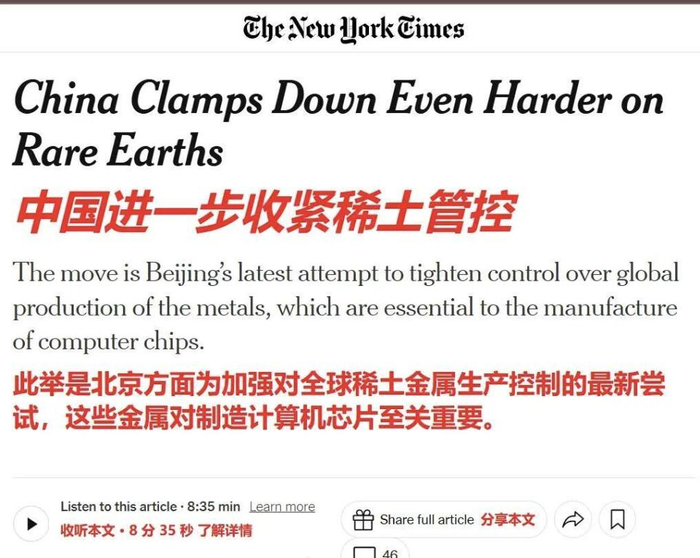
《纽约时报》:台积电因芯片含中国稀土,无法向美国出售任何半导体芯片
Xin Lang Cai Jing· 2025-10-12 04:25
Core Insights - The article outlines the implications of China's rare earth export controls as a response to U.S. technology restrictions, highlighting the ongoing tech rivalry between China and the U.S. [1] - The measures taken by China are seen as a legitimate counteraction to U.S. "long-arm jurisdiction," aiming to reshape global industry power dynamics [4][8] Summary by Sections - **U.S. Technology Restrictions** The U.S. has weaponized technology controls under the guise of national security, implementing chip export restrictions since 2022 and planning to blacklist 136 Chinese semiconductor entities by December 2024 [1][4] - **China's Rare Earth Controls** China's new regulations, effective from October 2025, will control not only rare earth materials but also any items with over 0.1% "Chinese content," particularly focusing on sensitive applications like chips below 14nm [4][5] - **Impact on Semiconductor Industry** The restrictions target critical components in the global semiconductor supply chain, affecting companies like ASML and TSMC, which rely on rare earth materials for high-end chip production [5][10] - **Strategic Response** China's measures are framed as a defense against the military use of sensitive technologies, contrasting with U.S. sanctions that often invoke "Taiwan-related" justifications [7][8] - **Legal Framework** China has established a legal framework centered around the Anti-Foreign Sanctions Law and Export Control Law, which further clarifies its operational pathways against U.S. sanctions [8][12] - **Global Supply Chain Dynamics** A RAND Corporation warning indicates that a 90-day disruption in China's rare earth supply could halt production for 78% of U.S. defense contractors, underscoring the importance of resource management in maintaining competitive advantage [10] - **Call for Cooperation** The article emphasizes that true technological competition should be based on open cooperation rather than zero-sum games, advocating for respect for sovereignty and adherence to rules in global tech governance [12]
贸易摩擦升级,再看稀土产业逻辑
Hu Xiu· 2025-10-12 00:25
Core Insights - Rare earth elements are essential in high-end manufacturing and defense technology, often referred to as "industrial vitamins" [1][9] - The demand for rare earth permanent magnets is expected to surge, particularly due to applications in humanoid robots [2][25] - China holds a critical position in the global supply chain of rare earths, leveraging its vast reserves and production capabilities amid escalating US-China trade tensions [3][4] Supply and Demand Dynamics - The recent export control policy implemented on October 9, 2025, is a significant catalyst for the rare earth sector, reshaping the global supply order [5] - China's strategic reserve of rare earths is set to increase by 25%, enhancing supply rigidity and control [6] - The combination of strong supply contraction and expanding high-end demand is projected to drive industry prosperity and elevate price levels [7] Industry Structure - The rare earth industry is characterized by a "North-South duopoly" structure, with major production concentrated in Baotou for light rare earths and Ganzhou for heavy rare earths [32][45] - China has completed the integration of its rare earth industry, with two major groups controlling 98% of the mining quotas, enhancing policy transmission efficiency and market regulation [47][57] Global Resource Distribution - As of 2024, global rare earth reserves are estimated at 90.88 million tons, with China accounting for 44 million tons, or 48.4% of the total [29][39] - The concentration of rare earth resources is primarily in China, Southeast Asia, Australia, Southern Africa, and the Americas [27] Technological and Competitive Advantages - China possesses a complete rare earth industry chain, from mining to refining to application, giving it unparalleled control in the global market [36][42] - Advanced separation and purification technologies, such as the low-temperature concentrated sulfuric acid roasting process, provide significant competitive advantages [43][44] Policy and Regulatory Environment - The new export control policy expands the range of controlled items and introduces "long-arm jurisdiction" principles, affecting global supply chains [65][70] - The policy aims to reshape the global rare earth supply chain and reinforce China's strategic dominance and pricing power in the sector [73][74] Key Companies in the Rare Earth Industry - **China Rare Earth**: Leading in heavy rare earths, with strategic advantages in resource security and industry pricing [76] - **Northern Rare Earth**: The largest supplier of light rare earths globally, with a complete industry chain and significant cost advantages [76] - **MP Materials**: The core of the US rare earth industry, moving towards vertical integration in magnet manufacturing [78] - **Lynas Rare Earths**: The largest rare earth separation producer outside China, crucial for Western efforts to establish an independent supply chain [78]
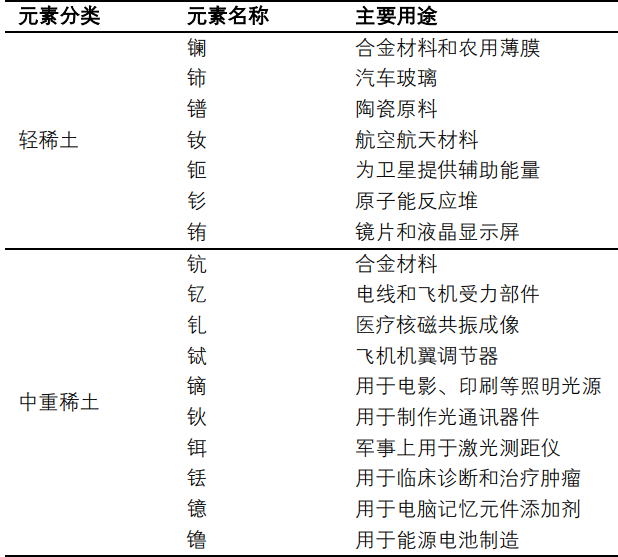
中国稀土新政出鞘,5种稀土+技术管制,特朗普紧急派两员大将应对
Sou Hu Cai Jing· 2025-10-11 17:50
Core Viewpoint - The recent announcement by China's Ministry of Commerce regarding rare earth export controls has heightened tensions in the U.S., prompting immediate action from the Trump administration to address the situation [1][3]. Group 1: China's Rare Earth Policy - The new rare earth management regulations set to be implemented in 2024 are based on a long-term strategy, establishing a traceability system for rare earth products that covers the entire supply chain from extraction to export [3]. - The new policy not only restricts raw material exports but also limits the dissemination of refining technologies, further solidifying China's control over the rare earth market [3]. - China currently dominates the global rare earth industry, producing 92% of the world's refining capacity and being the only country capable of fully producing all 17 rare earth elements [5]. Group 2: U.S. Response and Strategic Moves - The U.S. is attempting to mitigate its reliance on China by accelerating partnerships with countries like Canada and Australia, including the construction of rare earth separation plants [5]. - The U.S. Department of Defense has set a minimum price of $110 per kilogram for critical materials like neodymium and praseodymium, which is nearly double the market price, to secure military supply needs [3]. - The U.S. is also exploring a $200 billion currency swap agreement with Argentina to gain access to lithium and rare earth resources, although negotiations are complicated by Argentina's balancing act between the U.S. and China [3][10]. Group 3: Global Market Impact - China's export controls have triggered significant price fluctuations in the global market, with prices for dysprosium and terbium in Europe reportedly tripling [5]. - Major U.S. companies are beginning to stockpile inventory in response to supply chain risks, affecting production plans for companies like Tesla and Ford [5]. - Japan and the EU have initiated emergency measures in response to China's new regulations, but they face challenges in overcoming their dependence on Chinese refining technology [9]. Group 4: Future Outlook - Rebuilding a complete rare earth supply chain in the U.S. is estimated to require a decade and an investment of $300 billion [7]. - China's Ministry of Commerce has indicated that it will establish a "green channel" for expedited approval of compliant export applications, maintaining flexibility in its supply chain management [7][12]. - The military significance of rare earth elements complicates the geopolitical landscape, as new regulations restrict exports to foreign military users, impacting U.S. industries, including artificial intelligence [7][9].