
Holly Futures(001236)

Search documents
铁矿石周报20260120:供需偏宽松,盘面高位回落-20260120
Hong Ye Qi Huo· 2026-01-20 08:09
供需偏宽松,盘面高位回落 铁矿石周报 20260120 博士后工作站 | 宏观研究 | 大宗商品 周贵升 从业资格证:F3036194 投资咨询证:Z0015986 交易逻辑:供需偏宽松,盘面高位回落 供应:外矿方面,1月12日-1月18日,全球铁矿石发运总量2929.8万吨,环比减少251.1万吨;澳洲发运量1688万吨,环比减少 243.6万吨;巴西发运量553.7万吨,环比减少110.6万吨,非主流矿发运量1175.6万吨,环比增加175.7万吨。中国45港到港总 量2659.7万吨,环比减少260.7万吨。内矿方面,截至1月16日,全国186家矿山铁精粉日均产量46.67万吨,环比增1.02万吨, 产能利用率59.72%,环比增1.31%;矿山精粉库存87.5万吨,环比增1.18万吨。 需求:1月16日当周,日均铁水产量228.01万吨,环比-1.49万吨。受环保影响,铁水产量小幅回落,叠加包钢事故影响部分高 炉,原料矿石需求有所减弱。 库存:本期进口矿库存持续回升,在港船舶数量增加1艘至117艘。本期压港小幅增加,到港量小幅回落仍维持高位,港口库存 持续累积,对矿价上方空间有所压制,而钢厂库存有所增 ...

钢材周报:基本面偏弱,钢价震荡运行-20260119
Hong Ye Qi Huo· 2026-01-19 12:32
1. Report Industry Investment Rating No relevant content provided. 2. Core View of the Report The fundamentals of the steel industry are weak, and steel prices are expected to fluctuate in the short - term. The profitability of steel mills has increased, but with the deepening of the off - season, demand is expected to gradually weaken, and the upward driving force is limited [4][5]. 3. Summary by Related Catalogs 3.1成材 (Finished Products) - **Supply**: Some steel mills carried out maintenance. The weekly output of rebar from major steel mills nationwide was 1.903 million tons (- 0.74 thousand tons), and the weekly output of hot - rolled coils was 3.0836 million tons (+ 2.85 thousand tons) [4]. - **Demand**: Demand increased but was seasonally weak overall. The apparent demand for rebar last week was 1.9034 million tons (+ 15.38 thousand tons), and that for hot - rolled coils was 3.1416 million tons (+ 5.82 thousand tons) [4]. - **Inventory**: Rebar inventory decreased slightly, and hot - rolled coil inventory continued to decline but still faced pressure. Rebar total inventory was 4.3807 million tons (- 0.04 thousand tons), social inventory was 2.9541 million tons (+ 5.23 thousand tons), and steel mill inventory was 1.4266 million tons (- 5.27 thousand tons); hot - rolled total inventory was 3.6233 million tons (- 5.8 thousand tons), social inventory was 2.858 million tons (- 5.01 thousand tons), and steel mill inventory was 0.7653 million tons (- 0.79 thousand tons) [4]. - **Basis**: As of January 16, the basis of the rebar main contract was 137 yuan/ton (- 9 yuan/ton), and that of the hot - rolled main contract was - 15 yuan/ton (+ 9 yuan/ton) [4]. - **Summary**: The profitability rate of steel mills rose to 39.83%; the molten iron output was 2.2801 million tons, a week - on - week decrease of 14.9 thousand tons. The blast furnace operating rate was 78.84%, a week - on - week decrease of 0.47%, and the blast furnace capacity utilization rate was 85.48%, a week - on - week decrease of 0.56%; the electric furnace operating rate was 72.97%, unchanged from the previous week, and the electric furnace capacity utilization rate was 57.99%, a week - on - week increase of 1.08% [4]. 3.2 Raw Materials - **Prices**: The price of quasi - first - grade metallurgical coke was 1,470 yuan/ton (- 10 yuan/ton), the price of main coking coal in Lvliang was 1,426 yuan/ton (+ 23 yuan/ton), and the price of 61.5% PB powder at Qingdao Port was 819 yuan/ton (- 7 yuan/ton) [17]. 3.3 Steel Mill Operating Conditions - **Molten Iron Output and Blast Furnace Operating Rate**: Molten iron output declined, and the blast furnace operating rate decreased slightly. As of January 16, the blast furnace operating rate in Tangshan was 90.77%, a week - on - week increase of 0.78% [20][30]. - **Profitability Rate**: The profitability rate of steel mills increased [24]. 3.4 Production - **Rebar**: As of January 16, rebar production decreased by 0.74 thousand tons week - on - week. In terms of process, long - process production decreased by 1.94 thousand tons week - on - week, and short - process production increased by 1.2 thousand tons week - on - week [35]. - **Hot - rolled Coils**: Hot - rolled coil production increased by 2.85 thousand tons week - on - week [35]. 3.5 Demand - **Rebar**: As of January 16, the weekly average trading volume of rebar was 91.8 thousand tons [43]. - **Hot - rolled Coils**: As of January 16, the weekly average trading volume of hot - rolled coils was 30.2 thousand tons. The downstream cold - rolled production was 886.7 thousand tons, a week - on - week decrease of 0.17 thousand tons, and it was at a high level compared to the same period [48]. 3.6 Inventory - **Tangshan Billet**: As of January 16, the inventory of Tangshan billets was 521 thousand tons, a week - on - week decrease of 97.7 thousand tons. The inventory of major steel products was 8.661 million tons, a week - on - week increase of 0.74 thousand tons [52]. - **Rebar**: Rebar inventory decreased slightly [54]. - **Hot - rolled Coils**: Hot - rolled coil inventory continued to decline [59]. 3.7 Downstream Industries - **Steel Exports**: In November, steel exports were 9.98 million tons, a month - on - month increase of 197.8 thousand tons; from January to November, the cumulative steel export volume was 107.7 million tons, a cumulative year - on - year increase of 6.7%. In November, hot - rolled coil exports were 1.8303 million tons [64]. - **Automobile Industry**: In November, automobile production was 3.532 million vehicles, a month - on - month increase of 173.3 thousand vehicles; automobile sales were 3.429 million tons, a month - on - month increase of 106.9 thousand tons. In November, new - energy vehicle production was 1.88 million vehicles, a month - on - month increase of 108 thousand vehicles; new - energy vehicle sales were 1.823 million tons, a month - on - month increase of 108 thousand tons [68]. - **Real Estate Industry**: From January to December, national real estate development investment decreased by 17.2% year - on - year, with a decline of 1.3%. Specifically, from January to December, the cumulative new construction area of houses was 597.7 million square meters, a year - on - year decrease of 20.4%; the cumulative completion area of houses was 603.48 million square meters, a year - on - year decrease of 18.1%. From January to December, the sales area of newly built commercial housing was 881.01 million square meters, a year - on - year decrease of 8.7%. The sales amount of newly built commercial housing decreased by 12.6% year - on - year, with a decline of 1.5%. From January to December, the cumulative funds in place of development enterprises was 93.117 trillion yuan, a year - on - year decrease of 13.4% [72].
供需双减,工业硅震荡整理
Hong Ye Qi Huo· 2026-01-19 08:46
1. Report's Industry Investment Rating - No relevant information provided 2. Core Viewpoints of the Report - Industrial silicon is currently experiencing a double reduction in supply and demand, with high inventory difficult to deplete, but strong cost support below, so the short - term market is expected to remain volatile. Attention should be paid to the start - up changes in the north [2]. - Polysilicon currently has weak supply and demand and inventory pressure, but the supply - demand pattern is expected to improve due to the shutdown of leading enterprises, and it is expected to remain volatile in the short term [3]. 3. Summary by Relevant Catalogs Industrial Silicon Price - As of January 16, 2026, the spot price of Xinjiang industrial silicon 553 oxygen - passed was 8,800 yuan/ton, unchanged from last week. The futures main contract oscillated, closing at 8,605 yuan/ton on January 16 [2]. - As of January 16, 2026, the price of Xinjiang industrial silicon 421 oxygen - passed was 9,050 yuan/ton, unchanged from last week [6]. Supply - In Xinjiang, there are both production increases and decreases, with an overall reduction. It is rumored that ore mining is restricted due to weather, and large factories may shut down about 30 furnaces. In Yunnan, production is mainly for integrated supporting or long - term order delivery, and in Sichuan, only a sample large factory is in production. The overall output of industrial silicon has continued to decline month - on - month [2]. - As of January 16, 2026, the number of operating furnaces of industrial silicon nationwide was 227, a decrease of 7 from the previous week; the operating rate was 28.16%, a decrease of 0.87%; the weekly output was 85,700 tons, a decrease of 3,000 tons from the previous week [17]. Demand - The start - up of polysilicon is weak, with leading enterprises gradually shutting down from the middle of the month, and the output is expected to decline. The start - up of organic silicon remains stable, and is expected to remain stable or decline slightly before the Spring Festival. The price of aluminum alloy ingots has risen with the price of aluminum, but the downstream die - casting enterprises have limited acceptance, and the start - up expectation has been lowered. In November, the export of industrial silicon was 54,900 tons, a month - on - month increase of 22% and a year - on - year increase of 4% [2]. Cost - The cost of industrial silicon remained stable this week [2]. Inventory - As of January 15, the total social inventory of industrial silicon nationwide was 555,000 tons, an increase of 3,000 tons from the previous week [2]. Spread - As of January 16, 2026, the spread between Yunnan industrial silicon 553 oxygen - passed and 421 oxygen - passed was 400 yuan/ton, unchanged from last week. The spread between Xinjiang industrial silicon 553 oxygen - passed and 421 oxygen - passed was 250 yuan/ton, unchanged from last week [10]. Polysilicon Price - As of January 16, 2026, the spot price of polysilicon remained stable. The price of N - type dense material was 59,000 yuan/ton, unchanged from last week. The futures main contract corrected from a high level, closing at 50,200 yuan/ton on January 16 [3]. - As of January 16, 2026, the price of N - type re - fed material was 61,000 yuan/ton, the price of N - type mixed material was 56,500 yuan/ton, and the price of N - type granular material was 58,000 yuan/ton, all unchanged from last week [13]. Supply - The expected output of polysilicon in January is 104,800 tons. Due to the gradual shutdown of some leading enterprises from the middle of the month, the output in February may be less than 90,000 tons [3]. Demand - Polysilicon enterprises' quotations remain high at 63 - 65 yuan/kg, but downstream silicon wafer enterprises are holding down prices and waiting and seeing. Actual transactions are mainly for executing previous orders and a small number of scattered orders. Although there is a rush - to - install demand before the export tax rebate is cancelled in April, the terminal is still in the off - season, the price increase has not been passed on to silicon wafers, the crystal - pulling link is suffering serious losses, and the acceptance of high - priced polysilicon is low. In November, the import volume of polysilicon was 1,055.1 tons, a month - on - month decrease of 27%; the export volume was 3,230.1 tons, a month - on - month increase of 109% [3]. Cost - The cost of polysilicon remained stable this week [3]. Inventory - As of January 16, 2026, the polysilicon factory inventory was 297,100 tons, an increase of 1,500 tons from the previous week [21]. Downstream Silicon Wafers - As of January 16, 2026, the average prices of N - type M10 - 182(130µm), N - type G10L - 183.75(130µm), N - type G12R - 210R(130µm) and N - type G12 - 210(130µm) were 1.375, 1.375, 1.475 and 1.675 yuan/piece respectively, unchanged from last week. The silicon wafer market is generally stable, leading enterprises' quotations remain stable, the transaction prices of second - and third - tier enterprises have declined slightly. In the terminal off - season, buyers strongly resist high prices, battery factories have good profits and maintain small - order procurement for rigid demand [24]. Battery Cells - As of January 16, 2026, M10 single - crystal TOPCon, G10L single - crystal TOPCon, G12R single - crystal TOPCon and G12 single - crystal TOPCon were quoted at 0.405, 0.405, 0.405 and 0.405 yuan/watt respectively, an increase of 0.02 yuan/watt from last week. The battery cell market continues to strongly support prices. Exporters are locking in export orders in advance to cope with the cancellation of the VAT export tax rebate policy on April 1, and the export price is significantly higher than the domestic sales price [28]. Components - As of January 16, 2026, 182 single - sided TOPCon, 210 single - sided TOPCon, 182 double - sided TOPCon and 210 double - sided TOPCon were quoted at 0.72, 0.735, 0.72 and 0.735 yuan/watt respectively, an increase of 0.035, 0.03, 0.035 and 0.03 yuan/watt from last week. Affected by the upcoming cancellation of the export tax rebate policy, component manufacturers generally raised their quotations [32]. Organic Silicon - As of January 16, 2026, the price of organic silicon DMC in East China was 14,000 yuan/ton, an increase of 300 yuan/ton from last week. Recently, the profit of organic silicon monomer factories has improved, and the start - up has remained stable [35]. Aluminum Alloy - As of January 16, 2026, the price of Shanghai aluminum alloy ingot ADC12 was 23,400 yuan/ton, an increase of 100 yuan/ton from last week. The price of aluminum continues to be strong, but the downstream die - casting enterprises have limited acceptance, and the start - up expectation of alloy enterprises has been lowered [39].
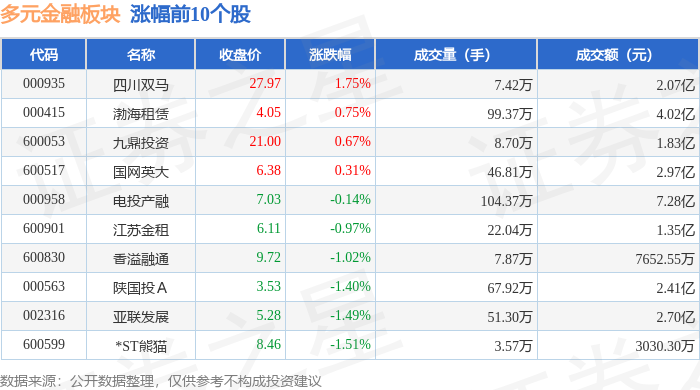
多元金融板块1月15日跌2.57%,拉卡拉领跌,主力资金净流出17.64亿元
Zheng Xing Xing Ye Ri Bao· 2026-01-15 08:59
Market Overview - The diversified financial sector experienced a decline of 2.57% on January 15, with Lakala leading the drop [1] - The Shanghai Composite Index closed at 4112.6, down 0.33%, while the Shenzhen Component Index closed at 14306.73, up 0.41% [1] Individual Stock Performance - Notable performers in the diversified financial sector included: - Sichuan Shuangma (Code: 000935) with a closing price of 27.97, up 1.75% and a trading volume of 74,200 shares [1] - Bohai Leasing (Code: 000415) closed at 4.05, up 0.75% with a trading volume of 993,700 shares [1] - Jiuding Investment (Code: 600053) closed at 21.00, up 0.67% with a trading volume of 87,000 shares [1] - Conversely, Lakala (Code: 300773) saw a significant drop of 5.92%, closing at 30.18 with a trading volume of 1,582,000 shares and a transaction value of 4.804 billion [2] Capital Flow Analysis - The diversified financial sector saw a net outflow of 1.764 billion from institutional investors, while retail investors experienced a net inflow of 1.092 billion [2] - The capital flow for individual stocks showed: - Bohai Leasing had a net inflow of 41.08 million from institutional investors, but a net outflow of 33.48 million from retail investors [3] - Jiuding Investment had a net inflow of 17.84 million from institutional investors, with a net outflow of 14.78 million from retail investors [3] - Sichuan Shuangma had a net inflow of 4.18 million from institutional investors, but a net outflow of 589.49 thousand from retail investors [3]



弘业期货跌3.51%,成交额2.03亿元,近3日主力净流入-1260.64万
Xin Lang Cai Jing· 2026-01-15 07:38
Core Viewpoint - 弘业期货 experienced a decline of 3.51% in stock price, with a trading volume of 203 million yuan and a market capitalization of 10.531 billion yuan [1] Company Overview - 弘业期货股份有限公司 primarily engages in commodity futures brokerage, financial futures brokerage, futures investment consulting, asset management, fund sales, and financial asset investment [2][7] - The company is the first A+H share listed company in the futures industry [2] - 弘业期货 is a state-owned enterprise, ultimately controlled by the Jiangsu Provincial Government's State-owned Assets Supervision and Administration Commission [3] Financial Performance - For the period from January to September 2025, 弘业期货 reported operating revenue of 462 million yuan, a year-on-year decrease of 76.77%, and a net profit attributable to shareholders of 2.0897 million yuan, down 87.27% year-on-year [7] - Cumulative cash distribution since A-share listing amounts to 44.3422 million yuan, with 14.1089 million yuan distributed over the past three years [8] Shareholder Structure - As of September 30, 2025, the number of shareholders is 54,400, a decrease of 13.10% from the previous period [7] - Major shareholders include Hong Kong Central Clearing Limited and Southern CSI 1000 ETF, with notable changes in their holdings [8] Market Activity - The stock has seen a net outflow of 4.4391 million yuan today, with a continuous reduction in principal funds over the past three days [4][5] - The average trading cost of the stock is 11.17 yuan, with current price action between resistance at 10.47 yuan and support at 10.41 yuan, indicating potential for range trading [6]
弘业期货跌2.00%,成交额1.61亿元,近3日主力净流入-2490.92万
Xin Lang Cai Jing· 2026-01-13 08:08
Core Viewpoint - 弘业期货 is experiencing a decline in stock price and trading volume, with a significant drop in revenue and net profit year-on-year, indicating potential challenges in its financial performance and market position [1][7]. Company Overview - 弘业期货股份有限公司 primarily engages in commodity futures brokerage, financial futures brokerage, futures investment consulting, asset management, fund sales, and financial asset investment [2][7]. - The company is the first A+H share listed company in the futures industry and is controlled by the Jiangsu Provincial Government State-owned Assets Supervision and Administration Commission [3][7]. Financial Performance - For the period from January to September 2025, 弘业期货 reported operating revenue of 462 million yuan, a year-on-year decrease of 76.77%, and a net profit attributable to shareholders of 2.09 million yuan, down 87.27% year-on-year [7]. - The company has distributed a total of 44.34 million yuan in dividends since its A-share listing, with 14.11 million yuan distributed over the past three years [8]. Market Activity - On January 13, 弘业期货's stock fell by 2.00%, with a trading volume of 161 million yuan and a turnover rate of 1.95%, resulting in a total market capitalization of 10.884 billion yuan [1]. - The main net inflow of funds was negative at 8.08 million yuan, indicating a reduction in institutional investment over the past three days [4][5]. Technical Analysis - The average trading cost of the stock is 11.20 yuan, with the current price approaching a resistance level of 10.83 yuan, suggesting potential for a price correction if this level is not surpassed [6].
弘业期货涨1.94%,成交额2.05亿元,近5日主力净流入-1427.20万
Xin Lang Cai Jing· 2026-01-12 11:23
Core Viewpoint - 弘业期货 is a leading player in the futures market, showing a recent increase in stock price and trading activity, but facing significant declines in revenue and profit year-over-year [1][7]. Company Overview - 弘业期货股份有限公司 primarily engages in commodity futures brokerage, financial futures brokerage, futures investment consulting, asset management, fund sales, and financial asset investment [2][7]. - The company is the first A+H share listed company in the futures industry and is controlled by the Jiangsu Provincial Government's State-owned Assets Supervision and Administration Commission [3][7]. - As of September 30, 2025, the company reported a revenue of 462 million yuan, a year-on-year decrease of 76.77%, and a net profit of 2.09 million yuan, down 87.27% year-on-year [7]. Financial Performance - The stock price of 弘业期货 increased by 1.94% recently, with a trading volume of 205 million yuan and a turnover rate of 2.47%, leading to a total market capitalization of 11.11 billion yuan [1]. - The average trading cost of the stock is 11.21 yuan, with the current price near a support level of 11.01 yuan, indicating potential for a rebound if this level holds [6]. - The company has distributed a total of 44.34 million yuan in dividends since its A-share listing, with 14.11 million yuan distributed over the past three years [8]. Shareholder Structure - As of September 30, 2025, the number of shareholders decreased by 13.10% to 54,400, with no circulating shares per capita [7][8]. - Major shareholders include Hong Kong Central Clearing Limited and Southern CSI 1000 ETF, with notable reductions in their holdings [8].
钢材周报:螺纹库存增加,钢价震荡运行-20260112
Hong Ye Qi Huo· 2026-01-12 11:16
Report Summary 1. Investment Rating No explicit investment rating for the industry is provided in the report. 2. Core View The steel market shows a pattern of increasing supply, weakening demand, and mixed inventory trends. Due to rising raw material costs, narrowing profit margins, and seasonal factors, steel prices are expected to fluctuate in the short term. Macro - level policies aim to maintain liquidity, but terminal demand remains weak, and attention should be paid to inventory accumulation [5]. 3. Summary by Category 3.1 Steel Product Situation - **Supply**: The output of both rebar and hot - rolled coils increased. The weekly output of rebar from major national steel mills was 191.04 million tons (+2.82 million tons), and that of hot - rolled coils was 305.51 million tons (+1 million tons). Some steel mills completed maintenance, leading to increased iron - water output and a significant rise in EAF operating rates [4]. - **Demand**: Demand was seasonally weak. The apparent demand for rebar last week was 174.96 million tons (-25.48 million tons), and that for hot - rolled coils was 308.34 million tons (-2.43 million tons). The weekly average trading volume of rebar as of January 9 was 8.03 million tons, and that of hot - rolled coils was 2.65 million tons [4][46][50]. - **Inventory**: Rebar inventory accumulated, while hot - rolled coil inventory continued to decline but at a slower pace. The total rebar inventory was 438.11 million tons (+16.08 million tons), and the total hot - rolled coil inventory was 368.13 million tons (-2.83 million tons) [4]. - **Basis**: As of January 9, the basis of the rebar main contract was 146 yuan/ton (-32 yuan/ton), and that of the hot - rolled coil main contract was -24 yuan/ton (-24 yuan/ton) [4]. - **Price**: The national average price of rebar was 3337 yuan/ton, a week - on - week increase of 16 yuan/ton, and that of hot - rolled coils was 3306 yuan/ton, also a week - on - week increase of 16 yuan/ton [10]. 3.2 Raw Material Situation The cost - side support strengthened. The price of quasi - first - grade metallurgical coke was 1480 yuan/ton, a week - on - week increase of 30 yuan/ton; the price of main coking coal in Lüliang was 1403 yuan/ton, a week - on - week decrease of 47 yuan/ton; and the price of 61.5% PB powder at Qingdao Port was 826 yuan/ton, a week - on - week increase of 18 yuan/ton [18]. 3.3 Steel Mill Situation - The profitability rate of steel mills declined to 37.66%. The iron - water output was 229.5 million tons, a week - on - week increase of 2.07 million tons. The blast furnace operating rate was 79.31%, a week - on - week increase of 0.37%, and the blast furnace capacity utilization rate was 86.04%, a week - on - week increase of 0.78%. The EAF operating rate was 72.97%, a week - on - week increase of 4.34%, and the EAF capacity utilization rate was 56.91%, a week - on - week increase of 1.76% [4]. - As of January 9, the blast furnace operating rate in Tangshan was 89.99%, a week - on - week decrease of 3.65% [29]. 3.4 Downstream Demand Situation - **Automobile Industry**: In November, automobile production was 3.532 million units, a month - on - month increase of 173,300 units; sales were 3.429 million tons, a month - on - month increase of 106,900 tons. New - energy vehicle production was 1.88 million units, a month - on - month increase of 108,000 units; sales were 1.823 million tons, a month - on - month increase of 108,000 tons [69]. - **Real Estate Industry**: From January to November, real estate investment decreased by 15.9% year - on - year, new housing starts decreased by 20.5% year - on - year, housing completion decreased by 18% year - on - year, commercial housing sales area decreased by 7.8% year - on - year, commercial housing sales revenue decreased by 11.1% year - on - year, and funds in place decreased by 11.9% year - on - year [72][73]. 3.5 Export Situation In November, steel exports were 9.98 million tons, a month - on - month increase of 197,800 tons. From January to November, cumulative steel exports were 107.7 million tons, a cumulative year - on - year increase of 6.7%. In November, hot - rolled coil exports were 1.8303 million tons [65].
双焦周报20260112:供需双增,盘面低位反弹-20260112
Hong Ye Qi Huo· 2026-01-12 08:28
Market View Coking Coal - Supply: The operating rate of 523 sample mines was 85.34% (+5.71%), and the daily average output of clean coal was 73.43 million tons (+4.42). The capacity utilization rate of 314 coal washing plants was 35.42% (+0.33%), and the daily average output of clean coal was 26.12 million tons (+0.31). The operating rate and daily average output of mines increased month-on-month, as did the capacity utilization rate and clean coal output of coal washing plants. After the import surge of Mongolian coal at the beginning of the year, the customs clearance volume at the Ganqimaodu Port remained high last week, and overall supply increased [4]. - Demand: The daily output of molten iron from 247 steel mills was 2.295 million tons (+2.07), the blast furnace operating rate was 79.31% (+0.37%), the available days of coking coal in steel mills were 12.8 days (-0.08), and those in 230 independent coking plants were 13.68 days (+0.07). The blast furnace operating rate of steel mills continued to rise, the daily output of molten iron increased month-on-month, the available days of coking coal in steel mills slightly decreased, and those in coking plants slightly increased. Downstream demand was mainly for rigid procurement [4]. - Inventory: The clean coal inventory of 523 sample mines was 2.9501 million tons (+1.67), that of all sample independent coking plants was 10.7168 million tons (+19.18), that of steel mills was 7.9773 million tons (-4.54), that of 314 sample coal washing plants was 3.1965 million tons (-9.36), and that of major ports was 2.998 million tons (-1.5). Currently, the inventories of coking coal mines and coking plants have slightly accumulated, while those of coal washing plants, ports, and steel mills have slightly decreased, and the purchasing sentiment has weakened [4]. - Summary: Last week, the supply and demand of the coking coal market both increased. Affected by positive factors such as the warming of macro - sentiment and the reduction of production capacity in production areas, the futures market rebounded from a low level. Previously shut - down coal mines gradually resumed production, and the operating rate of mines in the main production areas was 85.34%. Domestic supply gradually recovered. In terms of imports, Mongolian coal imports remained at a high level in the new year. On the demand side, the daily output of molten iron continued to rise, and the coke output remained stable for the time being. Coking and steel plants still mainly engaged in rigid procurement, and there was no large - scale centralized restocking. Overall, domestic coal mines have returned to normal production, imports remain at a high level year - on - year, supply has increased, while downstream coking and steel enterprises have poor profitability, and there is no large - scale centralized restocking. The market generally maintains a low - level shock [4]. Coke - Supply: The average profit per ton of coke in coking plants was - 45 yuan/ton (-31), the capacity utilization rate of all sample independent coking plants was 72.69% (+0.97%), the daily output of all sample independent coking plants was 635,700 tons (+0.85), and the daily output of coke from 247 steel mills was 468,800 tons (+0.05). The loss of the average profit per ton of coke in coking plants continued to expand, and there was still an expectation of a fifth - round price cut for coke, putting pressure on coking profits. However, overall production remained stable for the time being. The main reason was that the sales situation had improved recently, some coking enterprises increased production, and the coke output of steel mills slightly increased [5]. - Demand: The daily output of molten iron from 247 steel mills was 2.295 million tons (+2.07), the blast furnace operating rate was 79.31% (+0.37), and the available days of coke in 247 steel mills were 12.02 days (-0.08). The daily output of molten iron continued to rise, the blast furnace operating rate continued to increase, the inventory usage cycle of steel mills' coke slightly decreased, and there was a rigid demand for coke [5]. - Inventory: The inventory of all sample independent coking plants was 860,700 tons (-5.53), that of major ports was 1.841 million tons (+4.01), and that of 247 steel mills was 6.4573 million tons (+1.74). The inventory of coking plants slightly decreased, while those of steel mills and ports slightly increased, and the overall social inventory of coke slightly increased [5]. - Summary: In terms of supply, the overall production level of coking enterprises remained stable for the time being. Due to the improved sales situation, some coking enterprises increased production. Coupled with the increase in the coke output of steel mills, the overall supply slightly increased. In terms of demand, the profitability of steel mills has improved, the resumption of blast furnaces has increased, the daily output of molten iron from steel mills has risen, and steel mills have a rigid demand for coke. Overall, the current supply and demand of coke both increased. Recently, the strengthening of raw materials supported the futures market to be relatively strong, but the market still has an expectation of a fifth - round price cut. It is expected that the futures market will follow and maintain a low - level shock. Attention should be paid to the winter storage restocking demand [5]. Macro - Real Estate Tracking - The report presents data on the cumulative year - on - year growth rate of national fixed asset investment, the cumulative year - on - year growth rate of new construction, construction, completion, and sales areas of national real estate, the weekly commercial housing transaction area in 30 large - and medium - sized cities, the Purchasing Managers' Index (PMI) of the steel industry, and the Manufacturing Purchasing Managers' Index (PMI) [7][11][15][19] Coking Coal Supply - Demand Tracking - The report tracks data such as the purchase price of medium - sulfur main coking coal in Jiexiu, Jinzhong, Shanxi, the comparison of mainstream coking coal spot prices nationwide, the basis of coking coal futures contracts, the daily output and operating rate of 523 sample coal mines, the daily output and capacity utilization rate of 314 sample coal washing plants, the daily output and blast furnace operating rate of 247 steel mills nationwide, the inventories of 314 sample coal washing plants, 523 sample mines, 247 steel mills, and all sample independent coking plants, the port coking coal inventory, the available days of coking coal inventory in 247 steel mills and 230 independent coking plants nationwide, and the customs clearance vehicle numbers of Mongolian coal at the Ganqimaodu Port [22][26][32] Coke Supply - Demand Tracking - The report tracks data including the ex - factory price of quasi - first - grade metallurgical coke in Lvliang, the coke spot price adjustment schedule, the comparison of coke spot prices, the basis of coke futures contracts, the profit per ton of independent coking enterprises, the daily output and capacity utilization rate of all sample independent coking enterprises and 247 steel mills, the inventories of all sample independent coking enterprises, 247 steel mills, and port coke, and the available days of coke inventory in 247 steel mills [60][62][64]
弘业期货涨2.04%,成交额1.10亿元,主力资金净流出354.13万元
Xin Lang Cai Jing· 2026-01-12 03:26
Core Viewpoint - 弘业期货's stock price has shown a modest increase in early 2025, with a notable rise in recent trading days, despite a significant decline in revenue and net profit year-on-year [2][3]. Group 1: Stock Performance - As of January 12, 弘业期货's stock price increased by 2.04%, reaching 11.03 yuan per share, with a trading volume of 1.10 billion yuan and a turnover rate of 1.33% [1]. - Year-to-date, 弘业期货's stock price has risen by 4.06%, with a 3.67% increase over the last five trading days, a 7.61% increase over the last 20 days, and a 1.29% increase over the last 60 days [2]. Group 2: Financial Performance - For the period from January to September 2025, 弘业期货 reported an operating income of 462 million yuan, a year-on-year decrease of 76.77%, and a net profit attributable to shareholders of 2.09 million yuan, down 87.27% year-on-year [2]. - Cumulatively, 弘业期货 has distributed 44.34 million yuan in dividends since its A-share listing, with 14.11 million yuan distributed over the past three years [3]. Group 3: Shareholder Information - As of September 30, 2025, 弘业期货 had 54,400 shareholders, a decrease of 13.10% from the previous period, with an average of 0 shares per shareholder, unchanged from the previous period [2]. - Among the top ten circulating shareholders, Hong Kong Central Clearing Limited holds 2.86 million shares, a decrease of 3.20 million shares from the previous period, while Southern CSI 1000 ETF and Southern Financial Theme Flexible Allocation Mixed A have also seen changes in their holdings [3].