
HIKVISION(002415)

Search documents
城市24小时 | 海运大省,发力内河航运
Mei Ri Jing Ji Xin Wen· 2025-11-28 08:29
Core Insights - The "Shipping Zhejiang" initiative aims to reduce logistics costs and promote high-quality development of inland shipping in Zhejiang Province, with a focus on the year 2025 as a starting point for construction [1][3] - The province has developed a comprehensive inland waterway network plan, including 1,400 kilometers of secondary waterways, to support project implementation and funding acquisition [1][3] - The initiative emphasizes the importance of inland shipping in enhancing domestic circulation and supporting international trade, highlighting its cost-effectiveness and lower carbon emissions compared to road and rail transport [3][4] Summary by Sections Shipping Development - A high-level meeting was held on November 27 to promote the "Shipping Zhejiang" initiative, focusing on reducing logistics costs and enhancing inland shipping [1] - The plan includes the construction of a waterway network with a layout of "five verticals, eight horizontals, and ten trunks" [1][3] Economic Impact - Inland water transport costs are significantly lower, at only 1/7 of road transport and 1/3 of rail transport, providing substantial benefits for exports from regions like Yiwu and Shaoxing [3] - The carbon emissions from water transport are also much lower, at 1/6 of road transport and 2/3 of rail transport, contributing to environmental goals [3] Investment and Growth - In the first ten months of the year, Zhejiang's water transport investment reached 33.82 billion yuan, a year-on-year increase of 16.1% [4] - The inland ports handled a total cargo throughput of 360 million tons, up 9.3% year-on-year, with container throughput increasing by 14% [4] Trade Dynamics - Zhejiang's trade with ASEAN has surpassed that with the EU, with a total import-export value of 710.61 billion yuan, marking a 16.2% increase [13] - The province's exports of electric vehicles to ASEAN have surged by 195%, indicating a growing market for Zhejiang's manufacturing [13]




能源局组织开展“人工智能+”能源试点工作,AI人工智能ETF(512930)涨近1%
Xin Lang Cai Jing· 2025-11-28 05:23
Core Insights - The AI industry is undergoing a significant revolution, comparable to the Industrial Revolution, requiring a long-term perspective for observation [2] - The China Securities Artificial Intelligence Theme Index (930713) has shown positive performance, with notable increases in constituent stocks [1][3] Group 1: Market Performance - As of November 28, 2025, the China Securities Artificial Intelligence Theme Index (930713) rose by 0.65%, with key stocks like Xinyi Technology (300502) increasing by 4.17% and Hengxuan Technology (688608) by 4.13% [1] - The AI Artificial Intelligence ETF (512930) also saw a rise of 0.64%, with the latest price at 2.06 yuan [1] Group 2: Industry Development - The National Energy Administration has initiated a "Artificial Intelligence + Energy" pilot program, focusing on eight major scenarios and 37 key tasks to enhance the integration of AI in the energy sector [1] - CITIC Construction Investment Securities expresses optimism regarding the demand for AI computing power and applications, highlighting the need for significant investment in AI models for commercial realization [2] Group 3: Index Composition - As of October 31, 2025, the top ten weighted stocks in the China Securities Artificial Intelligence Theme Index (930713) accounted for 63.29% of the index, including companies like Zhongji Xuchuang (300308) and Cambricon Technologies (688256) [3] - The AI Artificial Intelligence ETF closely tracks the China Securities Artificial Intelligence Theme Index, which includes 50 companies involved in providing resources, technology, and application support for AI [2]


数智驱动 新质领航 2025世界智能制造大会在宁启幕
Zhong Guo Fa Zhan Wang· 2025-11-28 03:37
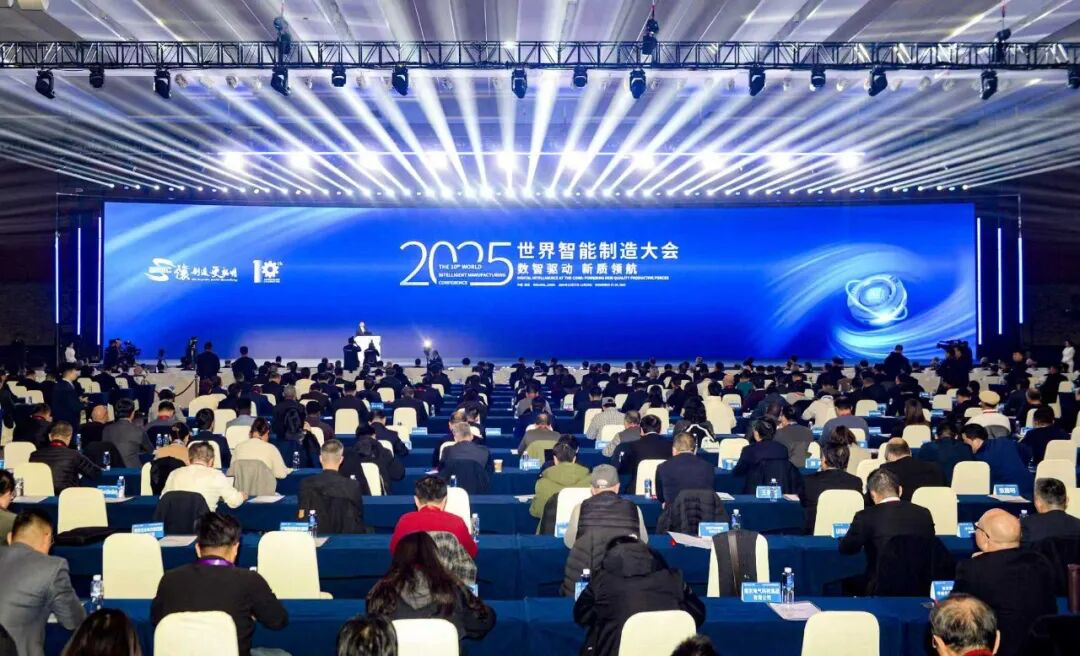
Core Insights - The 2025 World Intelligent Manufacturing Conference opened in Nanjing with the theme "Digital Intelligence Drives New Quality Leadership" [1] - The conference aims to create an international, high-end, and professional platform for global intelligent manufacturing exchange and cooperation, showcasing the latest achievements in the field and exploring the integration of technological breakthroughs and industrial transformation [1] Group 1: Conference Activities - The conference includes one main conference, one market-oriented exhibition, twelve thematic activities, and sixteen concurrent industrial ecosystem activities [1] - The event features the launch of the "Leading Action Plan" by the first batch of fifteen leading intelligent factories, which focuses on digital transformation, network collaboration, and intelligent change [3] Group 2: Key Announcements - A new session of the National Intelligent Manufacturing Committee was appointed, and several significant reports were released, including the 2025 Intelligent Manufacturing Blue Book and the top ten technological advancements in global and Chinese intelligent manufacturing for 2025 [5] - Prominent figures in the field, including academicians and executives from major companies, delivered keynote speeches on cutting-edge trends and strategic directions in intelligent manufacturing [5] Group 3: Exhibition Highlights - The World Intelligent Manufacturing Expo, held concurrently, covers an area of 55,000 square meters and features four main exhibition halls, including robotics and intelligent factories [9] - The expo attracted 456 companies from 21 countries and regions, showcasing international participation and facilitating various activities such as financial roadshows and technology exchanges [9] Group 4: Industry Significance - Intelligent manufacturing is identified as a primary focus for building a strong manufacturing nation, crucial for developing a modern industrial system and strengthening the real economy [9] - The conference has been held annually since 2016, becoming a high-end platform for China's participation in global intelligent manufacturing cooperation and showcasing the achievements of Jiangsu's manufacturing industry [9]

海康威视入选首批领航级智能工厂培育名单
Zheng Quan Shi Bao Wang· 2025-11-27 13:11
Group 1 - The "2025 World Intelligent Manufacturing Conference" was held in Nanjing, where Hikvision's "mass personalized customization intelligent factory" was recognized as one of the first "leading intelligent factories" [1] - The initiative aims to explore new manufacturing forms and establish globally leading benchmarks in intelligent manufacturing, supported by six government departments [1] - Hikvision's intelligent factory is set to produce 256 million smart IoT products in 2024, with over 30,000 hardware product models and an average of 10,000 orders processed daily, reflecting a production model of "multiple varieties, small batches, and large-scale customization" [1][2] Group 2 - Hikvision aims to address production challenges with a focus on "flexibility, efficiency, and agility," utilizing self-developed IoT sensing, AI, and big data technologies to create a comprehensive intelligent factory technology system [2] - The intelligent factory features a fully automated production line for smart cameras, achieving a 243% efficiency increase compared to traditional lines through highly coordinated operations [2] - The recognition of Hikvision as a benchmark in intelligent manufacturing highlights its role in leading the digital transformation of various industries, providing replicable and scalable solutions for high-quality manufacturing upgrades [3]
海康威视入选领航级智能工厂培育名单
Zhong Zheng Wang· 2025-11-27 12:16
Core Viewpoint - The "2025 World Intelligent Manufacturing Conference" held in Nanjing highlighted Hikvision's recognition as a leading intelligent factory, showcasing its capabilities in personalized mass customization within the IoT sector [1][3]. Group 1: Intelligent Factory Recognition - Hikvision's "IoT Perception Product Mass Customization Intelligent Factory" was selected as one of the first batch of "Leading Intelligent Factories" [1]. - The initiative aims to explore new manufacturing forms and establish benchmarks for intelligent manufacturing at a global level [1]. Group 2: Production Characteristics and Challenges - The company faces a highly fragmented market with diverse demands across over 90 sub-industries, leading to a production model characterized by "variety, small batches, and mass customization" [1]. - In 2024, Hikvision's intelligent factory is projected to produce 256 million IoT products, with over 30,000 hardware models and an average of 10,000 orders processed daily, each containing approximately 40 units [1]. Group 3: Technological Advancements - Hikvision aims for a "flexible, efficient, and agile" production system, leveraging self-developed IoT perception, AI, and big data technologies [2]. - The intelligent factory is evolving into a "super intelligent entity" with a complete feedback loop of "perception-decision-execution" [2]. Group 4: Automation and Efficiency - The company has developed a fully automated production line for intelligent cameras, achieving a 243% efficiency increase compared to traditional lines through high collaboration among robotic arms, industrial cameras, and mobile robots [2]. Group 5: Industry Impact and Future Plans - Hikvision's selection as a leading intelligent factory underscores its role in driving intelligent upgrades in manufacturing, providing replicable models for high-quality transitions in various sectors [3]. - The company plans to leverage its advantages in IoT to deepen the application of cutting-edge technologies across all business segments of intelligent factories, contributing to the upgrade of Chinese manufacturing [3].
我国首批,国家级名单公布,2家能源企业上榜!
中国能源报· 2025-11-27 09:36
Core Points - The first batch of leading intelligent factories in China has been officially announced, marking a significant leap towards intelligent manufacturing [1] - A total of 15 leading intelligent factories have been recognized, covering key industries such as equipment manufacturing, raw materials, electronic information, and consumer goods [1] - The Ministry of Industry and Information Technology stated that these factories integrate new-generation information technology, advanced manufacturing technology, and lean management concepts, representing the highest standards of intelligent manufacturing in China [1] Group 1 - The list of intelligent factories includes notable companies such as China Petroleum & Chemical Corporation and CNOOC (China National Offshore Oil Corporation) [1] - The 2025 cultivation list for leading intelligent factories features projects from various companies, including Baoshan Iron & Steel Co., Ltd. and Shanghai Aerospace Equipment Manufacturing Co., Ltd. [2] - The projects focus on advanced manufacturing techniques, such as high-end green silicon steel production and agile delivery of mobile cranes [2] Group 2 - Recent data indicates that over 7,000 advanced intelligent factories have been established in China [3] - Upgrades to hundreds of intelligent factories have resulted in an average reduction of product development cycles by 29%, an increase in production efficiency by nearly 22%, and a decrease in carbon emissions by approximately 20% [3]

2025世界智能制造大会在宁启幕 徐工、南钢入选我国首批15家领航级智能工厂名单
Yang Zi Wan Bao Wang· 2025-11-27 06:58
Core Insights - The 2025 World Intelligent Manufacturing Conference opened in Nanjing, focusing on "Digital Intelligence Driving New Quality Leadership" [1] - The conference announced the first batch of 15 leading intelligent factories in China, including XCMG and Nanjing Steel, as part of a national initiative to promote digital transformation and intelligent manufacturing [1][2] - The event featured a market exhibition covering 55,000 square meters, showcasing innovations from 456 companies across 21 countries, emphasizing international collaboration in intelligent manufacturing [2][3] Group 1: Intelligent Factories - The 15 leading intelligent factories span key industries such as equipment manufacturing, raw materials, electronic information, and consumer goods, demonstrating the breadth and depth of China's intelligent manufacturing [2] - XCMG has improved global customization capabilities through AI-driven R&D and manufacturing, reducing order delivery cycles by 55% [2] - Nanjing Steel achieved a 98.5% on-time delivery rate for customized special steel production using digital twin technology and AI, with a 50% reduction in new product development cycles compared to traditional methods [2] Group 2: Conference Highlights - The conference included the appointment ceremony for the new National Intelligent Manufacturing Committee and the release of several key documents, including the 2025 Intelligent Manufacturing Blue Book and the top ten technological advancements in global intelligent manufacturing [2][3] - The event aims to support the development of a modern industrial system and strengthen the real economy, aligning with national strategies for high-end, intelligent, and green manufacturing [3] - The conference has been held annually since 2016, establishing itself as a high-end platform for global cooperation and showcasing the achievements of Jiangsu's manufacturing sector [3]

涵盖装备制造等关键行业 我国首批15家领航级智能工厂名单公布
中国基金报· 2025-11-27 02:42
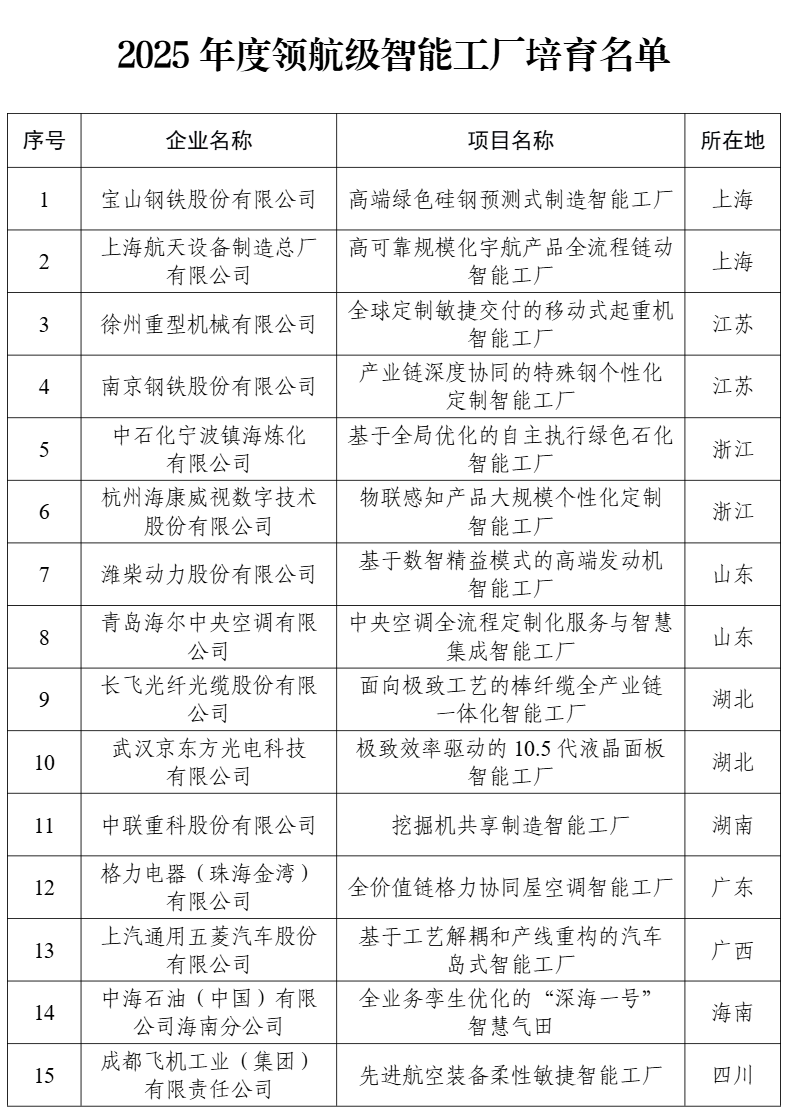
Core Insights - The Ministry of Industry and Information Technology, along with five other departments, has officially announced the first batch of leading intelligent factories, marking a significant leap in China's smart manufacturing from digitization and networking to intelligence [2] - A total of 15 intelligent factories have been recognized, spanning key industries such as equipment manufacturing, raw materials, electronic information, and consumer goods [2] - These leading intelligent factories integrate new-generation information technology, advanced manufacturing technology, and lean management concepts, representing the highest standards of smart manufacturing in China [2] Group 1: List of Leading Intelligent Factories - Baoshan Iron & Steel Co., Ltd.: High-end green silicon steel predictive manufacturing intelligent factory located in Shanghai [3] - Shanghai Aerospace Equipment Manufacturing Co., Ltd.: High-reliability large-scale aerospace product full-process chain intelligent factory located in Shanghai [3] - Xuzhou Heavy Machinery Co., Ltd.: Global customized agile delivery mobile crane intelligent factory located in Jiangsu [3] - Nanjing Steel Co., Ltd.: Deeply collaborative special steel personalized customization intelligent factory located in Jiangsu [3] - Sinopec Zhenhai Refining & Chemical Company: Self-executing green petrochemical intelligent factory based on global optimization located in Zhejiang [3] - Hikvision Digital Technology Co., Ltd.: Large-scale personalized customization intelligent factory for IoT perception products located in Zhejiang [3] - Weichai Power Co., Ltd.: High-end engine intelligent factory based on digital lean model located in Shandong [3] - Qingdao Haier Central Air Conditioning Co., Ltd.: Full-process customized service and smart integration intelligent factory located in Shandong [3] - Yangtze Optical Fibre and Cable Joint Stock Limited Company: Integrated intelligent factory for extreme process rod fibre cable located in Hubei [3] - Wuhan BOE Optoelectronics Technology Co., Ltd.: 10.5 generation liquid crystal panel intelligent factory driven by extreme efficiency located in Hubei [3] - Zoomlion Heavy Industry Science & Technology Co., Ltd.: Excavator shared manufacturing intelligent factory located in Hunan [3] - Gree Electric Appliances (Zhuhai Jinwan) Co., Ltd.: Full value chain Gree collaborative air conditioning intelligent factory located in Guangdong [3] - SAIC-GM-Wuling Automobile Co., Ltd.: Automotive island-style intelligent factory based on process decoupling and production line reconstruction located in Guangxi [3] - CNOOC (China) Limited Hainan Branch: "Deep Sea No. 1" smart oilfield optimized for all business processes located in Hainan [3] - Chengdu Aircraft Industrial (Group) Co., Ltd.: Flexible agile intelligent factory for advanced aviation equipment located in Sichuan [3] Group 2: Achievements in Smart Factory Construction - Currently, over 7,000 advanced intelligent factories have been established in China [3] - After upgrading and transforming hundreds of intelligent factories, the average product development cycle has been shortened by 29% [3] - Production efficiency has improved by nearly 22% on average, and carbon emissions have been reduced by nearly 20% [3]

计算机当前怎么看,标的怎么选?
2025-11-26 14:15
Summary of Key Points from Conference Call Industry Overview - The computer sector is currently undergoing its third technological cycle driven by data elements and the digital economy, with a long-term positive outlook on AI applications [1][4] - Despite discussions about potential bubbles, there are no killer applications yet in the market, leading to limited stock price increases [1][4] - The future direction of the industry is to connect computing power, models, and applications, forming a pyramid structure where application layer value exceeds that of models and chips [1][5] Financial Performance - In Q3 2025, the computer sector showed strong performance, with leading companies exceeding earnings expectations. Q1 profits grew over 100% year-on-year, Q2 revenue growth was 8%, and Q3 revenue growth was 5% with profit growth around 20% [1][6] - The overall industry performance is gradually recovering, with expectations for acceleration in 2026 [6] Market Sentiment and Investment - Current market allocation to the computer sector is low at approximately 3%, significantly below the 12-13% seen during the 2013-2015 "Internet Plus" period, indicating substantial room for growth [7][8] - Anticipation of a "Spring Festival effect" is expected to boost risk appetite as the year-end approaches [8] Key Innovations and Developments - Google's release of Gemini 3 is viewed as a significant breakthrough, altering perceptions of its AI capabilities and emphasizing the importance of model performance improvements [2][9] - The AI field has seen a plateau in model capabilities in the latter half of 2025, but recent innovations have led to significant advancements in multi-modal understanding and user experience [10][11] Notable Companies and Their Prospects - **Kingsoft Software**: Strong Q3 performance with significant growth in C-end and AI-enabled memberships. The company is expected to accelerate its innovation business [13][15] - **Hikvision**: Basic fundamentals have shown a turning point with Q3 revenue growth and a profit increase of 20%. Full-year profit is projected at 13.3-13.5 billion RMB [16][17] - **Foxit Software**: Successful dual transformation in subscriptions and channels, with Q3 revenue growth of 35% and a significant improvement in profitability [18] - **Hand Information**: One of the best-performing ERP companies, with expected AI revenue of over 300 million RMB this year, potentially reaching 500-600 million RMB next year [19] Conclusion - The computer sector is positioned for growth with strong financial performance and innovative developments. Key players like Kingsoft, Hikvision, Foxit, and Hand Information are highlighted as important investment opportunities due to their robust growth potential and market positioning [14][19]



榜单揭晓!这些公司荣膺ESG金牛奖
Zhong Guo Zheng Quan Bao· 2025-11-26 10:16
Core Points - The 2025 Golden Bull Enterprise Sustainable Development Forum and the third National New Cup ESG Golden Bull Awards ceremony were held on November 26, recognizing companies for their achievements in ESG (Environmental, Social, and Governance) practices [1][2] Group 1: ESG Golden Bull Awards - A total of 114 companies were awarded the ESG Golden Bull Award, including notable firms such as China Construction Bank, Midea Group, Hikvision, Haier Smart Home, and Kingsoft Office [1] - 62 central enterprises received the ESG Excellence Central Enterprise Golden Bull Award, including companies like Aero Engine Corporation of China, Poly Developments, and China Tungsten High-Tech [1][2] Group 2: ESG Carbon Neutrality Awards - 36 companies, including Longi Green Energy, Huadian International, and Jinfa Technology, were recognized with the ESG Carbon Neutrality Golden Bull Award [2] Group 3: ESG Technology Leadership Awards - 26 companies, such as Zhongwei Company, Northern Rare Earth, and iFlytek, received the ESG Technology Leadership Golden Bull Award [2] Group 4: ESG Governance Awards - 33 companies, including Huqin Technology, Shengyi Electronics, and Tianshan Aluminum, were awarded the ESG Governance Golden Bull Award [2] Group 5: ESG Rural Revitalization Awards - 31 companies, including Pianzaihuang, Chuan Investment Energy, and Shenen Co., were recognized with the ESG Rural Revitalization Golden Bull Award [2] Group 6: ESG New Star Awards - 27 companies, such as Yunda Holdings, Shida Shenghua, and Deep Zhenye A, received the ESG New Star Golden Bull Award [2]




