SHUANGHUAN COMPANY(002472)

Search documents
一周一刻钟,大事快评(W133):策略会重点公司更新,车展重点公司更新
Shenwan Hongyuan Securities· 2025-11-25 13:43
Key Insights - The report highlights the strong growth potential of companies in the automotive sector, particularly those with established brands and innovative technologies [3][4][5] - The focus on electric vehicles and smart technologies is driving significant changes in the industry, with companies like BYD, Geely, and XPeng being recommended for investment [3][4][5] Company Updates - **Uxin**: The profitability of new stores is increasing faster than expected due to brand establishment, which enhances profit elasticity in a favorable market [3][4] - **SAIC Motor**: Future prospects hinge on Huawei's involvement, with adjustments in new car launches expected to create opportunities [3][4] - **Tuhu**: Anticipated stable earnings in Q4 2025, with potential for growth in the aftermarket sector [4] - **Hengbo Co., Ltd.**: Strong positioning in the robotics sector with high technical added value and a comprehensive supply chain [5] - **Double Ring Transmission**: Direct collaboration with Tesla on reducers, with significant growth expected in traditional and new energy sectors [5] - **Great Wall Motors**: Plans to launch multiple new models and power versions in 2026, with expected sales growth [8] - **XPeng Motors**: Anticipated improvement in sales structure and gross margins, with new technologies aiding in profitability [8][9] - **Leap Motor**: Expected to exceed 1 million units in sales by 2026, with stable gross margins despite industry challenges [9] Industry Trends - The automotive industry is witnessing a shift towards electric and smart vehicles, with companies focusing on innovation and brand strength to capture market share [3][4][5] - The integration of advanced technologies and partnerships with tech firms like Huawei is becoming crucial for automotive companies to enhance their product offerings and market positioning [3][4][5]






大行评级丨花旗:维持优必选为内地仿真机器人首选股 对绿的谐波看法更趋正面
Ge Long Hui· 2025-11-25 02:47
Core Viewpoint - Citigroup's report indicates a positive outlook for the simulation robotics industry, supported by meetings with five related companies, which expect exponential revenue growth in the coming year due to accelerated production in both China and the U.S. [1] Group 1: Company Insights - The five companies discussed in the report include UBTECH, Orbbec, Lingyi iTech, Green Harmony, and Zhejiang Rongtai, all of which anticipate at least a doubling of their simulation robotics-related revenues next year [1] - Citigroup maintains a favorable view on UBTECH as a preferred stock in the simulation robotics sector, while showing an increasingly positive outlook on parts manufacturer Green Harmony [1] Group 2: Market Trends - The report highlights that leading U.S. companies in the new energy vehicle and simulation robotics sectors are accelerating supply chain development and increasing production capacity [1] - Citigroup suggests taking advantage of recent stock price weaknesses to accumulate shares in Hengli Hydraulic, Green Harmony, and Shuanghuan Transmission [1]


机器人指数ETF(560770)连续23日“吸金”!机构:人形机器人有望迎来量产落地时点
2 1 Shi Ji Jing Ji Bao Dao· 2025-11-25 01:49
Group 1: Market Performance - The market has shown volatility and a downward trend, with the CSI Robotics Index falling by 3.43% as of November 21, while the Shanghai Composite Index and the ChiNext Index dropped by 3.9% and 6.15% respectively [1] - Despite the overall market decline, the Robotics Index ETF (560770) has seen a continuous net inflow of funds for 23 days, totaling 813 million yuan, with its latest scale surpassing 2.55 billion yuan and a year-to-date share increase of 182.62% [1] Group 2: ETF and Index Composition - The Robotics Index ETF (560770) tracks the CSI Robotics Index, which includes sample stocks from system solution providers, digital workshop and production line integrators, automation equipment manufacturers, and other robotics-related listed companies [1] - The top ten constituent stocks of the index include companies such as Huichuan Technology, iFlytek, Dahua Technology, and others, covering the entire robotics industry chain from upstream components to midstream manufacturing and downstream system integration [1] Group 3: Industrial Robot Market Growth - The industrial robot market in China has been thriving, with production reaching 602,700 units from January to October this year, marking a year-on-year growth of 28.8%, surpassing the total expected production for 2024 [2] - China's industrial robot exports are projected to grow by 43.22% in 2024, reaching 1.13 billion USD, with a significant increase of 54.9% in exports during the first three quarters of this year compared to the overall foreign trade growth [2] Group 4: Future Prospects for Humanoid Robots - The humanoid robot sector in China is expected to enter a phase of large-scale development by 2025, with Beijing accelerating the commercialization and application of humanoid robots as a key driver of new productive forces [2] - With the rapid layout of domestic and foreign enterprises and breakthroughs in AI technology, humanoid robots are anticipated to reach mass production, creating a strong demand for independent innovation in core components [2]





双环传动跌2.06%,成交额4.09亿元,主力资金净流出1817.55万元
Xin Lang Zheng Quan· 2025-11-20 06:25
Core Viewpoint - The stock of Zhejiang Shuanghuan Transmission Co., Ltd. has experienced fluctuations, with a current price of 38.00 CNY per share, reflecting a year-to-date increase of 25.76% but a recent decline over the past five and twenty trading days [1][2]. Company Overview - Zhejiang Shuanghuan Transmission Co., Ltd. was established on August 25, 2005, and listed on September 10, 2010. The company specializes in the research, design, and manufacturing of mechanical transmission gears [1]. - The company's revenue composition includes: passenger car gears (63.11%), intelligent actuators (10.06%), engineering machinery gears (8.39%), reducers and others (8.25%), commercial vehicle gears (7.64%), electric tool gears (1.68%), and motorcycle gears (0.87%) [1]. Financial Performance - For the period from January to September 2025, the company reported a revenue of 6.466 billion CNY, a year-on-year decrease of 4.10%. However, the net profit attributable to shareholders increased by 21.73% to 898 million CNY [2]. - Since its A-share listing, the company has distributed a total of 958 million CNY in dividends, with 510 million CNY distributed over the past three years [3]. Shareholder Structure - As of September 30, 2025, the number of shareholders increased by 27.51% to 70,800, with an average of 10,659 circulating shares per person, a decrease of 21.40% [2]. - The largest circulating shareholder is Hong Kong Central Clearing Limited, holding 140 million shares, a decrease of 12.2283 million shares from the previous period. Other notable shareholders include Huaxia CSI Robotics ETF and E Fund National Robotics Industry ETF, with significant holdings [3].
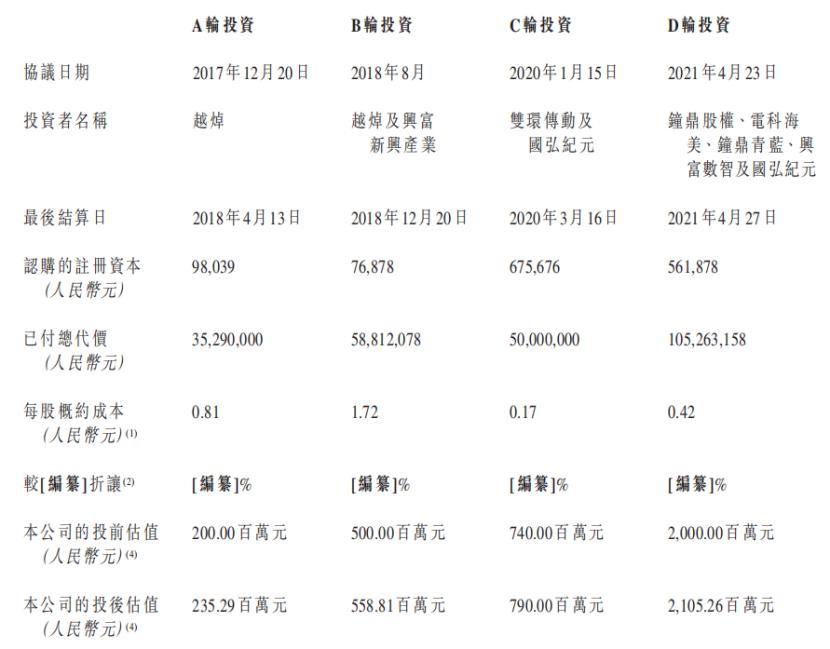
四川成都机器人公司冲击IPO,估值21亿,双环传动押注
3 6 Ke· 2025-11-20 00:03
Core Viewpoint - Multiple robotics companies have initiated public offerings this year, indicating a growing interest in the robotics sector, with Kanop Robotics being the latest to file for an IPO in Hong Kong [2][24]. Company Overview - Kanop Robotics, established in September 2012 and headquartered in Chengdu, Sichuan, focuses on the industrial robotics sector and aims to list on the Hong Kong Stock Exchange [2][4]. - The company has a diverse product portfolio, including over 70 models of industrial robots, with a strong emphasis on welding capabilities and applications in various industries such as automotive, electronics, and healthcare [4][10]. Financial Performance - The company's revenue has shown growth, with figures of RMB 197.44 million in 2022, RMB 222.37 million in 2023, and projected RMB 234.04 million in 2024, although net profits have declined significantly in 2023 and 2024 [9][11]. - The gross profit margins have improved, reaching 32.4% in the first half of 2025, attributed to a shift in product mix and increased sales volume [10][11]. Market Position - Kanop Robotics ranks first among Chinese welding robot manufacturers and third in the metal and machinery processing sector based on revenue [24][26]. - The Chinese industrial robotics market is projected to grow from RMB 315 billion in 2020 to RMB 467 billion in 2024, with a compound annual growth rate (CAGR) of 10.4% [22][24]. Product Offerings - The company’s product range includes six-axis and four-axis industrial robots, collaborative robots, and embodied intelligent robots, catering to various automation needs [4][5][8]. - Six-axis welding robots account for approximately 55% of the revenue, while multi-functional robots contribute about 25.9% [11][12]. Challenges - The company faces challenges such as increasing sales expenses and high accounts receivable, which have impacted its net profit and cash flow [10][16][27]. - As of mid-2025, Kanop Robotics reported significant accounts receivable and payable, indicating potential liquidity pressures [16][27].
双环传动(002472) - 关于公司为全资子公司提供担保的进展公告
2025-11-19 09:45
证券代码:002472 证券简称:双环传动 公告编号:2025-071 浙江双环传动机械股份有限公司 关于公司为全资子公司提供担保的进展公告 本公司及董事会全体成员保证信息披露的内容真实、准确、完整,没有虚 假记载、 误导性陈述或重大遗漏。 一、担保情况概述 浙江双环传动机械股份有限公司(以下简称"公司")于 2025 年 4 月 23 日召开的第七届董事会第三次会议和 2025 年 5 月 16 日召开的 2024 年年度股东 大会,审议通过了《关于 2025 年度公司及子公司提供融资担保的议案》。根据整 体生产经营计划和资金需求情况,公司合并报表范围内的部分公司拟向金融机构、 融资租赁公司进行融资,为确保生产经营持续、健康发展,公司拟为部分全资子 公司、控股子公司提供不超过 43.10 亿元额度的融资担保;部分控股子公司与其 下属全资子公司之间互相提供不超过 1.40 亿元额度的融资担保,实际担保金额 以最终签订的担保合同为准。上述担保额度的有效期自 2024 年年度股东大会审 议通过之日起至 2025 年年度股东大会召开之日止。 以上担保事项具体内容详见公司于 2025 年 4 月 25 日、2025 ...
双环传动- 花旗 2025 年中国会议新看点:2026 年有望跑赢市场
花旗· 2025-11-18 09:41
Investment Rating - The report maintains a Buy rating on Shuanghuan Drive with an unchanged target price of Rmb50.0, indicating an expected share price return of 26.7% and a total expected return of 27.4% [7]. Core Insights - Shuanghuan Drive plans to outgrow the market despite concerns over a potential slowdown in China’s NEV demand in 2026. The company aims to increase dollar content per NEV, focus on overseas projects, and strengthen its cost structure [1][2]. - The company expects to achieve double-digit year-on-year growth in NEV gear revenue in 2026, driven by increased shipments of coaxial gears and differentials [1][2]. - Strong growth is anticipated in the intelligent gear and industrial robot businesses, while revenue from ICE, CV, and CM gear is expected to stabilize [1]. Summary by Sections NEV Gear Strategy - Shuanghuan plans to increase dollar content per NEV by selling more coaxial gears (ASP Rmb1,000-1,200/set) and differentials (ASP Rmb100-200/set), with shipments projected at 6.8 million sets of NEV gears and 1 million sets of differentials in 2025 [2]. - The shipment of differentials is expected to double in 2026 [2]. Overseas Projects - NEV gear exports are projected to rise from 400k-500k sets in 2024 to 700k-800k sets in 2025, and further to over 1 million sets in 2026, primarily driven by demand from Stellantis, Hyundai, Volvo, and Renault [3]. - The ASP and gross profit margin of overseas projects are higher than domestic projects due to a greater percentage of PHEV [3]. Intelligent Gear and Other Segments - Revenue from intelligent gear is expected to grow from Rmb860 million-880 million in 2025 to Rmb1.2 billion in 2026, fueled by demand from robot vacuum cleaners and e-bikes [4]. - Revenue from commercial vehicle gear is anticipated to remain stable in 2026, supported by demand from European tier-1 clients and US electric truck manufacturers [5]. - Construction machinery gear revenue is also expected to stabilize in 2026, despite supplying gears to Caterpillar's large engines [5].
一周一刻钟,大事快评(W130):数据闭环
Shenwan Hongyuan Securities· 2025-11-18 07:11
Investment Rating - The industry investment rating is "Overweight" indicating a positive outlook for the sector compared to the overall market performance [8]. Core Insights - The report emphasizes that intelligence will be a key theme in the market for 2026, with investment opportunities extending beyond smart driving to areas like Robotaxi. A data closed loop is identified as the core starting point for achieving full-stack self-research, which differs fundamentally from mere data collection [1][3]. - The establishment of a data closed loop is crucial for filtering effective information from massive data, enabling machines to understand data, feedback to correct models, and perform OTA updates for secondary verification. This requires not only data ownership but also the ability to identify data gaps and utilize data to enhance models [1][3]. - The report suggests that the scale of the data closed loop team (e.g., whether it reaches a hundred members) and related investments should be key indicators for assessing a company's commitment and capability for self-research [1][3]. Summary by Sections Data Closed Loop - The report highlights that when algorithm models are truly driven by PB-level data, it will create a competitive barrier that is difficult to replicate. Even if competitors acquire model architectures or poach key personnel, lacking a substantial underlying data accumulation will hinder their ability to replicate similar algorithm capabilities in the short term [2][4]. - Building a solid data closed loop is expected to provide companies with a certainty of competitive advantage for six months to a year. Companies like Xiaopeng, Li Auto, and Huawei are noted to have established a leading advantage in the smart driving sector, with a high degree of technical moat [2][4]. Investment Recommendations - The report recommends focusing on domestic strong alpha manufacturers such as BYD, Geely, and Xiaopeng, as well as companies that represent the trend of intelligence like Huawei's HarmonyOS. Attention is also drawn to companies like JAC Motors and Seres, with specific recommendations for Li Auto, Kobot, Desay SV, and Jingwei Hengrun [2]. - For state-owned enterprise integration, the report suggests monitoring SAIC Motor, Dongfeng Motor Group, and Changan Automobile. Additionally, it highlights component companies with strong performance growth and capabilities for overseas expansion, recommending Fuyao Glass, New Spring, Fuda, Shuanghuan Transmission, and Yinlun [2].



双环传动11月17日获融资买入4037.61万元,融资余额9.64亿元
Xin Lang Cai Jing· 2025-11-18 01:31
Core Viewpoint - The company, Zhejiang Double Ring Transmission Machinery Co., Ltd., has shown mixed financial performance with a decrease in revenue but an increase in net profit for the first nine months of 2025, indicating potential resilience in profitability despite revenue challenges [2]. Financial Performance - For the period from January to September 2025, the company achieved operating revenue of 6.466 billion yuan, a year-on-year decrease of 4.10% [2]. - The net profit attributable to shareholders reached 898 million yuan, reflecting a year-on-year growth of 21.73% [2]. Shareholder and Market Activity - As of September 30, 2025, the number of shareholders increased to 70,800, a rise of 27.51% compared to the previous period [2]. - The average number of circulating shares per shareholder decreased by 21.40% to 10,659 shares [2]. - The company has distributed a total of 9.58 billion yuan in dividends since its A-share listing, with 510 million yuan distributed over the last three years [3]. Financing and Trading Data - On November 17, 2023, the company's stock price increased by 1.01%, with a trading volume of 488 million yuan [1]. - The financing buy-in amount for the same day was 40.38 million yuan, while the financing repayment was 52.46 million yuan, resulting in a net financing outflow of 12.08 million yuan [1]. - The total financing and securities lending balance reached 973 million yuan as of November 17, 2023 [1]. Institutional Holdings - As of September 30, 2025, the largest circulating shareholder was Hong Kong Central Clearing Limited, holding 140 million shares, a decrease of 12.23 million shares from the previous period [3]. - The Huaxia CSI Robot ETF and the E Fund National Robot Industry ETF have increased their holdings, indicating growing institutional interest [3].
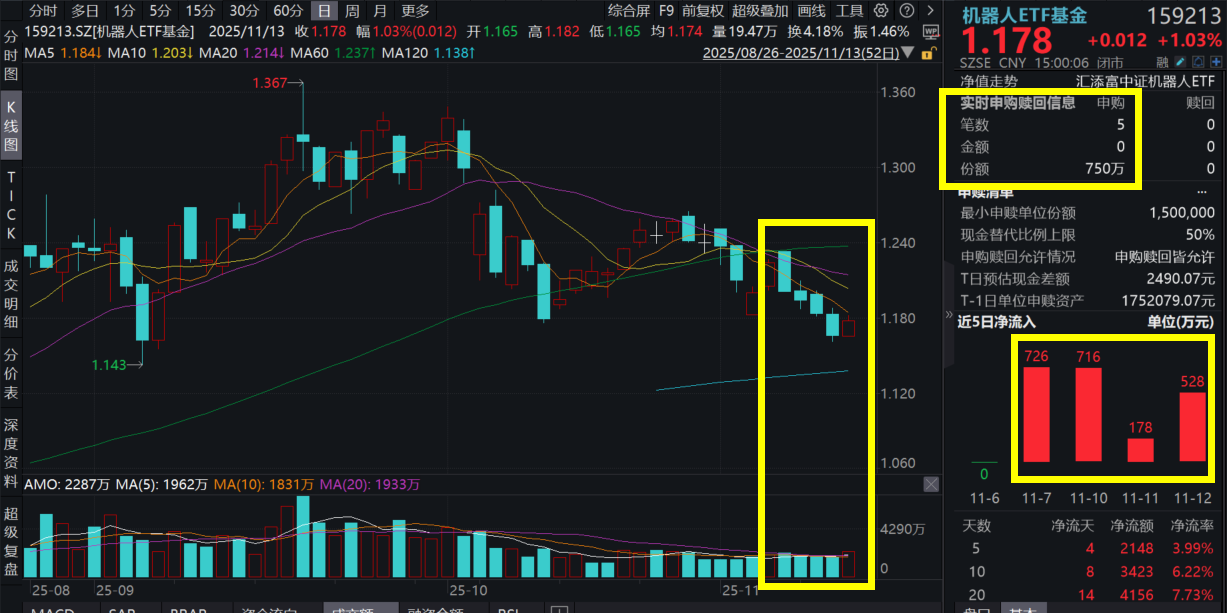
宇树科技再推新!机器人ETF基金(159213)涨超1%,连续5日净流入超3000万,机构:人形机器人产业明年有望迎来“iPhone”时刻!
Xin Lang Cai Jing· 2025-11-13 08:12
Core Viewpoint - The A-share market experienced a strong rebound on November 13, particularly in the hard technology sector, with the Robot ETF Fund (159213) rising over 1% and attracting significant net inflows of 9 million yuan on the same day, following a total of over 30 million yuan in net inflows over the previous five days [1][3]. Group 1: Market Performance - The Robot ETF Fund (159213) ended the day with a gain of over 1%, marking the end of a three-day decline [1]. - The fund has seen continuous strong capital inflow, with a total of over 30 million yuan in net inflows over the last five days [1]. - Key component stocks of the Robot ETF Fund showed positive performance, with several stocks, including Dahua Technology and Zhongkong Technology, rising by over 2% and 1% respectively [3]. Group 2: Component Stocks - The top ten component stocks of the Robot ETF Fund include: - Huichuan Technology (300124) with a gain of 1.26% and an estimated weight of 10.22% - Keda Xunfei (002230) with a gain of 0.63% and an estimated weight of 9.25% - Dahua Technology (002236) with a gain of 2.20% and an estimated weight of 5.26% [4]. Group 3: Industry Developments - Yushu Technology launched a full-stack solution for humanoid robot data collection training, featuring the G1-D robot, which is designed for various applications [5]. - UBTECH announced the mass production of its Walker S2 humanoid robots, with a delivery target of 500 units this year, contributing to a cumulative order amount exceeding 800 million yuan for the Walker series [5]. - Industry experts predict that 2026 will mark a significant turning point for the humanoid robot industry, akin to the "iPhone moment," leading to large-scale production and benefiting companies across the supply chain [6]. Group 4: Future Outlook - The robot sector is expected to enter a phase of validation and consolidation after significant adjustments in October, with key developments from companies like Tesla and others supporting market expectations [7]. - Domestic robot companies are accelerating their capitalizations, with notable IPO plans from Yushu Technology and Leju Robotics, indicating a critical moment for the industry [8]. - Major tech players are intensifying their focus on humanoid robots, with expectations for significant production increases by 2026, potentially reaching a shipment volume of "ten thousand units" for domestic robots [8].