
EASTMONEY(300059)

Search documents
主力资金 | 3股尾盘获主力资金重点抢筹
Zheng Quan Shi Bao· 2025-09-01 10:42
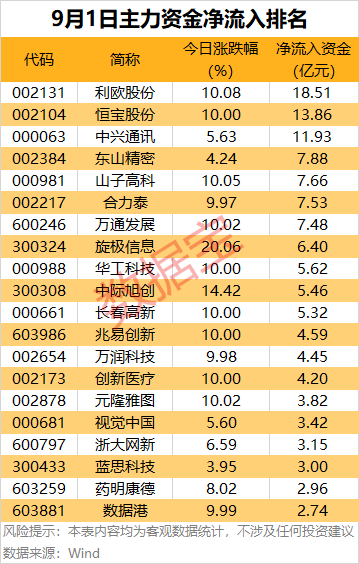
Group 1 - A-shares opened positively on September 1, with the ChiNext index rising over 2%, driven by gains in precious metals, jewelry, biopharmaceuticals, energy metals, medical services, and chemical pharmaceuticals sectors [1][2] - The main funds in the Shanghai and Shenzhen markets experienced a net outflow of 36.422 billion yuan, with eight industries seeing net inflows, particularly in telecommunications and biopharmaceuticals, which had net inflows of 1.533 billion yuan and 1.112 billion yuan respectively [1][2] - Among the 23 industries with net outflows, the computer industry led with a net outflow of 6.818 billion yuan, followed by power equipment, automotive, and electronics industries, each exceeding 4 billion yuan in outflows [1][2] Group 2 - Liou Co. saw the highest net inflow of 1.851 billion yuan, despite a 9.62% year-on-year decline in total revenue to 9.635 billion yuan, while net profit increased by 164.28% to 478 million yuan [2][3] - Hengbao Co. ranked second with a net inflow of 1.386 billion yuan, as digital currency concept stocks surged, with several companies hitting the daily limit [2][3] - A total of 173 stocks experienced net outflows exceeding 1 billion yuan, with 17 stocks seeing outflows over 5 billion yuan [3][4] Group 3 - The top three stocks with net inflows included Liou Co. (10.08% increase), Hengbao Co. (10.00% increase), and ZTE Corporation (5.63% increase) [3] - The leading stocks with net outflows were Dongfang Caifu (21.69 billion yuan outflow), BYD (17.23 billion yuan outflow), and China Rare Earth (14.12 billion yuan outflow) [4][5] Group 4 - In the late trading session, three stocks, including CATL, Innovation Medical, and Sanwei Communication, saw net inflows exceeding 1 billion yuan, with CATL leading at 155 million yuan [6][7] - The late session net outflows were led by Jinli Permanent Magnet, Lixun Precision, and Gree Electric, each with outflows exceeding 1 billion yuan [8]




东方财富9月1日现1笔大宗交易 总成交金额210.3万元 溢价率为0.00%
Xin Lang Cai Jing· 2025-09-01 09:28
Group 1 - The stock of Dongfang Caifu closed down 0.76% on September 1, with a closing price of 28.69 yuan, and recorded a block trade with a total transaction volume of 73,300 shares and a transaction amount of 2.103 million yuan [1] - The first transaction price was 28.69 yuan, with a total of 73,300 shares traded, resulting in a transaction amount of 2.103 million yuan and a premium rate of 0.00%. The buyer was China Zhongjin Wealth Securities Co., Ltd. Fuzhou Wusi Road Securities Business Department, while the seller was an institutional proprietary [1] - In the last three months, the stock has recorded a total of 11 block trades, with a cumulative transaction amount of 42.3045 million yuan. Over the past five trading days, the stock has increased by 1.63%, while the main capital has seen a net outflow of 1.651 billion yuan [1]
主力动向:9月1日特大单净流出260.63亿元
Zheng Quan Shi Bao Wang· 2025-09-01 09:21
Market Overview - The Shanghai Composite Index closed up by 0.46% today, with a net outflow of large orders amounting to 26.063 billion yuan across both markets [2] - A total of 1,922 stocks experienced net inflows from large orders, while 2,961 stocks saw net outflows [2] Sector Performance - Among the 11 sectors with net inflows, the pharmaceutical and biological sector led with a net inflow of 2.57 billion yuan and an index increase of 2.79% [2] - The communication sector followed with a net inflow of 2.442 billion yuan and a rise of 5.22% [2] - The non-bank financial sector had the highest net outflow, totaling 5.505 billion yuan, followed by the power equipment sector with 5.199 billion yuan [2] Individual Stock Performance - 51 stocks had net inflows exceeding 200 million yuan, with Liou Co., Ltd. leading at 2.024 billion yuan [2] - Other notable stocks with significant inflows include Hengbao Co., Ltd. (1.528 billion yuan) and Zhaoyi Innovation (1.379 billion yuan) [2] - On the outflow side, Dongfang Wealth had the largest net outflow at 2.128 billion yuan, followed by China Rare Earth and Jinli Permanent Magnet with outflows of 1.304 billion yuan and 1.230 billion yuan, respectively [2][5] Stock Price Movements - Stocks with net inflows over 200 million yuan saw an average increase of 8.57%, outperforming the Shanghai Composite Index [3] - Notable gainers included Meichen Technology and Xuanji Information, which closed at their daily limit [3] Industry Concentration - The sectors with the highest concentration of stocks with significant net inflows were electronics, computers, and communications, with 8, 6, and 6 stocks respectively [4]
今日这些个股异动 主力抛售计算机、电力设备板块




Di Yi Cai Jing· 2025-09-01 08:59
Volatility - A total of 8 stocks in the A-share market experienced a volatility exceeding 20% today, with Rongyi Precision, Hongyu Packaging, and Kaiteng Precision leading the list [1] Turnover Rate - There were 14 stocks in the A-share market with a turnover rate exceeding 30% today, with Sanwei Communication, Beifang Changlong, and Haoen Automotive Electric at the forefront [1] Main Capital Flow - Main capital today saw a net inflow into sectors such as telecommunications, pharmaceuticals and biology, real estate, oil and petrochemicals, and textiles and apparel, while there was a net outflow from sectors including computers, power equipment, automobiles, electronics, and non-bank financials [1] - The stocks with the highest net inflow of main capital included Liou Co., Hengbao Co., ZTE Corporation, Dongshan Precision, and Shanzigaoke, with net inflows of 1.851 billion, 1.386 billion, 1.193 billion, 788 million, and 766 million respectively [1] - The stocks with the highest net outflow of main capital included Dongfang Caifu, BYD, China Rare Earth, Jinli Permanent Magnet, and Tongfu Microelectronics, with net outflows of 2.169 billion, 1.723 billion, 1.412 billion, 1.115 billion, and 1.083 billion respectively [1]
A股收评:创业板指涨2.29%,黄金概念股大涨
2 1 Shi Ji Jing Ji Bao Dao· 2025-09-01 07:25
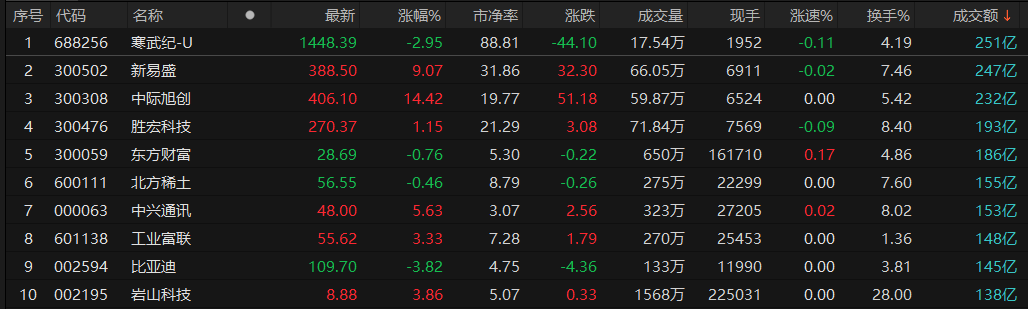
Market Overview - The market experienced fluctuations with the ChiNext Index leading the gains, while the Shanghai Composite Index showed narrow movements. By the market close, the Shanghai Composite Index rose by 0.46%, the Shenzhen Component Index increased by 1.05%, and the ChiNext Index surged by 2.29% [1]. Market Activity - The market displayed a mixed trend with more stocks rising than falling, as over 3,200 stocks in total saw an increase [2]. - The total trading volume for the Shanghai and Shenzhen markets reached 2.75 trillion yuan, a decrease of approximately 48.34 billion yuan compared to the previous trading day. The Shanghai market accounted for 1.21 trillion yuan, while the Shenzhen market contributed 1.54 trillion yuan [7]. Sector Performance - Gold concept stocks experienced a collective surge, with over ten stocks, including Western Gold, hitting the daily limit [3]. - CPO and other computing hardware stocks maintained strong performance, with companies like Yuanjie Technology reaching new historical highs [4]. - Innovative drug concept stocks rebounded, with Changchun High-tech hitting the daily limit [5]. - Conversely, large financial stocks underwent a collective adjustment, with insurance stocks leading the decline [6]. Top Stocks by Trading Volume - The stock with the highest trading volume was Cambrian Technology-U, with a turnover of 25.1 billion yuan. Following it were Xinyi Sheng (24.7 billion yuan), Zhongji Xuchuang (23.2 billion yuan), Shenghong Technology (19.3 billion yuan), and Dongfang Caifu (18.6 billion yuan) [8].



金融工程定期:券商金股解析月报(2025年9月)-20250901
KAIYUAN SECURITIES· 2025-09-01 06:16
Quantitative Models and Construction Methods 1. Model Name: "All Stocks Portfolio" - **Model Construction Idea**: This model aggregates all broker-recommended stocks ("golden stocks") and evaluates their performance as a portfolio[18][21] - **Model Construction Process**: 1. Collect all broker-recommended stocks for the month 2. Weight the stocks within the portfolio based on the number of recommendations by brokers 3. Exclude non-A-share stocks and Hong Kong-listed stocks to focus solely on A-shares[18] - **Model Evaluation**: The model demonstrates strong performance, significantly outperforming benchmark indices such as CSI 300 and CSI 500[18][21] 2. Model Name: "Newly Added Stocks Portfolio" - **Model Construction Idea**: Focuses on stocks newly added to the broker-recommended list, as they tend to exhibit better performance compared to repeated recommendations[18][23] - **Model Construction Process**: 1. Identify stocks newly added to the broker-recommended list for the month 2. Construct a portfolio weighted by the number of broker recommendations 3. Exclude non-A-share stocks and Hong Kong-listed stocks[18] - **Model Evaluation**: Newly added stocks outperform repeated recommendations, showcasing their superior return potential[18][23] 3. Model Name: "Repeated Stocks Portfolio" - **Model Construction Idea**: Focuses on stocks that have been repeatedly recommended by brokers across multiple months[18] - **Model Construction Process**: 1. Identify stocks that were recommended in the previous month and continue to be recommended in the current month 2. Construct a portfolio weighted by the number of broker recommendations 3. Exclude non-A-share stocks and Hong Kong-listed stocks[18] - **Model Evaluation**: While the performance is positive, it is generally weaker compared to newly added stocks[18] 4. Model Name: "Optimized Golden Stocks Portfolio" - **Model Construction Idea**: Selects the top 30 newly added stocks with the highest earnings surprise factor (SUE factor) to construct an optimized portfolio[23] - **Model Construction Process**: 1. Filter newly added stocks based on their earnings surprise factor (SUE factor) 2. Select the top 30 stocks with the highest SUE factor 3. Weight the portfolio based on the number of broker recommendations[23] - **Model Evaluation**: This optimized portfolio demonstrates superior performance compared to the "All Stocks Portfolio" and benchmark indices[23][25] --- Model Backtesting Results 1. All Stocks Portfolio - **August Return**: 13.6%[21] - **2025 YTD Return**: 33.5%[21] - **Annualized Return**: 13.7%[21] - **Annualized Volatility**: 23.6%[21] - **Sharpe Ratio**: 0.58[21] - **Maximum Drawdown**: 42.6%[21] 2. Newly Added Stocks Portfolio - **August Return**: 11.8%[21] - **2025 YTD Return**: 37.9%[21] - **Annualized Return**: 16.5%[21] - **Annualized Volatility**: 24.3%[21] - **Sharpe Ratio**: 0.68[21] - **Maximum Drawdown**: 38.5%[21] 3. Repeated Stocks Portfolio - **August Return**: 15.6%[21] - **2025 YTD Return**: 30.2%[21] - **Annualized Return**: 11.3%[21] - **Annualized Volatility**: 23.7%[21] - **Sharpe Ratio**: 0.48[21] - **Maximum Drawdown**: 45.0%[21] 4. Optimized Golden Stocks Portfolio - **August Return**: 19.6%[25] - **2025 YTD Return**: 37.6%[25] - **Annualized Return**: 22.3%[25] - **Annualized Volatility**: 25.5%[25] - **Sharpe Ratio**: 0.88[25] - **Maximum Drawdown**: 24.6%[25] --- Quantitative Factors and Construction Methods 1. Factor Name: Earnings Surprise Factor (SUE Factor) - **Factor Construction Idea**: Measures the degree to which a company's earnings exceed or fall short of market expectations, serving as a key indicator for stock selection[23] - **Factor Construction Process**: 1. Calculate the earnings surprise for each stock as the difference between reported earnings and consensus estimates 2. Normalize the earnings surprise to account for variations across stocks and industries 3. Rank stocks based on their normalized earnings surprise values[23] - **Factor Evaluation**: The SUE factor demonstrates strong predictive power, particularly in identifying high-performing newly added stocks[23] --- Factor Backtesting Results 1. SUE Factor - **Performance**: The SUE factor is highly effective in selecting top-performing stocks within the newly added category, contributing to the superior returns of the Optimized Golden Stocks Portfolio[23]




深市两融余额创纪录!这些股票,被融资客加仓
Zhong Guo Zheng Quan Bao· 2025-09-01 05:20
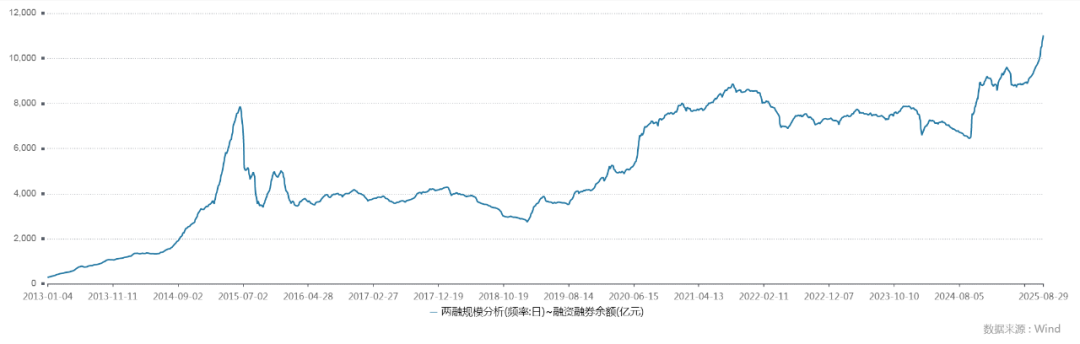
Core Insights - As of August 29, the A-share market's financing balance reached 22,454.72 billion yuan, with a margin trading balance of 158.77 billion yuan, marking an increase of 2,744.45 billion yuan in August [1][2] - The financing balance in the electronics sector increased by over 78 billion yuan, with the highest net buying stock being Cambrian-U and the largest net selling stock being Lu'an Environmental Energy [1][2][10] Financing and Margin Trading Overview - The total margin trading balance in the A-share market reached 22,613.49 billion yuan, with the financing balance at 22,454.72 billion yuan, both hitting over a 10-year high [2][7] - The Shenzhen market's margin trading balance reached a historical high of 11,020.41 billion yuan [2] Trading Activity - In August, there were 21 trading days, with the financing balance increasing on 18 of those days, and 11 days saw increases exceeding 11 billion yuan [5] - From August 13 to August 29, A-shares experienced 13 consecutive trading days where both trading volume and margin trading balance exceeded 20 billion yuan [5][6] Sector Performance - Among the 31 sectors, 30 saw an increase in financing balance, with the electronics, computer, and communication sectors leading in net buying amounts of 784.24 million yuan, 248.12 million yuan, and 235.51 million yuan respectively [7][9] Individual Stock Activity - In August, financing clients increased their positions in 687 stocks by over 100 million yuan, with Cambrian-U leading at a net buying amount of 60.48 billion yuan [10] - The top ten stocks with the highest net buying amounts included Cambrian-U, Shenghong Technology, and SMIC, with net buying amounts of 60.48 billion yuan, 57.48 billion yuan, and 53.19 billion yuan respectively [10] Margin Selling Activity - The margin selling balance in the A-share market was 158.77 billion yuan, with an increase of 20.78 billion yuan in August [11] - The top stocks for margin selling included Kweichow Moutai, New Yisheng, and Shenghong Technology, with margin selling balances of 0.87 billion yuan, 0.84 billion yuan, and 0.83 billion yuan respectively [11]



主力资金监控:东方财富净卖出超17亿
Xin Lang Cai Jing· 2025-09-01 03:16
【主力资金监控:东方财富净卖出超17亿】智通财经9月1日电,智通财经星矿数据显示,今日早盘主力 资金净流入医药、文化传媒、生物制品等板块,净流出电子、半导体、国防军工等板块,其中电子板块 净流出超86亿元。个股方面,利欧股份涨停,主力资金净买入17.17亿元位居首位,恒宝股份(维 权)、中兴通讯、万通发展(维权)获主力资金净流入居前;东方财富遭净卖出超17亿元,比亚迪、中 国稀土、华虹公司主力资金净流出额居前。 转自:智通财经 ...
东方财富上周获融资资金买入超226亿元丨资金流向周报
2 1 Shi Ji Jing Ji Bao Dao· 2025-09-01 02:53
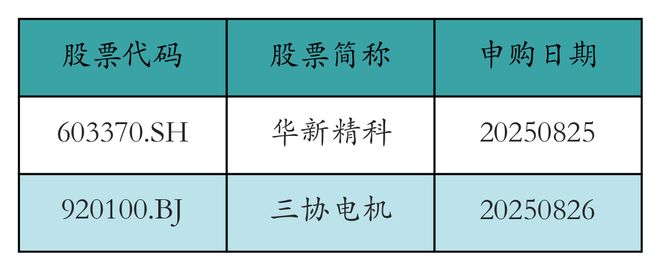
Market Overview - The Shanghai Composite Index rose by 0.84% to close at 3857.93 points, with a peak of 3888.6 points during the week from August 25 to August 29 [1] - The Shenzhen Component Index increased by 4.36% to 12696.15 points, reaching a high of 12791.18 points [1] - The ChiNext Index saw a significant rise of 7.74%, closing at 2890.13 points, with a maximum of 2933.99 points [1] - In contrast, major global indices experienced declines, with the Nasdaq Composite down by 0.19%, the Dow Jones Industrial Average down by 0.19%, and the S&P 500 down by 0.1% [1] - In the Asia-Pacific region, the Hang Seng Index fell by 1.03%, while the Nikkei 225 Index increased by 0.2% [1] New Stock Issuance - Two new stocks were issued last week: Huaxin Jingke (603370.SH) on August 25 and Sanxie Electric (920100.BJ) on August 26 [2] Margin Trading - The total margin trading balance in the Shanghai and Shenzhen markets reached 22539.77 billion yuan, with a financing balance of 22381.01 billion yuan and a securities lending balance of 158.77 billion yuan [3] - This represents an increase of 1062.47 billion yuan compared to the previous week [3] - The Shanghai market's margin trading balance was 11519.36 billion yuan, up by 570.99 billion yuan, while the Shenzhen market's balance was 11020.41 billion yuan, increasing by 491.48 billion yuan [3] - A total of 3445 stocks had margin buying, with 331 stocks having buying amounts exceeding 1 billion yuan, led by Dongfang Caifu, Shenghong Technology, and Hanwujing with buying amounts of 226.77 billion yuan, 197.72 billion yuan, and 175.57 billion yuan respectively [3][4] Fund Issuance - Eleven new funds were launched last week, including Huashang Advantage Industry Mixed C, Jingshun Longcheng Jiyi Yuli Bond F, and Nuoan Preferred Return Mixed C among others [5] Share Buybacks - A total of 23 companies announced share buybacks last week, with the highest amounts executed by Dahua Intelligent (97.33 million yuan), Aofei Entertainment (80.80 million yuan), and Luxi Chemical (37.78 million yuan) [6][7] - The industries with the highest buyback amounts were computer, media, and basic chemicals [7]



创业板公司融资余额15连增 其间累计增加645.91亿元
Zheng Quan Shi Bao Wang· 2025-09-01 02:38
Core Insights - The financing balance of the ChiNext board has reached 464.83 billion yuan, marking a continuous increase for 15 trading days, with a total increase of 64.59 billion yuan during this period [1][2]. Financing Balance Overview - As of August 29, 2025, the total margin balance of the ChiNext board is 466.35 billion yuan, with a day-on-day increase of 6.11 billion yuan. The financing balance is 464.83 billion yuan, increasing by 6.09 billion yuan from the previous day [1][2]. - The financing balance has increased for 15 consecutive trading days, with a cumulative increase of 64.59 billion yuan [1]. Individual Stock Performance - Among the stocks with increased financing balances, 615 stocks saw an increase, with 273 stocks experiencing an increase of over 20%. The stock with the highest increase is Meixin Technology, with a financing balance of 12.66 million yuan, reflecting a 334.26% increase [2][3]. - Conversely, 328 stocks experienced a decrease in financing balance, with 33 stocks seeing a decline of over 20%. The largest decrease was observed in Kailong High-Tech, with a financing balance of 3.58 million yuan, down 54.85% [2][3]. Sector Analysis - The stocks with financing balance increases of over 20% are primarily concentrated in the electronics, machinery equipment, and power equipment sectors, with 49, 36, and 34 stocks respectively [4]. - The average increase in stock prices for those with financing balance increases exceeding 20% is 16.37%, which is lower than the ChiNext index performance [5]. Notable Stocks - The stocks with the largest increases in financing balance include Shenghong Technology (11.92 billion yuan, up 6.03 billion yuan), New Yi Sheng (12.02 billion yuan, up 5.34 billion yuan), and Zhongji Xuchuang (10.92 billion yuan, up 4.45 billion yuan) [5][6]. - Stocks with significant decreases in financing balance include Guangxin Media (1.82 billion yuan, down 338 million yuan), Jingjiawei (2.09 billion yuan, down 210 million yuan), and Shuo Beid (808 million yuan, down 208 million yuan) [5][6].
