ZHONGJI INNOLIGHT(300308)

Search documents
融资融券周报:主要指数全部上涨,两融余额小幅上升-20251204
BOHAI SECURITIES· 2025-12-04 08:55
- The report does not contain any quantitative models or factors related to quantitative finance[1][2][3]



沪深两市今日成交额合计1.55万亿元,三花智控成交额居首
Xin Lang Cai Jing· 2025-12-04 07:14
Core Points - The total trading volume of the Shanghai and Shenzhen stock markets reached 1.55 trillion yuan on December 4, a decrease of approximately 121 billion yuan compared to the previous trading day [1] - The Shanghai stock market recorded a trading volume of 623.71 billion yuan, while the Shenzhen stock market had a trading volume of 925.25 billion yuan [1] - Sanhua Intelligent Control topped the trading volume with 14.48 billion yuan, followed by Zhongji Xuchuang, Aerospace Development, Xinyi Technology, and Tianfu Communication with trading volumes of 13.84 billion yuan, 12.64 billion yuan, 12.48 billion yuan, and 11.85 billion yuan respectively [1]


创业板人工智能ETF华夏(159381)开盘跌0.66%
Xin Lang Cai Jing· 2025-12-04 01:44
Core Viewpoint - The article discusses the performance of the ChiNext Artificial Intelligence ETF managed by Huaxia Fund, highlighting its recent market movements and returns since inception [1]. Group 1: ETF Performance - The ChiNext Artificial Intelligence ETF (159381) opened at a price of 1.659 yuan, experiencing a decline of 0.66% [1]. - The ETF's performance benchmark is the ChiNext Artificial Intelligence Index return [1]. - Since its inception on March 14, 2025, the ETF has achieved a return of 67.07%, with a recent one-month return of 1.26% [1]. Group 2: Top Holdings Performance - Key holdings in the ETF include: - Zhongji Xuchuang, which fell by 1.21% - Xinyi Sheng, which decreased by 1.61% - Tianfu Communication, which dropped by 1.89% - Xiechuang Data, which declined by 0.69% - Softcom Power, which increased by 0.09% - Quanzhi Technology, which fell by 0.02% - Shenxinfu, which rose by 0.43% - Beijing Junzheng, which decreased by 2.66% - Zhongke Chuangda, which dropped by 0.24% - Jingjiawei, which increased by 0.45% [1].



「数据看盘」北向资金、实力游资联手抢筹通宇通讯 航天发展龙虎榜现多路资金博弈
Sou Hu Cai Jing· 2025-12-03 10:07
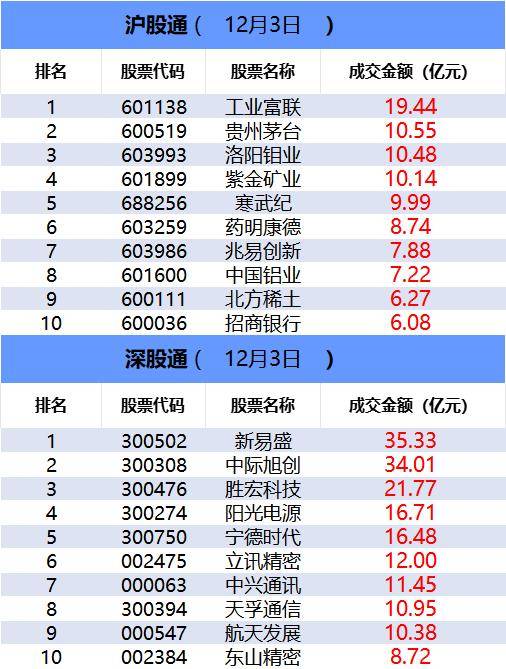
Core Viewpoint - The trading volume on the Shanghai and Shenzhen Stock Connects shows significant activity, with notable stocks and sectors experiencing varying levels of capital inflow and outflow, indicating potential investment opportunities and market trends. Group 1: Trading Volume - The total trading amount for the Shanghai Stock Connect was 83.656 billion, while the Shenzhen Stock Connect reached 103.653 billion [1]. - The top traded stocks on the Shanghai Stock Connect included Industrial Fulian (19.44 billion), Kweichow Moutai (10.55 billion), and Luoyang Molybdenum (10.48 billion) [2]. - On the Shenzhen Stock Connect, the leading stocks were Xinyi Semiconductor (35.33 billion), Zhongji Xuchuang (34.01 billion), and Panghong Technology (21.77 billion) [3]. Group 2: Sector Performance - Sectors with the highest capital inflow included cultivated diamonds, coal, and wind power equipment, while sectors such as AI applications and lithium mining saw the largest declines [4]. - The optical and optoelectronic sector led in net capital inflow with 14.32 billion, followed by small household appliances (5.97 billion) and industrial metals (4.63 billion) [5]. - The computer sector experienced the highest net capital outflow at -112.12 billion, followed by electronics at -91.84 billion and the new energy sector at -70.77 billion [6]. Group 3: Individual Stock Capital Flow - The top stocks with net capital inflow included N China Platinum (36.82 billion), Tianxue Communication (13.56 billion), and Jingyue Wan A (10.81 billion) [7]. - Conversely, the stocks with the highest net capital outflow were ZTE Corporation (-21.42 billion), Pingtan Development (-17.98 billion), and Zhongji Xuchuang (-14.79 billion) [8]. Group 4: ETF Trading - The top ten ETFs by trading amount included A500 ETF Fund (6.2678 billion), Hong Kong Securities ETF (5.3725 billion), and A500 ETF Huatai Baichuan (4.6938 billion) [9]. - The ETFs with the highest growth in trading amount compared to the previous trading day were Nasdaq ETF (9.2893 billion, +288.81%) and Growth Enterprise Board ETF (2.5507 billion, +127.05%) [10]. Group 5: Futures Positioning - In the four major futures contracts (IH, IF, IC, IM), both long and short positions increased, with the IM contract seeing a significant increase in long positions [11]. Group 6: Institutional Activity - Institutional activity was notable, with Sifangda seeing a 15.37% increase and receiving 56.74 million from institutions, while Pingtan Development faced a sell-off of 105 million [12][13]. - The trading activity of retail investors was also high, with significant purchases in Tongyu Communication and Aerospace Development [15].




券商分析师看好的12月金股出炉!3倍牛股被10家券商力荐!26股被多家券商共同看好!
私募排排网· 2025-12-03 10:00
Group 1 - The A-share market experienced a decline in November, with the ChiNext index dropping over 4% due to multiple factors including the Federal Reserve's interest rate expectations and year-end settlement by institutional investors [2] - December is viewed as a critical month for the A-share market, serving as a window for funds to position themselves for the upcoming year [2] - Longjiang Securities suggests focusing on three main lines: technology growth sectors like AI hardware and applications, market hot spots such as robotics and innovative drugs, and chemical industries benefiting from policy optimization [2] Group 2 - According to招商证券, the market is likely to choose an upward direction in December, with a high probability of a year-end rally driven by increased capital inflow [3] - Dongwu Securities notes that the short-term interest rate cut expectations have risen to over 80%, creating a warmer overall market atmosphere [3] - As of December 3, 2025, 37 brokerages have disclosed their December stock recommendations, covering 230 A-share companies, with many companies being recommended by multiple brokerages [3][4] Group 3 - The electronics sector remains the most favored, with 47 companies included in the December stock recommendations, significantly higher than other sectors [6] - The food and beverage and media sectors have seen a notable increase in attention, with the number of recommended stocks rising by 8 and 5, respectively [6] - In contrast, the number of recommended stocks in the power equipment, non-ferrous metals, and automotive sectors has decreased by more than 5 [6] Group 4 - 中际旭创 is the most recommended stock, with 10 brokerages supporting it, highlighting its strong position as a leader in optical modules [9] - The stock has seen a remarkable increase of nearly 320% from January to November 2025, with significant holdings from public funds and northbound capital [9][11] - 美的集团 is also highlighted, with substantial holdings from public funds and northbound capital, and a year-to-date increase of over 12% [12] Group 5 - 23 stocks are jointly held by public funds and northbound capital, each exceeding 2 billion yuan in market value, indicating strong institutional interest [12][13] - Among these, 5 stocks have doubled in value this year, and 16 have increased by over 30% [12] - The stocks are primarily from the electronics and non-ferrous metals sectors, reflecting current market trends and investor sentiment [12]



融资融券12月月报:主要指数全部震荡调整,两融余额小幅下降-20251203
BOHAI SECURITIES· 2025-12-03 08:44
- The report does not contain any quantitative models or factors for analysis[1][2][4] - The content primarily focuses on market data, financing and securities lending balances, and industry/stock-specific financing and securities lending characteristics[1][8][56] - No quantitative models or factors are constructed or tested in the provided report[1][2][4]


沪深两市今日成交额合计1.67万亿元,新易盛成交额居首
Xin Lang Cai Jing· 2025-12-03 07:16
Core Points - The total trading volume of the Shanghai and Shenzhen stock markets reached 1.67 trillion yuan on December 3, an increase of approximately 765.32 billion yuan compared to the previous trading day [1] - The Shanghai stock market accounted for 647.17 billion yuan, while the Shenzhen stock market contributed 1.02 trillion yuan to the total trading volume [1] Company Highlights - New Yisheng led the trading volume with 22.10 billion yuan [1] - Other notable companies by trading volume included Zhongji Xuchuang at 19.82 billion yuan, ZTE Corporation at 13.40 billion yuan, Aerospace Development at 12.47 billion yuan, and Tianfu Communication at 11.78 billion yuan [1]

算力彰显主线韧性,创业板人工智能ETF华夏(159381)再度翻红,盘中成交额超3亿元
Xin Lang Cai Jing· 2025-12-03 03:45
Group 1 - The AI computing sector experienced volatility with a significant drop followed by a recovery, highlighted by the strong performance of the ChiNext AI ETF, which surpassed 300 million in trading volume [1] - Fujian Province has introduced measures to enhance computing infrastructure, aiming for a public computing scale of over 12 EFLOPS by the end of 2027, and plans to improve energy efficiency in data centers [1] - The focus on domestic production and upgrades in core facilities is expected to drive growth in advanced storage capacity and overall computing infrastructure [1] Group 2 - The commercialization wave of TPU backed by major clients is accelerating structural differentiation in the AI computing market, leading to increased competition and innovation [2] - This diversification is anticipated to lower computing costs and stimulate demand across the entire supply chain, including specialized chip design and advanced packaging [2] - The ongoing global supply chain restructuring is expected to provide sustained momentum for self-controlled segments of the industry [2] Group 3 - The ChiNext AI ETF (159381) tracks the ChiNext AI Index, focusing on optical modules and domestic software/hardware, with a significant weight on optical modules at 56.7% [3] - The 5G Communication ETF (515050) has a scale exceeding 9 billion and focuses on the supply chain of major companies like Nvidia and Apple [3] - The Cloud Computing 50 ETF (516630) tracks an index with high AI computing content, covering various sectors including optical modules and data centers, and has the lowest total fee rate among similar ETFs [3]
5G通信ETF(515050)冲击7连阳,创业板人工智能ETF华夏(159381)涨超1%,海内外AI算力发展延续高景气
Mei Ri Jing Ji Xin Wen· 2025-12-03 03:10
Core Viewpoint - The AI computing power industry chain is showing active performance, with significant movements in related ETFs and stocks, driven by advancements in AI technology and hardware, particularly Amazon's new AI chip Trainium3 [1] Group 1: Market Performance - As of 10:15 on December 3, the ChiNext AI ETF (159381) rose by 1.48%, while the 5G Communication ETF (515050) increased by 1.34%, marking a strong seven-day upward trend [1] - Stocks such as Yuanjie Technology and Zhaolong Interconnect surged over 8%, while Xinyi Sheng and Tianfu Communication saw increases exceeding 5% [1] Group 2: Technological Developments - Amazon's cloud division launched its latest AI chip, Trainium3, which offers lower costs and higher efficiency for AI model computations compared to Nvidia's leading GPUs [1] - The "14th Five-Year Plan" emphasizes technological self-reliance, which is expected to accelerate innovation in the domestic AI chain and enhance the strategic position of the national integrated computing power network [1] Group 3: Future Outlook - The global AI ASIC shipment volume is projected to more than double by 2026, driven by a shift among cloud vendors towards AI ASICs to optimize costs and power consumption [1] - The demand for AI servers and high-speed optical interconnects is expected to remain strong, with the global market for 400G+ optical modules anticipated to reach $37.8 billion by 2026, alongside a significant increase in the penetration rate of silicon photonics solutions [1] Group 4: Related ETFs - The ChiNext AI ETF (159381) tracks the "ChiNext AI Index," focusing on optical modules, domestic software and hardware, and AI applications, with a weight of 56.7% in optical modules CPO [2] - The top three holdings in the ChiNext AI ETF are Zhongji Xuchuang (26.62%), Xinyi Sheng (19.35%), and Tianfu Communication (5.05%) [2] - The 5G Communication ETF (515050) tracks the CSI 5G Communication Theme Index, with a latest scale exceeding 8 billion, focusing on the Nvidia, Apple, and Huawei supply chains [2]

DeepSeek发布新模型!创业板50ETF(159949)涨0.48%,机构持续看好AI产业链投资机会
Xin Lang Cai Jing· 2025-12-03 02:33
Core Viewpoint - The news highlights the performance of the ChiNext 50 ETF (159949), which has shown a slight increase of 0.48% to 1.467 CNY, amidst a broader market fluctuation, indicating ongoing investor interest and activity in the growth sector [1][6]. Market Performance - As of 10:20 AM on December 3, the ChiNext 50 ETF (159949) was trading at 1.467 CNY, with a trading volume of 4.22 billion CNY and a turnover rate of 1.66% [1][6]. - The ETF has experienced a cumulative trading amount of 323.05 billion CNY over the last 20 trading days, averaging 16.15 billion CNY per day, and a total of 3,205.79 billion CNY over 222 trading days this year, averaging 14.44 billion CNY per day [7][10]. Top Holdings - The top ten holdings of the ChiNext 50 ETF (159949) include leading companies such as CATL, Zhongji Xuchuang, Dongfang Caifu, Xinyi Technology, Sungrow Power, Shenghong Technology, Huichuan Technology, Mindray, Yiwei Lithium Energy, and Tonghuashun [3][8]. Industry Insights - Longcheng Securities reports that the continuous implementation of AI applications will drive the acceleration of computing infrastructure, particularly in the AIDC industry chain, which includes optical modules, PCBs, and main equipment manufacturers, indicating a strong demand release and potential for performance and valuation growth [10]. - The report suggests that the demand for edge computing modules will steadily increase as AI applications continue to develop, transitioning from traditional data transmission modules to intelligent and computing modules [10]. Investment Recommendations - The ChiNext 50 ETF (159949) is presented as a convenient and efficient investment tool for investors looking to capitalize on the long-term growth of China's technology sector, with recommendations for dollar-cost averaging or phased investment strategies to mitigate short-term volatility [10].