ZHONGJI INNOLIGHT(300308)

Search documents
478股获融资买入超亿元,中际旭创获买入34.77亿元居首
Di Yi Cai Jing· 2025-12-26 01:18
Group 1 - On December 25, a total of 3,755 stocks in the A-share market received financing funds, with 478 stocks having a buying amount exceeding 100 million yuan [1] - The top three stocks by financing buying amount were Zhongji Xuchuang, Industrial Fulian, and Xinyisheng, with amounts of 3.477 billion yuan, 2.673 billion yuan, and 2.264 billion yuan respectively [1] - Eight stocks had financing buying amounts accounting for over 30% of the total transaction amount on that day [1] Group 2 - The stocks with the highest financing buying ratio to transaction amount were Guannong Co., Nanfang Pump Industry, and Jiuzhou Yigui, with ratios of 36.27%, 35.39%, and 33.65% respectively [1] - A total of 51 stocks had a net financing buying amount exceeding 100 million yuan [1] - The top three stocks by net financing buying amount were Industrial Fulian, Aerospace Electronics, and Goldwind Technology, with net amounts of 813 million yuan, 757 million yuan, and 555 million yuan respectively [1]





主力资金丨2股尾盘遭资金大幅出逃
Zheng Quan Shi Bao Wang· 2025-12-25 11:46
Group 1 - A-shares saw a slight increase on December 25, with the Shanghai Composite Index achieving a seven-day winning streak, while most industry sectors experienced gains, particularly aerospace, electrical machinery, paper printing, packaging materials, general equipment, and automotive parts [1] - The automotive industry led the net inflow of main funds with 1.158 billion yuan, followed by machinery equipment and food and beverage sectors with net inflows of 504 million yuan and 228 million yuan respectively [1] - The electronics sector faced the highest net outflow, exceeding 5 billion yuan, with other sectors like non-ferrous metals, computers, pharmaceuticals, communications, and basic chemicals also experiencing significant outflows of over 1 billion yuan each [1] Group 2 - Among individual stocks, Jin Feng Technology topped the net inflow with 829 million yuan, attributed to its involvement in a major offshore wind power project that set a new record for distance [2] - Yangguang Electric followed with a net inflow of 784 million yuan, with analysts optimistic about the photovoltaic sector's recovery due to policy support and technological advancements [2] - A total of 34 stocks experienced net outflows exceeding 200 million yuan, with Shenghong Technology, Aerospace Development, and Hainan Development each seeing outflows over 1 billion yuan [3] Group 3 - At the end of the trading day, the main funds saw a net outflow of 2.258 billion yuan, with the power equipment sector experiencing a net inflow of over 500 million yuan [4] - Individual stocks like Tianji Co. led the end-of-day net inflow with 382 million yuan, while Aerospace Development and Shenghong Technology faced significant outflows of 867 million yuan and 454 million yuan respectively [5]



下一只十倍股或从这里诞生!
Xin Lang Cai Jing· 2025-12-25 10:30
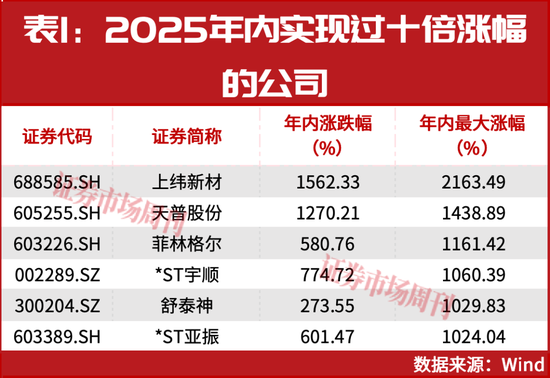
Core Insights - The A-share market has seen significant growth in 2025, with the Shanghai Composite Index rising over 18% as of December 25, although this growth is not particularly advantageous compared to major global indices [1][12] - Six companies have achieved over tenfold increases in stock prices this year, with only Shangwei New Materials and Tianpu Co., Ltd. maintaining such gains [1][13] Group 1: Tenfold Growth Companies - Shangwei New Materials has experienced a cumulative increase of 1562.33% this year, with a maximum increase of 2163.49%, driven by the acquisition of controlling rights by Zhiyuan Robotics and improvements in its wind power materials business [2][14] - Tianpu Co., Ltd. has seen its stock price rise by 1438.89%, primarily due to a takeover bid that linked it to the "AI chip reverse listing" concept, despite the company's clarifications regarding its independent IPO plans [4][16] - Other companies like Filinger, ST Yushun, and ST Yazhen have also recorded tenfold increases but have since fallen below that threshold after corrections [18] Group 2: Companies Approaching Tenfold Growth - Currently, 37 companies have achieved maximum increases exceeding 500%, with 14 of them reaching new highs since December [18] - Notable companies include Zhongji Xuchuang and Feiwo Technology, which are nearing tenfold growth, with Zhongji Xuchuang's maximum increase at 885.30% and Feiwo Technology at 543.53% [19] Group 3: Performance and Financials - Zhongji Xuchuang reported a revenue of 2.5 billion yuan with a year-on-year growth of 44.43%, and a net profit of 713.19 million yuan, reflecting a 90.05% increase [19] - New Yi Sheng, a leader in optical modules, has a maximum increase of 903.95% this year, with a significant recovery from its April low, showing a 797.01% increase since then [22] - Source Technology achieved a revenue of 383 million yuan, a 115.09% increase year-on-year, and a net profit of 106 million yuan, marking a significant turnaround [23][24] Group 4: Industry Trends and Innovations - The optical communication module sector is experiencing a surge due to technological breakthroughs, such as the development of all-optical computing chips by Shanghai Jiao Tong University, which enhances the growth potential of the domestic optical communication industry [7][22] - The AI hardware market is being driven by companies like NVIDIA and Google, which are expected to boost demand for related products, impacting the performance of companies in the CPO and optical sectors [20]



放量了 | 谈股论金
水皮More· 2025-12-25 10:09
Market Overview - The A-share market saw all three major indices rise slightly, with the Shanghai Composite Index achieving a seven-day consecutive increase, closing up 0.47% at 3959.62 points [2][3] - The total trading volume in the Shanghai and Shenzhen markets reached 1.92 trillion yuan, an increase of 443 billion yuan compared to the previous day [2][5] Key Index Movements - The Shanghai Composite Index's breakthrough of the 3950-point resistance was primarily driven by three leading companies: China Ping An, which rose approximately 4.7%, followed by China Merchants Bank and CITIC Securities [3] - The Shenzhen market experienced fluctuations, initially declining due to the drop in Ningde Times and Zhongji Xuchuang, but later rebounded in the afternoon [4] Individual Stock Performance - A total of 3647 stocks rose while 1386 fell, with a median increase of 0.50%, showing significant improvement from the midday close [5] - Financial stocks, particularly the insurance sector, were the main driving force, with the insurance sector peaking at over 3% before closing up 1.9% [6] Sector Analysis - The commercial aerospace and robotics sectors showed active performance, with the commercial aerospace sector experiencing a surge in stock prices [6] - Conversely, the energy and metal sectors, including precious and non-ferrous metals, performed poorly, influenced by the resumption of lithium mining by Ningde Times and a drop in silver futures prices [6] Capital Flow - The Shanghai market saw a net outflow of 11.1 billion yuan, while the Shenzhen market experienced a net outflow of 12.5 billion yuan, indicating some underlying issues in capital movement [5]






通信行业今日净流出资金23.35亿元,天孚通信等11股净流出资金超亿元
Zheng Quan Shi Bao Wang· 2025-12-25 09:09
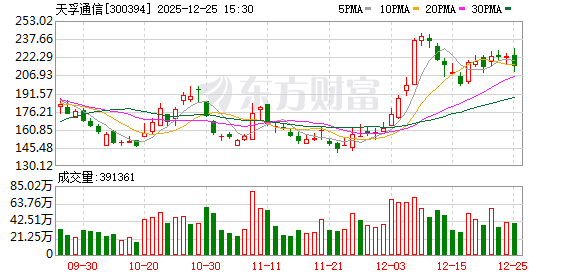
Market Overview - The Shanghai Composite Index rose by 0.47% on December 25, with 25 out of the 28 sectors experiencing gains. The top-performing sectors were defense and military industry, and light industry manufacturing, with increases of 2.91% and 1.59% respectively. The sectors that declined were comprehensive and non-ferrous metals, with decreases of 1.12% and 0.77% respectively. The communication sector fell by 0.18% [2]. Capital Flow Analysis - The main capital flow showed a net outflow of 18.129 billion yuan across the two markets. Eight sectors saw net inflows, with the automotive sector leading at a net inflow of 2.747 billion yuan and a daily increase of 1.46%. The machinery equipment sector followed with a daily increase of 1.51% and a net inflow of 1.862 billion yuan [2]. - In contrast, 23 sectors experienced net outflows, with the electronics sector leading at a net outflow of 6.123 billion yuan, followed by the non-ferrous metals sector with a net outflow of 4.135 billion yuan. Other sectors with significant outflows included communication, retail, and computer industries [2]. Communication Sector Performance - The communication sector experienced a decline of 0.18%, with a total net outflow of 2.335 billion yuan. Out of 124 stocks in this sector, 86 stocks rose, including 4 that hit the daily limit, while 37 stocks fell. There were 50 stocks with net inflows, with six stocks exceeding 100 million yuan in net inflow, led by Hai Neng Da with 0.552 billion yuan [3]. - The top gainers in the communication sector included Hai Neng Da, Tong Yu Communication, and Zhong Ji Xu Chuang, with daily increases of 9.99%, 10.00%, and 0.85% respectively [4]. - Conversely, the top losers included Tian Fu Communication, Xin Yi Sheng, and Heng Tong Guang Dian, with net outflows of 0.800 billion yuan, 0.786 billion yuan, and 0.392 billion yuan respectively [5].


沪深两市今日成交额合计1.92万亿元,中际旭创成交额居首
Xin Lang Cai Jing· 2025-12-25 07:17
Core Viewpoint - The total trading volume of the Shanghai and Shenzhen stock markets reached 1.92 trillion yuan on December 25, reflecting an increase of approximately 442.55 billion yuan compared to the previous trading day [1] Trading Volume Summary - The trading volume in the Shanghai market was 785.02 billion yuan, while the Shenzhen market recorded 1.14 trillion yuan [1] - The top traded stock was Zhongji Xuchuang, with a trading volume of 16.55 billion yuan [1] - Other notable stocks included Industrial Fulian, Aerospace Development, Xinyi Sheng, and Aerospace Electronics, with trading volumes of 13.55 billion yuan, 13.34 billion yuan, 12.73 billion yuan, and 11.59 billion yuan respectively [1]

5G50ETF(159811)开盘跌0.17%,重仓股新易盛涨0.55%,中际旭创涨1.67%
Xin Lang Cai Jing· 2025-12-25 03:44
Core Viewpoint - The 5G50ETF (159811) opened at a slight decline of 0.17%, indicating a mixed performance in the 5G sector stocks on December 25 [1] Group 1: ETF Performance - The 5G50ETF (159811) opened at 2.301 yuan [1] - Since its establishment on March 27, 2020, the fund has achieved a return of 130.72% [1] - The fund's return over the past month is reported at 20.37% [1] Group 2: Top Holdings Performance - Key stocks in the 5G50ETF include: - New Yisheng: increased by 0.55% [1] - Zhongji Xuchuang: increased by 1.67% [1] - Industrial Fulian: increased by 0.40% [1] - Shenghong Technology: remained unchanged [1] - ZTE Corporation: increased by 0.26% [1] - Zhaoyi Innovation: decreased by 0.49% [1] - OmniVision Technologies: decreased by 0.33% [1] - China Telecom: decreased by 0.46% [1] - Huadian Technology: decreased by 0.10% [1] - China Mobile: decreased by 0.12% [1] Group 3: Management Information - The 5G50ETF is managed by Bosera Fund Management Co., Ltd. [1] - The fund manager is Yin Hao [1] - The benchmark for the fund's performance is the CSI 5G Industry 50 Index [1]
444股获融资买入超亿元,中际旭创获买入27.26亿元居首
Mei Ri Jing Ji Xin Wen· 2025-12-25 01:30
Core Viewpoint - On December 24, 3754 stocks in the A-share market received financing funds, with 444 stocks having a buy amount exceeding 100 million yuan [1] Group 1: Financing Buy Amount - The top three stocks by financing buy amount were Zhongji Xuchuang, Xinyi Sheng, and Shenghong Technology, with buy amounts of 2.726 billion yuan, 2.318 billion yuan, and 2.074 billion yuan respectively [1] - Seven stocks had financing buy amounts accounting for over 30% of the total transaction amount on that day [1] Group 2: Financing Buy Proportion - The stocks with the highest financing buy amount proportion relative to total transaction amount were Guannong Co., Tianma Zhikong, and Hanbang Technology, with proportions of 42.81%, 36.84%, and 35.14% respectively [1] Group 3: Net Financing Buy Amount - A total of 43 stocks had a net financing buy amount exceeding 100 million yuan [1] - The top three stocks by net financing buy amount were Zhaoyi Innovation, Tianji Co., and SMIC, with net buy amounts of 399 million yuan, 397 million yuan, and 349 million yuan respectively [1]


牛股扎堆“南下” 从融资工具到战略支点
Shang Hai Zheng Quan Bao· 2025-12-25 00:46
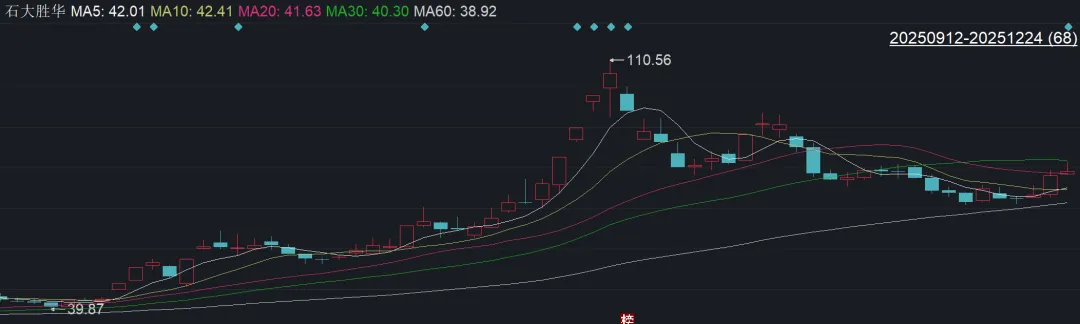
Core Viewpoint - The recent announcements by Shida Shenghua and Bertli to plan H-share issuance and listing on the Hong Kong Stock Exchange are part of a broader trend of high-quality A-share companies moving to Hong Kong since 2025, reflecting a wave of "southbound" listings [1][3]. Group 1: Market Trends - A significant number of A-share companies that have announced plans to list in Hong Kong are characterized as "bull stocks," with many experiencing price increases of over 100% or even several times their original value within the year [3][6]. - As of December 24, 2025, a record 177 A-share companies are planning to issue H-shares, with 69 of these companies having year-to-date price increases exceeding 50%, representing nearly 40% of the total [6][10]. Group 2: Company Performance - Notable examples of companies planning to list in Hong Kong include: - Zhongji Xuchuang, which has seen its stock price rise over 400% this year, with a market capitalization exceeding 700 billion yuan [3]. - Tianfu Communication, with a price increase of over 200% and a market cap surpassing 170 billion yuan [3]. - Shida Shenghua, benefiting from a surge in demand for new energy materials, has doubled its stock price, reaching a market cap of 18 billion yuan [3][4]. Group 3: Strategic Intentions - The move to list in Hong Kong is increasingly viewed as a key component of companies' global strategic layouts rather than merely a financing activity. For instance, CATL's H-share listing aims to enhance its global capital market integration and accelerate its international strategy [8]. - Bertli explicitly stated that its H-share listing is intended to deepen its international strategy, improve overseas production capacity, and enhance brand influence [8]. Group 4: Policy Support - The recent surge in A+H listings is supported by strong policy initiatives, including the China Securities Regulatory Commission's "Five Measures to Benefit Hong Kong," which encourages leading companies to list in Hong Kong [8].


4128只个股收涨!春季行情已来?
Guo Ji Jin Rong Bao· 2025-12-24 15:39
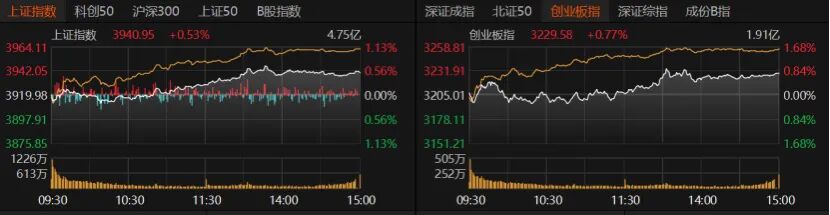
12月24日,A股午后发力,指数、板块和个股普遍收高,超4000只个股飘红。机构"去弱留强"调仓,军工、电子板块 领涨,消费与周期板块承压。成交额微降至1.9万亿元。 受访人士表示,市场对跨年行情仍观望,多头共识尚待形成。若明日站稳3936点,春季行情或有望开启。投资者不宜 盲目追高,建议"成长为主、消费为辅"配置。 A股午后拉升 今日早盘指数窄幅震荡,午后震荡走高。最终沪指收涨0.53%报3940.95点,创业板指收涨0.77%报3229.58点,深证成 指收涨0.88%。科创50、沪深300、北证50微涨,上证50微跌。 今日成交额1.9万亿元,较前一个交易日缩量约242亿元。杠杆资金热度增加,沪深京两融余额增至2.53万亿元。 盘面上,商业航天、航空航天、电子设备制造、电子元件、被动元件、天基互联均大涨,但煤炭、畜牧业、猪肉概念 领跌。 | 名称 | . | **** | 涨停家数 | 跌停家数 | 成交额 | 年初至今涨幅% | 5日涨幅% | | --- | --- | --- | --- | --- | --- | --- | --- | | 国防军工(中万) | | 2.88 | 7 | 0 | ...